Written by: Mariana Fonseca, Editorial Team, AI Growth Agent
Key Takeaways
- Social listening captures customer language and sentiment across open platforms. AI share of voice measures whether conversational AI surfaces cite and recommend the brand in synthesized answers.
- The two systems form a closed operating loop. Customer language from listening queries becomes prompts for AI share of voice tracking, and citation gaps become the next listening queries.
- AI share of voice requires repeated sampling across a stable prompt set of 100 to 500 prompts built from real buyer language, tracked across multiple platforms over a minimum 12-week window.
- Brands get a complete view when they use both the intelligence layer (social listening) and the distribution layer (AI share of voice). Together they show what customers say and whether AI surfaces repeat it back.
- AI Growth Agent closes this loop by mapping real-time Google and ChatGPT data, producing authoritative content, publishing on owned sites, and self-healing content over time.
Book A Demo With AI Growth Agent
AI Visibility Vs Social Listening: Side-By-Side View
The table below contrasts AI share of voice and social listening across key attributes so you can see how each system works and where it fits in your stack.
| Attribute | AI Share Of Voice | Social Listening |
|---|---|---|
| Where It Happens | Inside conversational AI models and answer engines (ChatGPT, Perplexity, Gemini, Google AI Mode, Google AI Overviews) | Across open platforms: X, Reddit, LinkedIn, news sites, forums, review platforms |
| What It Measures | Citations, source links, and brand mentions in synthesized AI output | Human post volume, reach, and net sentiment |
| The Goal | Measure and track the brand’s visibility in AI answers, which informs efforts to improve answer engine visibility | Extract consumer insights and brand health metrics |
| Core Question | Does AI cite and recommend the brand? | What do customers say, feel, and ask? |
| Unit Of Measurement | Prompt-level mention and citation events | Individual posts and conversations |
| Primary Metric | Share of voice across a defined prompt set | Share of voice, sentiment, theme frequency |
| Best Use Case | Measuring and tracking whether the brand wins visibility in AI answers | Intelligence layer: understanding customer language |
Social listening acts as the intelligence layer. AI share of voice acts as a measurement framework for tracking visibility in AI answers. The brands that win treat them as one loop and one system.
The False Choice Between Listening And AI Visibility
Teams do not need to choose between tracking AI visibility and tracking sentiment. The two capabilities connect in a single pipeline.
Social listening surfaces the language customers use when they talk to each other. That language, once embedded in authoritative content, earns citations in AI answers. AI share of voice then measures whether that embedding worked.
When the brand does not appear, the citation gap becomes the next listening query. The intelligence layer feeds the distribution layer. The distribution layer reveals gaps the intelligence layer should investigate next.
Treating them as a budget choice means running half the loop. A team with only social listening knows what customers say but cannot tell whether AI surfaces are repeating it back. A team with only AI share of voice knows whether the brand is cited but cannot tell what language to build content around next.
AI Share Of Voice Tracking: How To Measure Your Brand covers the measurement mechanics in detail. The operating model below explains how the two systems hand off to each other.
The Operating Loop Between Listening And AI Answers
The handoff between social listening and AI share of voice runs in both directions. Customer language from a listening query becomes a prompt in an AI share of voice set. An AI share of voice citation gap becomes the next listening query.
Consider a worked example. A social listening query surfaces repeated customer language about “adjustable beds for side sleepers with back pain.” That phrase becomes a prompt in the AI share of voice set: “What is the best adjustable bed for side sleepers with back pain?” When AI share of voice tracking shows the brand is not cited for that prompt, the gap becomes the next listening query: “What are side sleepers saying about adjustable bed brands?” The loop continues. Leva Sleep ran this loop and is now the most mentioned retailer for adjustable beds in Canada, with ChatGPT citing Leva Sleep content over 10,000 times per month.
The four pillars that make this loop operational are Search Intelligence, AI Analytics, Bot Tracking, and AI Ranking. Search Intelligence maps the traditional search landscape and surfaces which long-tail queries are worth pursuing. AI Analytics tracks brand value and consumer behavior across the full journey. Bot Tracking records every crawl, citation, and training sweep so the team can see whether the content is being read at all. AI Ranking tracks where the brand appears in AI answers and how that position evolves week over week, because AI answers have no static ordered list and citation context replaces the old idea of a ranking number.
AI Growth Agent closes this loop by mapping the brand’s full universe from real-time Google and ChatGPT data, producing authoritative content against each long-tail query, publishing on an owned site the client controls, and self-healing that content over time. The engine maps, publishes, and self-heals on a site the client owns instead of handing the work back.
How To Measure AI Share Of Voice Across AI Platforms covers the platform-level mechanics of running this measurement across ChatGPT, Perplexity, Gemini, and Google AI Mode.
See If AI Growth Agent Fits Your Workflow
Prompt-Set Construction And Sampling Rules
AI answers are probabilistic. The same prompt asked twice five minutes apart can produce different brand orderings, different brand sets, and sometimes a different answer entirely. A single ChatGPT check is one observation, not a stable measurement. Repeated sampling against a stable prompt set is required to separate signal from noise.
Alex Birkett, founder of Omniscient Digital, states: “The prompt set IS the measurement. Its construction determines validity.” There is no universal formula for AI share of voice. Paul DeMott, writing in Search Engine Land in May 2026, stated: “SOV alone is a vanity metric.” The number becomes meaningful only when it connects to a defined prompt set, a defined competitor list, and a trend window long enough to read.
The minimum viable prompt pool for tracking is 100 to 200 prompts, with 250 to 500 recommended for serious competitive analysis. Prompts should be built from real buyer language:
- Sales call transcripts
- Support tickets
- G2 reviews
- Reddit threads
- People Also Ask
- Autocomplete
To capture the full range of buyer intent, cover category, comparison, and use-case questions. Because AI answers vary between runs, each prompt should be run multiple times per platform. The prompt set must stay stable and should be versioned when it changes, because changing the prompt pool changes the denominator and can manufacture an apparent improvement in AI share of voice. Track at least three AI platforms, ideally ChatGPT, Gemini, Perplexity, Copilot, and Google AI Overviews, because tracking a single platform produces systematically biased data.
The connection to social listening is direct. The customer language that surfaces in a listening query becomes raw material for prompt construction. A prompt set built from internal jargon rather than buyer language is the single biggest cause of invalid measurement. Social listening shows the language buyers actually use.
How To Read A 50% AI Share Of Voice
A 50% AI share of voice means the brand accounts for half of all tracked brand mentions across a defined prompt set when measured against a defined competitor list. The number is only meaningful in that context. There is no defensible universal AI share of voice benchmark. Third-party figures are other people’s samples, not targets.
A 50% share might represent category leadership in a fragmented market with ten active brands. In a category dominated by one player at 80%, the same number would mean a distant second place. The number tells you where you stand relative to the competitor set you defined and the prompt set you built. It does not say anything about categories you did not measure.
The right interpretation is directional. The key questions are whether the number is moving, in which direction, against which competitors, and on which platforms. AI share of voice is volatile, with 40 to 60% of cited sources changing month-to-month, which requires a 12-week minimum observation window before drawing trend conclusions.
What Counts As A Good Share Of Voice Percentage
A good share of voice percentage is one that is measured against a defined prompt set and a defined competitor list, tracked over time, and improving. The baseline should be set against named competitors rather than an industry average from a third-party study.
Alex Birkett’s benchmark tiers provide a useful orientation: below 20% indicates a visibility problem, 20 to 50% an established player, 50 to 90% a category leader, and above 90% a dominant position. These tiers act as directional bands rather than fixed targets. AI Share Of Voice Benchmarks: What Good Looks Like explains how to set a defensible internal baseline.
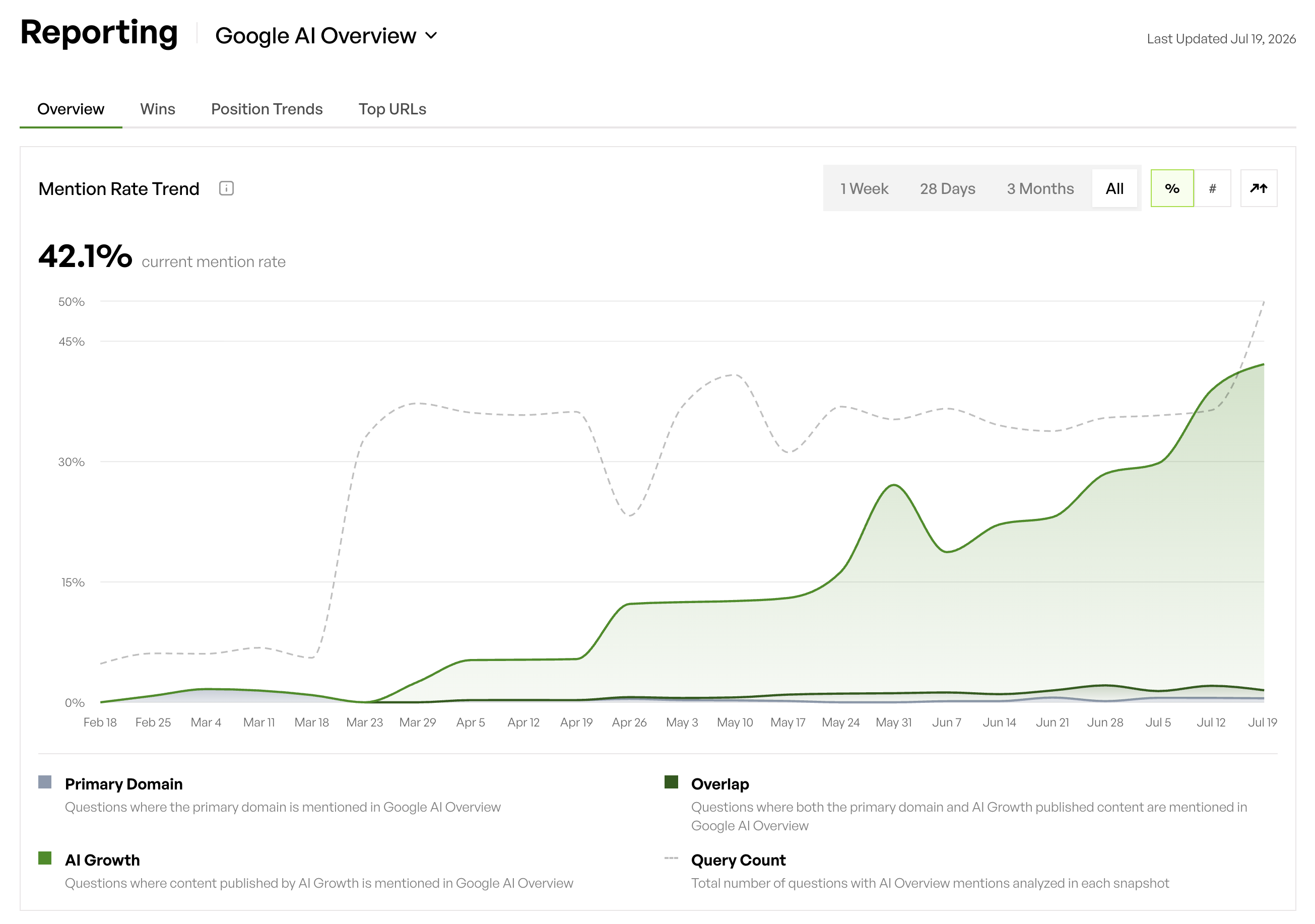
AthenaHQ’s State Of AI Search 2026 report puts the average brand mention rate at 17.2% (a separate AthenaHQ release cites 16.3%), meaning most brands sit at or below the visibility problem threshold. Category leaders in the same study captured 56.5%, roughly 3.5 times the average. The gap between the average and the leader represents the competitive opportunity. Establish a baseline against a named competitor set and track movement from there.
Why ChatGPT Cannot Replace Social Listening
ChatGPT cannot perform social listening. ChatGPT reads training data and live retrieval, not the open social firehose. Social listening tools monitor public conversations across X, Reddit, LinkedIn, news sites, forums, and review platforms in real time. ChatGPT does not have access to that stream. It synthesizes answers from its training data and whatever its retrieval layer can fetch from the indexed web.
This separation explains why the two systems stay distinct. BrightEdge AI Catalyst’s analysis of citations across ChatGPT, Perplexity, Gemini, Google AI Mode, and Google AI Overviews found that every engine draws from three distinct source layers: authoritative sources, commercial and editorial sources, and user-generated content, but none of them monitor the live social stream the way a social listening tool does. Social listening captures what customers say to each other. AI share of voice captures what AI surfaces say to customers. The inputs differ, the outputs differ, and the workflows differ.
Budget Sequencing For Listening And AI Visibility
Budget sequencing depends on the current gap. Use simple if-this-then-that logic to decide where to start:
- If the CEO is asking why the brand never shows up in ChatGPT, fund AI share of voice first.
- If the brand has no idea what customers actually say, fund social listening first.
- If the brand already has social listening and no AI visibility, add AI share of voice as the distribution layer.
- If the brand has AI share of voice and no social listening, add social listening as the intelligence layer.
A distinct “social listening alternative for ai visibility” category exists. AI visibility tracking tools query AI engines like ChatGPT, Perplexity, and Gemini with controlled prompts to measure brand mentions and citations, a capability traditional social listening tools such as Brandwatch, Brand24, and Meltwater do not provide. Social listening and AI share of voice serve different purposes. A team searching for a social listening alternative for AI visibility is looking for the distribution layer, which is a different product with a different function. Social listening tells you what customers say. AI share of voice tells you whether AI surfaces are saying it back to the next customer.
AI Growth Agent is not a social listening replacement. It operates as the distribution layer that acts on the intelligence layer. It maps the brand’s full universe of seed terms and long-tail queries from real-time Google and ChatGPT data, produces authoritative content that validates every claim and source, stands up a fully optimized site the client owns within the first week, and reports the incremental visibility it generates week over week. Pricing is a flat fee with no per-article charges, credit limits, or per-prompt billing. Clients own all the content they produce.
Talk With The Team And See A Live Workspace
Risks, Limitations, And Tradeoffs
Each approach carries clear blind spots. Social listening cannot tell you what AI surfaces cite. It captures what customers say, not what AI answers say. Social listening is structurally limited because public posts are performative, anonymous, and one-directional. The people who post are not representative of the quiet majority who never do, and the platform cannot be asked a follow-up question.
AI share of voice alone does not measure customer sentiment, but it can be tracked alongside AI sentiment analysis to capture how AI models characterize the brand. It measures citations and mentions. Sentiment and intent are tracked as separate companion metrics rather than as part of the share-of-voice calculation itself. Semrush’s 2026 Ghost Citations study found that 61.7% of AI citations were ghost citations, where the domain was cited as a source but the brand name never appeared in the answer text, which means citation share and mention share are distinct signals that can move in opposite directions. As noted earlier, AI share of voice is volatile and requires a long observation window before teams draw trend conclusions. Neither system alone gives the full picture. The closed loop between them does.
The questions teams ask at this point usually focus on benchmarks, prompt construction, and whether AI tools can replace listening. The answers below are woven into the sections above and give a concise recap for quick reference.
Conclusion
Social listening functions as the intelligence layer. AI share of voice functions as the distribution layer. The brands that win run them as one loop. Customer language from listening becomes the prompt set. Citation gaps from AI share of voice become the next listening query. The loop continues and compounds.
The difference between monitoring-first tools and AI Growth Agent comes down to architecture. Monitoring-first tools meter prompts and still require a human to act on the results. AI Growth Agent maps the universe, produces authoritative content, publishes on a client-owned site, and self-heals over time. The loop closes on its own. The client owns the output. The engine finds the next best action every day without being asked.
Book A Kickoff And See Your First Article Live