Written by: Mariana Fonseca, Editorial Team, AI Growth Agent
Key Takeaways
- AI share of voice measures how often AI-generated answers mention or recommend a B2B brand across platforms like ChatGPT, Perplexity, and Google AI Overviews.
- Zero-click search dominates B2B discovery, with 93% of Google AI Mode queries never resulting in a click, so AI visibility now defines brand presence in many buying moments.
- Mention rate and recommendation rate measure different outcomes, and recommendation rate is the more commercially relevant metric for shortlists and deals.
- Traditional share of voice and AI share of voice use different inputs and levers, so CMOs need separate tracking and reconciliation frameworks to explain performance gaps.
- AI Growth Agent helps B2B brands map buyer queries, publish authoritative content, and report incremental visibility across AI platforms in a way that holds up in the boardroom.
See how AI Growth Agent can defend your share of voice. Book a demo.
Why AI Share Of Voice Now Shapes B2B Buying Behavior
AI now shapes how B2B buying committees form their shortlists. Buyers resolve trust and vendor selection through AI-generated answers before they ever contact sales. The discovery shift is structural. Google AI Mode serves 1 billion monthly active users and ChatGPT processes over 1 billion queries per week. AI-driven search traffic surged 527% year over year, according to 2026 benchmark syntheses. Zero-click search is now the default. Google AI Mode carries a 93% zero-click rate, so a brand either appears in the answer or disappears from that buying moment.
The benchmark data makes the gap concrete in three ways. First, many enterprise B2B keywords trigger AI answers, yet very few brands earn citations inside those answers. Second, when researchers audit buyer-intent prompts directly, most brands vanish from the responses. Third, the brands that do appear capture a disproportionate share of mentions. Walker Sands analyzed more than 45 million search queries across 828 enterprise B2B companies and found that AI Overviews appear for a median of 48.8% of enterprise B2B brands’ ranking keywords, yet the median B2B brand is cited in only 3% of those answers. A separate 2026 audit of 33 brands across 177 buyer-intent prompts found that 82.5% of AI answers either omitted the audited brand entirely or buried it inside a competitor’s narrative. Klarivo’s 2026 AI Visibility Benchmark, which analyzed 16,134 AI answers across six B2B software categories, found that category leaders captured a median 31% of all brand mentions, with the top two brands together capturing 46% to 65%.
The implication for B2B marketing is direct. The funnel no longer starts with a Google search that lands on a ranked page. It starts with a conversational query that returns a synthesized answer naming two or three brands. Forrester’s 2026 Buyers’ Journey Survey found that 94% of B2B buyers used AI tools in their recent purchase, and 51% of B2B software buyers now start vendor research in an AI chatbot more often than in Google.
See how your brand appears in AI answers today. Book a kickoff with AI Growth Agent.
How To Measure AI Share Of Voice With A Defensible Prompt Panel
A defensible AI share of voice program starts with a prompt panel built from real buyer language. Internal jargon does not reflect how committees actually search. The following method produces a panel that stands up to scrutiny.
- Define The B2B Buying Committee And Its Question Types. Map the roles involved in the purchase decision and the questions each role asks at each stage. Cover problem-first queries, category queries, comparison queries, alternatives queries, and validation queries.
- Build The Panel Across Buyer-Question Types. Alex Birkett of Omniscient Digital recommends 100 to 200 prompts as the minimum viable set, with 250 to 500 for serious competitive analysis, sourced from sales call transcripts, support tickets, G2 reviews, Reddit threads, People Also Ask, and autocomplete. Once you have built the panel, freeze it. Changing prompts mid-program destroys the trend line because it changes the denominator.
- Set A Fixed Panel Size And Run Each Prompt Multiple Times. Maximus Labs recommends a minimum of 30 runs per query per platform. This achieves 95% confidence on a 10-percentage-point change. Only around 30% of brands stay visible from one regeneration of the same prompt to the next, which is why a minimum of three runs per prompt is required for a defensible reading.
- Refresh The Panel On A Fixed Cadence. AI citations drift 40 to 60% monthly, so single-snapshot measurements mislead. A monthly full audit with weekly spot-checks on the 10 to 15 highest-priority prompts sets a reliable baseline.
- Record Mention Position And Citation Context, Not Just Presence. Order of mention and citation context now function as ranking. About 74% of users select the top recommendation in an AI answer, so first-mention position carries the most commercial weight in the stack.
- Track Results Separately Per Platform. Track each engine before any roll-up. Perplexity cites brands at 13.05% versus ChatGPT’s 0.59% for the same query set, a 22-times gap that a blended number would erase.
For a full tracking methodology, see How To Measure Your Brand’s AI Share Of Voice.
See how AI Growth Agent tracks your share of voice across platforms. Book a demo.
Mention Rate Vs Recommendation Rate In AI Answers
AI share of voice alone can mislead CMOs. A brand can post a high AI share of voice and still lose deals because it is named but never recommended. Mention rate and recommendation rate describe different outcomes with different commercial consequences.
Mention rate is the percentage of tracked prompts in which the brand name appears anywhere in the AI answer. It measures awareness. Recommendation rate is the percentage of tracked prompts in which the AI actively suggests the brand as a solution to consider. It measures selection.
A June 2026 MarTech guide illustrates the divergence directly: ChatGPT’s response to “Do I need a lawyer to start an LLC?” mentions LegalZoom and Incfile only to note that people often use services to start an LLC, not as specific recommendations. The brand is named, yet the buyer walks away with a shortlist that does not include it.
Klarivo’s 2026 benchmark found that in a disclosed ChatGPT sentiment sample of 167 brand mentions, only 9% carried an outright recommendation, while 79.6% simply assigned the brand to a customer segment. Raw mention counts inflate the share of voice number while the recommendation slot, which drives shortlisting, goes to a competitor.
Revenue correlates more strongly with citation rate while awareness correlates more with mention rate. Both metrics must be tracked and reported separately, or teams end up optimizing for awareness instead of selection.
Stop losing recommendations to competitors. Book a demo to see your gap.
Reconciling AI Share Of Voice With Traditional Share Of Voice
Many practitioners struggle to reconcile AI share of voice with traditional share of voice and lose confidence in both numbers. The two metrics measure different things, use different inputs, and respond to different levers.
The reconciliation framework maps the two against each other across three diagnostic questions.
- Where Do They Agree? Queries where the brand ranks well in traditional search and also appears in AI answers represent confirmed authority. These positions form the baseline for incremental reporting.
- Where Does Traditional Outperform AI? Queries where the brand ranks in the top 10 organically but does not appear in AI answers reveal a structural gap. An Ahrefs study found that the share of Google AI Overview citations coming from top-10 ranked pages fell from approximately 76% in July 2025 to about 38% by March 2026, so traditional ranking no longer predicts AI citation. Weak entity authority, thin third-party coverage, or content that is not structured for extraction usually cause this gap.
- Where Does AI Outperform Traditional? Queries where the brand appears in AI answers but does not rank in traditional search reveal AI-native visibility driven by third-party mentions, review platforms, and community content. Roughly 82 to 89% of AI citations come from earned media rather than brand-owned pages, so this gap closes through digital PR and third-party presence, not on-page tweaks.
The reconciliation output is a map of where the two metrics diverge and why. That map shows which work will move each number. For a full attribution framework, see AI Share Of Voice: How To Measure And Attribute It.
How To Prove Your AI Visibility Work Actually Moved The Number
CMOs need to show that AI visibility work created new outcomes, not just counted what already existed. The core reporting challenge is isolation, not raw measurement. A brand that was already visible before any work began cannot credit new work for that visibility.
The answer requires a baseline, a separate publishing environment, and a cross-referenced data stack. Crealytics recommends a four-layer attribution framework: AI visibility measured via share of voice and citations; AI referral traffic and website engagement; commercial engagement such as qualified leads and pipeline; and revenue performance including influenced revenue and ROI. Each layer captures a different slice of the buyer journey. Changes in AI representation appear first, then pipeline, then revenue.
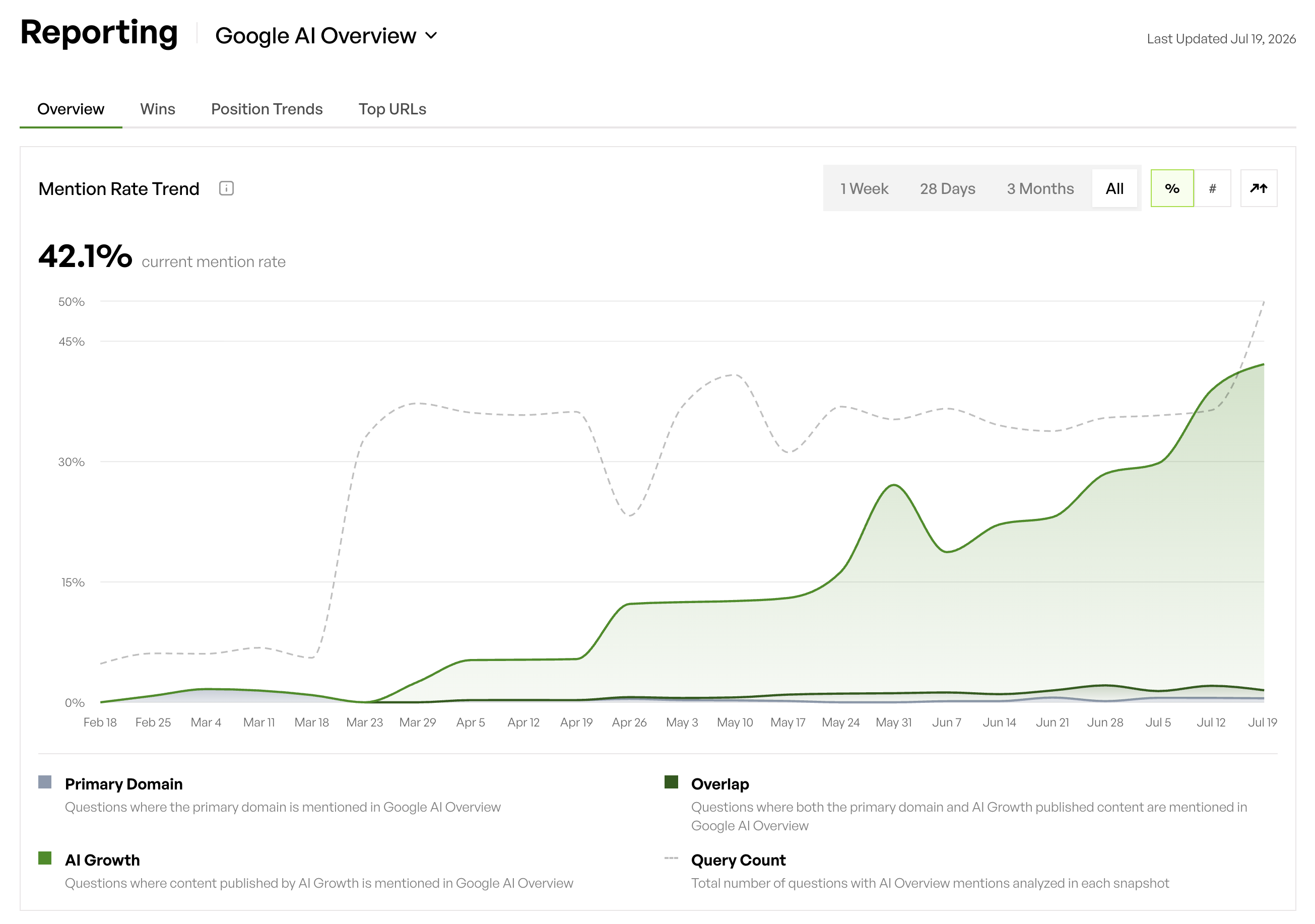
That four-layer framework is exactly what AI Growth Agent was built to operationalize. AI Growth Agent closes this loop by publishing into a separate environment, so it takes credit only for the visibility it actually generated. It never claims visibility the brand already had. The platform reports incremental visibility week over week and cross-references bot traffic, Google Search Console, and citation data. Across the first twelve weeks, clients average more than 12,000 additional AI citations and mentions, over 100,000 additional bot visits, and a 20%+ lift in impressions. Celcoin achieved 20%+ share of voice and 100+ mentions across high-intent queries. Jota reached 72% visibility across 310 tracked searches over seven months, a 49-point increase since launch.
What AI Share Of Voice Looks Like Across ChatGPT, Perplexity, And Google AI Overviews
Each AI surface behaves differently, and a blended score hides the per-engine gaps where strategy lives. Proving incremental results requires understanding where those results appear.
The per-engine differences are not subtle. Klarivo’s 2026 benchmark found that the leading brand changed by engine in two of six B2B categories: Salesforce led CRM on ChatGPT, Copilot, and AI Mode, while HubSpot led on the other three engines by a gap under two points. The same brand and category produced different winners depending on where the buyer asked.
ChatGPT is heavily biased toward its training data. ChatGPT replaces 54.1% of its cited sources every month. Citation volatility defines the measurement challenge on that platform. ChatGPT averages 7.92 citations per response and rewards structured definitional writing with clear H2 opening sentences.
Perplexity cites more sources per query but with lower average absorption per source. Perplexity query volume grew 300% year over year as of 2026 and leans heavily on Reddit and forum consensus. Perplexity and Copilot include external links in over 77% of responses, while ChatGPT does so in roughly 31%.
Google AI Overviews weight traditional E-E-A-T and author authority. Google AI Overviews appear in 25.11% of Google searches as of 2026 and reach well over a billion monthly users, with estimates ranging from 1.5 billion to 2.5 billion depending on the source. The Walker Sands finding mentioned earlier shows that AI Overviews appear for a large share of enterprise keywords, yet the median enterprise B2B brand is cited in only 3% of those answers.
Why Monitoring-First Tools Cannot Close The AI Visibility Loop
Architecture matters more than feature checklists. Monitoring-first tools meter prompts, hand back a dashboard and a to-do list, and the 2026 action layers they added still leave the client to review, publish, and maintain everything. These tools do not own the site, and they do not close the loop of mapping, publishing, and self-healing.
The audited brands in the 2026 Digital Elevator study were named in exactly zero of the 34 prompts closest to purchase, including comparison, alternatives, product-fit, and price queries, with the engine handing every “which one should I pick” answer to review sites, aggregators, and competitors. A dashboard that surfaces this finding and hands back a to-do list does not fix the problem. To fix it, the content has to be built, published, and maintained on a site the model can find and trust.
A rearview mirror with a to-do list taped to it still functions as a rearview mirror. The question is not whether the brand is missing from AI answers. The question is who is going to change what the answer says.
How AI Growth Agent Closes The Loop From Insight To Incremental Visibility
AI Growth Agent was built to be the answer to that execution gap. It is the autonomous engine that maps a brand’s full universe across online search and wins it on autopilot. The platform serves mid-market and enterprise B2B companies that already have an identity and now need to control the narrative around it.
The architecture follows a headless marketing model. One engine replaces the SEO agency, the content tool, the web agency, the GEO monitor, the schema plugin, the analytics stack, and the PR firm. Each capability builds on the previous one.
- It maps the full universe of seed terms and long-tail queries from real-time Google and ChatGPT data, with no cap on prompt count.
- From that map, it produces authoritative content that validates every claim and source, informed by journalistic rigor.
- That content is then published on a fully optimized site the client owns within the first week, connected through a reverse proxy rewrite under a subdirectory or subdomain.
- The content remains living and self-heals over time instead of going stale.
- The platform reports incremental visibility week over week, isolating exactly what it generated from visibility the brand already had.
- Pricing uses a flat fee with no per-article charges, credit limits, or per-prompt billing, so clients see their entire universe instead of a capped handful of tracked terms.
The same twelve-week averages cited earlier apply here: 12,000+ additional AI citations and mentions, 100,000+ additional bot visits, and a 20%+ lift in impressions. Content has indexed in as little as ten days, with the first article live within a week.
Breadless is now one of the most recommended healthy franchises in the US, ahead of CAVA, Rush Bowls, and Sweetgreen in its search universe. ChatGPT cites eatbreadless.com over 45,000 times per month, and the brand saw a 30x lift in Google Search Console impressions over six months. Leva Sleep is now the most mentioned retailer for adjustable beds in Canada, with ChatGPT citing Leva Sleep content over 10,000 times per month and $40,000 to $50,000 in deals closed in under three weeks from buyers who found them through AI Growth Agent content.
Frequently Asked Questions
What Is The Difference Between AI Share Of Voice And Traditional Share Of Voice?
As covered earlier, traditional share of voice is ranking-centric while AI share of voice is mention-centric. The key difference for CMOs is that traditional share of voice can be bought through media and distribution, while AI share of voice depends on structured, verified, and trusted content that models choose to cite.
How Many Prompts Do I Need For A Defensible AI Share Of Voice Measurement?
A minimum of roughly 50 prompts usually provides a directional AI share of voice read, though some sources place the directional threshold as low as 15 prompts. A standard audit typically uses 30 to 50 prompts. For a more rigorous tracking system, 100 to 200 prompts work better, and serious competitive analysis requires 250 to 500. Below roughly 50 prompts, single-prompt variance dominates and the share statistic becomes noisy. The panel must come from real buyer language such as sales call transcripts, support tickets, G2 reviews, Reddit threads, People Also Ask, and autocomplete. Once defined, the panel must be frozen, because changing prompts mid-program changes the denominator and can manufacture an apparent improvement that reflects nothing real. Each prompt should be run a minimum of three times per platform, with five preferred, under standardized conditions held identical between periods.
Why Does High AI Share Of Voice Not Guarantee Being Recommended?
Mention rate and recommendation rate are structurally different outcomes. A brand can appear in an AI answer as a named entity without the model actively suggesting it as a solution. As the Klarivo data showed, only 9% of mentions are recommendations, which means most mentions simply assign the brand to a segment. A brand that optimizes for raw mention counts focuses on awareness instead of selection.
What Are The Best AI Tools For B2B Marketing Measurement?
The measurement stack for B2B AI share of voice should cover three layers. First, prompt-based citation tracking across ChatGPT, Perplexity, Google AI Overviews, and Gemini. Second, GA4 referral analytics filtered for AI referral sources. Third, Google Search Console branded search lift as a lagging indicator. Purpose-built monitoring platforms track brand appearance across a metered set of prompts and surface the data in a dashboard. These tools identify the gap and then hand the work back. The measurement question for any B2B marketing leader is which engine changes the number, not just which tool shows it. AI share of voice functions as a leading indicator and should sit alongside branded search volume, AI referral traffic, and pipeline contribution.
How Long Does It Take To See Results From AI Visibility Work?
The timeline depends on the brand’s existing entity authority, the competitiveness of the category, and the publishing cadence. For brands starting from a low baseline, a new entrant to a competitive category should expect six to nine months to first meaningful AI citation share under a standard content program. AI Growth Agent compresses this timeline. The first article is typically live within a week of kickoff, content has indexed in as little as ten days, and clients see movement in bot traffic and Google Search Console impressions early in the engagement. The standard pilot runs three months, because indexing takes time and varies by industry, but incremental visibility reporting shows what the work generated week over week.
See how fast your brand can gain AI visibility. Book a kickoff with AI Growth Agent.
Conclusion: Building A Number You Can Defend
AI share of voice is a starting point, not a complete answer. The B2B brands that win measure recommendation quality and incremental visibility, not just raw mention counts. A high mention rate with a low recommendation rate means the model knows the brand and does not trust it enough to suggest it. A high AI share of voice built entirely on pre-existing brand strength means the work has not been proven to move anything.
The diagnostic loop that holds up in a board meeting covers four steps. First, a working definition with an explicit formula. Second, a defensible measurement method built from real buyer language. Third, a reconciliation framework that maps AI share of voice against traditional share of voice and explains the gaps. Fourth, a reporting narrative that isolates the visibility the work generated from the visibility the brand already had.
Monitoring-first tools stop at measurement and hand the rest back. AI Growth Agent closes the loop by mapping the full universe, producing authoritative content, publishing on a site the client owns, self-healing over time, and reporting the incremental visibility it generated. The brands cited in AI search this year are training the next generation of models with their own story. The brands that wait train the next generation with whatever happens to be sitting on the open web.
Defend your AI share of voice before competitors lock it in. Book a kickoff with AI Growth Agent.