Written by: Mariana Fonseca, Editorial Team, AI Growth Agent
Key Takeaways
-
AI share of voice replaces traditional rankings by tracking how often and in what context a brand appears inside AI-generated answers across ChatGPT, Perplexity, Gemini, and Google AI Overviews.
-
Effective measurement tracks citation context, order-of-mention, and prompt-level variance instead of relying on simple mention counts.
-
Weighted scoring that factors position, sentiment, and citation type gives a more accurate picture of brand influence than raw frequency alone.
-
Weekly tracking cadences, refreshed prompt sets, and platform-specific dashboards turn AI SOV measurement into a system for narrative control.
-
Schedule a consultation with AI Growth Agent to map your full prompt universe and see your first scored SOV report live.
How to Track AI Share of Voice
AI share of voice measures visibility inside generated answers, where the unit of analysis is the response itself rather than a results page or media inventory. Traditional share of voice focuses on ad spend, media mentions, or search impressions, but AI answers compress the field. Typically only three to five brands appear per response, compared to ten or more on a traditional SERP. That compression makes AI SOV measurement more consequential and more demanding.
Step 1: Define AI SOV and Its Unique Components
AI share of voice has three components that traditional SOV does not. Citation context describes where a brand appears in an answer, who it is grouped with, and what claim it is cited for. Citation context scoring distinguishes ranked recommendations and direct citations from shortlist inclusion, comparison mentions, or passing references, because those placements carry different downstream value.
Order-of-mention captures position within the answer. Position weighting assigns 1.00 to first mention, 0.50 to second, 0.33 to third, and so on, so top placement produces higher weighted share than lower placement even when total mention counts are identical. Prompt-level variance acknowledges that AI visibility can shift depending on exact phrasing, making single-prompt snapshots insufficient. The same query run multiple times can return different brand sets.
Two distinct metrics sit underneath AI SOV. Entity-based SOV counts how often a brand appears as a named recommendation, while citation-based SOV counts how often a brand’s content is cited as a source. A source can influence an answer without the brand being visibly recommended, so these numbers diverge and both matter.
Step 2: Build a Prompt Set and Competitor List
A reliable prompt set starts with segmentation by funnel stage. Awareness prompts ask “What is [solution]?”, consideration prompts ask “best [solution] for [use case]”, and decision prompts ask “[solution] pricing” or “alternatives to [brand]”. A balanced set of 100 to 200 prompts segmented by persona, funnel stage, platform, and competitor comparisons avoids prompt variance bias that produces misleading results. Seed terms anchor the taxonomy, and each seed spawns long-tail queries that mirror how buyers actually phrase questions inside AI surfaces.
The table below shows how to structure prompts across funnel stages, from early awareness through final decision.
|
Prompt Type |
Example |
Funnel Stage |
|---|---|---|
|
Category awareness |
“What is the best [category] solution?” |
Top of funnel |
|
Use-case consideration |
“Best [category] for [specific use case]” |
Mid funnel |
|
Competitor comparison |
“[Brand A] vs [Brand B] for [use case]” |
Mid to bottom funnel |
|
Decision / pricing |
“[Category] pricing” or “alternatives to [brand]” |
Bottom of funnel |
|
Branded validation |
“Is [brand] good for [use case]?” |
Bottom of funnel |
Map your full prompt universe in the first week and identify which queries your brand is already winning and losing inside AI answers — start your assessment.
Step 3: Run Queries Across ChatGPT, Perplexity, Gemini, and Google AI Overviews
Once you have built your prompt set and competitor list, the next phase is executing those queries and logging the results. Track AI share of voice separately by platform, because ChatGPT, Perplexity, and Gemini synthesize and weight signals differently, and aggregate numbers can hide meaningful platform-level variance. Run each prompt at least three times across target platforms and log every brand mention along with its position in the response and sentiment framing before computing per-platform scores.
Google AI Overviews appear in roughly 30-65% of search result pages (varying by dataset and personalization) and reach over 2 billion monthly users, so they are a non-optional surface. ChatGPT is the leading AI-first platform and usually warrants the heaviest weighting in any aggregate score.
Step 4: Capture Responses and Apply the Scoring Rubric
Raw mention counts understate the value of prominent, positive placements. The rubric below weights each response by citation type and sentiment to produce a score that reflects actual brand influence rather than binary presence. Notice how a number one ranked recommendation with positive sentiment at 1.20 scores nearly nine times higher than a passing reference with negative sentiment at 0.14.
|
Citation Type |
Position Weight |
Sentiment Modifier |
Effective Score |
|---|---|---|---|
|
Ranked recommendation (#1 mention) |
1.00 |
Positive: ×1.2 / Neutral: ×1.0 / Negative: ×0.7 |
0.70 – 1.20 |
|
Direct citation (“According to…”) |
0.80 |
Positive: ×1.2 / Neutral: ×1.0 / Negative: ×0.7 |
0.56 – 0.96 |
|
Shortlist inclusion (#2–3 mention) |
0.50 |
Positive: ×1.2 / Neutral: ×1.0 / Negative: ×0.7 |
0.35 – 0.60 |
|
Comparison mention |
0.33 |
Positive: ×1.2 / Neutral: ×1.0 / Negative: ×0.7 |
0.23 – 0.40 |
|
Passing reference (“Also consider…”) |
0.20 |
Positive: ×1.2 / Neutral: ×1.0 / Negative: ×0.7 |
0.14 – 0.24 |
A brand cited 30% of the time with consistently positive framing will see better click-through and conversion from AI-referred traffic than a brand cited 30% of the time with mixed or negative framing, which is why sentiment modifiers belong in the rubric rather than in a separate report. Sentiment should be tracked separately from raw frequency so that the SOV number and the brand-health signal remain distinct and actionable.
See how AI Growth Agent measures your entire prompt universe instead of a capped handful of prompts — review your scored report.
How Is Share of Voice Measured?
Step 5: Calculate Weighted SOV and Benchmark Your Percentage
The weighted AI share of voice formula is:
Weighted AI SOV = (Sum of your brand’s effective scores across all prompts ÷ Sum of all brands’ effective scores across all prompts) × 100
For a simpler baseline, use the unweighted formula introduced in Step 1, which divides your brand mentions by total responses. Use the unweighted version for a quick snapshot and the weighted version for strategic decisions.
Benchmarks help you interpret your percentage. The market leader in traditional search typically holds 25 to 40% AI SOV. In saturated B2B SaaS categories, 15 to 25% AI SOV is considered strong, while in emerging categories a dominant player may hold 40 to 60%. Two practical rules guide target-setting.
The 10-20-70 rule allocates measurement effort. Roughly 10% of tracked prompts will show dominant brand presence above 70% SOV, 20% will show contested presence between 30 and 70%, and 70% will show low or zero presence, which is where content investment produces the fastest lift. The 30% rule treats 30% weighted SOV as the threshold at which a brand moves from participant to category reference in AI answers. For branded queries, citation rates above 80% indicate healthy entity definition, while rates below 80% typically signal technical issues such as weak entity definition or conflicting information across sources.
Step 6: Set Up a Weekly Tracking Cadence and Dashboard
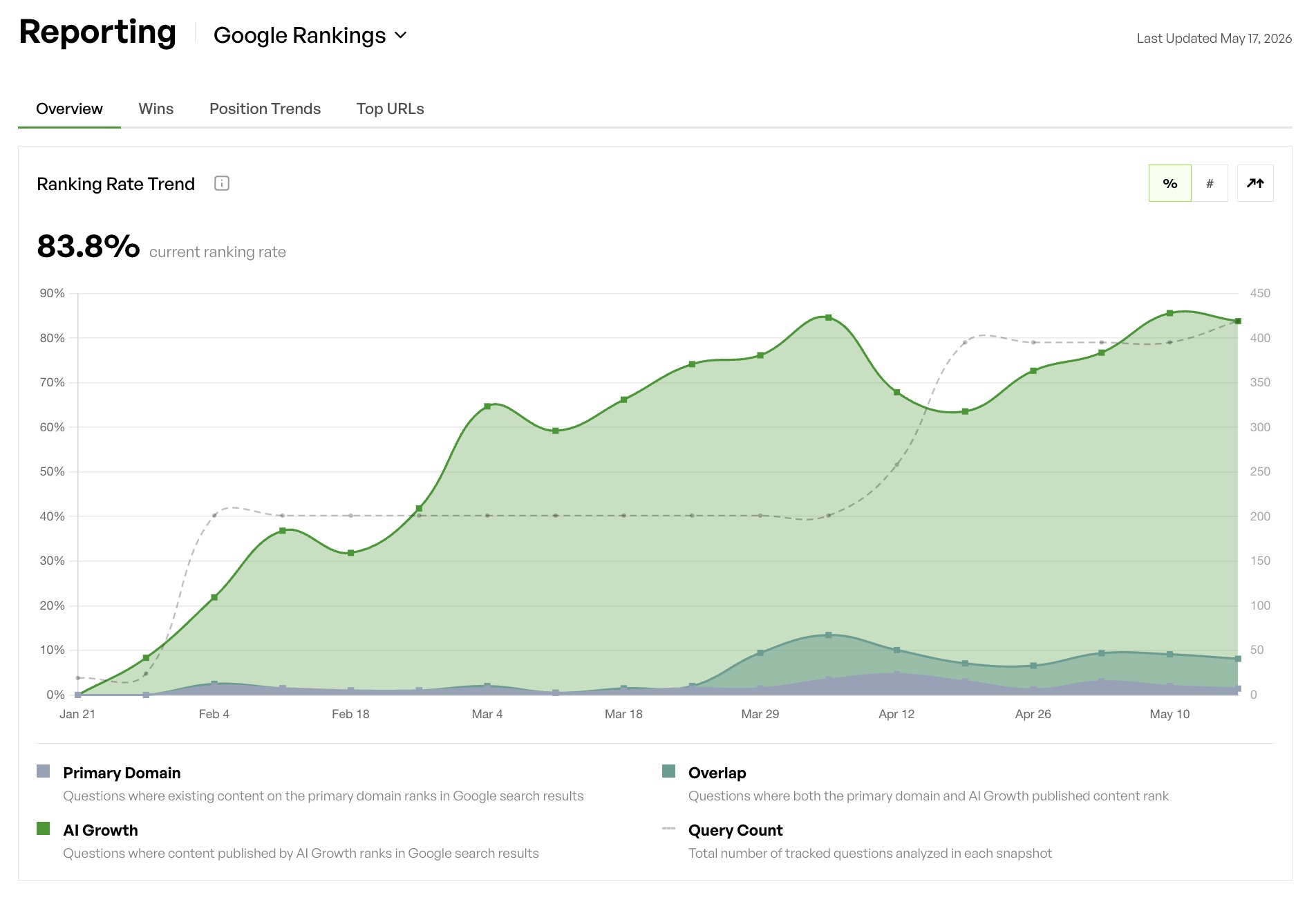
Consistent tracking keeps AI SOV data usable. As noted in Step 2, prompt sets must be refreshed at least quarterly to account for model updates and citation fluctuations. Weekly cadence is the operational standard for brands that actively manage narrative. The scorecard below structures that cadence by identifying four metrics that trigger immediate content or technical intervention when thresholds are breached.
|
Metric |
This Week |
Prior Week |
Action Trigger |
|---|---|---|---|
|
Weighted AI SOV (all platforms) |
— |
— |
Drop >3 points week-over-week |
|
Entity-based SOV (ChatGPT) |
— |
— |
Below 30% on decision prompts |
|
Citation-based SOV (Google AI Overviews) |
— |
— |
Below 80% on branded prompts |
|
Positive sentiment rate |
— |
— |
Below 70% of scored mentions |
See your first AI SOV measurement dashboard live within a week, with your brand’s weighted scores across every platform already populated — launch your dashboard.
Step 7: Convert Results Into Content and Optimization Actions
Measurement only creates value when it drives action. The four pillars that translate SOV data into narrative control are Search Intelligence, AI Analytics, Bot Tracking, and AI Ranking. These pillars work together to close the loop between measurement and action.
Search Intelligence maps the traditional search landscape, identifying which domains and URLs win each query and where white space exists. This view establishes your baseline competitive position. AI Analytics then tracks how that position translates into brand value and consumer behavior across the full journey, from external AI-tool queries through content consumption and sentiment.
Bot Tracking records every crawl, citation, and training sweep by traditional crawlers and AI training agents. Without this visibility, a brand cannot tell whether AI systems are reading its content at all. AI Ranking replaces the static ordered list with order-of-mention and citation context tracked week over week, turning these inputs into the new leaderboard that guides content prioritization.
Most monitoring tools cap prompts and stop at observation. AI Growth Agent clients average more than 12,000 additional AI citations and mentions, over 100,000 additional bot visits, and a 20%+ lift in impressions across the first twelve weeks because the platform maps the entire universe and produces the living content needed to improve future citations. These aggregate results play out differently by vertical. Leva Sleep became the most mentioned retailer for adjustable beds in Canada with 10,000+ monthly ChatGPT citations, Breadless achieved a 30x impression lift and now leads healthy franchise recommendations ahead of CAVA and Sweetgreen, and Bisutti became the second most recommended events brand in Brazil with 71% of visibility driven by the platform. These outcomes follow from a system that acts on SOV data rather than one that only reports it.
Traditional search tools show you where your brand stands. AI Growth Agent makes your brand the answer. Start building your narrative control.
Frequently Asked Questions
How long does it take to see meaningful AI share of voice results?
The first article is typically live within a week of kickoff, and content has indexed in as little as ten days. Meaningful SOV movement, defined as measurable shifts in weighted citation rates across ChatGPT, Perplexity, and Google AI Overviews, generally appears within the first four to eight weeks as content indexes and AI surfaces begin citing it. The standard engagement is a three-month pilot because indexing timelines vary by industry and competitive density, but clients consistently see early movement before the pilot closes.
Who should own AI share of voice measurement inside a marketing organization?
Ownership belongs with whoever controls the marketing outcome, typically the CMO, VP of Marketing, or a founder acting as chief marketing officer. AI SOV is a strategic metric, not a technical one, because it directly reflects whether the brand controls its narrative in the channel where buyers increasingly resolve purchase decisions. Delegating it to an SEO manager or analytics team without executive sponsorship produces data that never connects to content investment or narrative strategy.
Do I need a separate tool for each AI platform, or can one system cover all of them?
One system can cover all platforms if it runs prompts natively across ChatGPT, Perplexity, Gemini, and Google AI Overviews and logs per-platform results separately. The critical requirement is that the system does not aggregate results before logging them, because platform-level variance is where the most actionable signal lives. Tools that report only an aggregate score hide the fact that a brand may hold 40% SOV on Perplexity and 8% on Google AI Overviews for the same prompt set, which points to entirely different content and technical fixes.
What is the difference between AI share of voice and AI mention rate?
Mention rate measures the percentage of AI answers in which a brand appears at all. Share of voice measures relative presence against competitors within the same answers. A brand can have a 40% mention rate but only 15% share of voice if competitors co-appear frequently in the same responses. Both metrics matter. Mention rate diagnoses whether a brand is in the conversation, and share of voice diagnoses whether it is winning the conversation relative to the competitive set.
How does AI share of voice measurement scale as a brand’s prompt universe grows?
Scaling requires a system that treats prompt count as a non-billed operational variable rather than a pricing constraint. Most monitoring tools cap prompts, which means a brand’s measured universe is limited to the terms it already thought to track, leaving the long tail of buyer queries unmeasured and unaddressed. A mature AI SOV program covers 1,600 or more queries refreshed weekly, running thousands of searches to maintain a current snapshot of the full universe. At that scale, manual prompt management is not viable. The system must map, refresh, and score the universe automatically and surface the queries where content investment will produce the fastest SOV lift.