Written by: Mariana Fonseca, Editorial Team, AI Growth Agent
Key Takeaways
- Headless marketing architecture separates a brand’s front-end site from an autonomous back-end engine that maps queries, generates living content, and exposes agent-focused SEO endpoints for AI surfaces.
- Traditional agency workflows and DIY chatbot approaches move slowly and stay fragmented. A headless system replaces them with one engine that ships the first article in about one week and runs without new headcount.
- The three-layer stack of back-end orchestration, API and agentic endpoints, and an owned front-end blog lets AI surfaces read, trust, and cite a brand without clicks while the brand keeps full control.
- Winning 2026 AI search requires incremental visibility reporting, bot tracking, and self-healing content that keeps the brand’s narrative current across Google AI Mode and other zero-click surfaces.
- AI Growth Agent delivers the complete headless stack in one week. Schedule a demo to see the system produce your first live article.
Core Concepts That Anchor Headless Marketing
Several terms define how headless marketing architecture works in practice. These concepts shape every decision that follows.
The universe is the full set of queries and prompts that describe a brand's market, head terms and long tail together. Most brands track a handful of head terms and lose the rest of the conversation by default.
Seed terms are the strategic anchor topics that organize the universe, and each seed term spawns dozens of long-tail queries underneath it. This matters because the long tail is where the vast majority of customer queries live and where robots conduct most of their searches. Brands that focus only on head terms stay blind to most of their own market and invisible across AI surfaces that read the long tail.
Living and self-healing content updates automatically over time so a brand's presence does not decay as the world changes. It replaces content that ships once, goes stale, and quietly loses visibility.
Agentic technical SEO covers the endpoints AI surfaces need to read and cite a brand. These include Blog MCP, llms.txt and llms-full.txt, agent discovery via /.well-known/, natural language query parameters, and Markdown served to agent crawlers.
Incremental visibility is reporting that isolates the visibility a new effort actually generated, separate from what the brand already had. Narrative control is the upstream practice of producing the content AI surfaces will use to describe a brand, in formats and structures models can read, with the validation that earns the citation.
How Headless Marketing Architecture Differs from Traditional Marketing
Traditional marketing stacks revolve around human workflows. An agency RFP runs approximately three months, then three more months to produce the first assets. Close to a year passes before anything is in motion, and that time disappears into briefing, onboarding, and chasing. The stack usually needs an editor, an SEO specialist, a designer, an engineer, a content agency, a web agency, a PR firm, and a set of monitoring tools, each with its own contract and review cycle.
The do-it-yourself alternative looks cheaper but does not scale. Producing one article with a chatbot is possible. Producing the second requires running the entire process again from scratch. One company produced roughly 300 articles this way and not one was cited.
Headless marketing architecture replaces both models with two principles. The first principle is marketing by and for the robots. Content is engineered for the AI surfaces that read, cite, and act on it, structured the way bots can parse, backed by validated primary sources, and refreshed often enough that the next training sweep finds the brand's current narrative. Pages that look beautiful to a human and are invisible to a bot are not assets. They are decoration.
Delivering that level of technical precision and refresh frequency at scale is impossible with traditional headcount, which is why the second principle is marketing with no headcount. A single engine replaces the agency stack. The client owns the site, the content, the relationship with the AI surfaces, and the reporting. The engine handles the technical SEO, the schema, the bot tracking, the publishing, and the self-healing.
The Three-Layer Headless Architecture in Practice
Headless marketing architecture organizes into three layers that operate independently but reinforce each other.
Layer 1: Back-end orchestration. This layer is the autonomous engine. It maps the brand's full universe of seed terms and long-tail queries using real-time Google and ChatGPT data as the objective function. It runs a multi-agent content pipeline across multiple AI providers, validates every claim and source, applies anti-hallucination checks, and publishes authoritative content at scale. It also monitors bot traffic, tracks citation context, and triggers self-healing updates when content goes stale. Mature clients reach universes of 1,600+ queries, and the system runs 3,000+ searches every week just to refresh the snapshot.
Layer 2: API and agentic endpoints. This layer forms the connective tissue between the engine and the AI surfaces. It includes Blog MCP for direct agent interoperability, llms.txt and llms-full.txt so AI surfaces can read the brand in the format they require, OpenAI discovery and Agent Card guidance served via /.well-known/, natural language query parameters that return personalized responses to agents, and Markdown served to agent crawlers. These endpoints allow AI surfaces to find, trust, and cite the brand without a human click.
Layer 3: Front-end blog. This layer is the owned property the brand controls. It is styled to match the brand's main site and connected through a reverse proxy rewrite, usually under a subdirectory, or through a subdomain. It does not interfere with the curated main site. It is the surface where living content lands, where bot traffic accumulates, and where incremental visibility is measured.
The following text diagram shows how these three layers connect in sequence and how content flows from autonomous generation to machine-readable endpoints and finally to the brand-controlled publishing surface.
Text diagram: [Back-end orchestration engine] → [API and agentic endpoints: MCP, llms.txt, /.well-known/, schema] → [Front-end owned blog: reverse proxy subdirectory or subdomain, styled to brand]
2026 AI Search Requirements and Zero-Click Reality
AI search is already operating at massive scale, and that scale shapes how brands must respond. Google's AI Mode crossed 1 billion monthly users within its first year, queries more than doubled every quarter since launch, and information agents that monitor the web 24/7 are rolling out this summer for Google AI Pro and Ultra users. Every one of those surfaces consumes content the same way. Each surface reads, cites, and acts on whatever the model can find and trust.
Two facts define the zero-click reality. First, the user gets the answer inside the surface and never visits the source. Second, roughly 83% of people say they are skeptical of AI answers, yet only about 8% ever click through to verify them. For most people, whatever the AI says becomes the answer.
Four pillars of intelligence determine what an AI surface says about a brand. Search Intelligence covers the traditional search landscape and shows where the brand appears in conventional results. AI Analytics tracks brand value and consumer behavior across the full journey and reveals how users interact with AI-generated answers. Bot Tracking records every crawl, citation, and training sweep and exposes which AI systems are reading the brand's content. AI Ranking measures order of mention and citation context and functions as the new leaderboard for zero-click visibility. Teams winning this channel are the ones who can see all four pillars and act on them in the same week, because each pillar reveals a different dimension of AI surface behavior.
Headless vs. Traditional Architecture: Comparison Table
The following table compares traditional and headless architectures across orchestration speed, endpoint coverage, content ownership, and measurement precision so you can see why headless systems deliver measurable results in weeks instead of quarters.
See this full stack in action for your brand. Request a live architecture review.
Typical Implementation Stages for AI Growth Agent
Headless marketing architecture with AI Growth Agent follows a defined sequence that compresses work traditional stacks spread across quarters into a single week and a three-month pilot.
Week one: site and first article. A professional journalist interviews the client to build the brand manifesto. That material feeds the keyword topology and the first articles. The fully tuned site goes live within the first week, connected to the brand's domain through a reverse proxy rewrite, with no website agency and no RFP. The only integration step on the client's side is that reverse proxy rewrite.
Universe mapping. The engine maps the brand's full universe of seed terms and long-tail queries using real-time Google and ChatGPT data. A new account typically starts with three to four hundred queries. The client and AI Growth Agent jointly choose which seed terms to pursue first, with evidence behind every move rather than instinct.
Living content activation. Content has indexed in as little as ten days and often within two weeks. The engine produces between 2 and 50 articles per day per client, up to roughly 500 per month, with memory systems that enforce brand voice and validate every claim. The standard pilot runs three months, because indexing takes time and varies by industry, but clients see movement early.
Start a pilot and move from interview to live site in the first week.
Ongoing Management and Measurement of Headless Systems
Headless marketing architecture functions as a compounding system rather than a one-time launch. It needs continuous measurement and self-correction to keep authority growing.
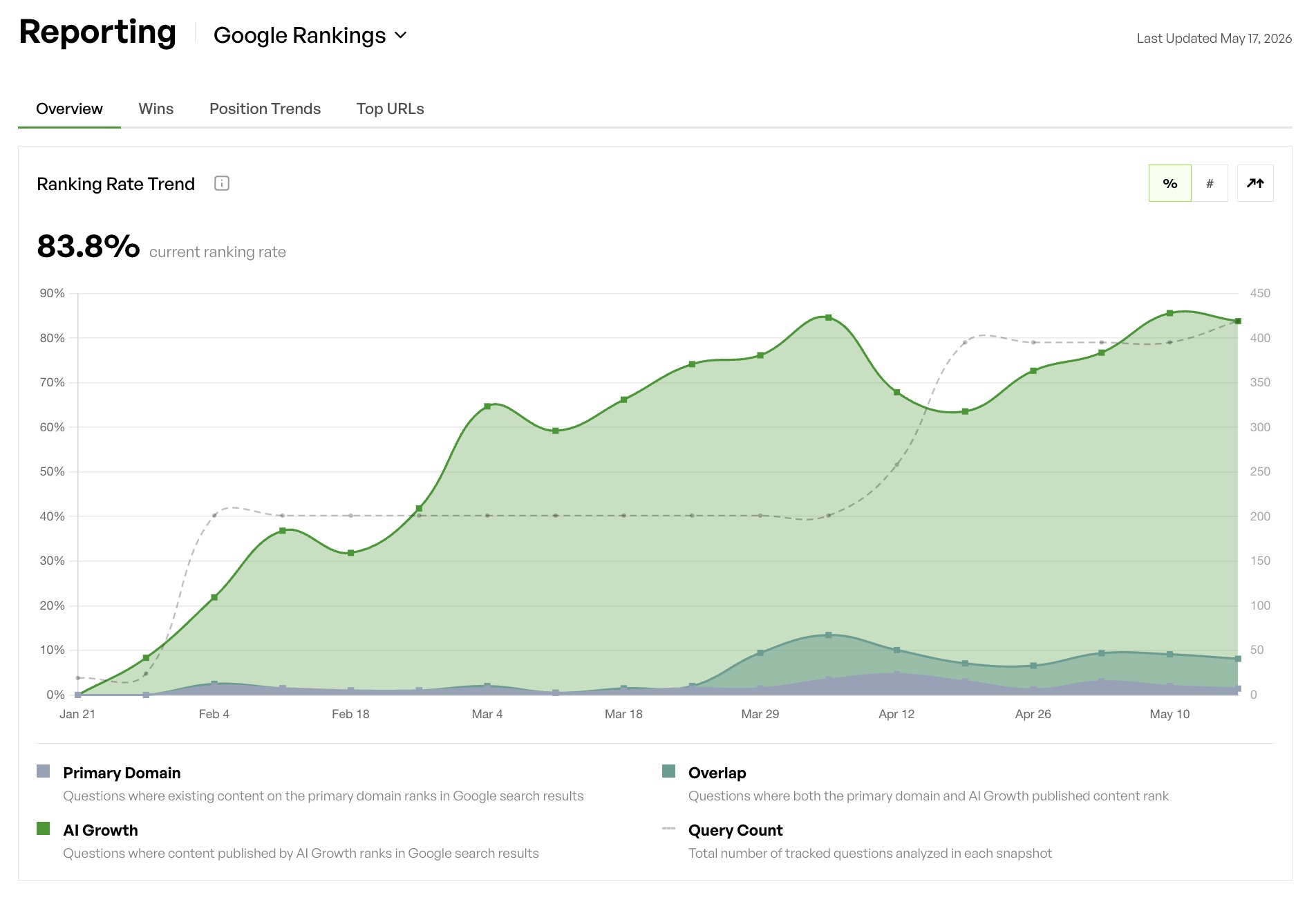
Incremental visibility reporting isolates exactly what the engine generated, week over week, by cross-referencing bot traffic, Google Search Console, and citation data. AI Growth Agent publishes into a separate environment so it can take credit only for the visibility it actually generates, never for visibility the brand already had. The metrics committed to are brand mention rate and citation rate, accompanied by Google Search Console impressions and bot traffic.
Bot tracking records every bot that touches the blog, including the bot ChatGPT uses to cite sources. If a brand cannot see who is reading it, it cannot tell whether it is being read at all. Per-article bot tracking across every bot type is included in every package.
Self-healing updates keep content current without manual intervention. When the year turns, every article in a sector refreshes automatically. Stale articles also refresh in response to Google Search Console signals and bot-traffic awareness. Every article's relationships, performance, and indexing data are centralized so authority keeps compounding instead of decaying.
Risks and Common Mistakes in Headless Marketing
Three failure modes account for most of the headless marketing implementations that do not deliver results.
Stale content. Content that ships and is never updated trains the next generation of AI models with an outdated narrative. The brands that wait are training the next generation of models with whatever happens to be sitting on the open web. Without the self-healing mechanism described earlier, a brand's narrative decays with every training sweep.
Capped prompts and partial universes. Monitoring tools that cap tracked prompts give brands a false sense of coverage. A brand tracking fifty prompts is blind to the hundreds of long-tail queries where customers are actually asking about it. Prompt count is never a billed metric in AI Growth Agent. Clients see their entire universe instead of a capped handful of tracked terms.
Agency dependency. Brands that do not own their own site or content are one contract termination away from losing their entire organic presence. AI Growth Agent stands up a site the client owns outright, with no agency in the loop. The architecture is designed so the brand controls the property, the content, and the relationship with AI surfaces from day one.
Summary and Decision Support for AI Growth Agent
Headless marketing architecture provides the framework required for narrative control in zero-click AI search. Its three-layer structure of back-end orchestration, agentic endpoints, and an owned front-end blog solves the problems that traditional agency stacks and monitoring tools cannot solve: speed, scale, living content, and proof of incremental results.
AI Growth Agent operates as the single engine that stands up the full stack in one week, replacing the SEO agency, the content tool, the web agency, the GEO monitor, the schema plugin, the analytics stack, and the PR firm, at a flat fee with no per-article charges, credit limits, or per-prompt billing. Clients own all the content they produce.
The leaderboard in AI search is being written this year. The brands that establish authoritative content now are training the next generation of models with their own narrative.
FAQ
What is the difference between headless architecture and traditional architecture in a marketing context?
Traditional marketing architecture couples the content management layer, the publishing workflow, and the presentation layer inside a single system or agency relationship. Every change touches the whole stack, and the brand often does not own the site outright. Headless marketing architecture decouples the autonomous back-end engine from the curated front-end the brand controls. The back-end maps the universe, produces living content, and exposes agentic endpoints for AI surfaces. The front-end stays branded and owned. The two sides scale independently, and the brand is never dependent on an agency to make changes or publish content.
What is a headless marketing architecture example?
A practical example is a mid-market brand that keeps its existing curated website unchanged while AI Growth Agent stands up a fully tuned blog connected through a reverse proxy rewrite under a subdirectory of the brand's domain. The back-end engine maps the brand's full universe of seed terms and long-tail queries, produces authoritative articles validated against primary sources, and publishes them with full schema, Blog MCP, llms.txt, and agentic endpoints. The front-end blog is styled to match the brand, owned by the client, and indexed by AI surfaces within days. The brand's main site stays untouched. The engine runs on autopilot, self-heals content over time, and reports incremental visibility week over week.
How long does implementation take?
The first article typically goes live within one week of kickoff. A professional journalist interviews the client to build the brand manifesto, the keyword topology is mapped, and the site is stood up and connected to the brand's domain in the same week. Content has indexed in as little as ten days and often within two weeks. The standard pilot runs three months, because indexing timelines vary by industry and competitive density, but clients see citation and bot-traffic movement early in the engagement. This timeline is structurally different from the traditional agency model described earlier, which requires nearly a year before the first assets are live.
Does headless marketing architecture require a technical team or additional headcount?
No. The architecture is specifically designed to remove that requirement. The engine provisions schema, the WordPress plugin, robots.txt, sitemaps, automatic web stories, Blog MCP, agent discovery via /.well-known/, llms.txt and llms-full.txt, instant indexing, autoredirects, and 404 tracking automatically. The only integration step on the client's side is the reverse proxy rewrite that connects the blog to a subdirectory under the brand's domain, with setup documentation generated for the client's specific host. The internal marketing team gives feedback in plain language, and the engine saves those instructions as memories so the same correction is never needed twice. No engineer, SEO specialist, or content editor is required on the client's side.