What Is AI Share of Voice? Definition & How It Works
Written by: Mariana Fonseca, Editorial Team, AI Growth Agent
Key Takeaways
AI Share of Voice tracks how often a brand is mentioned, cited, or recommended inside AI-generated answers across real buyer prompts. It replaces impression-based metrics in a zero-click search environment.
Three formulas – mention-based, position-weighted, and citation-based – use the same answers but return different SOV values. Mention-based SOV is usually the clearest signal for growth teams.
AI SOV relies on an effectively infinite prompt universe with no fixed denominator. Brands cannot buy this visibility with media spend and must earn it through content AI systems trust and can cite.
Each AI engine (ChatGPT, Perplexity, Gemini, Google AI Overviews) pulls from different sources and applies its own reranking logic. Teams need per-engine measurement instead of a single blended score.
AI Growth Agent maps your brand’s full prompt universe, produces authoritative living content, and delivers measurable citation gains within the first week.
How AI Share of Voice Works and How to Calculate It
AI Share of Voice is calculated across three formula variants, and each one highlights a different dimension of brand presence inside generative answers.
Mention-Based AI SOV AI SOV = (Your brand mentions ÷ Total brand mentions across all competitors) × 100
Position-Weighted AI SOV AI SOV = (Sum of your brand’s position weights ÷ Sum of all brand position weights) × 100 Position weight uses harmonic decay (1/n): Position 1 = 1.0, Position 2 = 0.50, Position 3 = 0.33, Position 4 = 0.25, Position 5 = 0.20.
Citation-Based AI SOV AI SOV = (Citations of your domain ÷ Total citations across all sources) × 100
The three formulas produce materially different results from the same underlying data. In a worked example across five project-management brands and 100 prompts, one brand recorded 32% mention-based SOV, 28% position-weighted SOV, and 18% citation-based SOV from the same set of answers. Mention-based SOV is usually the most actionable metric because it reflects raw brand visibility without extra weighting.
Citation-based SOV tends to produce lower values because its denominator includes every third-party source the model references, not just brand names. Position-weighted SOV sits between the two. It rewards first mentions and penalizes trailing appearances through harmonic decay, so prominence inside the answer affects the score.
The table below highlights six dimensions where AI SOV and traditional SOV diverge. Pay closest attention to the denominator and improvement lever rows, because they explain why AI SOV cannot be bought with media spend and depends on content quality instead.
Dimension
Traditional Share of Voice
AI Share of Voice
Measurement unit
Impressions, ad placements, or ranked keyword positions
Brand mentions and citations inside generative answers
Content that AI systems can understand, trust, and cite at scale
A study across hundreds of brands found that a significant share never surface in any AI recommendation at all. Monitoring tools reveal that gap. They do not close it.
How AI Systems Decide Which Sources to Cite
AI surfaces do not rank pages in a traditional list. They retrieve, synthesize, and then decide which sources to cite. Four pillars of intelligence work together to determine whether a brand earns a citation or disappears from the answer.
Search Intelligence. This pillar builds a complete portrait of the traditional search landscape, including positioning, competition, search volume, and who already wins. It turns raw search data into an actionable diagnosis.
AI Analytics. This pillar tracks brand value and consumer behavior across the full journey, from external touchpoints like Google and AI-tool queries through content consumption, demographics, and sentiment.
Bot Tracking. This pillar records every bot interaction, from traditional crawlers to AI training agents, including each crawl, citation, and training sweep. Without visibility into which agents read the content, teams cannot know whether it is being considered at all.
AI Ranking. This pillar measures order of mention and citation context inside AI answers. There is no static ordered list, so where the brand appears in the answer and how that position evolves week over week becomes the new leaderboard.
These four pillars form a single system. Search Intelligence identifies the competitive landscape, AI Analytics reveals buyer behavior, Bot Tracking confirms that agents are reading the content, and AI Ranking shows whether that reading turns into citations. Monitoring tools observe these signals. They do not act on them.
Per-Engine AI SOV: Why Each Platform Tells a Different Story
Each AI engine draws from different sources and applies different reranking logic, so treating them as equivalent produces misleading aggregate figures.
ChatGPT draws citations from Google’s index via SerpAPI and weights consistent cross-web brand mentions. Outputs must be run at least 30 times and averaged because responses vary between sessions.
Perplexity applies a three-layer reranking model that weights recency heavily. Referring domains and community presence on Reddit correlate more strongly with Perplexity visibility than on-site optimization alone.
Gemini draws from Google’s index and YouTube, so video transcript optimization becomes a distinct lever that other platforms do not offer.
Google AI Overviews cite domains only when the feature triggers for a query. AI Overviews appear on a meaningful share of keywords and carry a high zero-click rate when present.
AI SOV scores vary significantly by platform; a brand may hold substantially higher SOV in ChatGPT than in Perplexity because each engine pulls from different sources and weights authority differently. Per-engine tracking is not optional. Aggregate figures that blend engines without weighting by audience usage produce numbers that cannot guide action.
Why Position and Sentiment Weighting Change the Story
Position inside an answer changes impact. Raw mention counts treat a first-position citation and a seventh-position citation as equivalent, and they are not. First mention in an AI answer is more influential than later mentions. Position-weighted formulas apply the harmonic decay described earlier to correct for this, so a first-position citation carries more weight than a trailing mention.
Sentiment sits alongside position as a separate layer. Some AI SOV formulas incorporate sentiment weighting via variants such as sentiment SOV that measure positive mentions. A brand described as “expensive and complicated” in an AI answer still counts as a mention but does not improve the brand’s competitive position. Negative or neutral framing can reduce downstream conversion. Sentiment tracking reveals which claims models associate with the brand and whether those associations support or undermine the buying decision.
Benchmarks: What Good AI Share of Voice Looks Like
Benchmarks only make sense in context. Category structure, brand maturity, and the number of active competitors the AI surfaces cite all shape what “good” looks like.
In fragmented markets, 15% AI SOV may represent category leadership. In consolidated markets with two or three dominant players, anything below 30% means losing ground. Momentum matters as much as the absolute figure. A brand moving from 8% to 14% over 60 days is on the right trajectory, while a brand holding at 22% as a competitor climbs from 10% to 19% is losing position.
Treating all engines equally. Blending ChatGPT, Perplexity, Gemini, and Google AI Overviews into a single aggregate figure without weighting by audience usage produces a number that reflects no engine accurately.
Ignoring citation context. A brand mention in an AI answer is not the same as a brand recommendation. Framing, position, and sentiment determine whether the citation advances or undermines the buying decision.
Relying on monitoring-only tools. Monitoring tools reveal where the brand is absent but provide no system to produce the content that would earn citations in those gaps. The gap between observation and execution is where most brands stall.
These mistakes share a common root. They treat AI SOV as a monitoring problem instead of a content production problem. Fixing that requires a system that connects measurement to execution.
The System That Actually Improves AI Share of Voice
Example of long-form article produced by AI Growth Agent: fact-checked, credible research meets unique content, derives from a brand's Company Manifesto.
That system must do four things. It must map the full prompt universe, produce authoritative content against each relevant query, validate every claim, and report incremental visibility gains. AI Growth Agent is built as that system. It maps a brand’s full universe across real-time Google and ChatGPT data, produces living content that validates every claim and source, stands up a fully optimized site the brand owns within the first week, and reports the visibility it generates week over week.
AI Growth Agent's Content Planner show each brand's universe of search (tracked prompts/queries) and its visibility (ranking rate) on both Google Rankings, Google AI Overviews, and ChatGPT citations and mentions.
Across the first twelve weeks, clients average more than 12,000 additional AI citations and mentions, over 100,000 additional bot visits, and a 20%+ lift in impressions. Breadless went from invisible to the most recommended healthy franchise in the US, with ChatGPT citing eatbreadless.com over 45,000 times per month. Leva Sleep became the most mentioned adjustable bed retailer in Canada, with ChatGPT citations topping 10,000 per month and $40,000 to $50,000 in deals closed in under three weeks from buyers who found them through AI Growth Agent content.
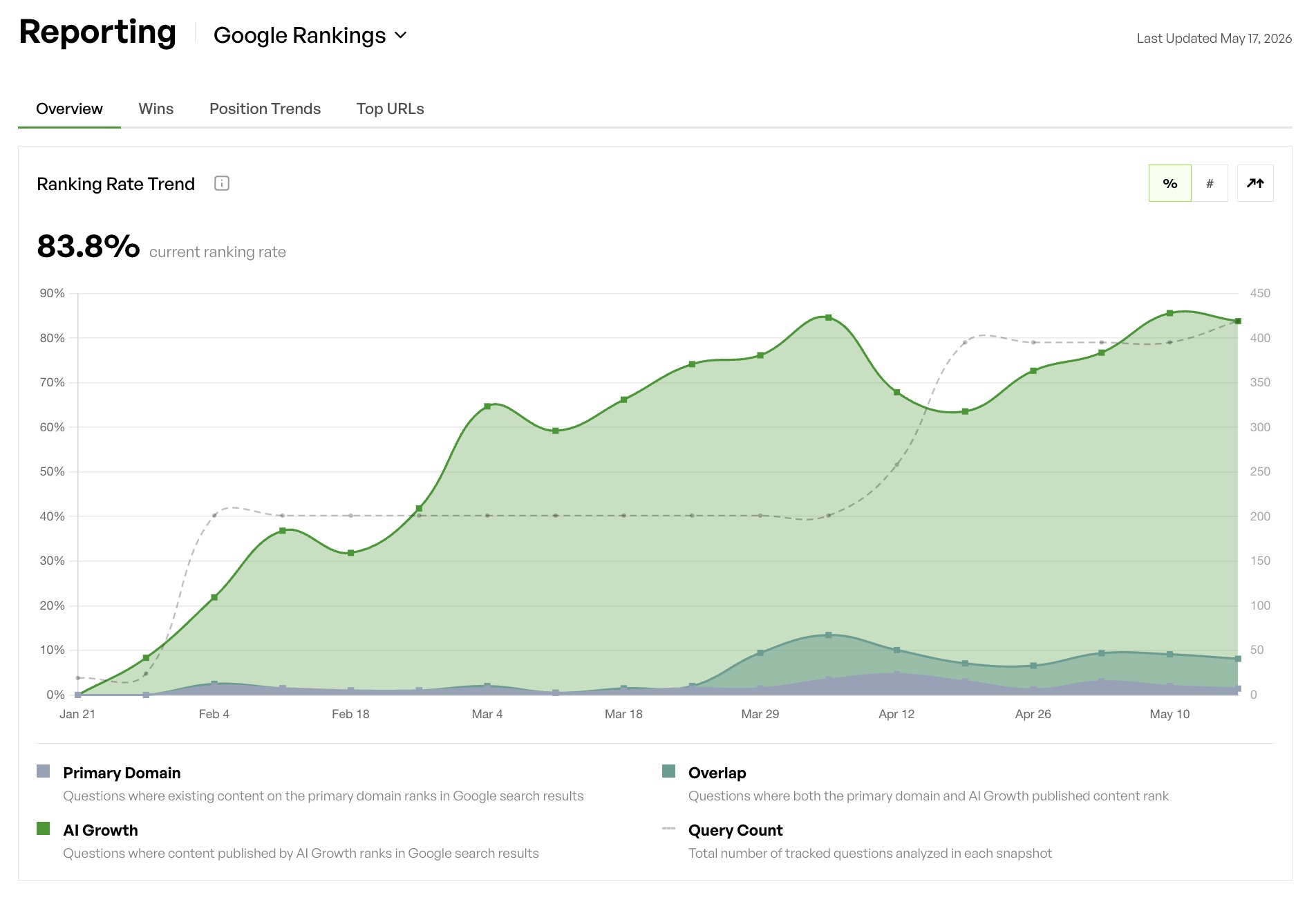
AI Growth Agent's Reporting dashboard, with ranking rates and their separation between Primary Domain results, Overlapping results, and AI Growth Agent content results (incremental visibility).
The difference between monitoring and execution is the difference between knowing the brand is absent and making the brand the answer. Search Intelligence, Content Topology, living content, and incremental visibility reporting are the four components that close that gap. No monitoring tool delivers all four. AI Growth Agent does.
Traditional search tools show you where your brand stands, and standing still does not close the gap. AI Growth Agent makes your brand the answer by producing the content that earns citations at scale. Book a kickoff and see your first article live within a week.
Frequently Asked Questions
What is AI Share of Voice and how is it different from traditional Share of Voice?
AI Share of Voice is the percentage of AI-generated answers across a defined prompt set that mention, cite, or recommend a brand relative to competitors. Traditional Share of Voice measured impressions, ad placements, or ranked keyword positions using a fixed, auditable keyword list as the denominator. AI Share of Voice operates against an effectively infinite prompt universe. Buyers ask AI engines questions in natural language, and the denominator becomes every relevant query a buyer might ask, not a pre-defined keyword list a brand chose to track. AI Share of Voice cannot be bought with media budget. It reflects how AI systems evaluate brand credibility, content quality, and citation worthiness, which makes owned, authoritative content the primary lever for improvement.
How do you calculate AI Share of Voice?
The base formula is: AI SOV = (Your brand mentions ÷ Total brand mentions across all competitors) × 100. Two additional variants add precision. Position-weighted AI SOV applies harmonic decay (1/n) to each mention before summing, so a first-position citation counts as 1.0 and a fifth-position citation counts as 0.20. Citation-based AI SOV replaces brand name mentions with domain citations: (Citations of your domain ÷ Total citations across all sources) × 100. Each formula produces a materially different result from the same underlying data, and mention-based SOV is the most actionable for most teams. All three require at least three to five repeated runs per prompt to stabilize the metric, because generative AI outputs vary between sessions.
What is a good AI Share of Voice benchmark?
Benchmarks depend on category structure, the number of competitors the AI surfaces actively cite, and brand maturity. The ranges outlined in the benchmarks section provide a starting framework, but momentum matters as much as the absolute figure. A brand moving from 8% to 14% over 60 days is on the right trajectory, while a brand holding at 22% as a competitor climbs from 10% to 19% is losing competitive position regardless of its headline number. Benchmarks must always be set relative to category structure rather than applied as universal absolutes.
Why does each AI engine require separate measurement?
The per-engine differences outlined earlier mean that a brand’s SOV can vary dramatically by platform. A brand may hold 35% SOV in ChatGPT while sitting at 12% in Perplexity, because each engine’s unique source pool and reranking logic favor different content characteristics. Blending all engines into a single aggregate figure without weighting by audience usage produces a number that accurately reflects no engine and cannot be acted on. Per-engine tracking is the minimum viable measurement standard.
What is the fastest way to improve AI Share of Voice?
The only durable lever is producing content at scale that covers the full universe of seed terms and long-tail queries buyers actually ask. Monitoring tools identify where the brand is absent but provide no mechanism to produce the content that would earn citations in those gaps. The brands that improve AI Share of Voice fastest are the ones that map their full prompt universe, produce authoritative content against each relevant query, validate every claim and source, and refresh that content as the world changes. Generic AI-generated text without brand intelligence, validated sources, and proper technical structure does not earn citations at the same rate as content built with journalistic rigor and full schema. The system behind the content matters as much as the content itself.