Written by: Mariana Fonseca, Editorial Team, AI Growth Agent
Key Takeaways
- AI share of voice uses a simple formula: (your brand mentions ÷ total brand mentions across all tracked brands) × 100. The denominator is where most mistakes happen.
- Write down the counting rule before the first run. Count each tracked brand at most once per completed answer after applying a declared alias rule.
- Run each prompt three to five times per engine within a fixed 24–72 hour window. Average the runs to smooth out AI randomness.
- Pair AI share of voice with presence rate and citation context. A brand can show rising share while absolute visibility falls when competitors gain mentions faster.
- AI Growth Agent maps the full universe of buyer prompts, refreshes it weekly, tracks citation context as the new ranking, and reports incremental visibility so AI share of voice reflects what the engine actually generated.
Book A Demo With AI Growth Agent
AI Share Of Voice Formula And Core Steps
The formula is: (Your brand mentions ÷ Total brand mentions across all tracked brands) × 100.
Three steps produce a defensible number:
- Select the prompts your buyers actually ask across the AI surfaces that matter to your category.
- Run each prompt across each engine and log every brand the model names, not just yours.
- Apply the formula and lock the counting rule before you report the number.
Write the counting rule down before running a single prompt. AuthorityTech’s measurement protocol states that changing the event class, numerator, denominator, prompt set, engines, competitive set, geography, or sampling window without disclosure makes the trend non-comparable. The rule must be documented before the first run.
For a full definition of what AI share of voice measures and how it fits into a broader visibility strategy, see What Is AI Share Of Voice? Definition & How It Works.
Worked Example: Three Brands Across 100 Prompts
The table below shows why the denominator matters more than the prompt count. The run used 100 prompts, yet the denominator is 100 brand appearances, not 100 prompts. Each brand is counted at most once per completed answer.
| Brand | Mentions Across 100 Prompts | AI Share Of Voice |
|---|---|---|
| Your Brand | 20 | 20% |
| Competitor A | 41 | 45.6% |
| Competitor B | 19 | 21.1% |
| Total | 100 | 100% |
This example follows the mention-based formula documented by LLM Pulse: your brand mentions divided by total brand mentions across all tracked competitors, multiplied by 100. In a 100-prompt run, Your Brand had 20 mentions and a 20% AI share of voice, calculated as 20 brand mentions divided by 100 total tracked brand mentions. The numbers add up because the denominator is the sum of all tracked brand appearances, not the total number of prompts or answers.
Replicate this table in a spreadsheet with your own prompt log. The prompt log is the audit trail that makes the number defensible to a CMO.
For a deeper look at how to structure and attribute these numbers over time, see AI Share Of Voice: How To Measure & Attribute It.
Choosing The Right Denominator Rule
The denominator is the single biggest source of error in AI share of voice calculation. Findrix identifies four common approaches: mention-based, citation-based, position-weighted, and volume-weighted, and notes there is no single formula used by every tool, which makes results hard to compare across platforms.
The key decision is whether the denominator includes only direct competitors or every brand the model names. The denominator rule you choose determines whether your share of voice is comparable across periods.
| Denominator Rule | Total Category Mentions | Your AI Share Of Voice |
|---|---|---|
| Direct competitors only (your brand plus 3 direct competitors) | 100 | 20% |
Under a direct-competitors-only denominator rule, if total category mentions are 100 and your brand accounts for 20 of them, your AI share of voice is 20% (20 ÷ 100).
Expanding the set to every brand the model names increases the denominator, so your share falls even when your own mentions stay flat. Switching to a citation-based denominator changes the metric entirely, because you now count domains instead of brand mentions. LLM Pulse’s worked example shows a brand that leads on citation-based share of voice while trailing on mention-based share of voice when competitors get named more often by reputation while the brand gets cited more often as a source through helpdesk articles and comparison pages.
Dan Taylor at Search Engine Land argues that AI visibility vendors select a small, arbitrary subset of static prompts and aggregate those limited outputs into a representative global percentage, creating a metric that only measures share of voice within a contrived and artificial environment. The denominator stays hidden inside proprietary, vendor-defined systems.
Choose one denominator rule and document it in the prompt log header before the first run.
Counting Rule: Once Per Answer Or Once Per Mention
A brand named three times in one answer can count once under a mention-share rule or three times under a raw-mention rule. This choice changes the result materially.
Findrix counts each brand at most once per answer, so repeating the same brand name multiple times in a response does not inflate its mention count. Maxlytics applies the same rule: a brand appearance is recorded once per run when the brand is named in the answer or its official domain is cited. If both occur in the same run, the brand still contributes only one appearance to the share of voice calculation.
AuthorityTech’s protocol specifies counting a tracked brand at most once in each eligible completed answer after applying a declared alias rule. The alias rule is an operator-designed anti-duplication rule that prevents the same brand entity from being counted under multiple name variants.
Lock the counting rule before the first run. Count each tracked brand at most once per completed answer after applying a declared alias rule. Then add a counting-rule version column to the prompt log so any future change is visible in the audit trail.
Repeat-Run Protocol For Stable Numbers
AI answers are non-deterministic, so a single pass does not qualify as a measurement. A 2026 methodology paper on LLM randomness attributes output variation to four distinct sources: deliberate sampling, silent model updates, numerical rounding, and expert routing in Mixture-of-Experts architectures. Setting temperature to zero removes deliberate sampling when available but does not eliminate the other sources.
Profound’s tracking found that 40–90% of the domains an engine cites can change when the same question is re-asked, which means a single run is a draw from a wide distribution rather than a reading.
Follow a repeat-run protocol. Run each prompt three to five times per engine within a fixed 24 to 72 hour window, log every run, and report the rate rather than a single outcome. Explorium advises that the repeat runs average out the probability distribution to produce a stable mention rate per prompt.
On stabilization, LLM Pulse states that a five-point week-to-week AI share of voice swing is usually noise, while a five-point swing held for three to four weeks is a real change. Annotate model release dates on dashboards to distinguish model changes from lost share.
Set the repeat-run count and the collection window before the next measurement cycle. For a structured framework covering all seven phases of measurement, see How To Measure AI Share Of Voice: 7-Phase Framework.
When Position Weighting Makes Sense
Position weighting is an optional refinement that changes the story when citation order matters. The common harmonic decay scheme assigns first position a weight of 1.00, second 0.50, and third 0.33, following the 1/n pattern documented by LLM Pulse. Applied to the same data set, position weighting produces a different number than mention-based share of voice. In LLM Pulse’s worked example across 100 prompts, the same brand ranked third by mention-based share of voice (20%) but slipped to fourth by position-weighted share of voice (16.8%) because most of its mentions came at positions three to five.
Position-weighted share of voice needs at least three to five repeats per prompt to stabilize because LLM outputs are sampled from probability distributions and the chance of two independent runs producing the exact same ordered brand list is very low.
Position weighting is worth the added complexity only if citation context matters to your category: where the brand appears in the answer, who it is grouped with, and what claim it is cited for. Decide whether position weighting is worth the added complexity before adding it to the reporting stack. For guidance on the tools that support position tracking, see AI Share Of Voice: Tools, Metrics & How To Act On It.
AI Share Of Voice And Presence Rate Together
AI share of voice is relative and can rise while your visibility falls. It needs presence rate and citation context alongside it, not as an afterthought.
Presence rate is calculated as (prompts where your brand appeared ÷ total prompts tracked) × 100. AI share of voice measures how much of the total conversation you own: (your brand mentions ÷ total brand mentions across all responses) × 100.
A brand can have a 30% presence rate but only a 6% share of voice if four competitors also appear in every one of the same responses, because the share of voice denominator includes all brands the AI mentioned, not just the brand’s own appearances.
Share of voice can fall while absolute visibility holds steady, purely because a competitor started appearing more. The two metrics describe different competitive positions and each one fills a gap the other leaves.
Report both numbers side by side on the same dashboard. For a platform-by-platform breakdown of how to track both metrics, see How To Measure AI Share Of Voice Across AI Platforms.
Interpreting A “Good” AI Share Of Voice
AI share of voice has no universal good number. A 15% mention share may be meaningful in a crowded market with many established brands, while the same figure may signal limited visibility in a narrow category.
AuthorityTech’s protocol states there is no portable AI share of voice percentage that is good across every category because the denominator changes with the tracked brands, prompts, engines, sampling schedule, market, and counting rules. The most useful benchmark is your own trend against a stable measurement universe.
Set an internal baseline and compare against it instead of chasing a vendor benchmark band. For context on what competitive benchmarks look like across categories, see AI Share Of Voice Benchmarks: What Good Looks Like.
Manual Tracking Versus Monitoring Tools
Manual prompt logs break down once you scale beyond a small test. Manual AI share of voice tracking becomes difficult to manage consistently once tracking 20 or more prompts, 10 or more competitors, and multiple AI platforms. At that point, dedicated tools become necessary.
Monitoring-first tools meter prompts, cap how much of the universe you can see, and hand the work back to a human. Semrush’s AI Visibility Toolkit describes its metrics as directional rather than definitive, and advises users to cross-reference movements in one metric against another rather than treating any single number as authoritative.
Google’s Merchant Center AI share of voice metric is scoped to shopping and rolling out by region, not a general live metric for every site. Google’s other 2026 AI reporting additions, such as Search Console generative AI performance reports and GA4’s native AI Assistant traffic channel, measure a brand’s own performance rather than competitive share.
That limitation points to a deeper problem. Monitoring-first tools were built to tell you what is happening. The action layers added in 2026 still hand the work back: draft agents that wait for approval, to-do lists the team has to execute, and shadow pages that stand in for a real site. Each one stops short of mapping, publishing, and self-healing on a site the client owns.
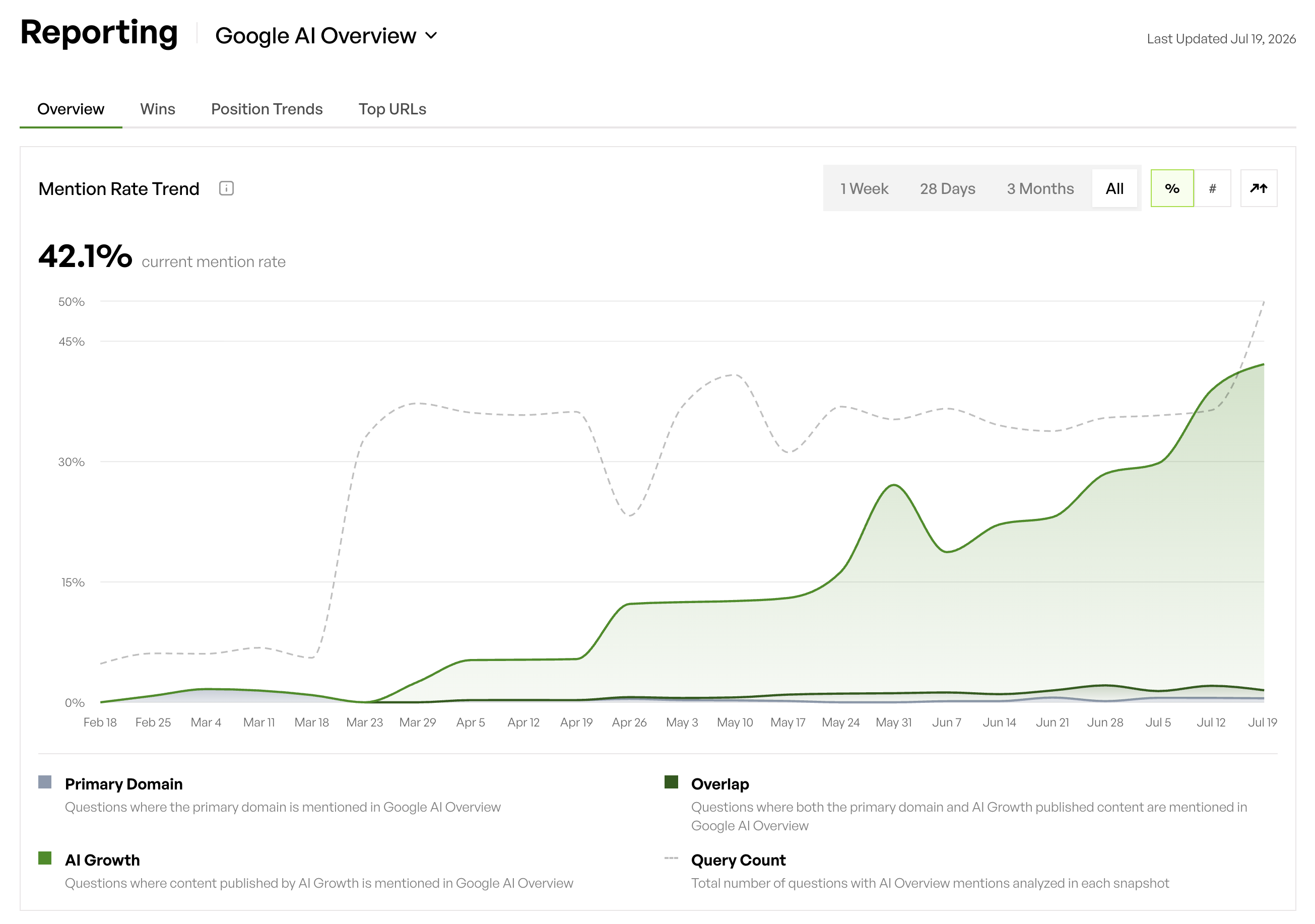
AI Growth Agent takes a different approach. It maps the full universe of seed terms and long-tail queries, refreshes it weekly, tracks citation context as the new ranking, and reports incremental visibility so the AI share of voice number is isolated to what the engine actually generated. AI Growth Agent owns the full loop. It produces the content, owns the publishing, self-heals what is live, and proves the incremental result.
See How AI Growth Agent Closes The Loop
AI Share Of Voice Compared To Traditional Share Of Voice
Traditional share of voice measured your brand’s impressions against a fixed keyword set, which gave it a stable, auditable denominator. AI share of voice tools obscure their denominator within proprietary, vendor-defined systems that are almost certainly incomplete, according to Dan Taylor’s Search Engine Land analysis.
The 60/40, 80/20, and 3-3-3 rules from traditional media buying do not transfer to AI share of voice. AI citations are driven by earned and owned media, about 90% per Edelman research, rather than paid placements. AI SOV is measured in citation frequency rather than impressions or spend share.
Traditional SOV still matters for brand campaigns and media buying, so run the two in parallel. Those rules were calibrated against a fixed keyword universe with auditable impression counts. AI share of voice has no fixed universe, no auditable impression count, and no stable position to hold. Pattern-matching AI share of voice to media-buying heuristics produces a number that looks familiar and carries the wrong meaning.
Stop pattern-matching AI share of voice to media-buying heuristics. For a full comparison of how AI share of voice differs from traditional measurement frameworks, see How To Measure AI Share Of Voice Metrics.
Frequently Asked Questions
How Should You Define The Denominator?
The denominator is the total qualifying brand mentions across every brand in your declared competitive set under your declared counting rule. It is the sum of your mentions plus competitor mentions across the same prompt run. Expanding the competitive set to include every brand the model names grows the denominator and lowers your share of voice number, even when the market has not changed. Changing the denominator rule changes the number, which is why the rule must be documented before the first run and held stable for period-over-period comparison.
How Many Times Should You Run Each Prompt?
Run each prompt three to five times per engine within a fixed 24 to 72 hour window. A single run is a draw from a distribution, not a measurement. The four sources of variation, including sampling and silent model updates, are why you need multiple runs. Report the rate across all runs rather than a single outcome. For borderline cases where a brand appears in roughly half of runs, extend to seven to ten runs before drawing a conclusion. Keep the collection window fixed so only the run varies, not the time, platform state, or session context.
Is AI Share Of Voice A Vanity Metric?
AI share of voice turns into a vanity metric when the denominator and counting rule are undefined. A number without a documented prompt set, a declared competitive set, a stated counting rule, and a repeat-run protocol cannot be defended to a CMO and cannot be compared across periods. Paired with presence rate and citation context, and locked to a documented protocol, AI share of voice becomes a defensible relative measurement instrument. The methodology determines whether the number is decorative or a leading indicator of competitive position in AI-generated answers.
Can AI Share Of Voice Rise While Visibility Falls?
AI share of voice can rise while visibility falls because it is a relative metric. If competitors lose mentions faster than you do, your share can rise even as your presence rate drops. Presence rate measures whether you appear at all across the tracked prompt set. Share of voice measures how much of the total brand conversation you own within those same answers. The 30% presence and 6% share example above illustrates how the two lines can move in different directions. Report both numbers side by side on the same dashboard and watch both trend lines.
Should You Weight Mentions By Position?
Position weighting is optional and adds complexity. It needs the same three-to-five repeats discussed above to stabilize because ordered brand lists vary across runs. The harmonic weights of 1.00, 0.50, and 0.33 are covered in the position-weighting section. Use position weighting only if citation context matters to your category and your stakeholders can interpret a weighted number alongside the unweighted one.
Conclusion: Make Your AI Share Of Voice Number Defensible
Most AI share of voice numbers are wrong because the denominator and counting rule are undefined. The formula is simple. The discipline lives in locking the inputs: a declared competitive set, a stated counting rule, a repeat-run protocol, and a fixed collection window. Those four elements are what make the number defensible.
AI share of voice is a relative measurement instrument. It needs presence rate and citation context beside it to tell the full story. A brand can hold a 30% presence rate and a 6% share of voice simultaneously. A brand can watch its share of voice rise while its absolute visibility falls. A single metric reported in isolation hides both patterns.
The teams that make this number defensible map the full universe of prompts their buyers actually ask, track citation context as the new ranking, and report incremental visibility rather than riding existing brand recognition. AI Growth Agent maps that full universe, refreshes it weekly, and reports the incremental visibility it generates so the number on the dashboard reflects what the engine actually produced.
For real-world examples of how brands have used AI share of voice as part of a broader visibility strategy, see AI Share Of Voice: Case Studies & How To Measure It. For a complete tracking framework, see AI Share Of Voice Tracking: How To Measure Your Brand.
Make Your Share-Of-Voice Number Defensible