Written by: Mariana Fonseca, Editorial Team, AI Growth Agent
Key Takeaways
- AI share of voice works as three separate metrics: mention share, citation share, and recommendation share. Blending them hides real competitive gaps.
- A single blended score behaves like a vanity metric. It removes diagnostic value and blocks teams from seeing which specific share they are losing.
- Reliable measurement depends on a fixed, versioned prompt set, multiple engines, repeated runs, and an open-denominator competitor list that prevents manufactured gains.
- Effective remediation when a competitor dominates a prompt category requires a closed loop: diagnose, map citations, create first- and third-party content, enforce entity consistency, and re-measure.
- AI Growth Agent runs this loop end to end by mapping missing prompts, producing authoritative content, publishing it, and self-healing results for clients.
Why One AI Share Of Voice Number Misleads
A single blended AI share of voice score functions as a vanity metric. Paul DeMott, writing in Search Engine Land, states it directly: “SOV alone is a vanity metric.” The problem is structural. When you collapse mention share, citation share, and recommendation share into one number, the components become unauditable. The diagnostic value disappears.
Each share answers a different question about your brand’s presence, and the formulas reflect that difference:
- Mention share = your brand-answer mention units ÷ all tracked brand-answer mention units × 100, where the denominator includes every brand-answer mention unit earned by your brand and all declared competitors in the same prompt, engine, market, language and run sample. This measures how often your brand name appears in AI answers relative to competitors. It is the broadest visibility signal and the closest analog to traditional share of voice.
- Citation share = citations of your domain ÷ total citations across all sources within a defined set of tracked prompts × 100. This measures how often AI engines pull your content as a source. LLM Pulse illustrates the denominator difference: 25 citations of your domain out of 1,200 total cited sources equals 2.1% citation share, because the denominator includes every third-party publisher the model used.
- Recommendation share = the share of answers that present your brand as a suitable option or shortlist choice, counted once per answer, where a passing mention must not count as a recommendation and the denominator is the recommendation units for every tracked brand under the same classification rule. Screpy defines this as counting only clear endorsements such as “best for” or “a good choice for” or inclusion in a presented shortlist, explicitly excluding factual references, comparison points, directory listings, or warnings.
A brand can win citation share because its documentation is frequently sourced yet earn a fraction of recommendation share because it never makes the shortlist. Trakkr’s worked example shows the same brand leading one measure and trailing another, and averaging the two into a single figure erases the diagnosis entirely.
The three shares require different improvement strategies. HubSpot notes that teams building AI prompt sets entirely from their top SEO keywords can end up with high citation share but weak entity mentions, because the two metrics require different improvement strategies. Running them separately is the only way to know which problem you actually have.
Once you separate the three shares, the next step is defining what you measure them against. That work starts with the prompt set.
How To Build A Prompt Set That Represents Your Market
The prompt set defines the measurement. Its construction determines validity. Alex Birkett of Omniscient Digital states: “The prompts you track [are] the determining factor for your AI visibility and your AI search work.” A prompt set built from keywords you already rank for reflects historical search behavior rather than where AI answers your category.
A defensible prompt taxonomy covers six types:
- Branded prompts, queries containing your brand name, used to test whether AI describes you accurately and recognizes your products. Keep these in a separate column, because they structurally inflate share when blended with organic prompts.
- Non-branded category prompts, such as “best [category] tools for [use case],” which provide the competitive metric that reveals organic discovery strength.
- Comparison prompts, such as “[Brand] vs [Competitor],” where AI draws on third-party review and comparison content.
- Best or top-list prompts, such as “top [category] platforms,” which surface the shortlist logic AI uses for recommendation share.
- Problem or solution prompts, such as “how do I [solve problem],” which reveal whether your brand appears when buyers describe their situation rather than your category.
- Use-case prompts, such as “[category] for [specific scenario],” which test whether your brand appears in the long-tail queries where most AI discovery actually happens.
Source prompts from sales call transcripts, support tickets, Reddit threads, G2 reviews, and People Also Ask blocks, not from internal jargon. Nadia Mohamed’s methodology writing recommends defining a prompt set that reflects real buyer intent, sampling from prompt types buyers actually use rather than from internal keyword lists.
Prompt-set size needs enough coverage to be meaningful. Mohamed states that 20 prompts is only a pilot and 50 prompts is a baseline, and that the prompt set should be grown before adding repeats because repeats of the same prompt are clustered observations rather than independent samples. Indexly recommends a prompt set of 50–500 queries for statistically meaningful AI share of voice measurement, with a baseline starting at 50 prompts, most single-category brands settling at 200–300 prompts, and each prompt run 5–10 times per platform to smooth out sampling variance.
Prompt-set size and composition matter, but they are meaningless without a correct denominator. The open-denominator rule is non-negotiable. A closed competitor list manufactures a fake share. LLM Pulse identifies the “closed-pool error” as a common AI share of voice measurement trap: calculating share only against a fixed, configured competitor set means emerging competitors never appear in the denominator. Define the denominator and hold it fixed. Version the prompt set whenever it changes. Changing the prompt pool, such as adding easier branded prompts or removing weak categories, changes the denominator and can manufacture an apparent improvement.
Consider a worked example. A B2B project management platform building its prompt set would start with category prompts (“best project management software for engineering teams”), use-case prompts (“project management software for remote teams under 50 people”), comparison prompts (“Asana vs Monday vs [Brand]”), problem prompts (“how to reduce onboarding time for new SaaS users”), and best-list prompts (“top project management tools for startups”). That set, sourced from sales calls and G2 reviews, represents where buyers actually ask. The team versions the set and runs the old set for one overlap period whenever prompts change so the trend line stays intact.
Run each prompt across at least three engines: ChatGPT, Perplexity, and Gemini at minimum. One brand recorded 35% share of voice in Gemini and meaningfully lower in ChatGPT, and the same brand showed a 27% citation rate on Grok versus 0.59% on ChatGPT. A single engine produces systematically biased data.
Why Single-Run Measurement Is Noise
A single run of a prompt produces a meaningless number. AI answers are sampled from probability distributions, and the same prompt sent to the same engine twice can return different brand mentions. SparkToro research, in which Rand Fishkin and Patrick O’Donnell of Gumshoe.ai recruited 600 volunteers to run 2,961 queries across 12 prompts on ChatGPT, Claude, and Google’s AI Overviews (with AI Mode used when Overviews did not appear), found under a 1 in 100 chance that two runs of the same prompt return the same list of brands, and roughly a 1 in 1,000 chance of the same list in the same order.
Variance comes from the way the systems work, not from a specific tool bug. An ICLR 2026 blog post on non-determinism in LLMs attributes run-to-run variation to floating-point arithmetic being non-associative on GPUs combined with dynamic batching in inference servers, meaning a request’s output depends on server load and what other users sharing that GPU were doing at that millisecond.
Understanding why variance occurs matters because it determines how many runs you need. A single sampled run recovers 62.2% to 76.8% of the expected five-run set, while the best single engine covers a median 83.1% of the observed six-engine union. For citation inventory, three to four repeats per engine per prompt form a practical floor. For rate metrics like mention share, the bar sits much higher. At an observed 40% appearance rate, reaching a ±10-point margin of error at 95% confidence requires roughly 100 runs per engine per prompt, consistent with the standard proportion sample-size formula n = (z*/ME)²·p*(1−p*), where the 40% planning value (rather than the conservative 50%) sets the required count.
The decision rule for when a share number is stable enough to act on comes from protocol, not from a magic percentage. Hold the prompt set, engines, location, and repeat count fixed. Treat a movement as signal only when it persists across repeated runs and survives the normal run-to-run band. AirOps recommends setting a detection threshold deliberately, deciding how big a drop counts as genuine decay and requiring it to hold across readings, since a single low reading is usually normal answer fluctuation, so ordinary churn never drives the content roadmap.
A fixed benchmark set provides the only honest measurement when answers move. Mohamed’s 2026 methodology article states that AI share of voice is only reproducible once five variables are fixed and written down: the brand set, the prompt set, the engines, the location, and the repeat count; changing any one makes the number non-comparable. Report per engine, not aggregated. Esteve Castells, Co-Founder of LLM Pulse, states the operational consequence directly: “Report SoV per model, not aggregated. An aggregated AI SoV figure hides the real story.”
With a reliable measurement protocol in place, the next question is what the resulting percentage actually tells you.
What Is A Good AI Share Of Voice Percentage
No universal benchmark exists for a good AI share of voice percentage. Mentionlytics’ 2026 guide “How to Measure Share of Voice & Check How AI Sees Your Brand” states there is no universal benchmark for a good Share of Voice percentage, because a given score depends on market crowding and competitor count rather than an industry-wide standard.
Category structure defines what a percentage means. Strivelabs notes that a 50% AI share of voice means the company appears in exactly half of assistant mentions for monitored prompts; in a two-player market this is simple parity, but against ten or more competitors it usually indicates a dominant position. In a market with two dominant competitors, 50% may only represent parity, while in a category with ten credible alternatives, 15% could represent genuine category leadership.
A 100% AI share of voice would mean your brand captured every tracked brand-answer mention unit across the fixed prompt, engine, market, language, and run sample, leaving no mentions for any competitor in the declared comparison set. If it appears in your data, it is worth checking whether the prompt set is too narrow, such as branded-only queries, before treating it as real category-wide dominance.
Three comparison baselines actually help:
- Your own baseline over time. The trend across multiple measurement cycles matters more than any single snapshot. A share moving consistently in one direction across repeated runs is signal. A single-week movement is noise.
- Your fixed benchmark set. The same prompt set, the same engines, the same competitor cohort, versioned and held constant. Movement is only meaningful when the denominator has not changed.
- The specific competitors in each prompt category. Cognizo recommends benchmarking AI share of voice by establishing a baseline across the prompt set, identifying the category leader, and measuring the gap to that leader over time, since the direction of change matters more than the absolute number.
For category-specific context, AI Share Of Voice Benchmarks: What Good Looks Like covers how benchmark ranges vary by vertical and competitive density.
How To Calculate AI Share Of Voice In Practice
Teams calculate AI share of voice separately for each of the three shares. The formulas are distinct, the denominators differ, and the results are not comparable to each other, which is exactly why they must be reported independently.
Mention Share = (Your brand mentions ÷ Total tracked brand mentions across the prompt set) × 100. Count each brand at most once per response, even if named multiple times. LLM Pulse’s example: 60 brand mentions out of 300 total brand mentions across 100 prompts equals 20% mention share.
Citation Share = (Citations of your domain ÷ Total citations across all sources) × 100. The denominator here includes every third-party publisher the model cited, not just tracked competitors. As noted earlier, citation share uses a broader denominator than mention share. Citation share is almost always lower than mention share because AI engines mention more brands than they cite.
Recommendation Share = (Eligible evaluation answers where your brand is actively recommended ÷ Total eligible evaluation answers) × 100. Count only clear endorsements such as “best for,” “a good choice for,” or inclusion in a presented shortlist. Exclude factual references, comparison points, and directory listings.
The measurement sequence:
- Define and version the prompt set, competitor cohort, engine list, location, and repeat count before running anything.
- Run each prompt the defined number of times per engine in fresh, depersonalized sessions.
- For each response, record: prompt ID, engine, model, date, whether web search was enabled, brand mentions, cited URLs, recommendation status, and listed position.
- Aggregate mention share, citation share, and recommendation share separately, per engine, before any cross-engine blending.
- Report each share with its sample size and run-to-run variation alongside the percentage. A number without its denominator and variance is not a measurement.
- Compare each share against the prior period using the same fixed benchmark set. Apply the same signal-detection rule described earlier.
LLM Pulse’s worked example shows that the same data set produced three different numbers for the same brand: 20% mention-based share, 16.8% position-weighted share, and 31.4% citation-based share. Each formula is correct under its own definition but not comparable to the others. Report all three. Never average them.
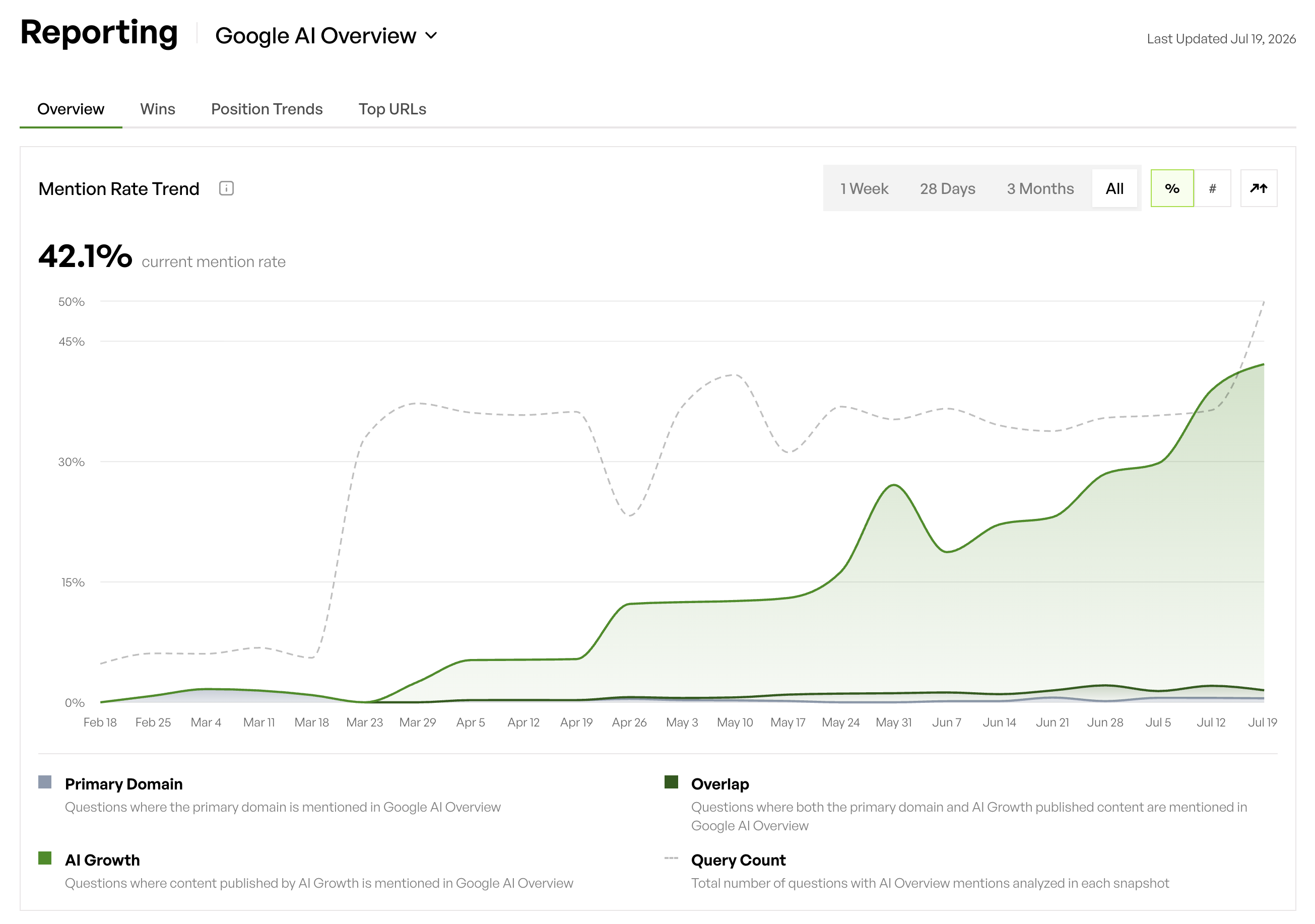
The Remediation Loop When A Competitor Owns A Prompt Category
Most programs stop at diagnosis. They surface a lost prompt category and hand a to-do list back to a team that cannot execute it. The remediation loop only closes when it runs in sequence: diagnosis, content production, third-party placement, entity consistency work, and re-measurement. Each step needs a named owner and a timeline.
Step 1: Diagnose which lost category to attack first. Prioritize by commercial value and gap size. A prompt category where a competitor owns recommendation share on high-intent buying prompts is worth more than a category where you trail on informational queries. Profound recommends auditing AI visibility per prompt against three questions: whether your brand is mentioned, whether it is cited, and whether it is described accurately in terms of sentiment and accuracy, because a response can name a brand, describe it inaccurately, and disqualify it in the same sentence.
Step 2: Map the competitor’s citation sources. Run the prompts where the competitor dominates and document every cited URL. Classify by source type: owned content, third-party review platforms, comparison articles, community threads, news coverage. TrySight advises diagnosing competitors across AI platforms by running the same prompt set through ChatGPT, Claude, Perplexity, and Gemini, documenting which competitors appear and which URLs are cited, analyzing what makes that content citation-worthy, and using those gaps to decide where to intervene, rather than reacting to individual AI answers.
Step 3: First-party content action. Publish content that directly answers the prompts where you are absent. Profound identifies three content formats that consistently outperform in AI search: specific, detailed pages that answer one question directly with the answer in the first sentence of each section; “best X for Y” listicles that match the comparative intent of buyer queries; and comparison pages covering both brand-versus-competitor and competitor-versus-competitor. Replace vague category claims with granular specifics such as named integrations, stated sizes, and described use cases. Ramp created two tailored accounts payable pages, Accounts Payable Software for Small Businesses and Accounts Payable Software for Large Businesses, which generated over 300 citations within one month and became some of Ramp’s top-cited content.
Step 4: Third-party source and community action. Lily Ray’s June 2026 research found that brands winning AI recommendations had far more referring domains and far more mentions across AI Overviews and ChatGPT than brands that were cited but passed over, and that content independent from the brand, specifically reviews, comparisons, and walkthroughs published by someone other than the vendor, is what earns a recommendation. Prioritize the sources the competitor’s citations already come from. Get your brand accurately described on those platforms before targeting new ones. Instant Press identifies review platform optimization, aligning G2 and Capterra profiles and syncing Review, AggregateRating, and FAQ schema to those reviews, as part of its high-impact AEO remediation work when a competitor has strong G2 or Capterra presence and you do not.
Step 5: Entity consistency work. AI systems expose the cost of fragmentation fast. If pricing lives in three formats, policy language changes by page, or the help center contradicts the sales deck, the model inherits the inconsistency and citation odds drop. Establish canonical business facts that stay consistent across key pages, remove duplicates, and consolidate conflicting claims. Implement schema markup across article, author, product, and FAQ types so AI retrieval systems can parse the entity correctly.
Step 6: Re-measure against the same fixed prompt set. Run the same prompts, same engines, same repeat count. Treat a movement as signal only when it persists across repeated runs. Citations.io recommends a repeatable monthly cycle in which each monthly scan is re-measured to verify lift, lock wins, and rotate to the next five gaps, delivered as a prioritised monthly Implementation Pack.
Monitoring-first tools usually stop at surfacing the gap. They hand back a queue. AI Growth Agent closes the loop. It maps the full universe of prompts where you are absent, produces the authoritative content against each long-tail query, publishes it on a site you own, and self-heals it over time. The fix loop closes instead of generating another to-do list for a team that cannot execute it. Clients average more than 12,000 additional AI citations and mentions in the first twelve weeks.
Connecting AI Share Of Voice To Business Outcomes
AI share of voice connects to business outcomes through a delayed funnel. Visibility and citations tend to appear first, branded search lift and direct traffic follow as AI-influenced users remember the brand name, and pipeline influence appears last, although the exact timing varies by category, engine, and competitive density.
Several leading indicators help before pipeline data matures:
- Branded search volume. Visionary Marketing’s 2026 AI Citation → GSC Branded Query Pair Study (n=240 accounts) found that brands cited in AI Overviews see a 23.4% lift in branded search volume during days 15–30 after citation, statistically significant at p<0.01, with the overall 30-day lift reported as approximately 23%. Brands cited consistently in AI Overviews over several weeks saw a compounded 41% lift in branded search volume over 90 days, per the Visionary AI Search Visibility Tracker (2026).
- AI referral traffic. Filter Google Analytics 4 for referrals from chatgpt.com, perplexity.ai, and gemini.google.com. Semrush’s June 2025 study of 500+ high-value digital marketing and SEO topics found that the average AI search visitor is 4.4 times as valuable as the average organic search visitor, measured by conversion rate, a figure Semrush itself describes as an extrapolation resting on modelling assumptions about untracked traffic and indirect conversions.
- Direct traffic trends. Unexplained increases in direct visits can indicate buyers learned about the brand through AI and returned later via direct navigation or branded search.
- Self-reported attribution. Add a “how did you hear about us” field to demo and signup flows with an explicit AI option. Fairing’s benchmark data shows customers naming an LLM in “how did you hear about us” surveys grew more than tenfold from January to mid-July 2025.
In a zero-click world, no one can fully attribute an AI recommendation to a sale. Aleyda Solis recommends separating AI business impact into confidence layers: Observed (directly attributable clicks and conversions), Proxy (split into own and third-party, such as branded search lift, direct traffic lift, and survey-based discovery), and Modelled (estimates applying assumptions to observed and proxy data), and explicitly warns against blending them into a single “AI impact” number.
Teams that measure well capture source at the conversion moment and track the pattern across all three layers. Sean Jackson, Lead AI Architect at Sprinklr, frames the shift: “Stop measuring channel performance and start measuring influence. You can lose the click and still win the decision.”
Frequently Asked Questions
These answers cover common questions about implementing and measuring an AI share of voice program.
How Long Does It Take To See Movement In AI Share Of Voice After Publishing New Content?
Movement timelines differ by platform. Retrieval-augmented platforms like Perplexity perform live web retrieval for every query, so newly published content typically becomes eligible for citation within approximately 48 to 96 hours (often hours to days), rather than four to eight weeks. ChatGPT, which blends parametric memory with optional live retrieval, typically takes two to four quarters for training-data influence to show up in mention share, per Signals.sh. Branded search lift, a downstream traffic signal, typically appears around 78 days (roughly 8–16 weeks) after consistent citation activity, not within 30 days; the ~28-day median applies to time-to-first-citation for consistent publishers. AI Growth Agent’s standard pilot runs for three months before drawing trend conclusions, because indexing takes time and varies by industry and competitive density.
Who Should Own The AI Share Of Voice Program Inside A Company?
Marketing owns the program because it connects audience research, brand positioning, content, web publishing, and demand generation. The program owner is one accountable person, not a committee. Named contributors from SEO or growth, content, product marketing, sales, and analytics feed into the program, but the measurement cadence, prompt set governance, and remediation prioritization sit with one owner. A monthly review works for most teams at the start, with weekly checks on priority commercial prompts as the program matures.
What Tooling Is Required To Run This Program?
Teams need a stable prompt set in a spreadsheet or CSV, API access or a purpose-built AI visibility tool, and a consistent cadence for running and logging results. Manual tracking of 30 to 50 prompts run monthly in fresh incognito sessions across one or two engines is feasible, taking a few hours per month for one person, though estimates range from about two to six hours per month depending on prompt count and engine coverage. Automated AI share of voice tracking becomes necessary when tracking 100 or more prompts across multiple platforms or reporting to executives, though other sources place the manual-to-automated threshold lower, at roughly 30 to 50 prompts across multiple engines. For AI share-of-voice tooling, the build-versus-buy crossover sits at a call-volume threshold. Build is out on economics below roughly 200,000 calls per year, where the fixed cost of a build team (with an engineering rota alone running £600–900k loaded cost) does not amortise. Most mid-market teams automate at the 50-prompt mark. Whatever tooling the team chooses, the tool executes the protocol. It does not replace one.
How Often Should The Prompt Set Be Refreshed?
Review the AI share of voice prompt set quarterly or biannually to preserve clean trend baselines and reliable reporting, though cadence is ultimately a design choice rather than a validated universal rule. Keep the old set running for one overlap period so the trend line stays intact. Version the prompt set every time it changes, and treat the change as a discontinuity in trend reporting. A prompt set built in one quarter measures a different system than the one users touch six months later, because AI engines update their weights, training data, and retrieval behavior continuously. Add new prompts alongside existing ones rather than replacing them, and label them in analysis so their first run is not compared against older runs.
Can AI Share Of Voice Be Gamed By Narrowing The Prompt Set?
Programs can game AI share of voice by narrowing the prompt set. Adding easier branded prompts or removing weak categories changes the denominator and manufactures an apparent improvement. The open-denominator rule exists to prevent this. The competitor set and prompt set must be defined before measurement starts, versioned whenever they change, and held constant within a reporting period. Any change to the denominator should be documented and the baseline restated. A program that cannot show its prompt set, run count, and competitor cohort alongside the percentage reports a screenshot, not a measurement.
What Is The Difference Between AI Share Of Voice And Traditional Share Of Voice?
Traditional share of voice (SOV) is calculated as a brand’s media spending expressed as a percentage of all media expenditures in the category, in that market, on that channel, and at that point in time. It measures presence and competitive means, not revenue or campaign impact. AI share of voice is calculated from sampled AI-generated answers across a fixed prompt set and engine list by dividing a brand’s AI mentions by the total AI mentions across all tracked brands in its category and multiplying by 100, measuring how often a brand appears in the answers AI systems produce for buyer queries.
See How AI Growth Agent Closes The Remediation Loop