Written by: Mariana Fonseca, Editorial Team, AI Growth Agent
Key Takeaways
- AI share of voice measures the percentage of AI-generated answers that mention or cite a client’s brand across tracked prompts and engines.
- Agencies need prompt sets that cover brand, category, and comparison prompts drawn from real buyer behavior to produce defensible measurements.
- Consistent measurement contracts with fixed prompts, competitors, engines, and repeated sampling turn snapshots into reliable trends.
- Effective reporting pairs AI SOV visibility metrics with business outcomes such as AI-attributed traffic and pipeline contribution to justify retainers.
- AI Growth Agent maps, produces, publishes, and self-heals content on client-owned sites so agencies can move AI share of voice instead of only monitoring it.
Book A Demo With AI Growth Agent
How To Calculate AI Share Of Voice
AI share of voice uses a simple formula.
AI SOV = (Number Of Answers Mentioning The Client's Brand ÷ Total Answers Sampled) × 100
AI visibility percentage and AI SOV answer different questions. AI visibility percentage is the share of tracked prompts where the client appears at all, which is an absolute number. AI SOV is a relative number that measures the client's mentions as a share of all brand mentions across the same answers. A client can improve its visibility percentage while losing AI SOV if competitors improve faster.
SE Ranking's 2025 survey of 260 agencies found that 61% were considering adding optimization for AI Overviews and other AI engines. The 2026 AEO/GEO CMO Investment Report by Conductor found that 94% of enterprises plan to increase AEO and GEO investment in 2026. Agencies that measure and move this number meet demand that already exists.
For deeper dives on the underlying concepts, see guides on how to measure and attribute AI share of voice, what AI share of voice is, and the 7-phase measurement framework.
See How AI Growth Agent Measures Your Share Of Voice
How To Design A Prompt Set For A Client
A strong prompt set gives the agency a defensible AI SOV number. Each prompt type answers a different diagnostic question, so the set needs all three.
Brand Prompts ask what the AI says when the buyer already knows the client's name. These test narrative accuracy rather than discovery. If the AI describes a client's product incorrectly or positions it against the wrong competitors, brand prompts surface that problem.
Category Prompts ask what the AI recommends when the buyer describes a problem without naming a brand. These test whether the client appears in the consideration set at all. A client can have strong brand prompts and near-zero category presence, which means buyers who do not already know the name never find them through AI.
Comparison Prompts ask how the AI positions the client against named competitors. These test whether the client makes the shortlist when a buyer actively evaluates options.
The engines to track are ChatGPT, Google Gemini, Perplexity, and Claude. Each draws on different retrieval backends and training data, so a brand can hold strong AI SOV on Perplexity while being nearly absent from ChatGPT. AI SOV diverges across models because of differing training data cutoffs, retrieval behavior, citation policies, system prompts, and source preferences. Tracking a single engine produces a distorted picture.
The competitor set must stay fixed, because adding or removing a competitor changes the denominator and makes every prior period non-comparable. That constraint means the set should reflect brands a buyer would genuinely consider, based on real purchase behavior. The list should not mirror an aspirational list of brands the client wishes to compete with.
Source prompts from sales call transcripts, support tickets, and customer interviews. Teams that build prompt sets entirely from their top SEO keywords get a high citation share but near-zero entity mentions, because the two outcomes require different strategies to improve. The prompt set should mirror real buying behavior and segment prompts by funnel stage: awareness, consideration, and decision.
Get Help Designing A Client Prompt Set
How To Keep The Metric Comparable Across Runs
Once the prompt set is designed, the next challenge is keeping the number comparable from one run to the next. AI answers are sampled from a probability distribution, so a single run is an anecdote. The measurement contract turns a snapshot into a trend.
The measurement contract has five fixed elements.
- Same Prompt Set, with no additions, deletions, or rewording between periods without versioning
- Same Competitor Set, so the denominator does not shift
- Same Engines, with per-engine reporting before any roll-up
- Same Sampling Cadence, weekly or monthly, documented and consistent
- Repeated Runs Per Prompt, because position-weighted AI SOV requires at least 3 to 5 repeats per prompt to stabilize, since LLM outputs are sampled from probability distributions
The April 2026 preprint "Don't Measure Once: Measuring Visibility In AI Search" found that day-to-day brand-set similarity ranged from 0.45 to 0.59 across verticals, and same-day brand similarity ranged from 0.33 to 0.48. Variance is structural rather than a measurement error. Repeated sampling and aggregation address this variance more effectively than chasing a single cleaner run.
When a metric moves, the first step is confirming that the measurement contract held. A 5-point shift that coincides with a prompt set change, a competitor addition, or a model update does not qualify as a signal. A 5-point shift that persists across two weekly runs under identical conditions deserves investigation and action.
See The Full 7-Phase Measurement Framework
Talk Through Your Measurement Contract
What A Good AI Share Of Voice Percentage Looks Like
AI SOV has no universal threshold that fits every category. A 20% share is unimpressive for the largest player in a four-vendor category and remarkable for the seventh player in a field of fifteen. Published benchmark ranges vary widely across sources and methodologies, and none function as audited industry standards.
The most useful benchmark is the client's own trend against a stable measurement universe and the specific competitors that matter to its buyers. An agency defending a number in a client meeting should answer three questions: what changed, who moved, and which gap deserves work. A rising AI SOV alongside a rising competitor tells a different story than a rising AI SOV in a stable competitive field.
Raw AI SOV percentage also matters less than where it shows up. A vendor can carry a strong share on broad top-of-funnel prompts and still lose every competitive deal; the more useful benchmark is share of voice on mid-funnel and deep-funnel prompts where buyers actively narrow a shortlist.
Review AI Share Of Voice Benchmarks
Benchmark Your Client's AI Share Of Voice
How To Report AI Share Of Voice To Clients
The monthly report is the agency's primary deliverable, so it needs to read clearly without a translator. A client should see what happened, why it matters, and what to do next.
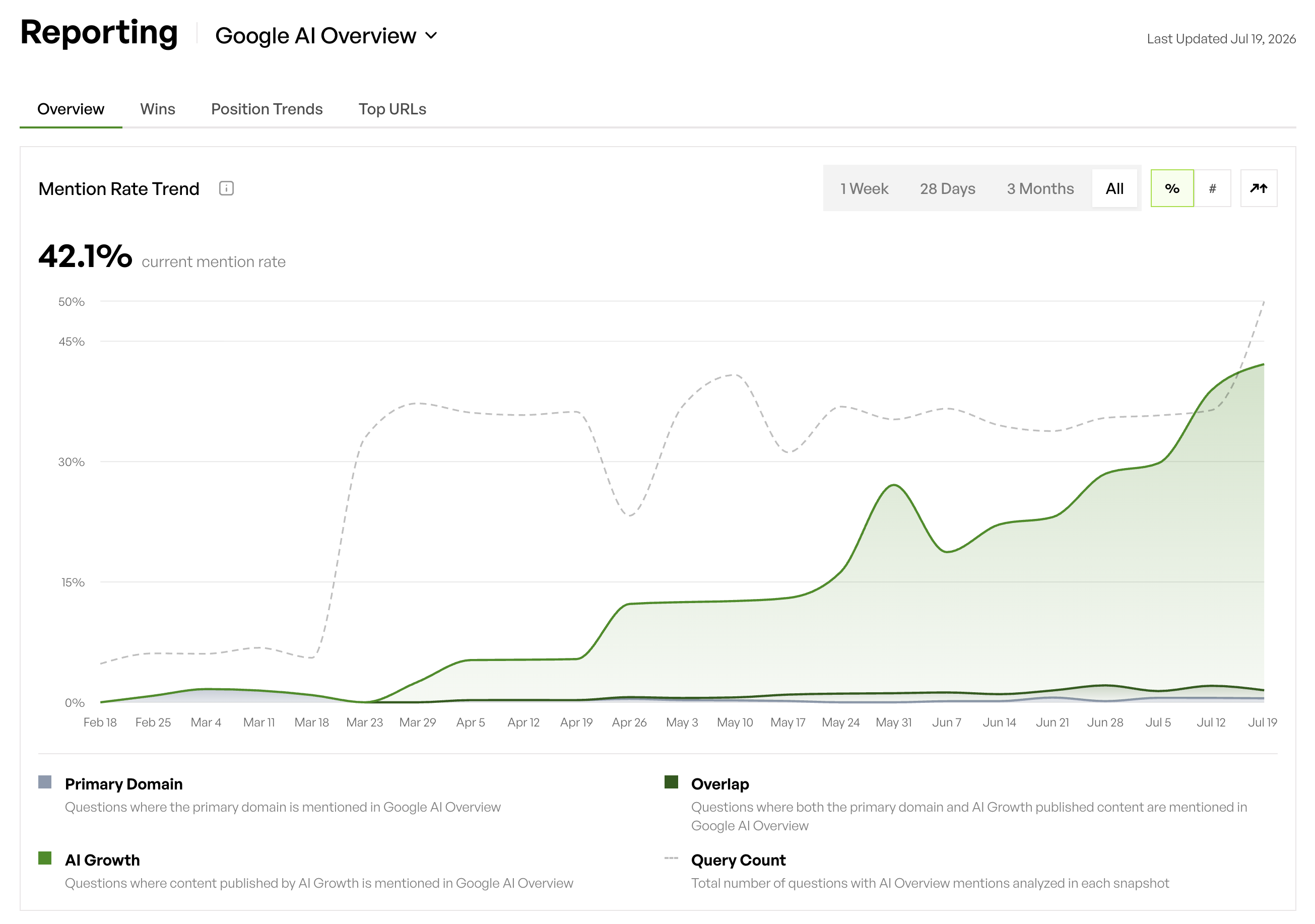
A defensible monthly report includes these elements.
- Headline AI SOV figure with the formula named explicitly
- Per-engine breakdown for ChatGPT, Gemini, Perplexity, and Claude before any roll-up
- Competitive movement showing which competitors gained or lost share and on which prompt clusters
- One prioritized recommendation tied to a specific prompt gap or content action
- A business-outcome number paired with the visibility number
The business-outcome layer separates a defensible report from a dashboard printout. AI traffic visitors convert at roughly twice the rate in one-third the number of sessions compared to traditional search traffic, which means the visibility number alone understates the value of the channel. That conversion premium is the number a client can take to a CFO. AI SOV functions as a leading indicator, while AI-attributed traffic and pipeline contribution serve as outcome metrics that justify the retainer.
Track AI-referred sessions in Google Analytics by filtering for sources containing "chatgpt," "perplexity," or "gemini." Pair that with a "how did you hear about us" field in demo and signup flows that includes an explicit AI option, because buyers who see an AI mention and later search the brand directly never appear in referral data.
Explore AI Share Of Voice Tools And Metrics
See Sample AI SOV Client Reports
How To Move From Measurement To Changing The Answer
Monitoring alone does not move the number. The architecture of the tool an agency uses determines whether the agency can change what AI says about a client or end up with a dashboard and a to-do list. The table below compares the two architectures on what they do, where they stop, and what work remains with the agency.
| Architecture | What It Does | Where It Stops | What The Agency Still Owns |
|---|---|---|---|
| Monitoring-first tools (LLM Pulse, Profound, Scrunch) | Track brand appearance for a metered set of prompts | 2026 action layers still hand work back to a human | Review, publish, maintain, and self-heal everything |
| AI Growth Agent | Maps the universe, produces content, publishes, self-heals on a site the client owns | Nothing: the engine closes the loop | The client relationship and the strategy |
LLM Pulse, Profound, and Scrunch operate as monitoring-first tools. Their 2026 action layers, such as draft agents, to-do lists, and shadow pages, validate the category but still hand execution back to a human. A rearview mirror with a to-do list taped to it remains a rearview mirror. The agency still needs to produce, publish, and maintain the content that changes what AI says.
AI Growth Agent is built the other way around. Content creation sits at the core of the business instead of serving as a monitoring add-on. The engine maps a client's full universe of seed terms and long-tail queries from real-time Google and ChatGPT data. It then produces authoritative content that validates every claim and source, stands up a fully optimized site the client owns within the first week, and reports the incremental visibility it generates week over week.
The content behaves as a living asset that updates and self-heals over time instead of going stale. This structure reaches Level 4 autonomy, where the engine creates plans, executes them, handles its own errors, and alerts a human only at a roadblock it cannot resolve.
See How AI Growth Agent Changes AI Answers
Across the first twelve weeks, clients average more than 12,000 additional AI citations and mentions, over 100,000 additional bot visits, and a 20% plus lift in impressions. Leva Sleep is now the most mentioned retailer for adjustable beds in Canada, with ChatGPT citing Leva Sleep content over 10,000 times per month and $40,000 to $50,000 in deals closed in under three weeks from buyers who found them through AI Growth Agent content. Breadless is now one of the most recommended healthy franchises in the US, with ChatGPT citing eatbreadless.com over 45,000 times per month.
How To Price And Scope The Service As A Retainer Line
The AI visibility agency category is roughly 18 months old as a named service line, with no entrenched pricing precedent the way there is for SEO, PR, or paid media retainers. This youth creates room for agencies to define the category before pricing compresses.
A productized AI SOV retainer has named deliverables, a fixed cadence, and a clear scope. The scope decisions that matter most are these.
- Number of prompts tracked, with a minimum of 50 for a defensible baseline and 100 to 200 as the sweet spot for most categories
- Number of engines covered, with ChatGPT, Gemini, Perplexity, and Claude as the standard set
- Competitor set size, typically 3 to 5 direct competitors fixed for the engagement
- Content production included or separate, which defines monitoring-only versus measurement plus content that moves the number
- Reporting cadence, such as a monthly report with weekly spot-checks on priority prompts
Adding content production on top of monitoring changes the price by 2 to 3 times. An agency that sells only monitoring sells the rearview mirror. An agency that sells measurement plus an engine that publishes and self-heals sells the steering wheel.
AI Growth Agent's model uses a flat fee with no per-article charges, credit limits, or per-prompt billing. Clients own all the content they produce. This pricing structure aligns with an engine that scales work without penalizing deeper coverage.
Discuss AI SOV Retainer Pricing
Honest Limits Of The Metric
AI SOV functions as a leading indicator rather than a revenue proof. AI share of voice is a visibility metric. It says nothing about whether being named produced a visit or a conversion, which is a separate measurement with its own losses.
Several factors can move the number without any real market change, including a prompt set edit, a competitor addition, a model update, or a change in engines tracked. A number that arrives without its methodology, including the prompt set, run count, engines, and competitor list, does not qualify as a defensible metric.
AI SOV also cannot distinguish a positive mention from a negative one. A brand mentioned 60 times across 100 prompts but framed as "expensive and complicated" in 40 of those mentions carries a visibility problem disguised as a visibility win. Pair AI SOV with sentiment tracking and recommendation rate to see the full picture.
Stronger client reporting pairs the visibility number with a business-outcome number such as AI-attributed traffic, pipeline contribution from leads who report discovering the brand through AI search, and branded search volume trends that correlate with AI SOV improvements. In a zero-click world, no one can fully attribute an AI recommendation to a sale, so the clients who measure best capture source at the conversion moment.
Learn How To Pair AI SOV With Outcomes
Frequently Asked Questions
What Is The Difference Between AI Share Of Voice And AI Visibility Percentage?
AI visibility percentage is an absolute number that shows the share of tracked prompts where a client's brand appears at all. AI share of voice is a relative number that shows the client's mentions as a share of all brand mentions across the same answers. A client can improve its visibility percentage while losing AI SOV if competitors improve faster. Both metrics are worth tracking, because they answer different questions and call for different responses when they move.
How Many Prompts Does An Agency Need To Produce A Defensible AI SOV Number?
A minimum of 50 prompts produces directional data. A set of 100 to 200 prompts is the practical sweet spot for most categories, allocated across brand prompts, category prompts, and comparison prompts. Below 50 prompts, sampling noise is too high for reliable trend detection. Each prompt should be run at least 3 to 5 times per measurement period to smooth response variability, because AI answers are probabilistic and a single run cannot distinguish a real change from noise.
How Long Does It Take To See Movement In AI Share Of Voice After Starting Optimization Work?
Timeline depends on the architecture that supports the work. Monitoring-first tools identify gaps and hand the work back to a human, so movement depends entirely on how fast the agency can produce and publish content. With AI Growth Agent, the first article is typically live within a week of kickoff, content has indexed in as little as ten days, and clients see citation movement early in the engagement. Meaningful AI SOV improvement typically shows at the 60 to 90-day mark, with stable compounding gains building over 6 to 12 months.
Can An Agency Run AI SOV As A Standalone Service Or Does It Need To Be Bundled With SEO?
Both models work for agencies. The most common go-to-market approach layers AI SOV onto an existing SEO retainer at a 20 to 30% uplift on the existing retainer value. A standalone AI SOV retainer also works well, particularly for clients who come specifically for AI search expertise. The critical distinction is whether the retainer includes only monitoring and reporting or includes the content production that actually moves the number. Monitoring-only retainers are defensible at lower price points. Retainers that include measurement plus an engine that publishes and self-heals command higher fees and produce stronger client outcomes.
What Should An Agency Do When A Client's AI SOV Drops Between Reporting Periods?
The first step is confirming that the measurement contract held, including the same prompt set, competitor set, engines, and sampling cadence. A drop that coincides with a methodology change does not qualify as a signal. A drop that persists across two weekly runs under identical conditions requires diagnosis.
The three most common root causes are a competitor gaining presence through new content or press, the client's own source coverage declining through unpublished content or dropped citations, or a model update that weighted the category differently. The fix depends on the cause. Content gaps require new content. Citation gaps require third-party coverage. Model drift requires patience and a consistent publishing cadence.
Ask AI Growth Agent To Review Your AI SOV Drop
Conclusion And Next Steps
AI share of voice for agencies has matured into a real service line. The demand is documented, and the agency and enterprise surveys cited earlier show that most buyers already plan to increase AI search investment. The category remains young, with no entrenched pricing precedent, so agencies that build a defensible methodology now shape how the market buys before it commoditizes.
The build, price, and report framework comes down to three decisions. First, design a prompt set that covers brand, category, and comparison prompts sourced from real buyer behavior instead of the client's existing keyword list. Second, lock a measurement contract with the same prompts, competitors, engines, and repeated runs so the number stays defensible month over month. Third, pair the visibility number with a business-outcome number so the client can take the report to a CFO.
A fourth decision separates agencies that only measure AI SOV from agencies that move it. Monitoring alone does not change what AI says about a client. An engine that maps, publishes, and self-heals on a site the client owns closes the loop, which is the role AI Growth Agent plays.
Practical next steps include gathering internal data on which clients already ask about AI search visibility, documenting current workflow gaps between measurement and content production, and clarifying what a defensible deliverable looks like for your client base before the next quarterly review.
Start Your AI Share Of Voice Service Line