Written by: Mariana Fonseca, Editorial Team, AI Growth Agent
AI brand authority monitoring tracks how large language models perceive, cite, and recommend your brand across a broad universe of queries, not a capped set of prompts. It differs from traditional SEO monitoring by focusing on entity recognition, citation context, and unbranded query performance. These signals then drive living content and technical fixes that establish narrative control without adding headcount.
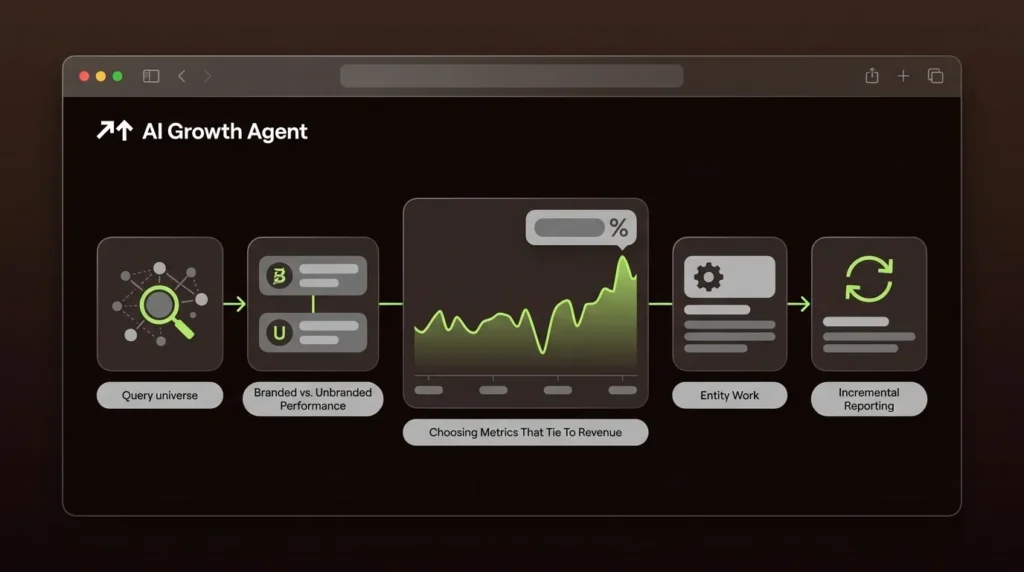
- Map the full universe of queries across branded and unbranded terms.
- Separate branded and unbranded performance to isolate true share of voice.
- Select core metrics: citation frequency, share of voice, recommendation rate, and bot traffic.
- Improve entities and produce living content against identified gaps.
- Report incremental visibility week over week and self-heal underperforming assets.
Key Takeaways From AI Brand Authority Monitoring
- AI brand authority monitoring tracks how LLMs perceive, cite, and recommend your brand across the full universe of queries, then converts those signals into living content and technical fixes that establish narrative control.
- Traditional SEO tools provide a rearview mirror of capped head terms, while AI monitoring acts as the steering wheel by mapping hundreds of seed and long-tail queries refreshed weekly and separating branded from unbranded performance.
- Core metrics, including citation frequency, share of voice, recommendation rate, and bot traffic, connect visibility data directly to business outcomes and incremental week-over-week gains.
- Entity work, living content production, and self-healing technical fixes close identified gaps faster than static publishing, with brands releasing 12+ optimized pieces per month seeing up to 200x faster AI visibility gains.
- AI Growth Agent turns monitoring insights into automated content and technical execution so your brand becomes the answer. Book a kickoff and see your first article live within a week.
Prerequisites For A Working AI Authority Program
Effective AI brand authority monitoring starts with three core inputs before any tracking begins. First, you need a brand manifesto that acts as a single source of truth defining voice, factual references, positioning, and the claims you want AI systems to associate with your brand. Second, you need a seed term list that anchors the universe map, covering the strategic topics the brand must own and the long-tail queries beneath them. Third, you need access to real-time data from both Google and ChatGPT, not cached snapshots, because citation drift reaches 40 to 60% month over month in active categories, which makes static data sets structurally unreliable.
Beyond these technical inputs, the organizational structure stays simple. On the roles side, the CMO or founder owns the strategic decisions, including which seed terms to pursue, which competitive gaps to close, and which content investments to prioritize. The execution engine then handles universe mapping, content production, technical SEO, and incremental visibility reporting. No additional headcount is required on the brand side.
Process Overview: Four Pillars That Feed One Action Loop
The monitoring-to-action workflow runs across four complementary pillars. Search Intelligence maps the traditional search landscape, including positioning, competition, and search volume. AI Analytics extends that view by tracking brand value and consumer behavior across the full journey, from external AI-tool queries through content consumption and sentiment. Bot Tracking provides the technical layer, recording every crawl, citation, and training sweep from both traditional crawlers and AI training agents. Finally, AI Ranking replaces the static ordered list with order of mention and citation context, tracked week over week as the new leaderboard.
These four pillars feed a single content and technical action loop. Monitoring data identifies gaps. Content production closes those gaps. Technical fixes ensure AI systems can read, trust, and cite the result. Incremental visibility reporting then isolates what the effort actually generated, separate from visibility the brand already held.
Step-by-Step Guide: The 5-Phase Monitoring-to-Action Workflow
Phase 1: Mapping Your Full Query Universe
Goal: Build a complete picture of every query where the brand should appear, not just the head terms it already tracks.
Most brands monitor a handful of head terms and lose the rest of the conversation by default. A mature AI brand authority monitoring program maps hundreds of seed terms and the long-tail queries beneath them, refreshed weekly. Real-time AI Overview and ChatGPT results serve as the objective function for which queries are worth pursuing. A minimum viable tracking system requires a 20 to 50 buyer-intent prompt panel rather than relying on single snapshots.
Inputs: Brand manifesto, seed terms, real-time Google and ChatGPT data. Validation: The universe map covers head terms, long-tail variants, unbranded category queries, and competitor comparison queries across the full buyer journey.
Phase 2: Separating Branded And Unbranded Performance
Goal: Isolate true share of voice from brand recognition the company already owns.
Branded query performance measures demand the brand has already earned. Unbranded query performance reveals whether AI systems associate the brand with the category when no brand name appears in the prompt. Answer Inclusion Rate, the percentage of tracked unbranded queries where a brand is cited in the primary summary, is a key 2026 visibility-first KPI for measuring influence in AI Overviews. Separating the two views prevents brands from taking credit for visibility they already had and obscuring the gaps that actually need closing.
Inputs: Universe map segmented by branded and unbranded query clusters. Validation: Branded and unbranded citation rates are reported separately, with unbranded Answer Inclusion Rate tracked as a leading indicator of category authority.
Phase 3: Choosing Metrics That Tie To Revenue
Goal: Establish a metrics framework that connects monitoring data to business outcomes.
The core metrics for AI brand authority monitoring are citation frequency, share of voice, recommendation rate, citation context, and bot traffic. Citation rate measures the percentage of relevant queries where AI platforms mention a brand, calculated by dividing brand mentions by total opportunities across a defined query set. AI Share of Voice is the percentage of AI-generated answers that mention, cite, or recommend a brand across a defined set of category prompts, measured relative to all brand mentions in those answers. A single formula must be selected and disclosed, because a brand can score 20% on mention-based share of voice, 16.8% on position-weighted share of voice, and 31.4% on citation-based share of voice using identical underlying data.
Ready to move from metrics to action? Book a kickoff with AI Growth Agent and see your first optimized article live within a week.
Phase 4: Entity Work And Living Content Execution
Goal: Close the gaps identified in monitoring by improving entity signals and producing authoritative content against high-value unbranded queries.
Once the metrics framework reveals where citation frequency is low or share of voice lags competitors, the next step is closing those gaps through entity work and content production. Entity optimization is the foundational workstream that determines whether AI systems correctly identify and categorize a brand. The four building blocks are entity definition, semantic relationships, structured data, and third-party corroboration. Sites with over 32,000 referring domains are 3.5x more likely to be cited by ChatGPT than those with fewer than 200.
Content production follows the entity audit, and volume matters. The 200x visibility advantage mentioned earlier comes from sustained publishing cadence, not one-off content drops. Volume alone does not suffice, because content must be living, updated and self-healed over time so the brand’s presence does not decay as the world changes. This freshness requirement reflects AI system behavior, since 65% of AI bot hits target content published within the past year.
Inputs: Entity audit results, gap analysis from Phases 1 to 3, content topology mapped to high-value unbranded queries. Validation: Entity consistency confirmed across owned and third-party properties, with new content indexed and appearing in bot tracking within two weeks of publication.
Phase 5: Incremental Reporting And Self-Healing Content
Goal: Prove what the monitoring-to-action workflow actually generated, separate from pre-existing brand visibility, and close the loop on underperforming assets.
Incremental visibility reporting publishes into a separate environment so the engine takes credit only for the visibility it generates. Bot analytics track every bot that touches the content, including the bot ChatGPT uses to cite sources. Google Search Console provides an independent audit. Week-over-week reporting shows where new content is indexing, where it is driving new citations, and where it overlaps with existing brand visibility.
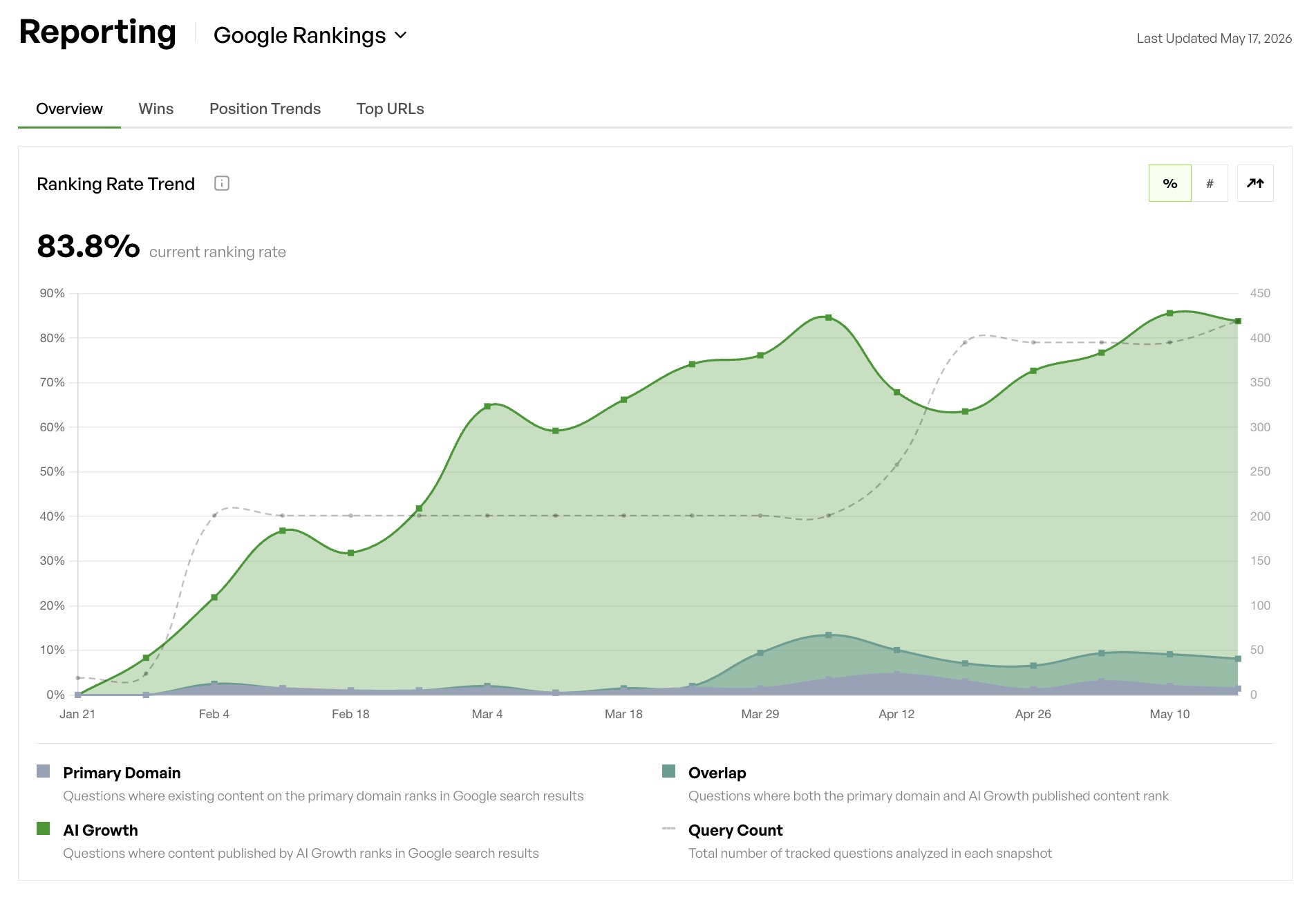
Self-healing closes the loop by reacting to performance signals. When Google Search Console data or bot-traffic patterns indicate an article is underperforming, the content refreshes automatically. Internal linking lifts assets that are not yet indexing at their target position. OtterlyAI’s analysis of over one million AI citations found that FAQ schema markup produces a 350% citation increase versus unstructured content, which illustrates how targeted technical fixes convert monitoring data into measurable citation gains.
Common Mistakes And How To Fix Them
The most common failure in LLM brand monitoring is capped prompt sets. Monitoring tools that track a fixed handful of prompts show only the slice of the market a brand already thought to ask about. The long tail, where AI agents actually reason and where most buying decisions are shaped, remains invisible. The fix is a full-universe approach that uses hundreds of seed terms and the long-tail queries beneath them, refreshed weekly rather than queried once.
Stale data is the second structural problem. Only 11% of domains cited by ChatGPT overlap with those cited by Perplexity, meaning each major engine functions as a separate game with distinct sourcing patterns. As noted earlier, citation patterns shift dramatically week to week in active categories, which means a monthly snapshot misses competitive displacement as it happens. Weekly refreshed snapshots, with per-article bot tracking that records every crawl and citation, form the minimum viable cadence for brands operating in active categories.
Limited visibility across engines is the third failure mode. Key AI platforms brands should monitor include Google AI Overviews, Gemini, ChatGPT, Perplexity, and Claude, with Google AI Overviews, ChatGPT, and Perplexity forming the core tier. Monitoring only one engine produces a systematically incomplete picture of brand authority.
Verifying Outcomes With Concrete Metrics
The metrics table below covers the core outcomes to verify after implementing the five-phase workflow. All formulas and benchmarks are drawn from cited sources.
| Metric | Formula | Benchmark | Source |
|---|---|---|---|
| Citation Frequency | Brand mentions ÷ Total query opportunities × 100 | Top-performing brands achieve 35-50%+ citation rates for core queries | UnrealSEO |
| AI Share of Voice | Responses mentioning brand ÷ Total responses analyzed × 100 | Below 10% indicates low AI visibility; 40%+ indicates category leadership on AI Share of Voice | Surva.ai |
| Answer Inclusion Rate (Unbranded) | Unbranded queries with brand citation ÷ Total unbranded queries tracked × 100 | Listed as a key 2026 visibility-first KPI | Yotpo |
| Bot Traffic (AI Training Agents) | Per-article bot visits tracked by engine type, week over week | AI Growth Agent clients average 100,000+ bot visits in first 12 weeks | AI Growth Agent |
Recommendation rate is tracked separately by issuing unbranded queries such as “best [category] solution for [use case]” across ChatGPT, Perplexity, and Google AI Mode and measuring how often the brand is prioritized in the response. Visitors from AI search platforms generated 12.1% of signups despite accounting for only 0.5% of overall traffic, which means the business case for citation rate improvement is measurable at the conversion level, not just the visibility level.
Advanced Scenarios For Scaling AI Visibility
Scaling AI visibility monitoring beyond a pilot requires systematic expansion of the query universe. Mature programs reach universes of 1,600 or more queries, with the system running 3,000 or more searches every week to refresh the snapshot. At that scale, the content topology becomes a strategic map of where to win, because it shows a hierarchy of seed terms, each backed by real-time data, with dozens of long-tail queries beneath it.
Multi-engine coverage is the second scaling requirement and directly affects where citations come from. Brand-owned websites generate single-digit citation rates for Gemini and other AI models, with earned and third-party sources accounting for 82-94% of citations. A brand that optimizes for one engine while ignoring the others leaves a significant share of AI-influenced discovery unaddressed. Multi-engine coverage requires engine-specific content strategies, per-engine citation tracking, and agentic technical SEO that exposes the brand to agent crawlers across all major platforms.
Tools Comparison: Monitoring-Only vs Full Execution Engines
Monitoring-only tools function as rearview mirrors and stop at visibility reporting. They tell a brand whether it appeared for a capped set of prompts and then hand off the work. The brand must still produce and publish the content that would close the gap, with no system to do it at scale. LLM-referred visitors convert at 4.4x the rate of traditional organic search visitors, which means the cost of a monitoring gap shows up in pipeline, not just impressions.
The complete engine connects all four pillars into one workflow. Search Intelligence covers the traditional search landscape. AI Analytics tracks brand value and consumer behavior across the full journey. Bot Tracking records every crawl and citation from AI training agents. AI Ranking tracks order of mention and citation context week over week. No monitoring-only solution connects these four pillars to content production, technical fixes, and incremental visibility reporting in a single system. As a result, brands using monitoring-only tools see the problem clearly and remain unable to act on it without assembling a separate stack of agencies, content tools, and engineers.
Stop monitoring gaps you cannot close. AI Growth Agent connects visibility data directly to content execution, so book a kickoff and see your first article live within a week.
Frequently Asked Questions
What is entity optimization and why does it matter for AI brand authority monitoring?
Entity optimization is the process of ensuring AI systems correctly identify, categorize, and describe a brand across every surface where they gather information. Large language models do not rank keywords, because they map entities such as named organizations, products, people, and the relationships between them. If a brand’s entity definition is inconsistent across its own website, third-party directories, schema markup, and earned media, AI systems may ignore it, describe it inaccurately, or allow a competitor with a clearer identity to displace it in generated answers. Entity optimization begins with an audit of how the brand is described across owned properties, earned properties, and online data sources. The gaps then close through consistent schema markup, corrected third-party profiles, and content that reinforces the brand’s association with the right topics and categories. This work continues over time, because AI systems continuously update their understanding as new information appears.
Why does unbranded query performance matter more than branded query performance for AI visibility?
Unbranded query performance creates new demand, while branded query performance measures demand the brand has already earned. A customer who types the brand name into ChatGPT already knows the brand exists. Unbranded query performance is where AI brand authority monitoring creates new value, because it reveals whether AI systems associate the brand with the category when no brand name is mentioned. Most buying decisions in AI search begin with an unbranded question such as “what is the best solution for X” or “which company should I use for Y.” A brand that appears only in branded queries stays invisible to the majority of AI-influenced discovery. Answer Inclusion Rate, the percentage of tracked unbranded queries where a brand is cited in the primary summary, acts as the leading indicator of whether a brand is training AI systems to recommend it unprompted. Separating branded and unbranded performance in reporting prevents brands from crediting existing awareness for gaps that require new content and entity work to close.
What is living content and how does it prevent AI citation decay?
Living content is content that updates and self-heals over time rather than going stale the day it ships. AI systems prioritize freshness, and the majority of AI bot hits target content published within the past year. Content that is not refreshed loses citation share as competitors publish newer, more accurate assets. Living content addresses this through automatic updates triggered by Google Search Console signals and bot-traffic data, annual refreshes across entire content sectors, and internal linking adjustments that lift underperforming assets. The practical result is that brand authority compounds instead of decaying. A brand with 500 living articles that update automatically holds a structural advantage over a brand with 500 static articles that go stale, because AI systems continuously re-evaluate what to cite based on freshness, accuracy, and authority signals. Living content converts a one-time monitoring-to-action workflow into a durable, self-reinforcing narrative control system.
How do I measure whether AI brand authority monitoring is actually driving business outcomes?
Business impact shows up when you connect citation rate and share of voice to downstream conversion signals. AI-referred sessions in Google Analytics, captured under referral traffic from platforms like perplexity.ai, provide a trackable link between citation volume and website visits. Branded search volume in Google Search Console acts as a lagging indicator, because branded search typically rises after AI visibility increases and more customers encounter the brand in AI answers. At the conversion level, adding a “How did you first hear about us?” field to CRM intake with AI assistants as an option tracks influenced pipeline dollars and average deal size for AI-influenced opportunities. Incremental visibility reporting, which isolates the visibility a new content effort actually generated separate from pre-existing brand visibility, provides the cleanest proof that the monitoring-to-action workflow is working rather than simply riding existing brand equity.
Brands that want this measurement loop running quickly can shortcut the build. Book a kickoff with AI Growth Agent and see your first article live within a week.
Conclusion: Establishing Narrative Control Now
The leaderboard for AI brand authority is being written in 2026. 51% of B2B software buyers now start their research with an AI chatbot more often than Google, and the brands that appear in those answers are training the next generation of models with their own narrative. Brands that wait are training the next generation with whatever happens to be sitting on the open web.
AI brand authority monitoring functions as the first step in a repeatable system, not a static report. The workflow maps the full universe, separates branded from unbranded performance, selects the metrics that connect visibility to pipeline, improves entities and produces living content against identified gaps, and reports incremental visibility week over week. Every phase of that system produces an action, not just a number, so the monitoring data becomes the steering wheel rather than the rearview mirror.
Brands that implement this workflow now establish the citation patterns, entity associations, and content authority that AI systems will draw on for years. The window to set that foundation before competitors do is open today and closing fast. Book a kickoff with AI Growth Agent and see your first article live within a week.