Written by: Mariana Fonseca, Editorial Team, AI Growth Agent
Key Takeaways for AI Citation Growth
- Enterprise citation rates remain low. The median blended rate is 11.4 percent for 500-plus-employee companies and 6.2 percent for mid-market firms. Most buyer-intent prompts still surface competitor sources instead of your brand.
- AI engines favor earned media, which accounts for 84 percent of citations, while cross-engine overlap stays minimal. Only 11 percent of domains earn citations from both ChatGPT and Perplexity.
- Content freshness drives visibility. Pages updated within the last 30 days receive 3.2× more ChatGPT citations than older content, and the median AI citation has a 4.5-week half-life.
- Traditional monitoring tools only report gaps. They do not create the authoritative, structured, self-healing content required to close those gaps at scale.
- AI Growth Agent maps the full query universe, produces authoritative content, and keeps it current automatically. See how it publishes your first live article within a week.
Why Citation Rates Now Define Brand Visibility
Google AI Mode crossed one billion monthly users within its first year, and queries more than doubled every quarter since launch. Forrester’s State of Business Buying 2026 report found that 94 percent of business buyers use AI during their research process but systematically validate AI outputs against trusted sources such as peers, analysts, and earned coverage. Google AI Mode runs at a 93 percent zero-click rate, which means the AI answer is the final stop for most queries.
Brands that fail to earn citations in that environment do not merely miss traffic. They train the next generation of models with competitor narratives. Low citation rates directly reduce brand visibility, complicate budget justification, and weaken competitive positioning in a zero-click environment where the answer functions as the product.
Core Concepts for Measuring AI Citations
Four terms structure every benchmark in this report.
- Citation rate measures the share of prompts that surface a domain as a cited source. Attrifast’s 2026 cohort study measured citation rate as the share of buyer-intent prompts where a domain appears as a citation across ChatGPT Search, Claude, Gemini, and Perplexity.
- Citation context records order of mention, grouped entities, and the specific claim supported. Presenc AI’s 2026 data shows that ChatGPT Search citation position-based click-through rates decline with position.
- Overlap tracks how few domains earn citations across multiple engines. Only 11 percent of domains earn citations from both ChatGPT and Perplexity.
- Authority signals include domain rating, content recency, FAQ schema, inline primary sources, and earned media placements. E-E-A-T signals correlated with AI citation probability at r=0.81, explaining 65.6 percent of variance, far higher than Domain Authority’s 3.2 percent.
2026 Benchmarks: Citation Rates by Headcount Band
The table below draws on Attrifast’s 2026 cohort study of 200 sites, which found that headcount is the single largest determinant of blended AI citation rate. Engine variation measures the ratio between the highest-citing engine (Perplexity) and the lowest (Gemini) within each band. Citation rates more than triple as companies scale from mid-market to enterprise, yet even the largest brands capture fewer than one in five relevant queries, leaving most buyer-intent prompts unanswered.
| Headcount Band | Median Blended Citation Rate | p75 Rate | Engine Variation (Perplexity vs. Gemini) |
|---|---|---|---|
| 0-10 | 1.4% | 3.8% | 3.8x |
| 10-50 | 3.4% | 7.1% | 3.2x |
| 50-500 | 6.2% | 14.0% | 2.6x |
| 500+ | 11.4% | 21.3% | 2.3x |
The engine variation column carries a strategic implication. Perplexity tends to be the easiest engine for citations at every size band while Gemini is the hardest.
Several additional data points sharpen what this table means in practice.
- Pages ranking number one in Google tend to earn higher ChatGPT citation rates than pages that rank lower.
- 44.2 percent of ChatGPT citations come from the first 30 percent of a page.
- DR70-plus generalist sites carry under 3 percent of LLM citations on treatment center queries.
- Content updated within the last 30 days receives 3.2× more ChatGPT citations than content older than 90 days or a year.
These citation patterns reveal a deeper structural issue: the sources AI engines prefer and how rarely those sources overlap across platforms.
Source Authority Patterns and Cross-Engine Overlap
Muck Rack’s May 2026 What Is AI Reading? report, analyzing more than 25 million links across ChatGPT, Claude, and Gemini, found that earned media accounted for 84 percent of all AI citations, with journalism alone representing 27 percent and paid or advertorial content at 0.3 percent. That ratio has held stable across three editions of the report spanning July 2025 through May 2026.
Cross-engine overlap compounds the challenge. Qwairy’s June 2026 study found that cross-engine citation overlap on the same question runs 4 percent to 19 percent. BrightEdge’s 2026 AI Catalyst analysis found that source overlap between AI engines ranges from 16 to 59 percent.
The practical consequence is clear. A brand that earns citations on one engine has no guarantee of visibility on another. Temso AI’s analysis of 2 million citations found that 71 percent of sources cited by AI engines are exclusive to a single model. Monitoring a capped set of prompts on one platform produces a systematically incomplete picture of where a brand stands.
Why Enterprise Brands Still Lag in AI Answers
Three structural causes explain the gap.
- Monitoring without production. GEO and AI search monitoring tools track whether a brand appears for a capped set of prompts. They report absence without producing the content that earns citations. With nearly three-quarters of B2B buyers now using AI during research (as noted earlier), most enterprise marketing stacks still lack any mechanism to act on that behavior at scale.
- Stale content. The median AI citation has a half-life of roughly 4.5 weeks, ranging from about 3.4 weeks on ChatGPT to 5.8 weeks on Perplexity. Content published once and left unchanged loses citation potential rapidly. Each year of age can cut retrieval visibility by roughly 40 to 60 percent, even if the page still ranks in classic Google search.
- Incomplete universe coverage. Many prompts trigger two or more fan-out queries generated by ChatGPT, expanding 15,000 prompts into 43,233 total searches in the AirOps March 2026 study. Brands that track a handful of head terms stay invisible to the long-tail queries that constitute most of the actual conversation.
The Four-Action Earned-Media Framework
The benchmark data points to a repeatable framework built on four actions.
- Map the full query universe. 32.9 percent of all cited pages in the AirOps dataset appeared in fan-out results only, meaning they were never the direct answer to the original prompt. A brand that tracks only head terms misses the majority of citation opportunities. The universe must include seed terms and every long-tail query beneath them, refreshed weekly against real-time Google and ChatGPT data.
- Produce authoritative, structured content. Pages with FAQ schema can receive more citations in ChatGPT than equivalent unstructured prose. Pages containing original data points are more likely to be cited in AI Overviews. Content needs to be long-form, written by named authors, and supported by inline primary sources.
- Earn third-party placements. Earned media distribution produces a median 239% lift in AI citations compared to publication on a brand’s own website. Press placements, industry publications, and community discussion threads sit at the center of an AI search strategy. They function as the primary citation source.
- Self-heal content continuously. A systematic 6-month content refresh cycle outperforms net-new content creation for both traditional search and AI search visibility in 2026. Content that updates automatically in response to indexing signals and bot-traffic data compounds authority instead of decaying.
The framework requires all four actions running simultaneously because each one covers a different failure point. Mapping the universe without production exposes gaps without filling them. Producing content without earned media limits reach to your own domain. Earning placements without structured, self-healing pages wastes authority on decaying assets. Monitoring tools deliver none of these actions, and traditional agencies deliver them too slowly and at too small a scale to cover the full query universe.
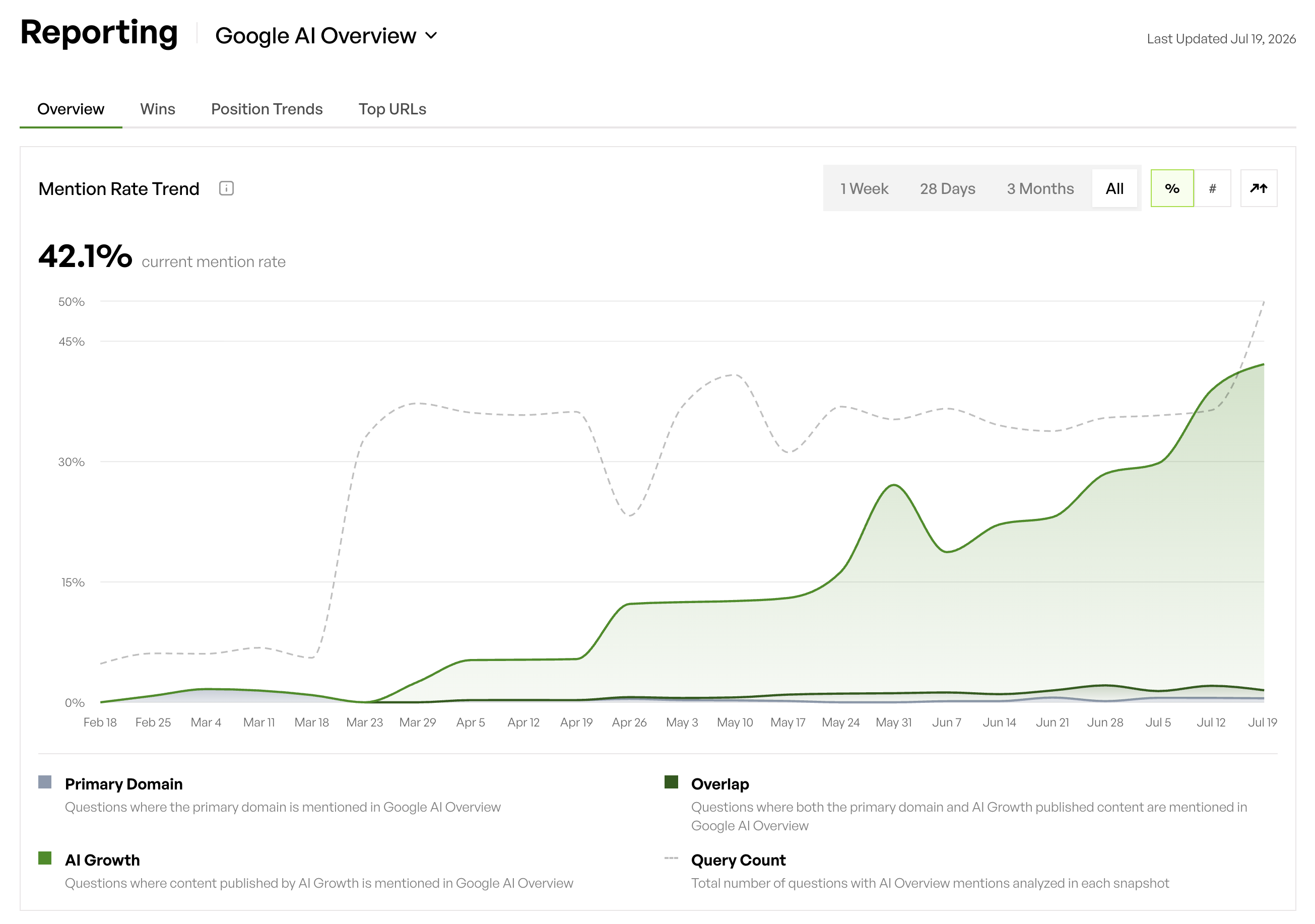
AI Growth Agent is the single autonomous engine that executes all four. It maps the full universe from real-time Google and ChatGPT data, produces authoritative content that validates every claim and source, publishes with full traditional and agentic technical SEO, and self-heals content over time. This integrated approach delivers measurable results within the first twelve weeks. Clients average more than 12,000 additional AI citations and mentions, over 100,000 additional bot visits, and a 20-plus percent lift in impressions. Those aggregate numbers translate to real business outcomes. Breadless, a healthy fast-casual franchise, now sees ChatGPT cite eatbreadless.com over 45,000 times per month, while Leva Sleep closed $40,000 to $50,000 in deals in under three weeks from buyers who found them through AI Growth Agent content.
Frequently Asked Questions
What is a good enterprise citation rate benchmark in 2026?
The median blended citation rate for enterprises with 500 or more employees is 11.4 percent across ChatGPT, Perplexity, Gemini, and Google AI surfaces, with the 75th percentile reaching 21.3 percent. Mid-market companies in the 50-to-500 headcount band sit at a median of 6.2 percent, with the top decile reaching 14.0 percent. These figures represent the share of buyer-intent prompts in which a domain appears as a cited source. A brand at or below the median for its size band stays invisible in the majority of AI-generated answers relevant to its market. The practical target for a competitive enterprise brand is to reach the 75th percentile within its headcount band, which requires covering the full query universe rather than a capped set of tracked prompts.
Why do citation rates vary so much across ChatGPT, Perplexity, and Gemini?
Each AI engine maintains a distinct source preference pattern that holds across intent categories and time periods. Perplexity applies a documented recency boost and leans heavily on editorial and social sources, which makes it easier to earn citations. Gemini is often the hardest. Cross-engine citation overlap is low. Only a small share of domains earn citations from multiple engines, and Temso AI’s analysis of 2 million citations found that 71 percent of sources cited by AI engines are exclusive to a single model. A brand that focuses on one engine has no guarantee of visibility on another. The only reliable approach is to produce authoritative, structured content across the full query universe so that each engine’s retrieval logic finds something worth citing regardless of its source preferences.
How much does content recency affect AI citation rates?
Content recency functions as a first-class ranking signal for AI engines. Content updated within the last 30 days receives 3.2× more ChatGPT citations than content older than 90 days or a year. The median AI citation has a half-life of roughly 4.5 weeks, ranging from about 3.4 weeks on ChatGPT to 5.8 weeks on Perplexity. Each year of age can cut retrieval visibility by roughly 40 to 60 percent, even if the page still ranks in classic Google search. A quarterly refresh cycle outperforms an annual refresh by roughly 42 percent in AI citation retention. Living, self-healing content therefore becomes a structural requirement for maintaining citation rates over time. Brands that publish once and leave content static will see their citation rates decay within weeks of publication.
Why do monitoring tools fail to close the citation gap?
Monitoring tools track whether a brand appears for a capped set of prompts and report absence. They do not produce content, own publishing, or act on the data. The gap between observation and execution forms the core problem. Many prompts trigger two or more fan-out queries generated by ChatGPT, expanding 15,000 prompts into 43,233 total searches in the AirOps March 2026 study. A brand that monitors 100 prompts stays blind to the thousands of long-tail queries that constitute most of the conversation in its market. Monitoring tools also cannot address the structural causes of low citation rates: stale content, missing earned media placements, incomplete schema, and the absence of living content that self-heals as the world changes. They function as a rearview mirror. Closing the citation gap requires an engine that maps the full universe, produces authoritative content, and keeps that content updated continuously.
Can mid-market brands compete with enterprise brands on AI citation rates?
Mid-market brands can outperform larger enterprise competitors on specific queries when they produce original research, named-author content supported by inline primary sources, and recently updated structured pages. AI citation behavior rewards epistemic contribution more than link equity alone. Within each authority tier, content originality and depth are stronger predictors of AI citation than domain authority, which allows some mid-authority sources to outperform larger competitors on targeted queries. The practical implication is that a mid-market brand covering its full query universe with authoritative, self-healing content can reach the 75th percentile of its headcount band and compete directly with enterprise brands on the long-tail queries that constitute most buyer-intent AI searches. The constraint is scale. Producing and maintaining that content across hundreds of seed terms and thousands of long-tail queries requires an autonomous engine, not a content team or a monitoring tool.