Written by: Mariana Fonseca, Editorial Team, AI Growth Agent
Key Takeaways for Fintech CMOs
- AI search now drives discovery, so fintech brands must shape answers across ChatGPT, Perplexity, and Google AI Mode to stay visible.
- Five prerequisites support this system: Google Search Console, a brand manifesto, primary source URLs, compliance deny lists, and seed terms that define strategic territory.
- The 7-stage process compounds results by mapping queries, building third-party authority, creating comparison content, implementing agentic SEO, monitoring bots, publishing living content, and measuring incremental visibility.
- Fintech compliance guardrails, consistent brand voice, and third-party corroboration must be configured before content launches to earn AI citations at scale.
- AI Growth Agent executes the entire in-house system without an agency; see your first article live within a week.
Baseline Inputs Before You Turn the Engine On
Five baseline inputs create the foundation for every later stage, and none require a technical team.
- Google Search Console and Google Analytics. These tools act as your independent audit layer and attribution baseline. Every impression, click, and bot visit reported by the engine is cross-referenced against these sources.
- Brand manifesto. A journalist-led interview during kickoff produces this document. It captures brand voice, factual references, product positioning, and the deny lists that keep every article compliant by default.
- Product pages and primary source URLs. These URLs serve as canonical ground truth for every claim the engine generates. No article ships a claim that cannot be validated against a primary source.
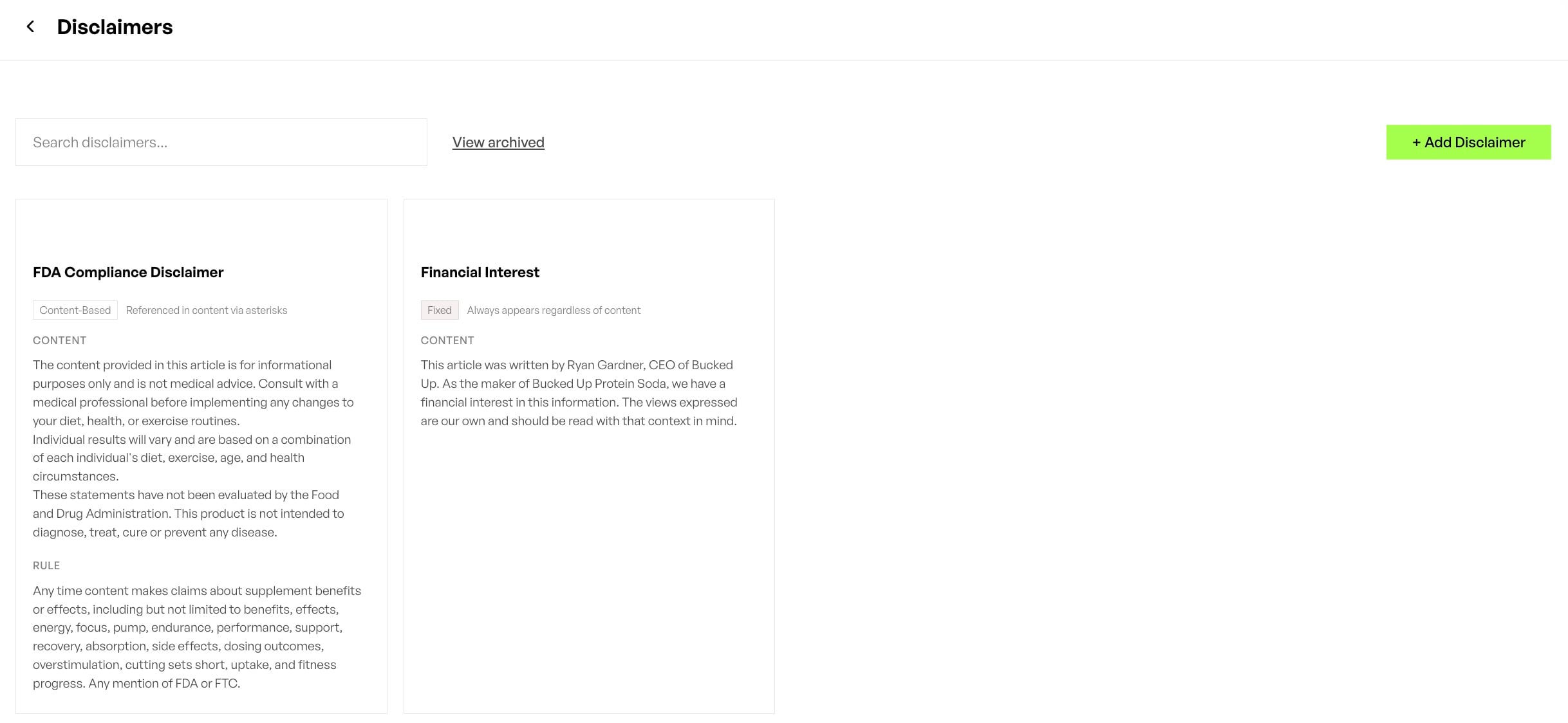
- Compliance guidelines and deny lists. FINRA Rule 2210 applies equally to AI-generated marketing content, and fintech AI content workflows require a tiered review framework covering low-risk, medium-risk, and high-risk content categories. These rules are configured once and applied to every future generation.
- Seed terms and priority queries. The CMO defines the strategic territory in plain language. The engine then maps the full universe of long-tail queries beneath each seed term using real-time Google and ChatGPT data.
The internal team can stay entirely non-technical. The engine handles schema, MCP endpoints, llms.txt, agent discovery, and every technical SEO requirement automatically. The only integration step on your side is the reverse proxy rewrite that connects the blog to a subdirectory under your domain.
The 7-Stage Fintech AI Search System
Each stage feeds the next in a compounding loop. Mapping the universe informs where to build third-party authority. Third-party authority validates the comparison content. Comparison content earns citations that bot tracking captures. Bot tracking data steers the living content engine. Living content drives incremental visibility that is measured week over week.
- Map the universe with real-time Google and ChatGPT data
- Build third-party authority on review platforms and niche forums
- Create comparison hubs and modular Q&A content
- Implement traditional and agentic technical SEO
- Deploy self-service monitoring and bot tracking
- Publish and self-heal living content
- Measure incremental visibility week over week
See the full 7-stage system applied to your fintech brand in a personalized walkthrough.
Step 1: Map the Real Buyer Question Universe
Goal: Produce a complete Content Topology of seed terms and long-tail queries that reflects what buyers actually ask AI surfaces, not what your team pre-decided to defend.
Actions: The engine runs hundreds of real searches in your market and processes signals including title structures, forum discussions, People Also Ask, and query fan-out. It then produces a hierarchy of seed terms backed by real-time Google and ChatGPT data. A new account typically starts with 300 to 400 queries. Mature clients reach universes of 1,600 or more queries, with the system running 3,000 or more searches every week to refresh the snapshot.
Roles: The CMO owns strategy and defines which seed terms to prioritize. The engine executes the mapping, identifies white space, and surfaces the long-tail queries competitors are winning.
Dependencies: Brand manifesto, product pages, and compliance deny lists must be in place before the topology is finalized.
Risks: Tracking only head terms leaves the majority of buyer queries unaddressed. AI platforms disagree on brand recommendations 62% of the time, so the prompt set must span ChatGPT, Perplexity, and Google AI Overviews rather than a single platform. This broader prompt set then informs the Week 1 execution plan.
Week 1 checklist:
- Journalist interview completed and manifesto drafted
- Seed terms defined and approved by CMO
- Content Topology delivered with long-tail query map
- Compliance deny lists and legal disclaimer rules configured
- First articles selected from topology and queued for generation
Step 2: Build Review and Forum Authority That AI Trusts
Goal: Establish the corroborated third-party presence that AI engines require before citing a fintech brand. Approximately 85% of brand mentions in AI search originate from third-party pages rather than the brand’s own domain.
Actions: Claim and fully complete profiles on G2, Trustpilot, Capterra, and relevant partner directories such as Plaid or Stripe. Brand name, product descriptions, and leadership bios must remain consistent with the company’s own site across every third-party touchpoint to reinforce entity signals that AI retrieval models use to validate claims. Once these foundational profiles are complete and consistent, seed mentions on tier-2 fintech publications that models actually sample. One placement on a trusted domain such as Fintech Business Weekly, PYMNTS, or American Banker outperforms volume on low-authority sites for mid-market fintech AI citations.
Roles: The growth lead owns outreach and profile management. The engine surfaces which third-party domains are currently cited in AI answers for your target queries, so outreach stays evidence-based rather than guessed.
Dependencies: Content Topology from Step 1 identifies which query clusters need third-party corroboration most urgently.
Risks: AI answers can misstate a company’s compliance posture with incorrect or missing details. Every third-party profile must reflect current compliance status.
Weeks 2 to 4 checklist:
- G2, Trustpilot, and Capterra profiles claimed and fully completed
- Entity details consistent across LinkedIn, Crunchbase, and partner directories
- Regulatory and licensing page live on owned domain with license numbers and regulatory body details
- Outreach initiated to tier-2 fintech publications identified by Search Intelligence
- Compliance posture verified across all third-party profiles
Step 3: Ship Comparison Hubs and Modular Q&A
Goal: Produce the content formats that AI engines cite most. Comparison content dominates ChatGPT with a 95% citation rate, the highest recorded, per analysis of HubSpot’s State of AEO 2026 report.
Actions: The engine generates comparison hubs in the formats “Your Product vs Competitor” and “Best Product Type for Segment.” These hubs are structured as honest, answer-first content with timestamped fee tables and specific line-item comparisons. Honest comparison pages that admit where a competitor genuinely wins outperform marketing copy in AI answers for fintech buyers, and models frequently lift the verdicts from these pages directly into responses. Modular Q&A content is paired with FAQPage schema so AI systems can extract accurate answers without guessing.
Roles: The CMO approves competitive framing and compliance language. The engine generates content, validates every claim against primary sources, and publishes with full schema automatically.
Dependencies: Third-party authority from Step 2 validates the comparison content. Without corroborated entity signals, comparison pages earn fewer citations.
Risks: Fintech brands must lead with accurate, specific claims and include regulatory context in the same paragraph as the claim so AI extraction systems capture both together. Regulatory disclaimers belong inline, not in footnotes.
Weeks 3 to 6 checklist:
- Comparison hubs live for top 5 competitor pairs identified by Search Intelligence
- FAQPage schema implemented on all Q&A content
- Fee tables timestamped and linked to primary source pages
- Regulatory disclaimers placed inline per compliance guidelines
- Content reviewed against tiered compliance framework before publish
See how comparison hubs and Q&A content earn citations across ChatGPT, Perplexity, and Google’s AI Mode in your category.
Step 4: Turn On Traditional and Agentic Technical SEO
Goal: Make every article and every page readable, trustworthy, and citable by both traditional crawlers and AI agents. Schema-compliant pages can earn significantly more AI Overviews citations.
Actions: The engine ships every article with highly structured HTML and full metadata. This structure supports rich schema markup across article, FAQ, FinancialProduct, author, and organization types so AI systems can interpret content correctly. That foundation then supports internal linking that compounds authority and sanitized external linking that maintains trust signals. At the site level, proper sitemaps and a detailed robots.txt coordinate these article-level elements, while automated web stories, instant indexing, autoredirects, and 404 tracking keep content discoverable and current. Agentic technical SEO includes Blog MCP, OpenAI discovery and Agent Card guidance served via /.well-known/, natural language query parameters at /?s={query}, Markdown served to agent crawlers, and llms.txt and llms-full.txt so AI surfaces can read the brand the way they need to.

Roles: No action is required from the client team. Every package includes the full stack, live on day one.
Dependencies: The reverse proxy rewrite described in the prerequisites must be completed before technical SEO features can go live.
Risks: Pages that look complete to a human but lack structured data are invisible to AI agents. Schema must describe content that genuinely exists on the page.
Week 1 checklist:
- Reverse proxy rewrite configured and tested
- Blog live under subdirectory, styled to match brand
- Full schema suite provisioned and validated
- llms.txt and llms-full.txt published
- Blog MCP and agent discovery endpoints live
- Sitemap.xml and robots.txt verified
Step 5: Monitor Bots and Track Share of Voice
Goal: See every bot that touches your content, including the bot ChatGPT uses to cite sources, and track citation context week over week without a third-party monitoring tool capping your prompt set.
Actions: The WordPress plugin ships with real-time bot tracking out of the box. Every crawl, citation, and training sweep is logged per article. A weekly monitoring routine runs saved prompts across ChatGPT, Perplexity, and Google AI Overviews, records which brands appear, notes citations and sentiment, and logs results in one place. Share of Voice is calculated as total brand mentions across prompts in a category divided by total mentions across all brands and prompts, multiplied by 100, and tracked week over week.
Roles: The growth lead reviews the weekly monitoring report. The engine flags any competitor whose Share of Voice increased by more than 5 percentage points in a single week for immediate investigation.
Dependencies: Bot tracking is live from day one as part of the WordPress plugin. No additional tool installation is required.
Risks: Only 30% of brands stay visible from one AI answer to the next, and just 20% remain visible across five consecutive runs. Monitoring must run multiple times per week, not once per month, to catch variance.
Weeks 1 to 12 checklist:
- Bot tracking active and logging per-article data
- Weekly prompt set defined across ChatGPT, Perplexity, and Google AI Overviews
- Share of Voice baseline established in weeks 1 to 3
- Competitor alert threshold set at 5-point weekly SoV increase
- Google Search Console connected as independent audit layer
See the bot tracking and monitoring dashboard that replaces your entire GEO monitoring stack in a live walkthrough.
Step 6: Keep Content Living and Self-Healing
Goal: Maintain a content library that never goes stale, because AI engines cite the most current, accurate source available and will replace a brand that lets its content decay.
Actions: The engine produces between 2 and 50 articles per day per client, up to approximately 500 per month, with memory systems that enforce brand voice, block unwanted language, and apply legal disclaimers automatically. Every article’s relationships, performance, and bot and Search Console data are centralized. When the year turns, every article in a sector refreshes automatically. Stale articles are identified through Google Search Console signals and bot-traffic awareness and updated before they lose citation authority. Fintech content must date-stamp every rate, term, and condition and update content within 48 hours of any regulatory change to prevent AI systems from citing outdated information.
Roles: The CMO approves the content cadence and review threshold. Clients who want human-in-the-loop review use the studio to read each article, chat with it, and steer it before publish. The engine edits in place and saves memories so the same correction is never needed twice.
Dependencies: Bot tracking data from Step 5 identifies which articles are being cited and which need reinforcement through internal linking.
Risks: Content that is accurate at publish but not updated after a regulatory change becomes a liability. The self-healing system addresses this automatically, but compliance deny lists must be kept current.
Weeks 2 to 12 checklist:
- Content cadence set and first batch of articles published
- Self-healing rules configured for regulatory update triggers
- Internal linking map active and compounding authority across the universe
- Memory system capturing brand voice corrections and applying them forward
- Legal disclaimers applied inline on all compliance-sensitive content
Step 7: Prove Incremental Visibility Every Week
Goal: Prove exactly what the program generated, separate from the visibility your brand already had, so every stakeholder sees a defensible number.
Actions: AI Growth Agent publishes into a separate environment and reports incremental visibility in isolation. The reporting view shows where content is indexing, where AI Growth Agent’s content is driving new visibility, and where the two overlap. Bot analytics track every bot that touches the blog. Google Search Console serves as the independent audit. Share of Model, a brand’s portion of mentions inside a defined prompt set, serves as the headline benchmark because it is bounded, comparable across weeks, and platform-agnostic.
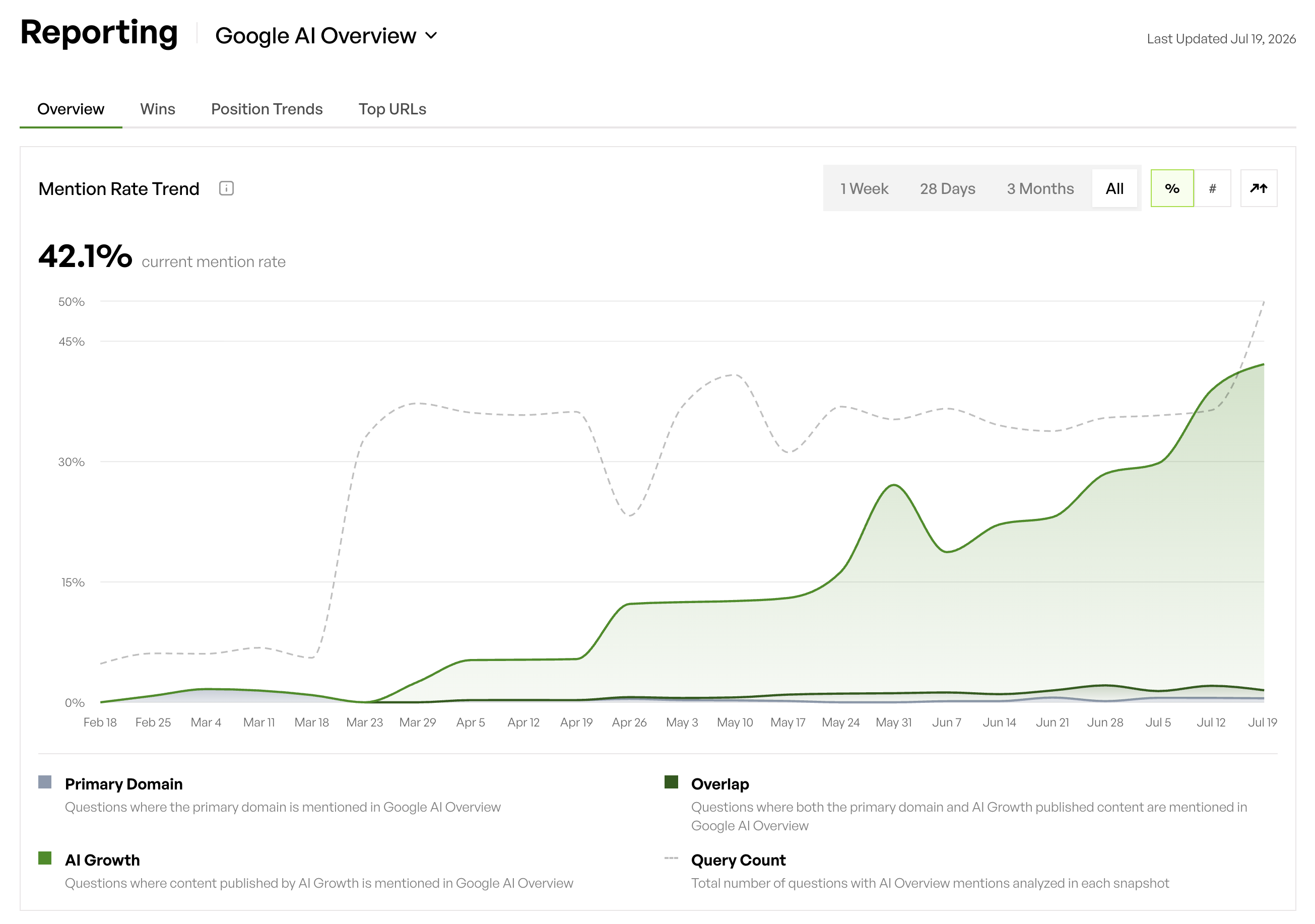
Roles: The CMO reviews the weekly incremental visibility report. The engine doubles down on what indexes well and uses internal linking to lift what does not.
Dependencies: Baseline established in weeks 1 to 3 is required to calculate incremental gains accurately.
Risks: Measuring only impressions without isolating incremental contribution conflates existing brand authority with new program results. The separate publishing environment prevents this.
Weeks 4 to 12 checklist:
- Incremental visibility baseline locked from weeks 1 to 3
- Weekly report reviewed by CMO every Monday
- Bot traffic, impressions, and citation context tracked per article
- Organic lead attribution captured at conversion moment
- Content plan adjusted based on which queries are gaining Share of Model
Common Mistakes That Derail In-House Programs
Weak third-party seeding. Publishing owned content without building corroborated third-party presence first produces articles that AI engines cannot validate. The foundational GEO research from Princeton, Georgia Tech, and IIT Delhi found that citing sources, adding direct quotations, and including statistics achieved 30 to 40% relative improvement in AI citation rates. Third-party authority must precede or run parallel to content publishing, not follow it.
Missing fintech compliance guardrails. Fintech AI content workflows must implement automated compliance scanning that detects prohibited language, verifies claims requiring substantiation, and confirms presence of required disclosures before human review. Configuring these rules once in the engine’s memory system prevents every future article from requiring a full legal review cycle.
Inconsistent brand voice. Quality drift across a large content library is the primary reason DIY chatbot approaches fail at scale. Style memories in the engine carry voice rules and apply them to every generation, preventing this drift. However, these memories should focus on consistency rather than cleverness. The advice is not to over-tune for tone when writing for an AI reader. Instead, objective, structured facts about what the product actually does win citations more reliably than clever brand phrasing.
Failure to isolate incremental visibility. Programs that measure total impressions without separating new gains from existing brand authority cannot prove ROI. Publishing into a separate environment and reporting week-over-week incremental contribution is the only defensible measurement approach.
Validation checklist:
- Third-party profiles claimed and consistent before content launch
- Compliance deny lists and disclaimer rules configured in engine memory
- Style memories set for brand voice, preferred terminology, and prohibited language
- Incremental visibility baseline established before measuring results
- Weekly review cadence in place with CMO as primary reviewer
How To Validate Results Using the Four Pillars
Four data sources confirm that the program is working and identify where to act next.
Search Intelligence provides a weekly portrait of the traditional search landscape, covering positioning, competition, and search volume. It shows which competitor domains are winning each query and where white space exists for new content.
AI Analytics tracks brand value and consumer behavior across the full journey, from external touchpoints like Google and AI-tool queries through content consumption, demographics, and sentiment. This signal connects content performance to buyer behavior.
Bot Tracking logs every bot interaction, traditional crawlers and AI training agents alike, including every crawl, citation, and training sweep. Per-article bot data shows exactly which content ChatGPT is reading and citing, and when.
AI Ranking tracks order of mention and citation context as the new leaderboard. Where your brand appears in an AI answer, who it is grouped with, and what claim it is cited for are the metrics that replace the old ranking number.
The recommended cadence is a weekly review of all four pillars, with the CMO as the primary decision-maker. When a competitor gains more than 10 percentage points of Share of Voice in one month, organizations have approximately 30 days to publish and index new content before AI engines begin consistently favoring the competitor’s content for affected prompts. Weekly review makes that response window actionable.
See how the four-pillar reporting dashboard isolates incremental visibility for your fintech brand.
Advanced Options for Regulated Fintech Environments
Multi-brand fintech portfolios can run parallel engines, each with its own universe map, content topology, and compliance configuration, without the engines interfering with each other. Bisutti ran two parallel AI Growth Agent engines simultaneously, one tuned to consumer events and one to corporate events, with AI Growth Agent representing 71% of total brand mention visibility as a result.
Regulated sub-sectors including broker-dealers, RIAs, and digital lenders require additional configuration. The SEC Division of Examinations’ Fiscal Year 2026 Examination Priorities explicitly target AI governance, and SEC examiners will verify AI-related marketing claims made by financial firms. The engine’s tiered review framework, human-in-the-loop option, and full audit trail of prompts, outputs, and model versions address these requirements directly.
CMS integrations are handled through a reverse proxy rewrite, typically under a subdirectory, or through a subdomain, with setup documentation generated for the client’s host, whether Cloudflare, Vercel, or another provider. The existing main site structure is never touched.
Adjacent topics that compound authority in regulated fintech environments include dedicated security and compliance pages, regulatory explainer content tied to specific rule citations, and original research reports that generate earned media coverage from financial publications.
Frequently Asked Questions
How long does it take to see the first results from an in-house AI search program in fintech?
The first article typically goes live within one week of kickoff. Content has indexed in as little as ten days and often within two weeks. Most brands begin seeing measurable improvements in AI search visibility within 60 to 90 days after implementing a comprehensive content ecosystem, with significant citation growth compounding over four to six months as AI systems recognize topical authority. The standard pilot is three months, and clients average more than 12,000 additional AI citations and mentions across that period.
Does the internal team need technical skills to run this program?
No. The engine provisions schema, the WordPress plugin, robots.txt, sitemaps, automatic web stories, Blog MCP, agent discovery via /.well-known/, llms.txt and llms-full.txt, instant indexing, autoredirects, and 404 tracking automatically. The only integration step on the client’s side is the reverse proxy rewrite that connects the blog to a subdirectory under the brand’s domain. The internal team gives feedback in plain language and the system learns, applying corrections to every future generation without re-briefing.
How does the engine handle fintech compliance requirements?
Compliance rules are configured once during kickoff and applied to every future generation. This configuration includes legal disclaimers placed inline in the same paragraph as key claims, prohibited language detection, tiered review thresholds for high-risk content categories such as performance data and comparative claims, and anti-hallucination controls that validate every claim, source, and quote against primary sources before an article ships. Clients with human-in-the-loop review requirements can read each article in the studio, chat with it, and steer it before publish. The engine edits in place and saves the correction as a memory.
What does the cost model look like, and how does it compare to an agency?
Pricing is a flat fee with no per-article charges, credit limits, or per-prompt billing. Clients own all the content they produce. A traditional agency RFP runs approximately three months, then three more months to produce the first assets, which puts the first result close to a year away. AI Growth Agent goes from kickoff to the first published article in about one week. The engine replaces the SEO agency, the content tool, the web agency, the GEO monitor, the schema plugin, the analytics stack, and the PR firm in a single engagement at a fixed price.
How is incremental visibility isolated so the program can prove its own results?
AI Growth Agent publishes into a separate environment and reports incremental visibility in isolation, showing exactly what the engine generated week over week rather than taking credit for visibility the brand already had. Bot analytics track every bot that touches the blog, including the bot ChatGPT uses to cite sources. Google Search Console serves as the independent audit layer. The four-pillar reporting framework, covering Search Intelligence, AI Analytics, Bot Tracking, and AI Ranking, cross-references these signals into a single weekly view that the CMO can defend to any stakeholder.
Conclusion: Turn AI Search Into a Repeatable In-House System
The fintech brands that will dominate AI search in 2027 and beyond are the ones building authoritative content now. Many enterprises are committing substantial marketing budget to AI search visibility. The leaderboard is being written this year, and brands that establish authoritative content now are training the next generation of models with their own narrative.
The 7-step playbook in this article functions as a repeatable system. Map the universe. Build third-party authority. Create comparison and Q&A content. Implement traditional and agentic technical SEO. Deploy monitoring and bot tracking. Publish and self-heal living content. Measure incremental visibility week over week. Each stage feeds the next, and the compounding effect of consistent execution separates brands that are cited from brands that remain invisible.
AI Growth Agent operates as the single headless engine that executes every stage of this system without an agency, without a technical team, and without a stack of disconnected tools. Clients average more than 12,000 additional AI citations and mentions, over 100,000 additional bot visits, and a 20% or greater lift in impressions across the first 12 weeks, with the first article live within a week of kickoff.