Written by: Mariana Fonseca, Editorial Team, AI Growth Agent
Key Takeaways
- Self healing content systems continuously detect authority decay, diagnose root causes, repair affected assets, and encode lessons to prevent future erosion, unlike traditional CMS that treat publishing as a terminal event.
- The four-stage loop (Detect, Diagnose, Repair, Learn) maps directly from infrastructure self-healing to content operations, so brands can maintain AI search authority as citation half-lives shrink to roughly 4.5 weeks.
- Key differentiators include universe mapping of 1,600+ queries, living content that updates automatically, citation context tracking, and large language model optimization (LLMO) that outperforms legacy SEO in natural-language AI surfaces.
- Implementation delivers a client-owned site within one week via reverse-proxy deployment, with no technical team required and governance embedded through manifesto-driven guardrails and anti-hallucination controls.
- Brands like Leva Sleep and Breadless achieved 10,000–45,000 monthly ChatGPT citations and 20–30× impression growth; schedule a demo with AI Growth Agent to see your first living content article live within a week.
How Self Healing Content Systems Work
The four-stage loop that governs infrastructure self-healing, documented by LogicMonitor and Infosys, maps directly onto content operations. Each stage has a precise content equivalent.
- Detect. The system monitors every published asset for signals of authority decay, such as falling bot visit rates, citation loss, stale statistics, and indexing gaps. In AI Growth Agent’s architecture, bot tracking records every crawl and citation sweep across ChatGPT, Perplexity, and Google AI Mode, while Google Search Console data surfaces impression and click erosion at the article level. Detection runs continuously rather than on a fixed audit schedule.
- Diagnose. Raw signals are correlated into actionable root causes. A drop in AI citations may trace to a statistic that aged past its source, a competitor publishing a more authoritative treatment, or a structural gap in schema markup. AI Growth Agent’s Content Topology and Search Intelligence layer identify which long-tail queries have shifted and which content is losing ground. The result is a prioritized repair queue instead of an undifferentiated alert list.
- Repair. Corrective actions execute within governance guardrails. For content systems, repair means substantive rewriting of affected sections, injection of fresh primary-source citations, schema updates, and internal-link adjustments that redistribute authority across the universe. Content refreshed regularly is often cited more than outdated content, so timely repair becomes a direct visibility lever. AI Growth Agent’s living content architecture automates this cycle, refreshing articles in response to bot-traffic signals and Search Console data without manual editorial intervention.
- Learn. Every repair event is written back into the system’s governance layer as institutional knowledge. In self-healing data architectures, corrections become encoded platform capabilities rather than ephemeral fixes, so the system’s model of healthy content grows richer with every cycle. In AI Growth Agent’s implementation, style memories, anti-hallucination steering, and content performance data compound across every future generation, so the engine produces better output with less correction over time.
Core Concepts That Define Self Healing Content
Six concepts underpin self healing content systems and distinguish them from conventional content management.
- Universe. The universe is the full set of queries and prompts that describe a brand’s market, head terms and long tail together. Most brands track a handful of head terms and lose the rest of the conversation by default. AI Growth Agent maps universes of 1,600 or more queries, refreshed weekly using more than 3,000 real searches.
- Long tail. The long tail contains the vast majority of queries a customer actually asks. AI surfaces search the long tail. Brands that focus only on head terms remain invisible to most of their own market.
- Incremental visibility. Incremental visibility is reporting that isolates the visibility a new effort actually generated, separate from the visibility the brand already had. Without incremental measurement, brands cannot distinguish compounding authority from existing brand equity.
- Living content. Living content updates and self-heals over time so a brand’s presence does not decay as the world changes. Early adopters of living content pipelines for statistics-heavy evergreen articles report a 34% average increase in organic traffic to updated pages, driven by improved freshness signals and increased topical depth.
- Citation context. Citation context describes where a brand appears in an AI answer, who it is grouped with, and what claim it is cited for. This replaces the old idea of a ranking number. AI answers have no static ordered list, so order of mention and citation context form the new leaderboard.
- Large language model optimization (LLMO). LLMO is the discipline of writing and structuring content so that AI surfaces find it, trust it, and cite it. It works natively in natural language, which makes it fundamentally stronger than legacy SEO.
Current Market and Ecosystem Overview
Now that the core concepts are clear, the market context shows why self healing content has become urgent. The content decay problem is measurable and accelerating. The median cited-source half-life is roughly 4.5 weeks, and 40 to 60 percent of cited domains rotate month-to-month for an identical query, with 70 to 90 percent rotating over six months. Roughly 50 percent of all AI-cited content is under 13 weeks old, so recency now acts as a dominant selection signal.
LLM Research Lab’s Q1 2026 report, analyzing 14,237 responses across 480 brands and 6 AI engines, found that recently updated content can correlate with higher AI mention rates. The same report found that leading brands in any category capture a large share of AI-generated mentions, so the leaderboard is concentrating rapidly.
Static content management cannot keep pace with this rotation rate. Microsoft’s Global Help Desk reviews its knowledge base articles as part of a manual review process, a cadence that cannot match a 4.5-week citation half-life. The shift from static to living content has become a structural requirement for sustained AI search authority.
Comparing Content Architectures for Self Healing
Two architectures compete for the same outcome, which is sustained brand authority in AI search. The table below compares them on four dimensions where the difference is decisive.
| Dimension | Software Self-Healing Systems | Content Self-Healing Systems (Traditional) | Content Self-Healing Systems (AI Growth Agent) |
|---|---|---|---|
| Detection mechanism | Continuous infrastructure monitoring via unified telemetry (metrics, logs, traces) | Periodic manual audits, and neglected content can lose up to 20% of organic traffic per year without refresh | Continuous bot tracking, Search Console signals, and citation-rate monitoring per article |
| Repair speed | 60% faster resolution times with Edwin AI | Weeks to months depending on editorial bandwidth | Automated refresh triggered by signal thresholds, and content updated within the last 30 days receives 3.2× more AI citations than content older than 90 days |
| Learning and compounding | Remediation events encoded as forward-looking data contracts in the governance layer | Lessons remain in editorial memory and are not systematically encoded | Style memories, anti-hallucination steering, and performance data encoded per client, so every correction improves future generations |
| Governance model | Closed-loop automation with bounded agent execution, pre-approved playbooks, and full audit trails | Process-dependent and reliant on editorial calendars and human review cycles | Manifesto as single source of truth, with deny lists, claim registries, and anti-hallucination checks applied at generation, and human-in-the-loop review available |
The architectural differences in the table above reveal which capabilities separate monitoring from true self-healing. When evaluating providers, focus on the factors that determine whether a system can actually close the loop without adding headcount to your team.
Key Factors When Choosing a Self Healing Approach
Four factors determine whether a content architecture can sustain authority in AI search without adding headcount.
- Governance without manual overhead. Forrester recommends treating knowledge management as a continuous operational process with dedicated resources rather than an ad hoc activity. A self healing content system must embed governance into the generation and repair pipeline, not rely on editorial calendars.
- Scalability across the full universe. Ahrefs studied 14 billion pages and found 96.55 percent get zero traffic from Google. Scalability means covering the long tail systematically rather than capping tracked queries at an arbitrary number.
- Ownership of the site and content. Agency-controlled sites create dependency that prevents self-healing. The brand must own the property outright so the repair loop can execute without external approval.
- Ability to self-heal without headcount. The team needed to run this channel manually does not exist in any company. The architecture must replace the stack rather than add to it. As outlined in the implementation timeline, the fully optimized site is client-owned from day one, with no agency in the loop and no technical skill required from the client side.
Schedule a demo to see if you’re a good fit for AI Growth Agent’s self healing content architecture.
Typical Implementation Stages for AI Growth Agent
A self healing content system goes live in four sequential stages, not a year-long ramp.
- Kickoff. A journalist-led interview builds the brand manifesto, including voice rules, factual references, deny lists, and the personalization needed to make content compliant by default. The manifesto becomes the single source of truth that governs every future generation and repair cycle.
- Universe mapping. AI Growth Agent ingests the manifesto alongside real-time Google and ChatGPT data to build a Content Topology, a hierarchy of seed terms, each backed by evidence, with dozens of long-tail queries beneath it. This initial mapping typically yields 300 to 400 queries for a new account, which then expands as the system captures more of the universe.
- First living content. The first articles are live within approximately one week of kickoff, with indexing occurring in as little as ten days. Each article ships with full schema markup, internal linking, and agentic technical SEO including Blog MCP, llms.txt, and agent discovery endpoints. The self-healing loop therefore has instrumented assets to monitor from day one.
- Reverse-proxy deployment. The optimized blog connects to the client’s domain through a reverse-proxy rewrite, usually under a subdirectory or through a subdomain. Nothing in the existing site structure changes. The engine writes, publishes, monitors, repairs, and reports from this point forward on autopilot.
Ongoing Management and Measurement Practices
Ongoing management in a self healing content system is defined by three measurement disciplines.
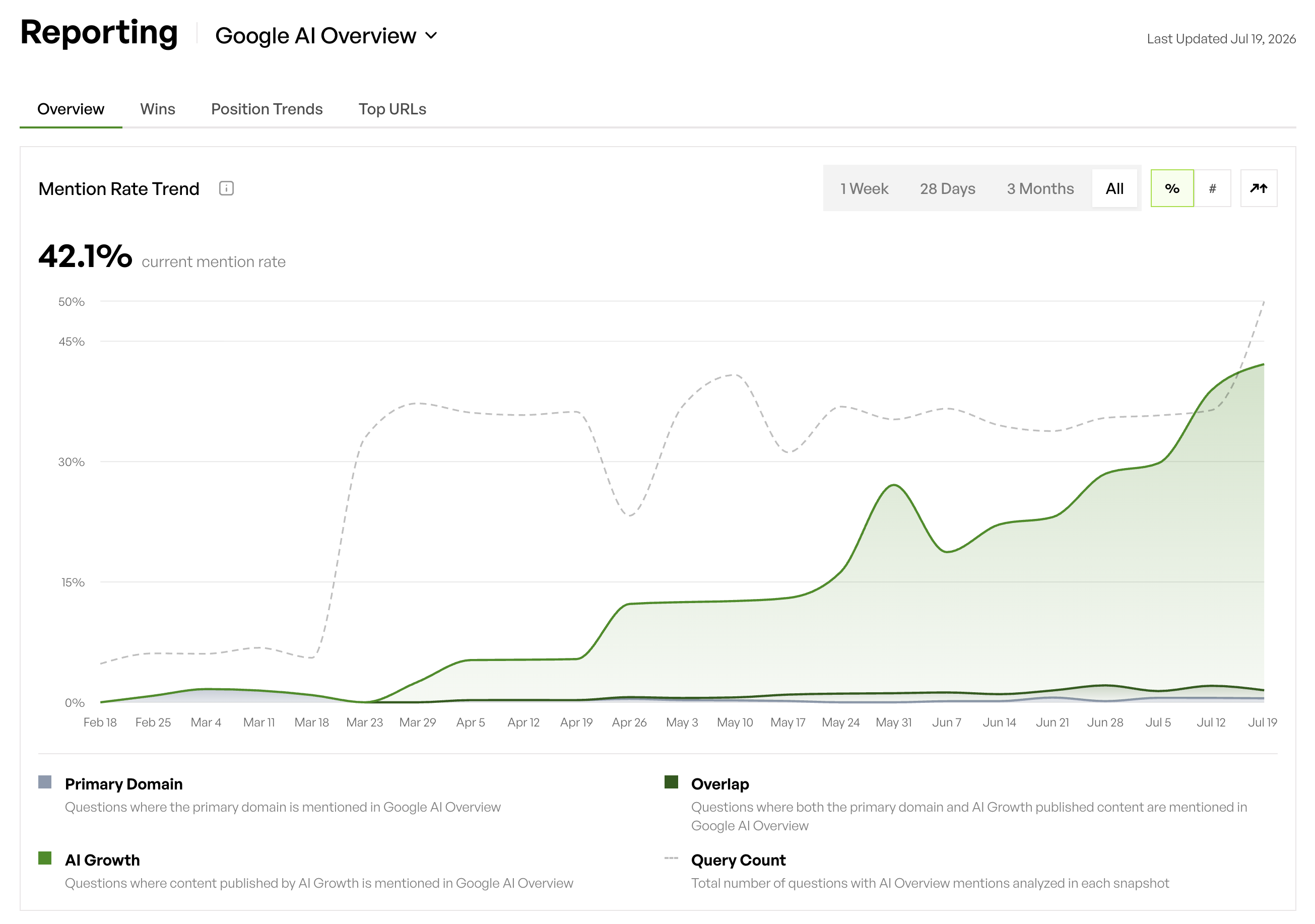
- Incremental visibility reporting. AI Growth Agent publishes into a separate environment and reports only the visibility it actually generated, week over week, cross-referenced against Google Search Console as an independent audit. This isolated measurement approach makes it possible to attribute results with confidence, so clients see more than 12,000 additional AI citations and mentions and more than 100,000 additional bot visits across the first twelve weeks, all verified as incremental rather than inherited from existing brand equity.
- Bot tracking. Every bot interaction, traditional crawlers and AI training agents alike, is recorded at the article level. This includes the bot ChatGPT uses to cite sources, which makes citation events visible rather than inferred.
- Citation context monitoring. Order of mention and citation context are tracked week over week against the content plan. Branded web mentions correlate at 0.664 with AI citation visibility, roughly three times more strongly than backlinks at 0.218. Citation context monitoring surfaces which claims are earning citations and which need repair before authority erodes further.
Risks, Limitations, and Common Mistakes
Three failure modes account for most self healing content system breakdowns.
- Stale content left in place. As noted in the comparison above, stale content suffers a dramatic citation penalty. Brands that publish and forget are actively training AI surfaces to prefer competitors. The repair stage of the loop must execute on a cadence that matches the citation half-life of the category, not an annual editorial calendar.
- Monitoring-only tools mistaken for self-healing systems. Tools that track whether a brand appears for a capped set of prompts detect decay but cannot repair it. Detection without repair does not qualify as a self healing content system. It becomes an alert queue that grows faster than any editorial team can clear it.
- Agency dependency blocking the repair loop. When an agency controls the site, every repair requires a briefing, a review cycle, and an approval chain. Knowledge base articles can become irrelevant without active intervention. An agency operating on quarterly cycles cannot close a loop that needs to run weekly.
2026 AI-Search Example: Living Content in ChatGPT, Perplexity, and Google AI Mode
Leva Sleep, a North American adjustable bed retailer, illustrates the citation mechanics of a self healing content system in practice. AI Growth Agent mapped Leva Sleep’s universe across financing, setup, side-sleeper, back-pain, and anti-snoring queries, then produced living content targeting each long-tail cluster across ChatGPT, Perplexity, and Google AI Mode. Given the 4.5-week citation half-life discussed earlier, the repair loop kept articles current as product details and market conditions shifted.
The outcome was clear. ChatGPT citations of Leva Sleep content exceeded 10,000 per month, Google Search Console impressions on AI Growth Agent content doubled, and the brand reached an 88 percent ranking rate in target queries with a 61 percent AI Overview mention rate. Sales teams closed $40,000 to $50,000 in deals within three weeks from buyers who arrived carrying specific article details they had discovered through AI-cited content.
Breadless, a healthy fast-casual franchise, followed the same architecture. Within 90 days, ChatGPT cited eatbreadless.com more than 45,000 times per month, Google Search Console impressions grew roughly 30 times over six months, and the brand reached a 72 percent recommendation rate versus Sweetgreen’s 13 percent within its search universe.
Both outcomes reflect the same mechanism. Structured markup can improve inclusion in AI-generated responses, and adding statistics and quotations to source content lifts citation probability by 25 to 41 percent. Living content that combines structured markup, validated primary-source citations, and continuous repair outperforms static content on every AI surface that reads, cites, and acts on what it finds.
Summary and Decision Support for Marketing Leaders
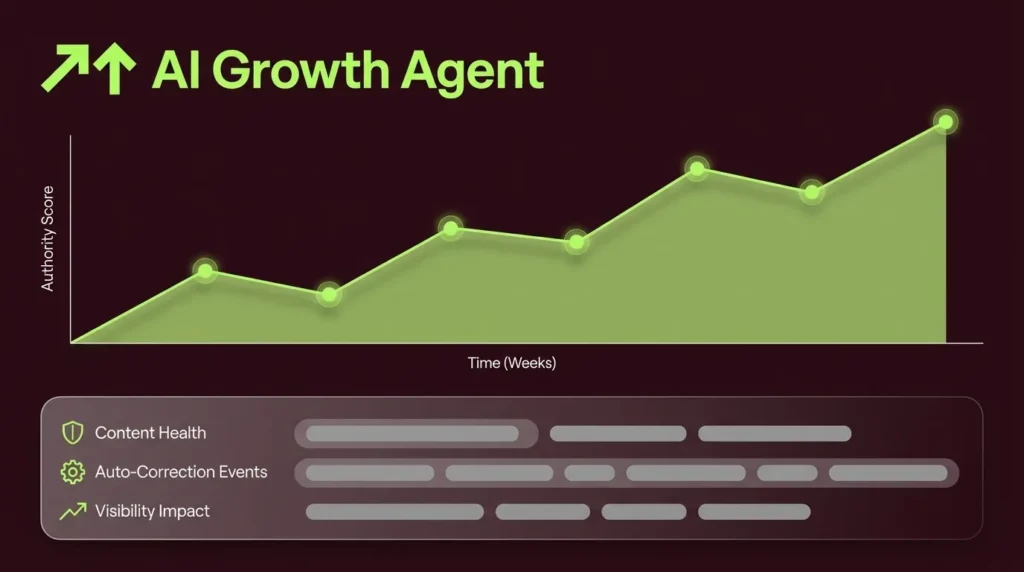
Self healing content systems operate as an architecture rather than a feature of a content tool. They form a closed loop of detection, diagnosis, repair, and learning that runs continuously so brand authority compounds rather than decays. The four-stage loop maps directly from infrastructure self-healing to content operations, and the data on citation freshness, rotation rates, and mention concentration makes the business case unambiguous.
The decision centers on how to adopt living content. Teams can attempt to build the loop with an agency stack that cannot close it, a monitoring tool that only detects decay, or a single headless engine that detects, diagnoses, repairs, and learns on autopilot. AI Growth Agent is the only fixed-fee engine that replaces the entire marketing stack with this architecture and reports only the incremental visibility it actually generates.
The brands cited in AI search this year are training the next generation of models with their own narrative. Brands that wait are training the next generation with whatever happens to be sitting on the open web.
FAQ
What is a self healing content system, and how is it different from a traditional content management system?
A self healing content system is a closed-loop architecture that continuously monitors published content for authority decay, diagnoses the root cause of that decay, repairs affected assets automatically, and encodes the lessons from each repair cycle into the system so future decay is caught and corrected faster. A traditional CMS manages the creation and publication of content but treats publishing as a terminal event. Once an article is live, it sits unchanged until a human editor decides to update it, which in practice means most content goes stale within weeks. A self healing content system replaces that editorial dependency with a continuous loop that runs on autopilot, keeping every asset current relative to the citation freshness signals that AI surfaces use to decide what to recommend.
How long does it take to see results from a self healing content system?
With AI Growth Agent, the first article is typically live within one week of kickoff, and content has indexed in as little as ten days. The standard engagement is a three-month pilot because indexing timelines vary by industry and domain authority, but clients consistently see citation and impression movement early in that window. Across the first twelve weeks, AI Growth Agent clients average more than 12,000 additional AI citations and mentions, more than 100,000 additional bot visits, and a 20-percent-plus lift in impressions. Results vary by category, competitive density, and the size of the universe being targeted, but the architecture is designed to generate measurable incremental visibility rather than riding existing brand equity.
Do we need a technical team to implement and run a self healing content system?
No. The point of headless marketing is that the engine handles every technical requirement. AI Growth Agent automatically provisions schema markup across the full schema suite, an advanced WordPress plugin with bot tracking and Blog MCP, robots.txt, sitemaps, automatic web stories, agent discovery endpoints, llms.txt and llms-full.txt files, instant indexing, autoredirects, and 404 tracking. The only integration step required from the client is the reverse-proxy rewrite that connects the blog to a subdirectory under the brand’s domain, with setup documentation generated for the client’s specific host. The internal marketing team gives feedback in plain language, and the system encodes that feedback as memories applied to every future generation. No engineering hours are required on the client side after the initial connection.
How does a self healing content system maintain brand voice and accuracy at scale?
Brand voice is governed by a manifesto built during kickoff and a layered set of style memories that the engine applies to every generation. When a brand uses specific terminology, such as calling users “members” rather than “users,” that rule is configured once and respected everywhere. Accuracy is enforced by a cascade of anti-hallucination controls. The engine always prefers claims from the manifesto and the client’s primary sources, scrapes and verifies every external source before passing it into the generation pipeline, re-extracts every claim from the finished draft and checks it against product pages and verified sources, and removes or softens any claim that cannot be backed up. The client can also designate which claim types deserve the heaviest scrutiny, such as pricing or ingredient specifications, and the engine focuses its checks there. Every article ships validated rather than assumed to be accurate.
How is incremental visibility measured, and how do we know the results are attributable to the self healing content system rather than existing brand authority?
AI Growth Agent publishes into a separate environment, which means it can report only the visibility it actually generated rather than taking credit for impressions the brand already had. Incremental visibility reporting cross-references per-article bot tracking, Google Search Console data, and citation-rate monitoring week over week, isolating what the engine contributed. Google Search Console serves as an independent audit that clients can verify directly. Bot tracking records every crawl and citation event at the article level, including the specific bot ChatGPT uses when citing sources, so citation events are observable rather than inferred. In a zero-click world, full attribution from AI recommendation to closed sale is not always possible, but clients who measure best capture source at the conversion moment and consistently see a lift in organic leads that correlates with the citation and impression data the engine reports.