Written by: Mariana Fonseca, Editorial Team, AI Growth Agent | Last updated: September 2, 2026
Key Takeaways
- AI search now favors zero-click answers, so brand citations act as the ranking signal that controls visibility.
- Most monitoring tools only track citations and surface gaps, which leaves brands with data but no clear remediation path.
- An autonomous platform must complete a seven-step loop: discover, probe, diagnose, prioritize, act, verify, and learn without manual work.
- AI Growth Agent operates as a full-stack execution engine that produces authoritative content, stands up owned sites, and compounds authority over time.
- AI Growth Agent closes the gap between diagnosis and execution, getting your first article live within a week.
What Is an Autonomous Platform for AI Citations?
An autonomous platform for AI citations is a system that continuously discovers, probes, diagnoses, prioritizes, acts, verifies, and learns without manual intervention to increase a brand’s mentions and citations across AI search surfaces like ChatGPT, Perplexity, and Google AI Mode.
This definition separates two categories that the market often conflates. Monitoring tools tell you where you stand. Execution engines change the answer. The autonomous loop is a seven-step framework that distinguishes a dashboard from a digital brand manager.
- Discover: Map the full universe of queries a brand’s customers actually ask, including the long tail that monitoring tools never reach.
- Probe: Run those queries across AI surfaces to capture citation behavior, competitor positioning, and source preferences in real time.
- Diagnose: Identify where the brand is absent, misrepresented, or outranked by a competitor or a Reddit thread.
- Prioritize: Rank gaps by business impact, citation leverage, and content effort required.
- Act: Produce authoritative, structured content that fills the gap and publish it to an owned, technically optimized property.
- Verify: Confirm indexing, bot visits, and citation movement across surfaces week over week.
- Learn: Feed results back into the system so the strategy compounds rather than decays.
AI Growth Agent implements this loop as a single engine. It maps a brand’s universe across hundreds of seed terms and long-tail queries using real-time Google and ChatGPT data. It produces authoritative content that validates every claim and source. It stands up a fully optimized site the client owns within the first week and reports the incremental visibility it generates week over week. This living content updates and self-heals over time instead of going stale.
The Problem With the Leading Platforms: Monitoring Versus Execution
The table below compares the major platforms across core function, content generation, and site ownership. Every data point is cited inline.
Profound is the most-benchmarked name in the category. It is backed by a Sequoia-led Series B and a reported Series C of $96M at a $1B valuation. Its strength is deep prompt-intelligence data and enterprise-grade tracking. But its limitation is structural: even at the Growth tier ($399/month billed annually), it functions as a monitoring tool. It does not push content fixes to a CMS, source backlinks, or execute technical SEO changes. Because it lacks execution, customers consistently report needing an external contractor to extract value from the data, making the real cost at the Growth tier closer to $2,400/month.
OnCited offers citation automation across Reddit, Quora, and niche forums, with blog automation on a dedicated domain starting at $399/month for its Ranking plan. Its placements are described as human-written by niche experts. However, its public copy does not indicate that customers own the site or that the platform fully manages website infrastructure. It operates as a citation service rather than a full-stack execution engine.
Newer entrants including showin.ai, rankscope.ai, quattr.com, and getcited.me focus primarily on AI visibility tracking and brand mention monitoring. They provide dashboards and alerts but do not produce authoritative content, stand up owned sites, or refresh content over time. Monitoring-only tools report visibility scores, sentiment, and citation sources, yet they do not generate the content needed to close identified citation gaps, which requires a separate content or development team to act on the findings.
AI Growth Agent operates as a full-stack execution engine. It produces authoritative content, stands up a fully optimized site the client owns within the first week, and refreshes content over time. It creates citations instead of simply tracking them.
The Problem: AI Search Is Volatile and Content Goes Stale
AI search behaves like a moving target that reshuffles citation sources with no announcement and no warning. Promptwatch data shows that Reddit’s share of ChatGPT Search citations averaged 3.83% from July 18 to August 7, 2026, then collapsed to 0.52% by August 14–17, an 86.4% relative drop. The change coincided with ChatGPT dramatically increasing its use of the site: search operator, jumping from about 0.4% to nearly 17% of its fanout queries on August 8, 2026.
A seoClarity study tracking ChatGPT citations across five markets found citation volumes fell 86–94% between February and April 2026 before rebounding, which demonstrates platform-level volatility rather than a sustained decline. The lesson is clear. A platform that sets and forgets will lose visibility overnight. A platform that self-heals keeps authority compounding. To find that kind of resilience, brands need a different class of AI search visibility platform.
How to Choose an AI Search Visibility Platform
Five criteria separate a platform that changes what the AI says from one that only reports it.
- Content creation versus tracking: Monitoring highlights where you are missing. Execution produces the content that fills the gap. If the platform cannot generate authoritative, validated articles, you are buying a diagnostic with no treatment.
- Site and content ownership: When an agency or platform controls your site, every change becomes a dependency. AI Growth Agent stands up a site you own outright, styled like your own, connected through a reverse proxy rewrite or subdomain.
- Predictable pricing: Flat fee versus per-prompt billing changes how much of your universe you can afford to see. AI Growth Agent charges a flat fee with no per-article charges, credit limits, or per-prompt billing.
- Incremental visibility reporting: If the platform reports only total visibility, it takes credit for brand equity you already had. AI Growth Agent publishes into a separate environment and reports exactly what it generated, week over week.
- Self-healing content: Content ages quickly while AI search remains volatile. A platform that refreshes and updates content automatically keeps your authority compounding instead of decaying.
Why Content and Technical SEO Win Citations
AI surfaces favor content that is structured, validated, and technically accessible. The Princeton and Georgia Tech GEO study, which tested over 10,000 content variations across ChatGPT, Bing Chat, and Google Bard, found that adding statistics improves AI visibility by 35%, authoritative quotations by 34%, and citing authoritative sources by 20%. Pages with FAQ schema and inline citations receive approximately 40% higher citation weighting in ChatGPT.
AI Growth Agent ships this technical foundation automatically. Every article and every site ships with full schema markup, Blog MCP, llms.txt and llms-full.txt, OpenAI discovery via /.well-known/, and natural language query parameters. This living content updates and self-heals over time instead of going stale. When the year turns, every article in a sector refreshes automatically. This shift turns decaying content into compounding authority.
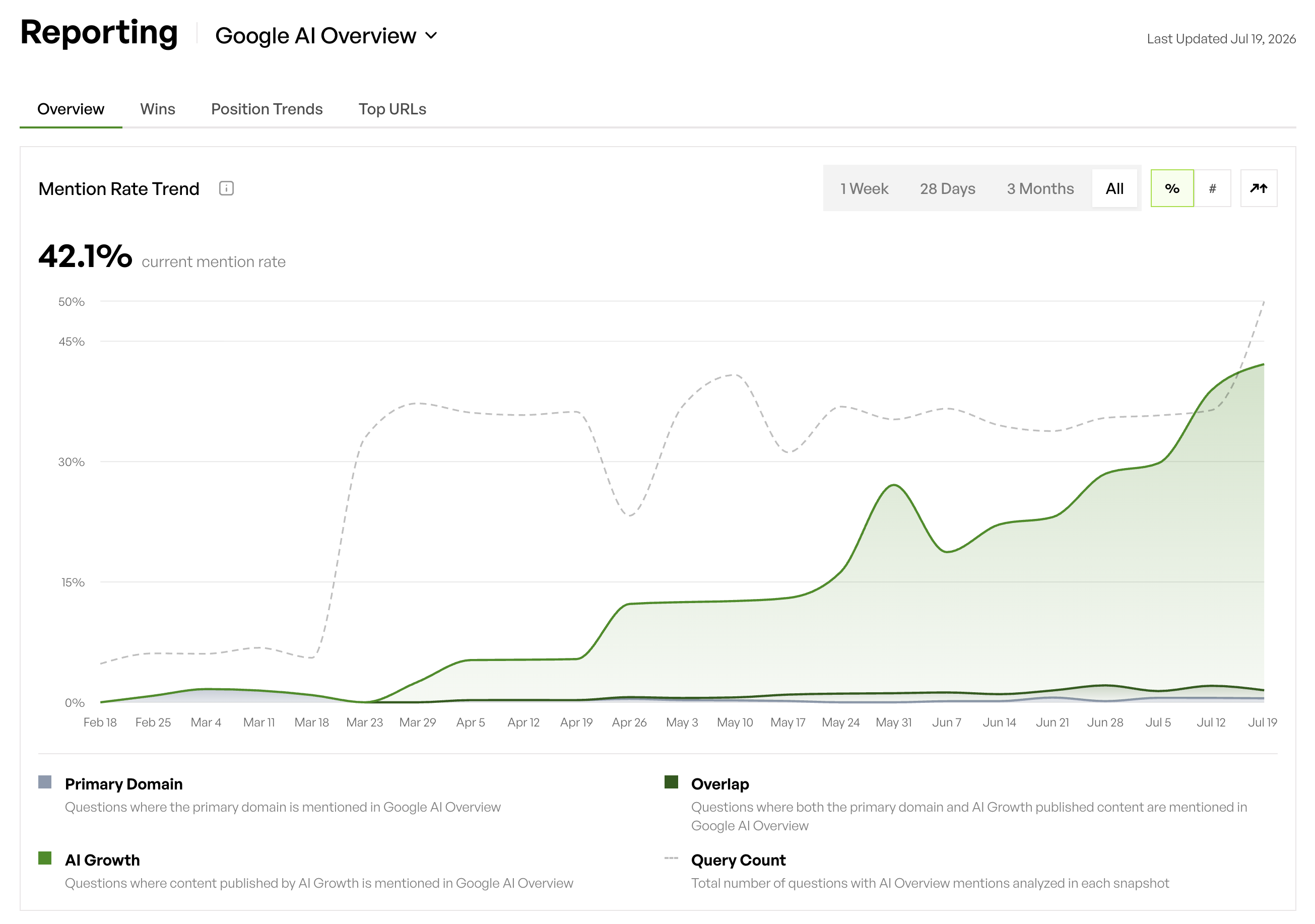
Across the first twelve weeks, clients average more than 12,000 additional AI citations and mentions, over 100,000 additional bot visits, and a 20%+ lift in impressions, with content indexing in as little as ten days and the first article live within a week. Breadless is now one of the most recommended healthy franchises in the US, ahead of CAVA, Rush Bowls, and Sweetgreen in its search universe, with ChatGPT citing eatbreadless.com over 45,000 times per month. Similarly, Leva Sleep is now the most mentioned retailer for adjustable beds in Canada, with ChatGPT citations of Leva Sleep content topping 10,000 per month and $40,000 to $50,000 in deals closed in under three weeks from buyers who found them through AI Growth Agent content.
A Phased Approach to Implementing an AI Citation Engine
- Audit your current AI visibility. Run your brand’s core queries across ChatGPT, Perplexity, and Google AI Mode. Record where you appear, where you are missing, and who is cited instead of you. Most brands discover they are invisible on the long tail of queries their customers actually ask.
- Pilot with a platform that can execute. Choose a platform that produces content, stands up an owned site, and refreshes content automatically. AI Growth Agent goes from kickoff to the first published article in about one week, with content indexing in as little as ten days. As noted earlier, clients see substantial gains within the first twelve weeks, including over 12,000 additional citations, more than 100,000 additional bot visits, and a 20%+ lift in impressions.
- Scale and refine your program. Use incremental visibility reporting to see what is working and double down. Let the engine refresh content that is aging and add internal links to lift what is underperforming. The system runs 3,000+ searches every week to refresh the universe snapshot, so the strategy stays current.
Conclusion: Make Your Brand the Answer
Monitoring tools show you where your brand stands in AI search but leave the response unchanged. An autonomous platform closes the loop from discovery to execution by discovering, probing, diagnosing, prioritizing, acting, verifying, and learning without manual intervention.
AI Growth Agent operates as a full-stack execution engine that produces authoritative content, stands up an owned site, and refreshes content over time. In a zero-click world, being cited is the new ranking. The brands that establish authoritative content now are training the next generation of models with their own narrative. Brands that delay allow the next generation to train on whatever happens to be sitting on the open web.
Traditional search tools show you where your brand stands. AI Growth Agent makes your brand the answer. Start your kickoff today and see your first article live within a week.
Frequently Asked Questions
What is the difference between a monitoring tool and an autonomous platform for AI citations?
A monitoring tool tracks whether a brand appears in a defined set of AI-generated responses. It reports visibility scores, citation rates, and competitor share of voice, then stops. The remediation, which includes producing content, publishing it, and ensuring it is technically accessible to AI crawlers, falls entirely on the customer’s team. An autonomous platform for AI citations handles both diagnosis and action. It identifies where a brand is missing and then produces authoritative content, publishes it to an owned and technically optimized property, and verifies that the content earns citations over time. In practice, a monitoring tool produces a dashboard, while an autonomous execution engine produces a result. Most brands that invest in monitoring tools discover they need a separate content team, an SEO agency, and a web agency to extract value from the data, which defeats the purpose of automation.
How does AI Growth Agent increase brand citations without adding headcount?
AI Growth Agent replaces the stack that would otherwise require an editor, an SEO specialist, a designer, an engineer, a content agency, a web agency, and a monitoring tool. The process begins with a journalist-led interview that builds the brand’s manifesto, which becomes the single source of truth for voice, facts, and positioning. From there, a multi-agent orchestration maps the brand’s full universe of seed terms and long-tail queries using real-time Google and ChatGPT data, produces authoritative content that validates every claim and source, and publishes it to a fully optimized site the client owns. The site ships with full schema markup, Blog MCP, llms.txt and llms-full.txt, OpenAI discovery via /.well-known/, and natural language query parameters, all handled automatically with no technical skill required from the client. Content refreshes over time so authority compounds rather than decays. The only integration step on the client’s side is the reverse proxy rewrite that connects the blog to a subdirectory under their domain.
Why does AI search citation behavior vary so much across ChatGPT, Perplexity, and Google AI Overviews?
Each AI surface uses a distinct retrieval architecture, training data composition, and source preference. ChatGPT favors reference-quality content and third-party editorial coverage, with Wikipedia accounting for a significant share of its top citations. Perplexity performs real-time web search for every query and averages far more citations per response than ChatGPT, with a strong preference for community sources. Google AI Overviews draw heavily from YouTube and high-authority editorial content, and they share only a small fraction of cited URLs with Google AI Mode despite semantic similarity. These differences mean a single content strategy will not perform evenly across all three surfaces. A full-stack execution engine must produce content that is structured, validated, and technically accessible in the formats each surface prefers. It must also refresh that content continuously as citation behavior shifts, as it did when ChatGPT’s use of the site: search operator jumped dramatically in August 2026 and Reddit’s citation share collapsed by more than 86% in a single week.
How long does it take to see results from an autonomous AI citation platform?
AI Growth Agent goes from kickoff to the first published article in about one week, with content indexing in as little as ten days and often within two weeks. The standard engagement is a three-month pilot, because indexing timelines vary by industry and the citation loop requires time to compound. Clients see movement early. Jota saw a 52% rise in daily average impressions and a 36% rise in clicks within the first three weeks. Jelly earned its first citation within three weeks and reached the number one cited solution for restaurant inventory management in the UK within the same pilot window. Across the first twelve weeks, clients average more than 12,000 additional AI citations and mentions, over 100,000 additional bot visits, and a 20%+ lift in impressions. The brands that move fastest are the ones that commit to a full-stack execution approach rather than waiting for a monitoring tool to dictate the next step.
What technical infrastructure does an autonomous platform need to earn AI citations reliably?
AI surfaces cite content that is structured, validated, and technically accessible to their crawlers. The minimum viable technical stack includes highly structured HTML, full metadata on every asset, rich schema markup across article, author, FAQ, and organization types, a proper sitemap, a detailed robots.txt that allows AI crawlers, and fresh content with automatic updates. Beyond that baseline, earning reliable citations in the current environment requires agentic technical SEO. This includes Blog MCP for direct interoperability with AI search agents, OpenAI discovery and Agent Card guidance served via /.well-known/, natural language query parameters that return personalized responses to agents, Markdown served to agent crawlers, and llms.txt and llms-full.txt published so AI surfaces can read the brand the way they need to. AI Growth Agent ships every one of these elements automatically on every article and every site, with no plugin to install, no schema work, and no engineering hours required from the client. Every package includes the full stack.