Written by: Mariana Fonseca, Editorial Team, AI Growth Agent
Key Takeaways
- ChatGPT visibility depends on three layers working together: crawl access via OAI-SearchBot, extractable content, and third-party authority.
- Most brands fail because they block OAI-SearchBot, skip structured data, bury answers, or lack independent mentions.
- Core technical fixes include allowing OAI-SearchBot in robots.txt, adjusting CDN and WAF rules, using server-side rendering, adding schema markup, and submitting sitemaps to Bing.
- Effective content strategy uses answer-first formatting, question-based headings, named statistics, expert quotes, and monthly refreshes.
How to Appear in ChatGPT Results
ChatGPT cites sources it can crawl, trust, and match to a user’s question. It evaluates three layers in sequence: OAI-SearchBot must reach your pages, your content must be easy to extract, and your brand must have enough third-party validation to feel credible.
ChatGPT Search is powered by Bing’s index for real-time web retrieval, and research found ChatGPT search results share 73% overlap with Bing’s results. If Bing does not index your site, ChatGPT will not surface it, no matter how strong the content looks. This playbook walks through each gate in turn: first, you will make your site crawlable, then you will structure content for extraction, and finally you will build the third-party authority that earns ChatGPT’s trust.
- Crawl access: OAI-SearchBot must be allowed in your robots.txt and not blocked by your CDN or WAF.
- Content extractability: Your pages must answer questions directly, with clear headings and structured data.
- Authority validation: Independent sources must confirm your brand exists and is credible.
Most brands miss at least one of these layers, and most tools only address a single layer. AI Growth Agent is built to coordinate all three.
Why Your Brand May Not Appear in ChatGPT Answers
The most common causes, in order of likelihood, are:
- Blocked by robots.txt or CDN edge rules. Since July 2025, Cloudflare’s account-abuse protection has blocked AI bots by default for many customers. A correct robots.txt that allows OAI-SearchBot fails when the edge layer overrules it. This is the single most common reason a brand disappears from ChatGPT Search.
- No structured data. Pages with three or more schema types have a higher likelihood of being cited by LLMs.
- Thin or buried answers. A significant portion of ChatGPT citations come from the first third of each piece of content. When the answer hides in a long introduction, ChatGPT often never reaches it.
- No third-party validation. Earned media accounts for a large majority of AI citations, while a smaller portion come from brand-owned websites. Without independent mentions, ChatGPT has little reason to trust your brand.
Each cause has a direct fix, and those fixes work best when applied together. AI Growth Agent automates this full stack.
What OAI-SearchBot Is and How It Controls Access
OAI-SearchBot is OpenAI’s retrieval crawler that powers ChatGPT Search citations. It is distinct from GPTBot, which collects training data. This distinction drives how you configure robots.txt.
- GPTBot: Collects content for training OpenAI’s foundation models. Blocking it does not affect ChatGPT Search citations.
- OAI-SearchBot: Retrieves web content to surface in ChatGPT Search results. Blocking it removes your site from citations entirely.
- ChatGPT-User: Fires when a ChatGPT user explicitly asks the model to fetch a specific URL. Blocking it breaks user-initiated browsing inside ChatGPT.
Many brands block GPTBot to protect content and accidentally block OAI-SearchBot at the same time. For most B2B sites, the recommended default is to block GPTBot and allow OAI-SearchBot, which keeps content out of training while preserving eligibility for citations.
AI Growth Agent manages robots.txt configuration automatically, including agent discovery via /.well-known/ and llms.txt files, so the systems that cite content can read your site cleanly.
How to Make Your Brand Visible in ChatGPT Answers: Technical Foundations
The following five steps create the technical base for ChatGPT visibility. A technical team can implement them, or AI Growth Agent can handle them end to end.
Step 1: Verify OAI-SearchBot Access in robots.txt
OpenAI’s official documentation instructs site owners to explicitly allow OAI-SearchBot in robots.txt using this configuration:
User-agent: OAI-SearchBot Allow: / Also allow ChatGPT-User so people can fetch your pages when they share links inside ChatGPT. Blocking GPTBot is acceptable when you want to opt out of training data, while blocking OAI-SearchBot removes you from ChatGPT Search citations entirely.
Step 2: Check Your CDN and WAF Settings
To see whether Cloudflare blocks OAI-SearchBot, open the Cloudflare dashboard, navigate to Security → Events, and filter for OAI-SearchBot. If requests show as blocked, add a WAF custom rule that skips bot protection for the OAI-SearchBot user agent. Disable Cloudflare’s “Block AI Bots” toggle and its managed robots.txt feature, which prepends AI crawler disallow directives to your robots.txt and can override your origin file.
Step 3: Confirm Your Content Is Server-Side Rendered
A majority of AI crawlers do not execute JavaScript, according to a Vercel and MERJ joint engineering study from 2024. If your site uses React, Vue, or Next.js with client-side rendering, AI crawlers may see an empty page. Use server-side rendering, static site generation, or pre-rendering so your core text appears in the initial HTML.
Step 4: Implement Structured Data
Add schema.org markup for the content types that matter to your brand, such as Article, Product, FAQ, Organization, and BreadcrumbList. JSON-LD structured data can increase AI selection, according to Ziptie’s 2026 analysis. Every page that answers a customer question should carry the relevant schema.
Step 5: Submit Your Sitemap to Bing Webmaster Tools
Because ChatGPT Search uses Bing’s index, Bing indexation is a binary prerequisite. A site not indexed in Bing is invisible to ChatGPT regardless of content quality. Submit your sitemap and confirm that key pages appear in Bing.
| Audit Step | What to Check | Common Failure |
|---|---|---|
| robots.txt | OAI-SearchBot explicitly allowed | GPTBot blocked correctly, OAI-SearchBot blocked by mistake |
| CDN/WAF | No edge rule blocking OAI-SearchBot | Cloudflare default AI bot blocking active since July 2025 |
| Rendering | Core content present in initial HTML | Client-side rendered JavaScript invisible to a majority of AI crawlers |
| Schema | Article, Product, FAQ markup present | No structured data implemented |
| Bing index | Sitemap submitted and indexed | Site tuned only for Google visibility |
AI Growth Agent provisions this stack automatically, including an advanced WordPress plugin with bot tracking, Blog MCP, robust robots.txt, and clean sitemaps from day one.
See how AI Growth Agent automates these five steps in practice by booking a short demo.
How to Get ChatGPT to Cite Your Website: Content Strategy
Once your site is technically accessible, the next step is earning citations. Technical access creates eligibility, while content structure and authority determine whether ChatGPT actually selects your pages.
Write answer-first. ChatGPT reads the first portion of each section to decide whether to cite it, and a significant portion of citations come from the first third of each piece of content. Because of this pattern, every section should open with a direct, declarative answer.
Structure for extraction. Use H2 and H3 headings that mirror real user questions. Pages with moderate word counts between headings tend to perform better, while very short sections perform worse. Support these sections with bullet points, numbered steps, and comparison tables, because ChatGPT extracts list items and table data cleanly.
Include statistics with named sources. Articles with more statistical data points tend to receive more citations than articles with minimal data. Format statistics as “According to [Source] ([Year]), [specific claim]” so ChatGPT can lift the claim and attribution together.
Add expert quotes. Research published by Aggarwal et al. at Princeton (KDD 2024) found that adding named expert quotations to content produced a lift in AI citation rates. Pages with attributed expert quotes consistently earn more citations.
Keep content fresh. Content updated within 30 days receives more citations than older material, and brands updating content monthly see higher AI coverage than those with stale content.
Cover the long tail. An AirOps study analyzing hundreds of thousands of pages across thousands of prompts found that a majority of original prompts triggered two or more follow-up searches, and a significant portion of cited pages appeared only in fan-out results, not the original prompt. Brands that focus only on head terms miss most of the real demand.
AI Growth Agent produces content tuned for large language model behavior, with living articles that refresh and self-heal instead of going stale.
Building Authority Through Third-Party Mentions
Technical setup and strong content create a foundation, and third-party validation turns that foundation into trust. ChatGPT leans heavily on independent sources when deciding which brands to cite.
- Earned media accounts for a large majority of all AI citations.
- Brands with active third-party trust signals appear in a much higher percentage of AI answers versus brands without, according to Seer Interactive research.
- Domains with active profiles on Trustpilot, G2, Capterra, or Yelp have higher citation probability compared to sites without such presence.
The authority signals to prioritize include:
- Consistent NAP data. Your business name, address, and phone number should match across your website, Google Business Profile, directories, and social channels. Inconsistencies create a noisy, contradictory picture that weakens authority.
- Digital PR. Earn mentions in industry publications, podcasts, and expert roundups. A mention from a site with no relationship to your business carries more weight than multiple mentions you arranged, because AI systems check whether information holds up when nobody coordinates it.
- Review volume and quality. Multiple years of consistent, detailed reviews carry more weight than a spike of reviews in a single month.
- Expert content with named authors. Every author should have a detailed on-site biography, an up-to-date LinkedIn profile, and external presence such as media mentions or conference appearances.
This approach produces measurable outcomes. Leva Sleep is now the most mentioned retailer for adjustable beds in Canada, with ChatGPT citing Leva Sleep content over 10,000 times per month and meaningful revenue from buyers who discovered them through AI Growth Agent content. Breadless has become one of the most recommended healthy franchises in the US, ahead of CAVA, Rush Bowls, and Sweetgreen, with ChatGPT citing eatbreadless.com over 45,000 times per month and a clear lift in Google Search Console impressions over six months.
How to Monitor and Measure ChatGPT Visibility
Once authority work begins, you need to see whether it translates into visibility. ChatGPT does not provide a native dashboard, so brands must assemble their own tracking.
- Bot visits. Filter your server logs for OAI-SearchBot user agents. If you see GPTBot visits but no OAI-SearchBot visits, a Cloudflare or CDN edge rule likely blocks the retrieval crawler before it reaches the origin.
- Citations. Run structured prompt tests across the queries that matter to your brand. Track whether your brand appears, where it appears in the answer, and which claim it supports. This citation context replaces the old idea of a single ranking number.
- Impressions and clicks. Use Google Search Console as an independent view of how your content performs in traditional search, which often correlates with AI visibility.
- Referral traffic. Filter analytics for AI assistant referrers to measure how much traffic ChatGPT actually sends.
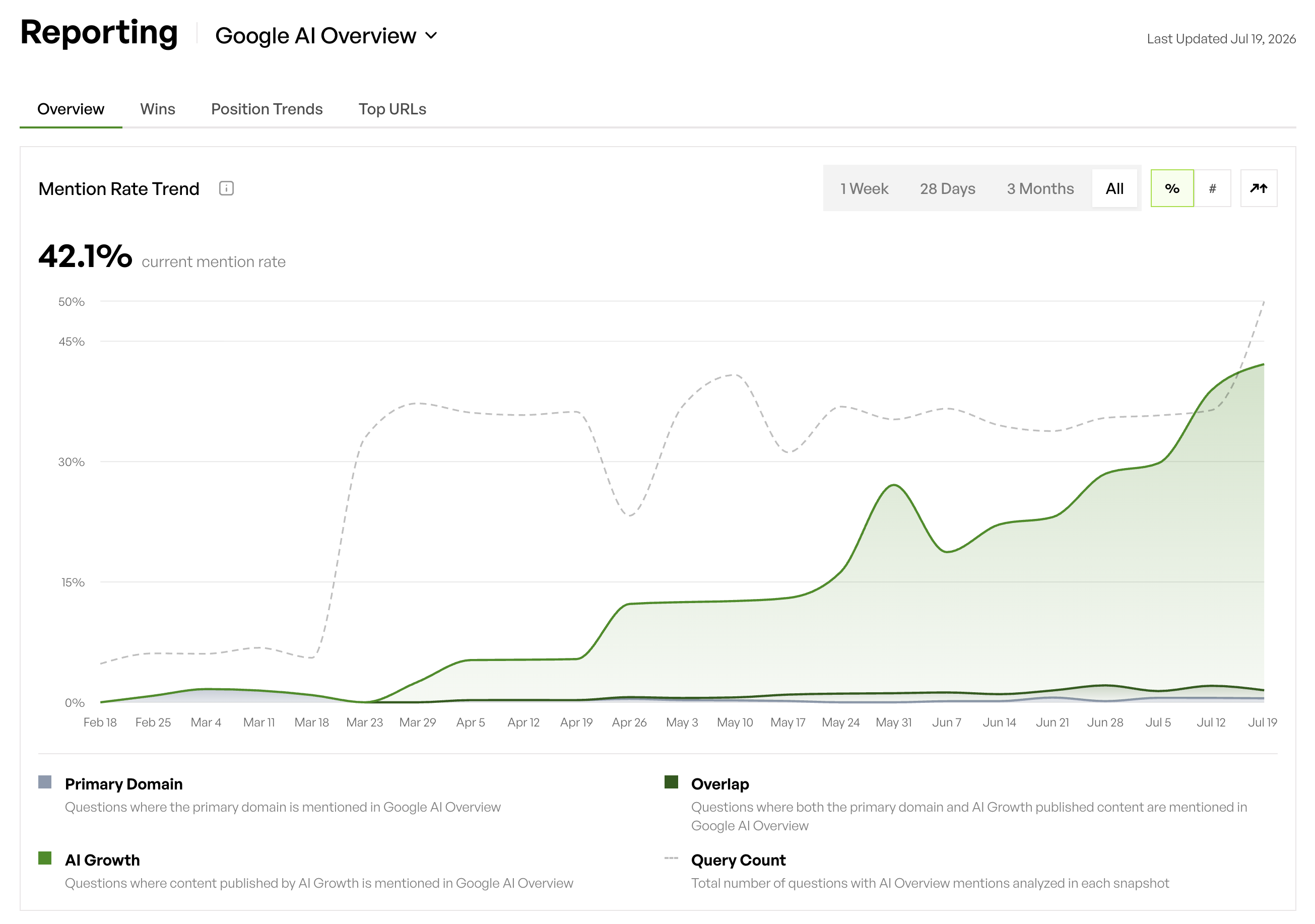
Most monitoring tools track a small, capped set of prompts and stop at diagnosis. They show that you are missing from AI answers and leave the fix to you. AI Growth Agent publishes into a separate environment so it can report incremental visibility, isolating exactly what it generated week over week. Clients see their full universe, with hundreds of seed terms and the long-tail queries beneath them, refreshed weekly, with prompt count never treated as a billed metric.
Common Mistakes and Troubleshooting
| Mistake | Why It Happens | The Fix |
|---|---|---|
| Blocking OAI-SearchBot in robots.txt | Site owners often confuse OAI-SearchBot with GPTBot. | Allow OAI-SearchBot in robots.txt and block GPTBot in a separate rule. |
| Cloudflare blocking the bot at the edge | Cloudflare’s default AI bot protection has been active since July 2025. | Add a WAF skip rule for OAI-SearchBot and disable global AI bot blocking. |
| No structured data | Teams treat schema as technical debt and postpone implementation. | Implement Article, Product, and FAQ schema; pages with multiple schema types are more likely to be cited. |
| Burying the answer | Writers prioritize narrative intros over direct responses. | Open every section with a direct answer and follow the first-third citation pattern described above. |
| No third-party mentions | Brands rely only on owned content and ignore earned media. | Invest in digital PR and review volume; brands with strong trust signals appear in a far higher share of AI answers. |
| Stale content | Teams publish once and never revisit older articles. | Refresh content monthly; updated content receives more citations. |
Future-Proofing Your ChatGPT Visibility Strategy
AI search is still in its first generation, and the leaderboard is forming now. Brands that establish authoritative content today help train the next generation of models with their own narrative, while brands that wait leave that narrative to competitors.
ChatGPT visibility functions as an ongoing system rather than a one-time project. Content ages, competitors publish new claims, and models adjust citation behavior. Brands that win treat this as a systematic, automated program that maps the universe, produces content, monitors results, and refreshes pages over time.
Traditional search tools mainly show your current position. AI Growth Agent actively drives your brand toward becoming the answer. Headless marketing runs this entire system with minimal headcount: one engine replaces the SEO agency, the content tool, the web agency, the GEO monitor, the schema plugin, the analytics stack, and much of the PR effort.
Conclusion
Appearing in ChatGPT responses requires crawl access through OAI-SearchBot, structured content ChatGPT can extract, third-party validation ChatGPT trusts, and ongoing monitoring to sustain visibility. Most brands fall short on at least one of these layers, and most tools only address a slice of the problem.
AI Growth Agent runs the entire system. It maps your universe, produces authoritative content tuned for large language models, launches a fully optimized site you own within the first week, and reports the incremental visibility it generates every week. The content behaves like a living asset that updates and self-heals instead of going stale. Across the first twelve weeks, clients average more than 12,000 additional AI citations and mentions, over 100,000 additional bot visits, and a 20% or greater lift in impressions, with content indexing in as little as ten days.
Frequently Asked Questions
What is the difference between OAI-SearchBot and GPTBot, and which one should I allow?
OAI-SearchBot and GPTBot are two separate OpenAI crawlers that serve different purposes. OAI-SearchBot is the retrieval crawler that powers ChatGPT Search citations. When a user asks ChatGPT a question and ChatGPT pulls live web results, OAI-SearchBot fetches those pages. Blocking this crawler removes your site from ChatGPT Search citations entirely.
GPTBot collects content for training OpenAI’s foundation models. Blocking GPTBot only opts your content out of future training rounds and does not affect whether ChatGPT cites your site in search results.
For most mid-market B2B sites, the recommended configuration is to block GPTBot and allow OAI-SearchBot in robots.txt. This setup keeps your content eligible for citations while opting out of training data collection.
You should also allow ChatGPT-User, which fires when a ChatGPT user explicitly asks the model to fetch a specific URL. Blocking ChatGPT-User breaks user-initiated browsing inside ChatGPT. Many brands intend to block GPTBot and accidentally block OAI-SearchBot, which silently removes them from all ChatGPT Search citations.
Why is my brand not appearing in ChatGPT answers even though my robots.txt allows OAI-SearchBot?
A correct robots.txt covers only one layer of access. Since July 2025, Cloudflare’s account-abuse protection has blocked AI bots by default for many customers, which means the edge layer can overrule your origin robots.txt entirely.
To diagnose this, open your Cloudflare dashboard, navigate to Security → Events, and filter for OAI-SearchBot. If requests show as blocked, add a WAF custom rule that skips bot protection for the OAI-SearchBot user agent. Disable Cloudflare’s “Block AI Bots” toggle and its managed robots.txt feature.
The same edge-layer risk applies to Akamai, Fastly, Imperva, and DataDome, which often treat unknown bots as suspicious by default. Beyond access, your content may also be invisible because it is client-side rendered. Approximately 69% of AI crawlers do not execute JavaScript, so sites built with React, Vue, or Next.js that rely on client-side rendering may appear as an empty page to OAI-SearchBot. Server-side rendering or static site generation resolves this problem.
Even when OAI-SearchBot can reach and parse your pages, ChatGPT still needs third-party validation to trust your brand. If independent sources do not mention your brand, ChatGPT lacks external confirmation of credibility and will often favor sources it can cross-reference.
How long does it take to start appearing in ChatGPT responses after making these changes?
The timeline depends on which layer you improve. Technical access changes, such as updating robots.txt and WAF rules to allow OAI-SearchBot, usually take effect quickly. Once OAI-SearchBot can reach your pages and Bing indexes those pages, they become eligible for ChatGPT Search citations within days to a few weeks.
Content structure improvements, such as implementing answer-first formatting, adding schema markup, and restructuring sections to moderate word counts, often produce measurable citation gains within four to eight weeks.
Building third-party authority through earned media, review platforms, and digital PR takes longer. Expect three to six months for meaningful impact, because this work depends on external parties publishing about your brand and those publications being indexed and recognized by AI systems.
For brands starting from scratch, a realistic expectation is early citation movement within two to six weeks for technical and content fixes, with consistent, sustained citations building over two to three months. AI Growth Agent clients typically see thousands of additional AI citations and mentions in the first twelve weeks, with content indexing in as little as ten days.
Does ranking on Google guarantee that ChatGPT will cite my website?
Google rankings and ChatGPT citations follow different logic. ChatGPT Search uses Bing’s index, not Google’s, so Bing indexation is the more relevant prerequisite for ChatGPT search-mode citations.
Beyond indexation, the selection criteria differ significantly. Only approximately 12% of URLs cited by AI engines rank in Google’s top ten, which means most ChatGPT citations come from pages that do not sit in Google’s top positions.
ChatGPT evaluates content based on extractability, answer-first structure, schema markup, and third-party validation, rather than relying solely on domain authority or Google ranking position. A page that ranks fifteenth on Google can still outperform a first-ranked page if it opens with a direct answer, carries FAQ schema, and is mentioned in multiple independent sources. The first-ranked page may bury its answer in a long introduction.
The practical takeaway is that ChatGPT visibility requires its own optimization strategy that complements traditional Google SEO instead of mirroring it.
What role do third-party mentions play in ChatGPT visibility, and how do I build them?
Third-party mentions act as one of the strongest signals ChatGPT uses to decide whether a brand is credible enough to cite. Earned media accounts for a large majority of AI citations, and brands with active third-party trust signals appear in a far higher share of AI answers than brands without those signals.
ChatGPT cross-references information across multiple independent sources to confirm credibility. A brand that only publishes on its own website faces a structural disadvantage, even with strong on-site content.
The most effective third-party signals include earned media coverage in industry publications, consistent and detailed customer reviews on platforms such as Trustpilot, G2, Capterra, or Yelp, podcast appearances that generate episode pages and transcripts, and consistent NAP data across your website, Google Business Profile, and directories.
Unlinked mentions still count. A mention in a relevant publication that does not link back to your site contributes to the picture AI systems build of your brand’s credibility. Mentions you did not arrange often carry more weight than mentions you coordinated, because AI systems look for consensus across independent, unconnected sources when they assess trustworthiness.