Written by: Mariana Fonseca, Editorial Team, AI Growth Agent
Key Takeaways For Growing AI Share Of Voice
- AI share of voice is a lagging indicator, so improving it requires a sequenced playbook rather than just measurement dashboards.
- Start with a prompt matrix across ChatGPT, Perplexity, and Google AI Overviews to establish a baseline before any changes.
- Prioritize winning third-party mentions on review sites, forums, and listicles before restructuring on-site content for extraction.
- Restructure pages with answer-first paragraphs, question-led headings, FAQ blocks, and schema to make content easy for AI engines to cite.
- AI Growth Agent executes the full sequence autonomously, delivering measurable citation and bot-visit growth within the first twelve weeks.
Book A Demo With AI Growth Agent
Six Phases To Improve AI Share Of Voice
- Phase 1: Build A Prompt Matrix across ChatGPT, Perplexity, and Google AI Overviews to establish a baseline before touching anything else.
- Phase 2: Win Third-Party Mentions First by targeting review aggregators, community forums, and industry listicles before investing in on-site work.
- Phase 3: Restructure On-Site Content For Extraction so answer engines can parse, quote, and cite your pages cleanly.
- Phase 4: Close Competitor Gaps by mapping which prompts competitors win and building the content types that beat them.
- Phase 5: Re-Measure On A Defined Cadence to separate real progress from noise.
- Phase 6: Hand The Sequence To One System Or Run It By Hand depending on the speed and scale you need.
See How AI Growth Agent Runs This Playbook
Why AI Share Of Voice Lags Behind Your Actions
The AI share of voice number you see today reflects citation and content signals that were indexed weeks or months earlier. Consistent improvements in AI share of voice typically show up within 60 to 90 days of running a focused content and citation program, and larger shifts, where a brand moves from rarely mentioned to consistently appearing across a broad range of prompts, generally take 6 to 12 months. LLM update schedules vary. Retrieval-augmented systems like Perplexity can reflect live web changes faster than training-data-dependent models, so citation timing is inconsistent across platforms.
Competitors can also inflate their apparent share with volume, which makes a raw score misleading without competitive context. A brand moving from 8% to 14% over 60 days is on the right track, while a brand stuck at 22% while a competitor climbs from 10% to 19% is losing competitive position despite a higher raw number. This playbook reflects that reality. Each phase sets up the next one, so the order of moves matters as much as the individual tactics.
Phase 1: Build A Prompt Matrix Across Major AI Engines
A prompt matrix gives you the baseline that makes every later phase actionable. Without it, you are working blind. Google’s AI Mode crossed 1 billion monthly users within its first year. The average AI Mode search is triple the length of a traditional query, which means the surface area of prompts you need to cover is far larger than a handful of head terms.
Run 20 or more priority prompts monthly across ChatGPT, Perplexity, Claude, and Google AI Overviews, grouped into five intent categories:
- Identity prompts: brand name, brand plus location, brand plus service
- Service and category prompts: “Best [service] in [market]”
- Problem prompts: “How to [solve problem your product addresses]”
- Comparison prompts: “[Your brand] vs [competitor]”
- Expertise prompts: “[Industry] expert advice on [topic]”
For each prompt, record four data points: whether your brand was cited at all, its position in the cited source list, which competitors were cited alongside it, and what specific information the engine attributed to your brand. That last data point matters most, because it reveals the narrative the model has already absorbed about you, and changing that narrative is the goal of the work.
Connect every prompt to a content or outreach action. A prompt where you are absent but a competitor is present is a Tier 1 fix. Create the content type that competitor used to win it. A prompt where you are named without a link is a Tier 2 fix. Rewrite the opening of the page the model is likely drawing from so your brand name appears in the first 150 words.
Phase 2: Win Third-Party Mentions Before On-Site Work
Once the prompt matrix shows where you are absent, the next decision is where to invest first. Third-party mentions beat on-site work in the first 30 days because AI engines weight external validation more heavily than self-reported claims. The citation almost never points at the seller. It points at the places people talk about the seller.
Community platforms capture 52.5% of all AI citations, while brand-owned domains capture only 47.5%. The source hierarchy to target, in order of citation impact:
- Review aggregators: G2, Capterra, and Trustpilot. Brands with profiles on these platforms have a 3x higher chance of being cited by ChatGPT.
- Industry forums and Reddit threads: Reddit citations in Google AI Overviews grew 450% from March to June 2025. AI models heavily weight organic discussions on platforms like Reddit, Quora, and specialized industry forums.
- “Best of” listicles: 64% of all B2B SaaS AI citations go to listicles and comparison posts. Getting into the right roundups creates more impact than publishing a new blog post.
- Expert contributions: LinkedIn content is now a significant citation source. Between November 2025 and February 2026, LinkedIn went from outside the top 20 cited domains to the most-cited domain for professional queries on ChatGPT.
The strategic implication is direct. Forum consensus and Forbes roundups have to be earned through outreach, not publishing. Focus on earning mentions on the sources the engines already trust before you invest heavily in on-site restructuring.
See How AI Growth Agent Wins Third-Party Mentions
Phase 3: Restructure On-Site Content For AI Extraction
Answer engines extract from the beginning of a section outward, so structure matters as much as substance. Well-structured mediocre content gets cited more often than poorly structured excellent content. The goal in this phase is making your brand easy to quote by structuring content for answer engines and still serving human readers.
The concrete checklist for every priority page:
- Clear headings that name what the section answers. Use H2s as questions or direct statements, not clever titles. “What Does [Product] Do?” consistently beats “Overview.”
- Answer-first paragraphs. Put the direct answer in the first sentence of every section, then add context and detail. A 1,200-word page using answer-first paragraphs, one comparison table, bold definitions, and five sourced statistics consistently outperforms a 4,000-word guide that buries answers in context.
- Bulleted capability statements. Lists are more reliably extracted than prose. Tables and numbered lists rank at “High” extraction reliability, while prose paragraphs rank at “Low” because they require interpretation.
- FAQ blocks with direct answers in the first sentence. FAQPage schema improves AI citation rates by 30% on average, and 72% of pages cited by ChatGPT contained a clear answer capsule within the first few sentences of a section.
- Complete product coverage. State all capabilities and use cases explicitly. Vague content invites AI interpolation, which can produce inaccurate attributions.
Pages with sequential headings and rich schema markup correlate with 2.8x higher AI citation rates. That correlation is why you should implement Article, FAQPage, Organization, and Author schema at the template level so every page ships with the full stack rather than requiring per-page retrofitting. Freshness works the same way. Pages not updated within the last quarter are 3x more likely to lose AI citations, so content freshness functions as a citation retention strategy.
Book A Demo To See This Structure In Action
Phase 4: Close AI Share Of Voice Gaps Against Competitors
The prompt matrix from Phase 1 shows exactly which prompts competitors win. Closing those gaps means mapping each winning competitor prompt to the content type that earned it, then building a stronger version of that content type.
Map competitor wins to one of four page types:
- Comparison pages for prompts containing “vs,” “alternative to,” or “best for”
- Definitional guides for “what is” and category-level prompts
- How-to tutorials for problem and process prompts
- FAQ collections for question-cluster prompts
Prioritize prompts where your brand is absent but a direct competitor is present. These gaps carry the highest leverage because the category already earns citations and you simply do not appear yet. Comparison prompts containing “vs,” “alternative to,” or “best for” are strong opportunities because AI models often struggle to give confident answers when authoritative comparison content does not exist. Publishing a well-structured, answer-first comparison page on a prompt where no authoritative source exists is one of the fastest ways to earn a new citation.
For each gap you close, tie the new content back to the prompt matrix. Run the target prompt again 60 days after publishing and record whether your citation position changed. That feedback loop tells you whether the content type matched the engine’s preference for that query class.
What A Good AI Share Of Voice Looks Like
A single benchmark percentage never defines “good.” AI share of voice only becomes meaningful when you compare it to competitors and to the citation density of your category. A brand at 22% in a fragmented market with no dominant player may hold category leadership. In the 22% vs. 10-to-19% scenario described earlier, the same number signals a loss of ground.
For a detailed look at what good looks like by category and competitive context, see AI Share Of Voice Benchmarks: What Good Looks Like. The frame that matters most is relative momentum. You want to gain share against the competitors who matter, on the prompts that drive your buyers’ decisions.
How To Tell Real Progress From Noise
Real progress in AI share of voice appears over weeks, not days, because AI retrieval pipelines take time to propagate content and citation changes. AI retrieval pipelines take 4 to 12 weeks to propagate schema and content updates, so week-over-week comparisons mainly show variance unrelated to your actions.
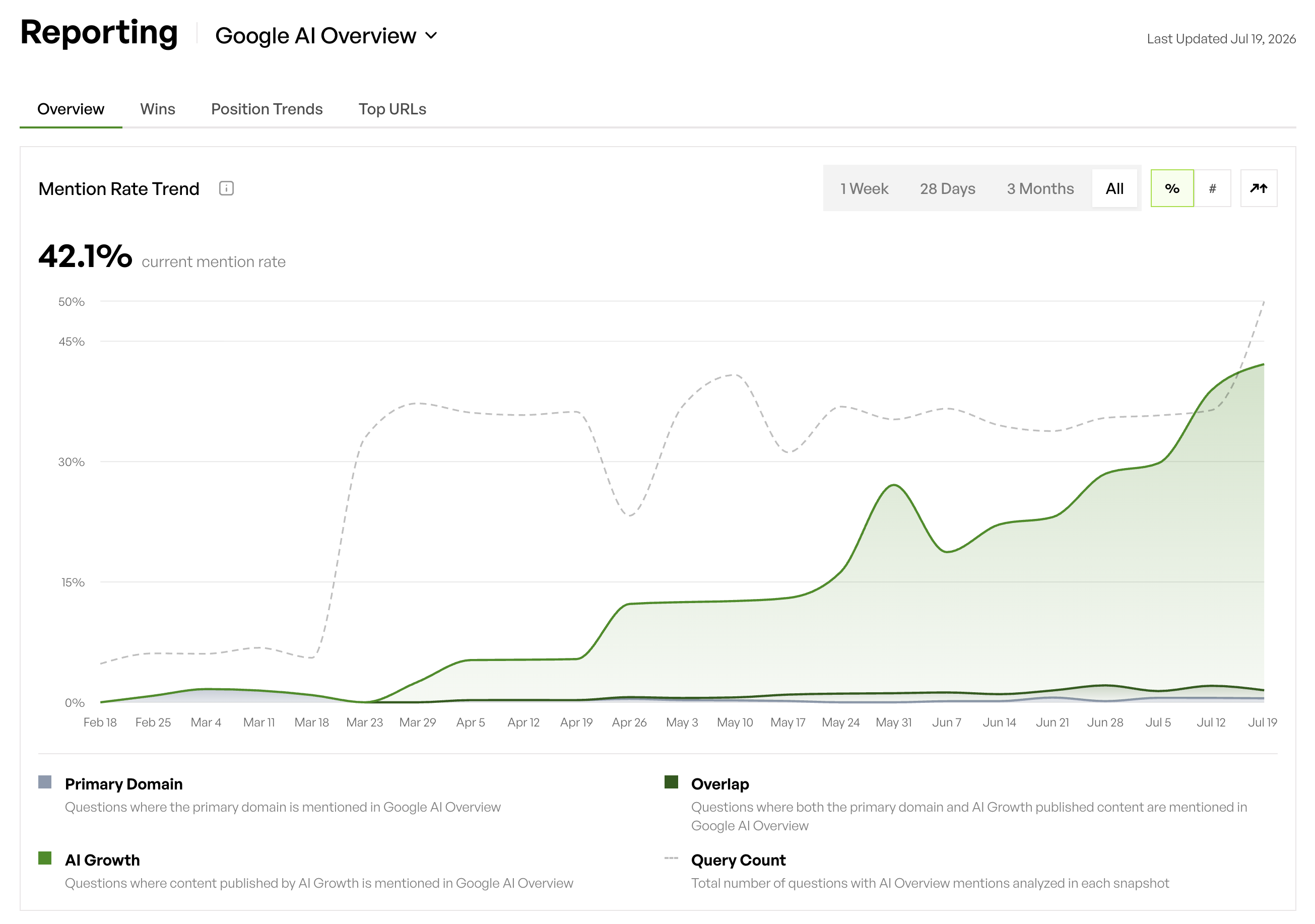
The correct re-measurement cadence is monthly for the full prompt matrix and quarterly for an expanded prompt set. The signals that indicate real progress:
- Citation context: Where your brand appears in an AI answer, who it is grouped with, and what claim it is cited for. This is the new ranking signal. Being cited first alongside category leaders is a different outcome than being mentioned last in a list of alternatives.
- Order of mention: Whether your brand is named first, second, or buried. Position SOV, or how prominently the brand appears, is one of the three components of AI share of voice that matter most.
- Bot activity: Every bot interaction, including every crawl, citation, and training sweep, tells you whether the engines are reading your content. If bot traffic to your pages is not growing, your content is not being indexed at the rate you need.
The signals that are noise are the ones that move without a corresponding change in underlying activity: a single prompt returning a different answer than last week, a one-point share of voice movement in either direction, or citation counts that shift while bot activity and third-party mention volume stay flat.
Approach Comparison: AI Growth Agent Vs. Monitoring-First Tools Vs. DIY
With the sequence defined, the remaining decision is how to run it at the speed and scale your team needs. The table below compares the three main approaches across what each one actually does and where it stops.
| Approach | What It Does | Where It Stops |
|---|---|---|
| AI Growth Agent | Maps the full universe of seed terms and long-tail queries, produces authoritative content validated against primary sources, publishes to a fully optimized site the client owns, self-heals content over time, and reports incremental visibility week over week. Clients average more than 12,000 additional AI citations and mentions and over 100,000 additional bot visits across the first twelve weeks. | Operates at Level 4 autonomy, so the engine plans, executes, handles its own errors, and surfaces only exceptions. The human manages by exception. |
| Monitoring-First Tools | Track brand appearance across a metered set of prompts and surface dashboards showing where the brand appears and where it does not. In 2026, several added action layers such as draft agents, to-do lists, and shadow pages. | The 2026 action layers still hand the work back to a human. Draft agents wait for approval, to-do lists require a team to execute, and shadow pages are not a site the client owns. The loop between measurement and published, self-healing content never fully closes. |
| DIY With A Chatbot | Produces individual well-structured articles against specific prompts. Useful for testing content formats and drafting single pages. | Provides no universe mapping, no validated sourcing at scale, no technical SEO, no schema, no self-healing, and no publishing infrastructure. Quality drifts from the first article to the fiftieth, and consistency breaks down once the process needs to repeat. |
Frequently Asked Questions
These are the questions teams raise most often when they start running this sequence.
How Long Does It Take To Improve AI Share Of Voice?
Consistent improvements typically show up within the 60-to-90-day window described earlier for focused content and citation programs. AI share of voice behaves as a lagging indicator of content and citation work, so the number you see today reflects actions taken weeks or months ago. The planning implication is simple. Start the sequence now, measure at 60 days, and set CEO expectations around the 90-day mark for initial signal and the 6-month mark for meaningful category movement.
How Do I Get Cited By ChatGPT And Perplexity?
ChatGPT and Perplexity pull from different sources, so the emphasis shifts by platform. For ChatGPT, focus on brand mention density and broad topical authority. External mentions across the open web carry more weight than on-site work alone, because ChatGPT weights brand mention density and broad topical authority more heavily.
For Perplexity, focus on traditional Google ranking and recency. Perplexity weights traditional ranking more heavily and leans toward recent web content, so strong technical SEO produces visible Perplexity citation lift faster than it does on ChatGPT. Both engines reward answer-first structure, clear headings, and FAQ blocks. The shared baseline of answer-first paragraphs, question-led H2s, FAQPage schema, and consistent third-party mentions satisfies both platforms without separate content programs.
How Do I Measure AI Share Of Voice Before I Improve It?
Run a manual prompt matrix of 20+ priority prompts across ChatGPT, Perplexity, Claude, and Google AI Overviews, which takes roughly 60 to 90 minutes per cycle. For each prompt, record whether your brand was cited, its position in the cited source list, which competitors were cited, and what information was attributed to your brand. This process requires only a spreadsheet and browser access. Run the full matrix monthly and expand the prompt set quarterly. For a detailed walkthrough of the measurement methodology, see How To Measure AI Share Of Voice Metrics.
What Is The Difference Between AI Visibility And AI Share Of Voice?
AI visibility score is the percentage of prompts where your brand appears at all. AI share of voice adds competitive context by measuring your brand’s citation rate relative to all competitor mentions across the same prompt set. A brand can have high visibility but low share of voice if competitors appear far more often across the same prompts. The practical implication is clear. Visibility tells you whether you exist in the conversation, while share of voice tells you whether you are winning it.
Conclusion: Run The Sequence Or Hand It To One System
Most guidance on improving AI share of voice stops at measurement, but the real gains come from a sequenced order of operations. Build the prompt matrix, win third-party mentions first, restructure on-site content for extraction, close competitor gaps, and re-measure on a defined cadence. Each phase creates the conditions the next phase depends on, so the order matters.
The difference between running this playbook by hand and handing it to one system is architectural. Monitoring-first tools meter prompts, and their 2026 action layers still hand the work back to a human. AI Growth Agent maps the full universe and produces authoritative content. It publishes that content on a site the client owns and self-heals it over time. The engine operates at Level 4 autonomy, so it plans, executes, handles its own errors, and surfaces only exceptions. The human manages by exception while the engine delivers results, automated end to end.
For a broader look at the strategy behind AI share of voice, see How To Measure, Diagnose, And Improve AI Share Of Voice and What Is AI Share Of Voice? Definition And How It Works.
Book A Demo To See If You Are A Good Fit