Written by: Mariana Fonseca, Editorial Team, AI Growth Agent
{ "@context": "https://schema.org", "@type": "Organization", "@id": "https://aigrowthagent.co/#organization", "name": "AI Growth Agent", "url": "https://aigrowthagent.co", "logo": "https://aigrowthagent.co/logo.png", "description": "Autonomous engine that maps a brand's universe and wins AI search citations on autopilot.", "foundingDate": "2024", "sameAs": [ "https://www.linkedin.com/company/aigrowthagent", "https://twitter.com/aigrowthagent", "https://www.crunchbase.com/organization/ai-growth-agent" ], "knowsAbout": ["AI search optimization","schema markup","large language model optimization","headless marketing","entity recognition"] } Key Takeaways for AI Schema Success
- Schema markup turns brand content into structured signals that AI crawlers use to verify entities and confidently cite sources.
- JSON-LD with stable @id references and accurate dateModified values raises the odds of earning consistent AI citations.
- Google and Microsoft confirmed in 2025 that structured data is essential for AI-powered search features and helps LLMs understand and trust content.
- Zero-click searches now dominate user behavior, so entity clarity and content freshness through schema markup are critical for visibility in AI Overviews.
- AI Growth Agent automates schema provisioning, validation, and self-healing across your content universe—see the automation in action.
How Schema Markup Supports AI Search
Schema markup supports AI search by strengthening entity infrastructure rather than acting as a shortcut for citations. Google’s Search team stated in April 2025 that structured data is essential for AI-powered search features, and Microsoft Bing’s principal product manager Fabrice Canel confirmed in March 2025 that schema markup helps Bing’s LLMs understand content for Copilot. Schema makes content recognizable to LLMs during pre-training rather than acting as a real-time citation hack, populating the foundational indexes and knowledge graphs that AI models use when generating answers.
The zero-click context makes this infrastructure urgent. 58.5% of U.S. searches ended without a click in 2024, and AI Overviews appear on a significant share of Google searches, reducing organic click-through rates. In that environment, citation becomes the new ranking. JSON-LD with a stable @id and an accurate dateModified gives AI crawlers two vital signals: entity clarity and content freshness. dateModified is often overlooked but critical because AI Overviews and AI Mode favor recent, well-attributed content. If evergreen content carries a dateModified two years old, it signals staleness to every AI crawler regardless of content quality.
See how AI Growth Agent provisions and self-heals schema across your entire content universe.
Best Schema Types for AI Overviews
The eight templates below form a complete schema foundation, ordered from most fundamental to most specialized. Start with Organization schema to establish entity identity. Then layer in content-level types such as Article, FAQPage, and HowTo that reference that foundation. Finally, add specialized types like Product, LocalBusiness, SoftwareApplication, and WebSite based on your business model. Each template includes inline comments on the fields AI crawlers weight most heavily. Implement them server-side in JSON-LD, because AI crawlers achieve higher parsing success on static HTML with schema but lower success on JavaScript-rendered content.
1. Organization with @id as the Entity Anchor
Organization schema creates the entity foundation that every other schema type references. Organization schema must be implemented before content-level types because AI models build understanding from the ground up, verifying entity identity before trusting content.
{ "@context": "https://schema.org", "@type": "Organization", // Stable @id, all Article and Person schema reference this URI "@id": "https://example.com/#organization", "name": "Brand Name", "url": "https://example.com", "logo": "https://example.com/logo.png", "foundingDate": "2020", // sameAs: minimum 3-5 authoritative profiles for entity verification "sameAs": [ "https://www.linkedin.com/company/brand", "https://www.wikidata.org/wiki/QXXXXXXX", "https://www.crunchbase.com/organization/brand" ], // knowsAbout: 5-10 specific topics used for topical authority scoring "knowsAbout": ["topic one","topic two","topic three"], "contactPoint": { "@type": "ContactPoint", "contactType": "customer support", "email": "[email protected]" } } 2. Article + Person for E-E-A-T Signals
Article and Person schema together express authorship, expertise, and publisher identity in a way AI citation systems can parse. Person schema is present in a high percentage of AI-cited sources, the highest rate of any schema type, indicating that named, credentialed authorship is a consistent predictor of AI citation.
{ "@context": "https://schema.org", "@graph": [ { "@type": "Article", "@id": "https://example.com/article-slug/#article", "headline": "Article Title", // dateModified, update on every edit, used for freshness scoring "datePublished": "2025-01-15", "dateModified": "2026-07-06", "author": { "@id": "https://example.com/team/jane-smith/#person" }, // publisher links back to Organization @id to build a connected entity graph "publisher": { "@id": "https://example.com/#organization" }, "mainEntityOfPage": "https://example.com/article-slug/", "image": "https://example.com/article-image.jpg", "description": "150-character description for AI extraction." }, { "@type": "Person", "@id": "https://example.com/team/jane-smith/#person", "name": "Jane Smith", "jobTitle": "Senior Analyst", // worksFor references Organization @id to close the entity graph loop "worksFor": { "@id": "https://example.com/#organization" }, "sameAs": ["https://www.linkedin.com/in/janesmith"] } ] } With Organization, Article, and Person schema in place, the next layer focuses on structured answers.
3. FAQPage for Structured Answers
FAQPage markup makes pages more likely to appear in Google AI Overviews, with answers between 40 and 60 words optimal for ChatGPT and AI Overview extraction. Google deprecated FAQ rich results in May 2026, so this type now functions as a structured answer layer for AI extraction rather than a rich result trigger. The template below shows how to structure 5–8 high-value questions with concise answers that AI systems can extract and cite, with emphasis on answer length and clear question phrasing.
{ "@context": "https://schema.org", "@type": "FAQPage", // mainEntity: 5-8 questions max, more can signal FAQ padding "mainEntity": [ { "@type": "Question", "name": "What is [topic]?", "acceptedAnswer": { "@type": "Answer", // Keep answers 40-60 words for optimal AI Overview extraction "text": "Concise, factual answer in 40-60 words using natural buyer language." } }, { "@type": "Question", "name": "How does [topic] work?", "acceptedAnswer": { "@type": "Answer", "text": "Direct answer referencing the Organization @id context where relevant." } } ] } 4. Product/Service for Commercial Queries
Product schema describes commercial offerings in a format AI shopping and recommendation layers can trust. Product schema combined with AggregateRating makes products more likely to appear in AI-generated recommendations than basic markup alone.

{ "@context": "https://schema.org", "@type": "Product", "@id": "https://example.com/product-name/#product", "name": "Product Name", "brand": { "@id": "https://example.com/#organization" }, "description": "Factual product description matching visible page text.", "aggregateRating": { "@type": "AggregateRating", "ratingValue": "4.8", "reviewCount": "124" }, "offers": { "@type": "Offer", // priceValidUntil required for shoppable AI surfaces like ChatGPT Shopping "price": "99.00", "priceCurrency": "USD", "availability": "https://schema.org/InStock", "priceValidUntil": "2026-12-31", "seller": { "@id": "https://example.com/#organization" } } } 5. HowTo for Step-by-Step Guidance
HowTo schema turns procedural content into explicit, ordered steps that AI engines can parse and cite. HowTo schema supplies an ordered sequence of steps that AI engines including ChatGPT can parse and cite.
{ "@context": "https://schema.org", "@type": "HowTo", "name": "How To [Task Name]", // totalTime: ISO 8601 duration, used for query matching on timed tasks "totalTime": "PT30M", "step": [ { "@type": "HowToStep", "position": 1, "name": "Step One Name", "text": "One to two sentence instruction matching visible page text exactly." }, { "@type": "HowToStep", "position": 2, "name": "Step Two Name", "text": "One to two sentence instruction." } ], "tool": [ { "@type": "HowToTool", "name": "Required Tool" } ] } 6. LocalBusiness for Physical Locations
LocalBusiness schema fits any brand with a physical presence by combining place and organization details. Schema follows a hierarchical tree structure that allows subtypes like LocalBusiness to inherit properties from both Place and Organization.
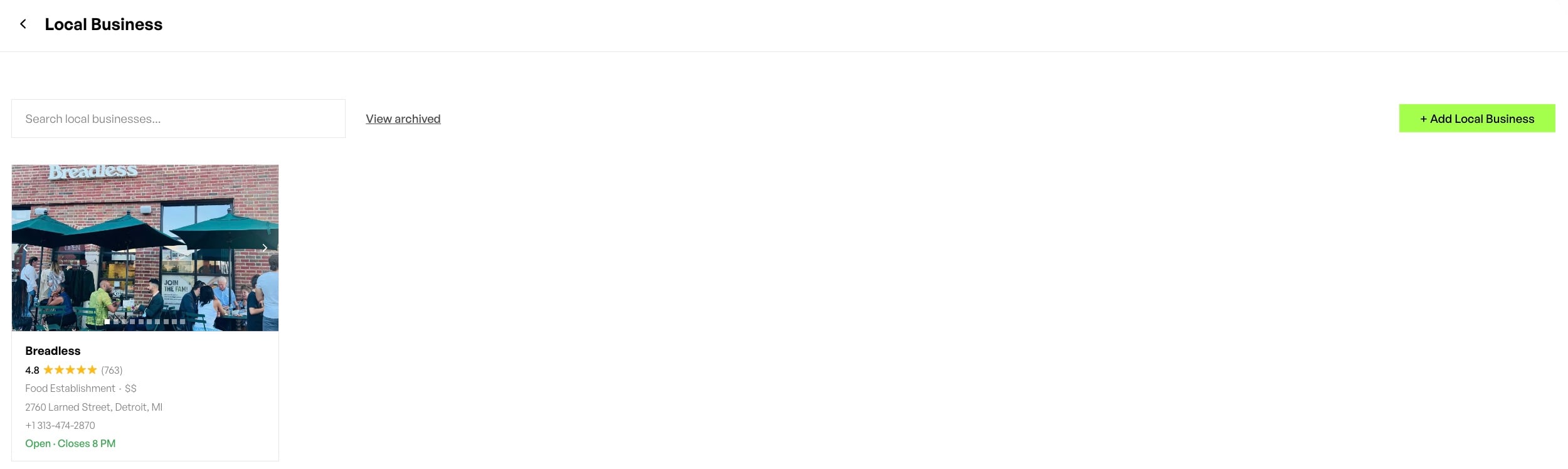
{ "@context": "https://schema.org", "@type": "LocalBusiness", "@id": "https://example.com/#localbusiness", "name": "Brand Name", "url": "https://example.com", "telephone": "+1-800-000-0000", "address": { "@type": "PostalAddress", "streetAddress": "123 Main St", "addressLocality": "City", "addressRegion": "ST", "postalCode": "00000", "addressCountry": "US" }, // openingHoursSpecification, agentic booking surfaces read this directly "openingHoursSpecification": [ { "@type": "OpeningHoursSpecification", "dayOfWeek": ["Monday","Tuesday","Wednesday","Thursday","Friday"], "opens": "09:00", "closes": "18:00" } ], "sameAs": ["https://www.google.com/maps/place/PLACE_ID"] } 7. SoftwareApplication for SaaS Products
SoftwareApplication schema describes SaaS products in a way that supports recommendation queries and agentic tool selection. It clarifies category, platform, pricing, and publisher trust.
{ "@context": "https://schema.org", "@type": "SoftwareApplication", "@id": "https://example.com/product/#softwareapplication", "name": "App Name", "applicationCategory": "BusinessApplication", "operatingSystem": "Web", "offers": { "@type": "Offer", "price": "0", "priceCurrency": "USD" }, // author links to Organization @id to establish publisher trust "author": { "@id": "https://example.com/#organization" }, "aggregateRating": { "@type": "AggregateRating", "ratingValue": "4.7", "reviewCount": "89" }, // dateModified, update with every release for freshness signals "dateModified": "2026-07-06" } 8. WebSite with SearchAction for Agent Queries
WebSite schema with a SearchAction property signals that the domain supports natural language queries and can accept direct query pass-through from AI agents.
{ "@context": "https://schema.org", "@type": "WebSite", "@id": "https://example.com/#website", "name": "Brand Name", "url": "https://example.com", // publisher @id reference closes the entity graph at the domain level "publisher": { "@id": "https://example.com/#organization" }, "potentialAction": { "@type": "SearchAction", "target": { "@type": "EntryPoint", "urlTemplate": "https://example.com/?s={search_term_string}" }, "query-input": "required name=search_term_string" } } How to Validate Schema for ChatGPT Citations
Implementing the eight schema types above is the first step, and confirming they work is the second. Schema that fails validation does not earn citations, which is why the six-step checklist below should be run before and after every deployment.
- Google Rich Results Test. Run every page template through Google’s Rich Results Test to confirm syntax is valid and required fields are present. Re-run after every content update that touches schema fields.
- Schema Markup Validator. Use the Schema Markup Validator to check conformance against the Schema.org vocabulary independently of Google’s rich result rules. This step catches type mismatches and missing recommended properties.
- @id consistency audit. Confirm that every Article, Person, and SoftwareApplication schema on the domain references the same Organization
@idURI. An Article schema linked to an Author, linked to an Organization, linked to a website is far more legible to AI than three disconnected schema blocks. - dateModified alignment. Verify that
dateModifiedin Article and SoftwareApplication schema matches the actual last-edited date visible on the page, as discussed in the context of freshness signals above. Contradictions between structured data and visible content cause AI to lose confidence, reducing citation reliability. - Bot tracking signals. Monitor which AI crawlers read each page so you can tie schema changes to citation outcomes. AI Growth Agent’s WordPress plugin tracks every bot interaction, including the crawler ChatGPT uses to cite sources, so teams can confirm that schema-decorated pages are being read and compare that data with citation rate changes.
- Google Search Console Enhancements. Check the Enhancements report monthly for schema errors and warnings. Quarterly site-wide schema audits are essential to detect drift, deprecated types, and formatting issues that incremental monitoring misses.
See how AI Growth Agent’s validation and bot tracking stack eliminates manual schema audits entirely.
How AI Growth Agent Automates Schema for Living Content
Manual schema maintenance does not scale because the volume of tasks grows faster than any team can handle. A brand publishing two to fifty articles per day cannot hand-code and validate JSON-LD for each piece, update dateModified on every edit, and audit @id consistency across hundreds of pages without dedicated engineering time. That challenge is exactly what headless marketing addresses.
AI Growth Agent provisions all eight schema types automatically at publish time. Every article ships with Article and Person schema that reference a canonical Organization @id. Every product page carries Product, Offer, and AggregateRating schema. Every how-to guide includes HowTo schema with numbered steps. Clients do not configure templates or maintain a separate schema plugin.
Content stays living instead of static. When an article is updated, dateModified updates automatically. When Google Search Console signals that a page is losing impressions, the self-healing engine refreshes the content and the schema together so structured data never drifts from visible page text. For living content, best practices mandate automated schema updates that pull from the same real-time data source as visible page content to ensure structured data always reflects current values.
The WordPress plugin that ships with every AI Growth Agent engagement handles the infrastructure layer that makes schema automation reliable. Bot tracking confirms that AI crawlers read your structured data. Blog MCP exposes schema to agents in a machine-readable format, and automatic indexing ensures schema-decorated pages reach AI systems within days rather than weeks. The plugin also includes advanced robots.txt, a proper sitemap.xml, automatic web stories, instant indexing, autoredirects, and 404 tracking. Agentic technical SEO layers on top: Blog MCP exposes schema, manifest, discovery, and capability guidance to agents; OpenAI discovery and Agent Card guidance are served via /.well-known/; and llms.txt and llms-full.txt are published so AI surfaces can read the brand the way they need to.
Troubleshooting Common Schema Issues
Missing @id links. The most common schema error is failing to implement the @id linking described in the Organization and Article templates above. Using @id references in BlogPosting or Article schema connects it to a canonical Organization schema, enabling AI systems to resolve entities without ambiguity during citation decisions. Fix this by assigning a stable @id URI to the Organization node and referencing it in the publisher and worksFor fields of every Article and Person block on the domain.
Stale dateModified values. A dateModified that has not changed in over a year signals content decay to AI retrieval systems regardless of how accurate the text is. The dateModified field in Article schema serves as a direct recency signal that Perplexity weights significantly higher for content updated within 30 days. Fix this by automating dateModified updates through the CMS so the field reflects the actual last-edited timestamp on every save.
Schema conflicts with existing plugins. WordPress sites running multiple SEO plugins frequently output duplicate or conflicting schema blocks for the same page, which causes AI crawlers to encounter contradictory entity signals. Schema that describes content that is not actually present, or is not the primary focus of the page, reduces trust as a signal for AI citation. Fix this by auditing the page source for duplicate @type declarations, disabling schema output from all but one authoritative source, and using the @graph array to consolidate multiple schema types into a single coherent block per page.
Generic schema with only required fields. Minimal schema that satisfies the validator but omits recommended properties like sameAs, knowsAbout, dateModified, and nested author credentials underperforms. Generic schema containing only required fields produces a citation penalty compared with having no schema at all. Fix this by populating every recommended field, particularly sameAs with a minimum of three authoritative external profiles and knowsAbout with five to ten specific topic areas.
Frequently Asked Questions
Does schema markup directly cause AI systems to cite my content?
Schema markup increases citation probability by reducing the computational work AI systems must do to classify, verify, and trust content. It does not guarantee a citation. The strongest outcomes come from combining complete JSON-LD with @id entity linking, accurate dateModified values, and authoritative content that matches the structured claims exactly. Schema functions as entity infrastructure that makes content recognizable to AI systems during pre-training and retrieval, not as a direct citation trigger.
Which schema type should I implement first?
As explained in the schema templates section, Organization schema is the correct starting point because every other type references its @id. Prioritize a stable @id, a minimum of three sameAs links, and five to ten knowsAbout topic declarations.
How often should dateModified be updated?
dateModified should reflect the actual date of the most recent substantive edit to the page. For evergreen content, that means updating the field whenever facts, statistics, or recommendations change, not on a fixed calendar schedule. Automated CMS workflows that update dateModified on every save are the most reliable approach. A dateModified value that has not changed in over a year signals content decay to AI retrieval systems regardless of the underlying content quality.
Can AI Growth Agent handle schema for a site that already has a schema plugin installed?
AI Growth Agent can work alongside an existing schema plugin by standing up a separate, fully optimized blog connected to the brand’s domain through a reverse proxy rewrite or subdomain. It does not touch the existing main site or its plugins. The AI Growth Agent WordPress plugin handles all schema provisioning, validation, and self-healing for the new property independently, so there is no conflict with whatever schema tooling already runs on the main site.
How do I measure whether schema is contributing to AI citations?
The most direct measurement combines bot tracking data with Google Search Console impressions and citation rate monitoring. AI Growth Agent’s bot tracking layer records every AI crawler visit at the article level, including the crawler ChatGPT uses to cite sources, and cross-references that data with Search Console signals and citation rate changes week over week. Incremental visibility reporting isolates exactly what AI Growth Agent generated, so teams can see whether schema-decorated pages are being read, indexed, and cited at a higher rate than undecorated pages.
Conclusion: Make Your Brand the Answer
In an environment where most searches end without a click, schema markup with proper entity linking and freshness signals is now table stakes for AI citation. A high percentage of pages cited by ChatGPT include structured data, and a page with strong content but broken schema will not get extracted for zero-click surfaces such as AI Overviews or knowledge panels. The eight templates above give any team a production-ready starting point. The harder problem is keeping them current, consistent, and connected across hundreds of living pages without adding headcount.
AI Growth Agent solves that operational problem. A single headless engine provisions all eight schema types at publish time, updates dateModified automatically, maintains @id consistency across the entire content universe, and tracks every AI bot that reads the result. No schema plugin to configure. No engineering queue. No content that goes stale and loses its citation signal. Traditional search tools show you where your brand stands. AI Growth Agent makes your brand the answer.