Written by: Mariana Fonseca, Editorial Team, AI Growth Agent
Key Takeaways for AI Citation-Ready Schema
- Attribute-rich schema markup with complete properties and entity links drives a 61.7% AI citation rate versus 41.6% for generic schema, according to 2026 research across 730 citations.
- Server-side rendered JSON-LD placed in the <head> is essential, as JavaScript-rendered schema drops parse success from 94% to 23%.
- Prioritize Organization, Person, Article, FAQPage, and HowTo schema types with full ISO 8601 dates, sameAs links, and visible on-page content matching.
- Common mistakes such as stale data, missing sameAs URLs, and schema fields without visible counterparts trigger Spammy Structured Data flags and remove citation eligibility.
- AI Growth Agent automates the full attribute-rich schema stack, entity linking, validation, and ongoing maintenance across every template, and you can book a demo to get started.
Technical Prerequisites Before You Add Schema
Goal: Confirm the technical environment supports valid, parseable schema before any markup is written.
Schema markup must be server-side rendered because AI parsing success is 94% for static HTML with schema versus 23% for JavaScript-rendered content. Confirm schema appears in the raw page source, not only in the browser-rendered DOM, so AI systems can read it reliably. JSON-LD is the required format and should sit in a separate <script type="application/ld+json"> tag in the <head>. JSON-LD holds approximately 70% market share among structured-data sites as of 2026, which aligns with Google’s recommendation.
Required inputs: CMS access, raw HTML inspection capability, and a confirmed list of page templates. Roles: A technical SEO or engineer confirms rendering, and a content owner confirms visible on-page fields match intended schema values. Validation checkpoint: Run every URL through the Schema.org Validator and Google’s Rich Results Test before you proceed.
Teams managing schema across multiple domains manually face compounding drift risk as templates and plugins change. See how AI Growth Agent handles prerequisite validation and schema deployment automatically by booking a demo to review your current technical stack.
Schema Selection and Entity Mapping for AI Surfaces
Goal: Match each page template to the correct primary schema type and map entity relationships before writing any JSON-LD.
The priority order for AI citation schema is clear. First, use Organization with sameAs references. Second, add Person schema for named authors with knowsAbout declarations. Third, implement Article with dateModified. Fourth, apply FAQPage on Q&A pages. Fifth, use HowTo for instructional content. Sixth, add SpeakableSpecification for key passages, based on AccuraCast’s September 2025 study of 9,000 citation sources across ChatGPT, Google AI Overviews, and Perplexity.
| Page Template | Primary Schema Type | Required Supporting Types | Entity Links Required |
|---|---|---|---|
| Homepage / About | Organization | WebSite, BreadcrumbList | sameAs to LinkedIn, Wikidata, Crunchbase |
| Blog Article | Article / BlogPosting | Person (author), BreadcrumbList | author @id, publisher @id |
| FAQ Page | FAQPage | BreadcrumbList, Organization | publisher @id |
| Product / Service | Product or Service | AggregateRating, Offer, Organization | brand @id, provider @id |
Use the @graph pattern to combine multiple types in a single block and connect them with stable @id values. The @graph pattern allows combining Organization, WebSite, and WebPage in one block with entity cross-referencing via @id, which supports clean, maintainable implementations that help AI resolve entities accurately. Ensure Organization sameAs arrays contain at least three authoritative URLs such as LinkedIn, Crunchbase, or Wikidata for strong entity disambiguation, and see the Organization Schema section below for the complete implementation.
Article Schema Example That Supports AI Citations
Goal: Supply AI systems with authorship, freshness, publisher identity, and entity relationships for every editorial page.
The fields that drive citation eligibility are author, publisher, datePublished, dateModified, sameAs, about, and mentions. Article schema requires full ISO 8601 datetime format for dateModified (for example, 2026-06-07T00:00:00+00:00) rather than bare YYYY-MM-DD to send effective freshness signals. The Growth Marshal February 2026 study identified sameAs on the author (with LinkedIn mandatory), an image declared at 1200×630 landscape format, and a real dateModified value reflecting actual content updates as the three properties that deliver direct returns in AI citation rates.
<script type="application/ld+json"> { "@context": "https://schema.org", "@type": "Article", "@id": "https://example.com/blog/your-article-slug/#article", "headline": "Your Article Headline Here", "description": "A concise description of the article content, 150–160 characters.", "image": { "@type": "ImageObject", "url": "https://example.com/images/article-image-1200x630.jpg", "width": 1200, "height": 630 }, "datePublished": "2026-01-15T08:00:00+00:00", "dateModified": "2026-07-07T08:00:00+00:00", "author": { "@type": "Person", "@id": "https://example.com/authors/jane-doe/#person", "name": "Jane Doe", "jobTitle": "Senior Content Strategist", "url": "https://example.com/authors/jane-doe/", "sameAs": [ "https://www.linkedin.com/in/janedoe", "https://twitter.com/janedoe" ], "worksFor": { "@id": "https://example.com/#organization" } }, "publisher": { "@id": "https://example.com/#organization" }, "mainEntityOfPage": { "@type": "WebPage", "@id": "https://example.com/blog/your-article-slug/" }, "about": { "@type": "Thing", "name": "Schema Markup for AI Citations", "sameAs": "https://www.wikidata.org/wiki/Q4117183" }, "mentions": [ { "@type": "Thing", "name": "JSON-LD", "sameAs": "https://www.wikidata.org/wiki/Q6244512" }, { "@type": "Thing", "name": "Google AI Overviews", "sameAs": "https://www.wikidata.org/wiki/Q22679" } ] } </script>Validation checkpoint: Confirm dateModified reflects the actual last edit date, the image URL resolves to a 1200×630 file, and the author sameAs LinkedIn URL is live. Book a demo to see how AI Growth Agent maintains author sameAs links and dateModified values automatically as your team publishes.
Organization Schema Example That Anchors Brand Citations
Goal: Establish a canonical brand entity that all other schema types reference so AI systems can verify and cite the organization with confidence.
Organization schema forms the foundation for AI visibility because it establishes clear, consistent brand identity that AI systems use to evaluate source reliability. A canonical Organization node with a stable @id such as https://yoursite.com/#organization should be created on the homepage and referenced site-wide via worksFor and provider properties to prevent fragmented entities across pages. Brands with complete Organization schema, including four or more verified sameAs external identifiers, have a Knowledge Panel creation rate 4.1 times higher than brands with minimal schema.
<script type="application/ld+json"> { "@context": "https://schema.org", "@type": "Organization", "@id": "https://example.com/#organization", "name": "Example Company", "url": "https://example.com", "logo": { "@type": "ImageObject", "url": "https://example.com/logo-600px.png", "width": 600, "height": 60 }, "description": "A concise description of what the organization does and who it serves.", "foundingDate": "2018", "sameAs": [ "https://www.linkedin.com/company/example-company", "https://www.crunchbase.com/organization/example-company", "https://www.wikidata.org/wiki/QXXXXXXX", "https://twitter.com/examplecompany" ], "knowsAbout": [ "Schema Markup", "AI Search Optimization", "Structured Data", "Large Language Model Optimization" ], "contactPoint": { "@type": "ContactPoint", "contactType": "customer support", "email": "[email protected]" } } </script>Validation checkpoint: The sameAs array must contain at least three live, authoritative URLs to deliver strong entity disambiguation signals.
FAQPage Schema Example for Q&A Extraction
Goal: Map question-answer pairs directly to the query format AI systems use so they can extract answers with high confidence.
A BrightEdge study found sites adding FAQ blocks saw a 44% increase in AI search citations. Pages with coherent FAQPage markup were cited 2.3 times more often by Perplexity and 1.8 times more often by Google AI Overviews than equivalent pages without schema, based on 27 PingPrime audits in 2025 to 2026. Google removed FAQ rich results for standard pages on May 7, 2026, yet it explicitly stated it will continue using FAQ structured data to better understand pages, and Perplexity, ChatGPT Search, Gemini, and Google AI Overviews still parse FAQ schema as a primary signal when extracting Q&A answers.
<script type="application/ld+json"> { "@context": "https://schema.org", "@type": "FAQPage", "mainEntity": [ { "@type": "Question", "name": "What is schema markup for AI citations?", "acceptedAnswer": { "@type": "Answer", "text": "Schema markup for AI citations is attribute-rich JSON-LD structured data that supplies AI systems with verifiable entity details, authorship, freshness signals, and entity relationships so models can confidently extract and cite page content across ChatGPT, Perplexity, and Google AI Overviews." } }, { "@type": "Question", "name": "Which schema types improve AI citation rates most?", "acceptedAnswer": { "@type": "Answer", "text": "Organization with sameAs references, Person schema for named authors with knowsAbout declarations, Article with a current dateModified value, and FAQPage on Q&A pages deliver the highest citation lift when fully populated with required properties and entity links." } }, { "@type": "Question", "name": "Does FAQPage schema still work after Google deprecated FAQ rich results?", "acceptedAnswer": { "@type": "Answer", "text": "Yes. Google deprecated FAQ rich results for standard pages in May 2026 but confirmed it continues using FAQ structured data to understand page content. ChatGPT Search, Perplexity, and Google AI Overviews continue to parse FAQ schema as a primary signal for Q&A extraction and citation." } } ] } </script>Validation checkpoint: Every Question.name must match the visible H2 or H3 question text on the page verbatim. Every Answer.text must match visible copy exactly, as mismatches trigger the Spammy Structured Data flag described in the validation section below.
Product, Review, and HowTo Schema Examples for Commerce and How-To Queries
Goal: Cover transactional and instructional page types with the specific properties AI commerce and procedural queries require.
Product schema combined with AggregateRating makes products three times more likely to appear in AI-generated recommendations than basic markup alone. Product schema with filled prices, ratings, and specs achieved the highest AI citation rates in the Growth Marshal February 2026 analysis of 730 citations.

<!-- Product Schema --> <script type="application/ld+json"> { "@context": "https://schema.org", "@type": "Product", "name": "Example Product Name", "description": "A precise description matching visible page content.", "brand": { "@type": "Brand", "name": "Example Brand" }, "sku": "EX-12345", "image": "https://example.com/images/product-1200x630.jpg", "offers": { "@type": "Offer", "price": "49.00", "priceCurrency": "USD", "availability": "https://schema.org/InStock", "priceValidUntil": "2026-12-31", "seller": { "@id": "https://example.com/#organization" }, "aggregateRating": { "@type": "AggregateRating", "ratingValue": "4.7", "reviewCount": "312", "bestRating": "5" } } } </script> <!-- Review Schema --> <script type="application/ld+json"> { "@context": "https://schema.org", "@type": "Review", "itemReviewed": { "@type": "Product", "name": "Example Product Name" }, "author": { "@type": "Person", "name": "Alex Rivera" }, "reviewRating": { "@type": "Rating", "ratingValue": "5", "bestRating": "5" }, "reviewBody": "Visible review text that exactly matches what appears on the page." } </script> <!-- HowTo Schema --> <script type="application/ld+json"> { "@context": "https://schema.org", "@type": "HowTo", "name": "How To Implement Schema Markup for AI Citations", "totalTime": "PT2H", "step": [ { "@type": "HowToStep", "name": "Confirm server-side rendering", "text": "Verify JSON-LD appears in raw page source before browser execution." }, { "@type": "HowToStep", "name": "Map entity relationships", "text": "Assign a canonical @id to Organization and link all Article and Person schemas to it." }, { "@type": "HowToStep", "name": "Validate and deploy", "text": "Run Schema.org Validator and Google Rich Results Test before publishing." } ] } </script>Placement Rules, Validation, and Mistakes That Block Citations
Goal: Remove implementation errors that cause schema to be ignored or flagged before AI systems evaluate content quality.
Place all JSON-LD blocks in the <head> of the page so parsers encounter them early. Every schema property must match visible rendered page content, because Google flags mismatches as Spammy Structured Data. Stale schema, such as outdated prices or availability, performs worse than no schema for Offer fields and can cause AI systems to ignore the data entirely.
| Mistake | Effect | Fix | Validation Tool |
|---|---|---|---|
| JavaScript-rendered JSON-LD | Parse rate drops dramatically | Server-side render all schema | View raw page source |
| Schema fields with no visible on-page counterpart | Flagged as Spammy Structured Data | Match every field to visible content | Rich Results Test |
| Bare YYYY-MM-DD dateModified | Freshness signal ignored | Use full ISO 8601 datetime | Schema.org Validator |
| sameAs array with fewer than 3 URLs | Weak entity disambiguation | Add LinkedIn, Crunchbase, Wikidata | Manual link check |
After any CMS or plugin update, crawl key templates and compare entity counts and @id strings against pre-update baselines to confirm schema remains intact in the rendered HTML. See how AI Growth Agent detects and repairs schema breaks after CMS updates by booking a demo to review your validation workflow.
Measuring AI Citations and Maintaining Schema Over Time
Goal: Build a repeatable measurement loop that connects schema changes to citation rate changes and prevents markup decay.
Pages updated within the last 60 days are 1.9 times more likely to appear in AI answers. AI Overviews often cite recent content, so schema maintenance must remain ongoing rather than a one-time project. Monitor Google Search Console Enhancements weekly, run Screaming Frog structured data extraction crawls monthly, and update dateModified only when content actually changes.
Measurement inputs include the Google Search Console Enhancements report, per-article bot tracking, and AI citation monitoring across ChatGPT, Perplexity, and Google AI Overviews. Track order of mention and citation context as the primary performance indicators, since AI answers do not use static rank positions.
Advanced Multi-Domain Schema Automation with AI Growth Agent
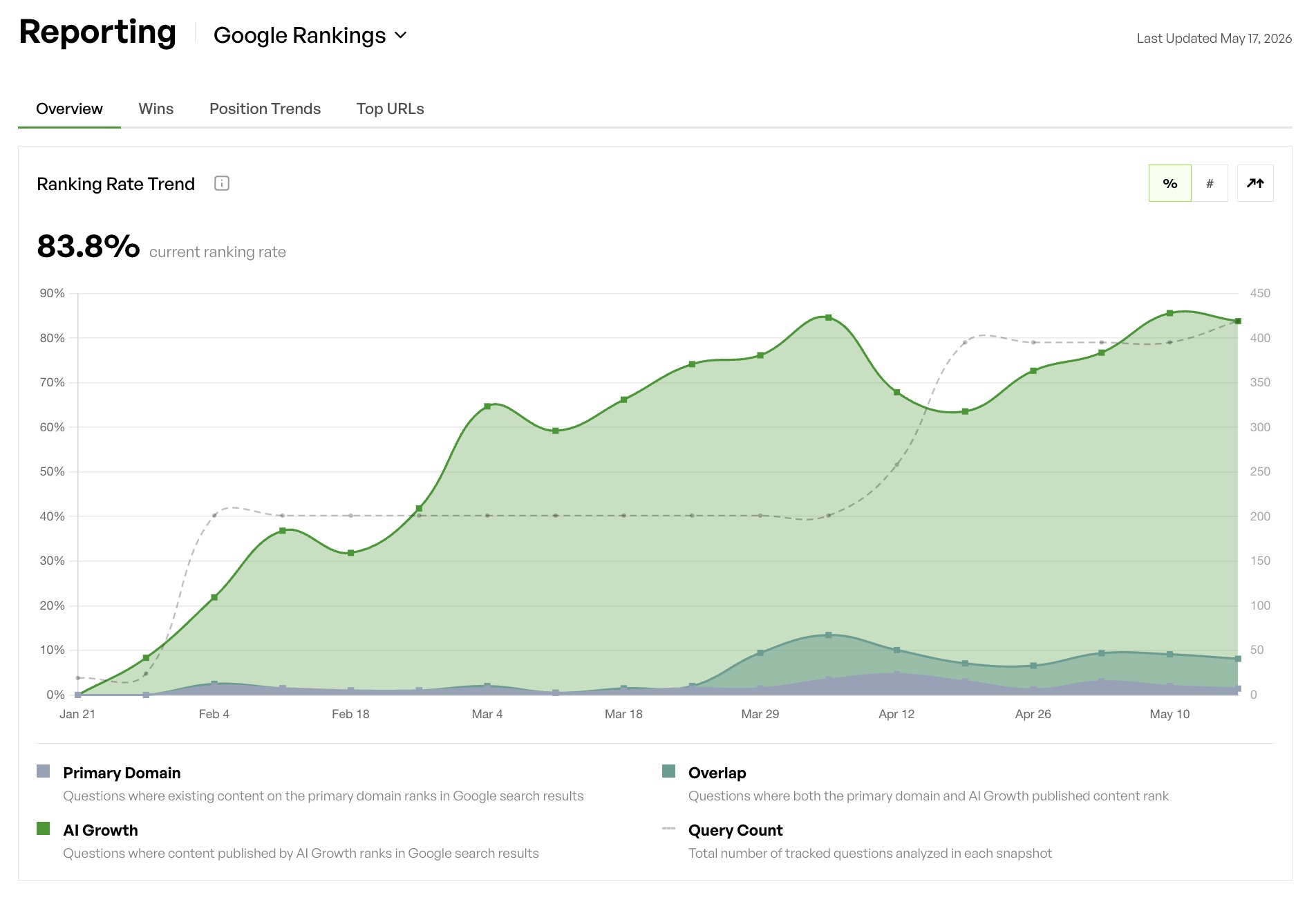
Manual schema implementation across multiple domains creates compounding maintenance debt as each site evolves. Centralizing schema ownership to a single source of truth and disabling overlapping Organization or LocalBusiness graphs emitted by multiple plugins prevents entity collisions. At enterprise scale, that level of coordination requires automation rather than ad hoc fixes.
AI Growth Agent provisions the full attribute-rich schema stack automatically across every article and site template, including Article, Organization, FAQPage, Product, Review, HowTo, Author, and BreadcrumbList schema, with entity linking to Wikidata, LinkedIn, and Crunchbase built in. The engine maintains dateModified values against actual content update cycles, validates every schema block before publication, and self-heals markup after CMS or plugin changes without engineering involvement. Clients averaging more than 12,000 additional AI citations in their first twelve weeks run this stack on autopilot instead of managing it manually.
Frequently Asked Questions
How long does it take for schema markup to improve AI citation rates?
Schema changes are typically crawled within days to weeks, depending on crawl frequency for the domain. Citation rate changes in AI Overviews and LLM-based tools appear the next time those systems index or re-evaluate the page, which can range from days to several weeks. Freshness signals from a current dateModified value accelerate re-evaluation. Brands using AI Growth Agent’s automated schema stack often see content indexed in as little as ten days and measurable citation movement within the first month of a standard three-month pilot.
Who owns schema maintenance in a typical marketing team?
Schema maintenance usually sits at the intersection of technical SEO, content, and engineering, which means it often falls through gaps. Content teams update articles but rarely update dateModified in schema. Engineers deploy CMS updates that silently break JSON-LD blocks. SEO teams validate at launch but rarely run ongoing crawls. Effective ownership requires a single accountable role with a defined validation cadence or an automated system that handles maintenance without human intervention.
Does schema markup guarantee AI citations?
Schema markup does not guarantee AI citations. Schema provides a strong signal that improves citation eligibility and entity disambiguation, but AI systems also weigh content quality, domain authority, topical relevance, freshness, and the competitive landscape. Generic or minimal schema with no filled properties produces no measurable lift. Attribute-rich schema with complete entity linking, current freshness signals, and visible on-page content matching acts as a prerequisite for citation eligibility rather than a guarantee.
What happens to FAQPage schema after Google’s May 2026 deprecation of FAQ rich results?
Google removed FAQ rich result display for standard pages in May 2026 but explicitly confirmed it continues using FAQ structured data to understand page content. ChatGPT Search, Perplexity, and Google AI Overviews continue to parse FAQPage schema as a primary extraction signal for Q&A queries. The implementation standard remains the same. Answers must match visible on-page content verbatim, fall between 40 and 80 words, and lead with a direct response. The change removes the visual rich result in traditional SERPs but does not reduce the value of FAQPage schema for AI citation surfaces.
How should schema be validated before and after deployment?
Pre-deployment validation requires three steps. First, lint the JSON with a JSON validator to catch syntax errors. Second, check schema coverage and entity relationships with the Schema.org Validator. Third, verify Google eligibility with the Rich Results Test. After deployment, monitor Google Search Console Enhancements weekly for errors discovered during crawling. Run structured data extraction crawls with a tool like Screaming Frog monthly to detect regressions after CMS updates, theme changes, or plugin upgrades. Every schema field must have a visible on-page counterpart, because any mismatch risks a Spammy Structured Data flag regardless of whether the schema type generates rich results.
Conclusion: Use Attribute-Rich Schema to Influence AI Citations
Minimal or generic schema produces no measurable lift in AI citations, while attribute-rich schema supports consistent visibility. The implementation phases above cover the complete stack, including technical prerequisites, entity mapping, Article and Organization schema with full property sets, FAQPage markup calibrated for AI extraction, Product and HowTo blocks for transactional and instructional pages, validation rules that prevent silent failures, and a measurement loop that connects schema changes to citation outcomes.
The gap between teams that execute this stack consistently and teams that do not continues to widen. Sixty-six percent of pages cited by AI engines, including ChatGPT, include schema markup, yet few web pages implement the comprehensive structured data and entity signals required for consistent AI citation. Brands that establish attribute-rich schema now, with current entity links and maintained freshness signals, train the next generation of models with their own narrative.
AI Growth Agent is the only headless engine that automates the full attribute-rich schema stack, entity linking, validation, and maintenance across domains without internal engineering resources. Traditional search tools show you where your brand stands, while AI Growth Agent positions your brand as the answer. Book a demo and get your first schema-optimized article live within a week.