Written by: Mariana Fonseca, Editorial Team, AI Growth Agent
Key Takeaways
- AI search optimization for software companies requires active content production and strong technical signals, not just passive visibility tracking across platforms like ChatGPT and Perplexity.
- Monitoring tools measure citation frequency and share of voice but cannot produce content or change what AI surfaces say about a brand.
- Content generation suites and comprehensive SEO tools with AI features remain primarily diagnostic, identifying gaps without closing them through structured publishing.
- Production engines that map query universes, generate authoritative content, and ship complete technical SEO stacks outperform monitoring-only approaches for sustained citation gains.
- Software companies achieve the highest AI citation rates, and AI Growth Agent delivers full-stack production that replaces multiple tools and agencies in one engine—book a demo to see results in your first week.
1. Visibility Trackers That Show Your AI Search Baseline
Foundational visibility tracking tools measure citation frequency, brand mention rate, and share of voice across AI engines. Platforms in this category include Profound, Peec AI, Scrunch AI, and Otterly.AI. They answer a basic diagnostic question: does this brand appear when a buyer asks a relevant question on ChatGPT, Perplexity, Gemini, or Claude?
For software companies, this diagnostic view has real value. Foglift’s 2026 benchmark of SaaS and B2B software brands highlights citation and mention rates across AI platforms. Knowing where a brand sits against industry benchmarks gives teams a clear starting point. Dedicated tracking platforms can detect citation changes faster than all-in-one SEO tools with GEO add-ons, which matters when citation sets shift weekly.
The evaluation criterion that separates useful trackers from noise generators is whether the platform reports share of answer normalized against named competitors rather than raw mention counts. Tracking citation count alone is a vanity metric, because tools that cannot benchmark against competitors act as mention monitors, not citation trackers. Even the strongest competitive trackers share a structural limitation: they record the score but cannot move it, since none of these platforms produce content, add schema, or change what AI surfaces say.
2. Bot Analytics That Explain Why AI Citations Are Low
Knowing the score only helps when you can diagnose why it is low. AI analytics and bot tracking platforms extend visibility measurement into traffic behavior and crawler activity. They reveal which AI bots crawl the site, how often they visit, which pages they index, and whether bot activity correlates with citation outcomes. This category includes platforms that surface GPTBot, PerplexityBot, and ClaudeBot visit data alongside traditional analytics.
For software companies, bot tracking closes a critical blind spot. A VisibleIQ 2026 study of citations from B2B SaaS buyer queries analyzed citation patterns across leading AI models. Without bot tracking, a software team cannot tell whether those crawlers read their pages at all. AI visibility platforms track which bots access a site, how often, and which pages they index, giving teams crawl-level evidence they can use to diagnose gaps.
The key evaluation criterion here is data granularity at the page level. Platform-level citation aggregates obscure which specific URLs AI crawlers see and which remain invisible. Most AI visibility tracking platforms suffer from measurement flaws including API response variance, unbounded statistical noise without confidence intervals, and failure to distinguish brand mentions from passage citations, which can mislead attribution models. Bot tracking platforms that report per-URL crawler activity and cross-reference it with citation outcomes provide the most actionable signal in this category.
3. Content Suites That Create AI-Friendly Formats
Content generation and on-page optimization suites produce article text and recommend structural improvements to existing pages. Tools in this category include Jasper, Writesonic, Surfer SEO, and Frase. They address the production gap that monitoring tools leave open: when a brand is not being cited, something specific needs to be written or restructured.
For software companies, the citation case for structured content production is strong. Adding citations produced a 115.1% AI-visibility increase, adding statistics increased visibility by about 37%, and adding quotations increased it by about 22%, per GEO optimization and Perplexity studies. These results show that AI engines reward content with verifiable claims. Format also matters. Listicles account for 21.9% of all AI citations, ahead of articles at 16.7%, according to 2026 citation data, because their modular structure makes them easier for retrieval systems to parse and attribute. Content generation tools that produce these formats at volume, with the structural elements AI engines prefer, move the needle in ways that monitoring alone cannot.
The evaluation criterion is whether the tool produces content structured for AI retrieval, not just readable for humans. Static HTML with schema can achieve higher AI parse success rates than JavaScript-rendered content or PDF documents. Content suites that output clean HTML with schema markup, named entities, and front-loaded facts outperform those that produce prose tuned only for human readability. A gap remains around publishing infrastructure, because most content suites hand the client a draft and stop there, leaving schema provisioning, technical SEO, and site management to other tools or agencies.

4. SEO Platforms That Add AI Visibility Modules
Comprehensive SEO suites with AI features are established keyword and rank-tracking platforms that have added AI visibility modules. Semrush, Ahrefs, and Moz fall into this category. They offer broad data coverage across traditional search signals and now surface AI citation metrics alongside organic rankings.
For software companies, the traditional SEO data these platforms provide still matters. Traditional Google rankings overlap with AI citations only 38% of the time according to Ahrefs data, which means a software brand focused only on organic rankings misses most AI citation opportunities. SEO suites that surface both signals in one interface reduce the analytical overhead of running separate tools. The WinWithSEO 2026 AI Search Benchmark of commercial-intent queries found that AI search now accounts for 17% of B2B SaaS branded discovery, up from 4% in Q1 2025, a shift that makes cross-signal visibility increasingly important.
The evaluation criterion is whether the AI features are diagnostic or operational. The single most important distinction when selecting an AI search visibility tool is whether it stops at measurement or includes an action layer that turns data into prioritized work, because measurement without action is theater. Comprehensive SEO suites with AI add-ons remain primarily diagnostic. They identify citation gaps but do not produce the content, provision the schema, or publish the pages that close those gaps. For software teams that already have content and engineering resources, these suites provide useful signal. For teams that need to change what AI surfaces say, they serve as a starting point rather than a complete solution.
5. Production Engines That Replace Your AI SEO Stack
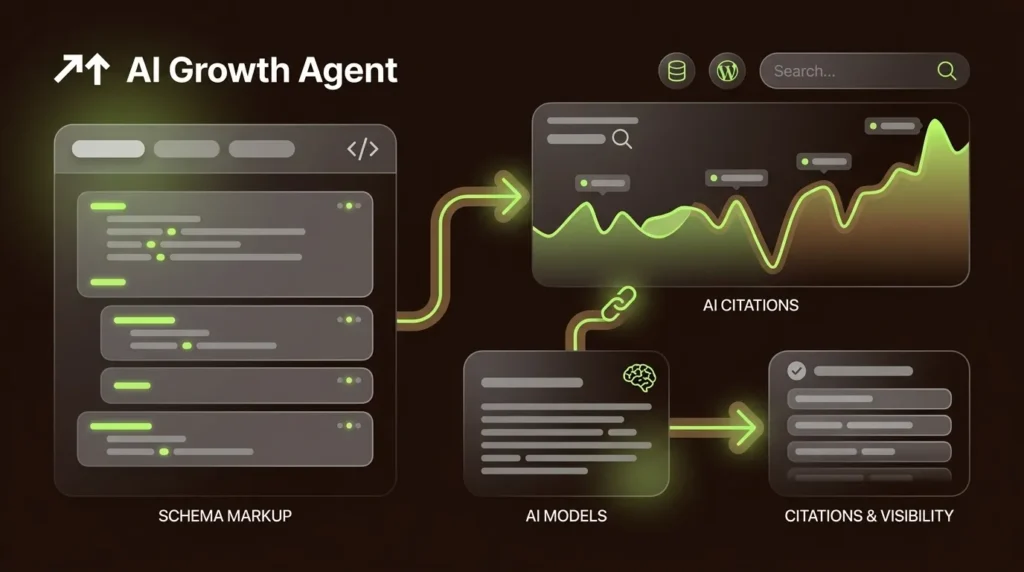
Production engines for full-stack replacement map a brand’s entire query universe, produce authoritative content against it, publish with complete technical and agentic SEO, and report the incremental visibility generated. This category exists because the monitoring-to-execution gap is an architectural gap, not a feature gap that any monitoring tool can close by adding a content module. Meaningful citation rate improvement for B2B SaaS companies typically requires sustained content production, with initial citation movement appearing in one to two weeks and larger gains developing over three to four months.
For software companies, the citation mechanics favor production at scale. Attrifast’s 2026 study of buyer-intent prompts across 12 verticals found SaaS content earned a median 5.1 citations per AI-generated answer, the highest of any vertical studied. Blog posts, listicles, and comparison pages rank among the most cited content formats. Implementing structured-data elements improves prompt coverage significantly. A production engine that ships every article with the full technical stack closes that gap systematically rather than article by article.
The evaluation criterion is whether the engine owns the full loop: universe mapping, content production, technical SEO provisioning, publishing, bot tracking, and incremental visibility reporting. The table below reveals the critical gap. Monitoring tools and content suites each handle one piece of the citation puzzle, while production engines close the entire loop from query mapping through incremental reporting, which explains why monitoring-only approaches plateau while production engines compound citation gains over time.
| Capability | Monitoring Tools (e.g., Profound, Peec AI) | Content Suites (e.g., Jasper, Surfer SEO) | AI Growth Agent (Production Engine) |
|---|---|---|---|
| Universe mapping from real-time AI data | No | No | Yes — hundreds of seed terms and long-tail queries refreshed weekly from live Google and ChatGPT data |
| Authoritative content production with anti-hallucination controls | No | Partial — text generation without claim validation or primary-source verification | Yes — multi-agent orchestration across OpenAI, Anthropic, Gemini, Grok, Perplexity, Exa, and Firecrawl with post-draft claim re-extraction |
| Full technical and agentic SEO stack (schema, MCP, llms.txt, bot tracking) | No | No | Yes — provisioned automatically on every article and site with the static HTML + schema architecture that maximizes parse success |
| Incremental visibility reporting isolated from existing brand visibility | Partial — citation share tracked but not isolated to new content | No | Yes — publishes into a separate environment and reports week-over-week incremental gains cross-referenced with bot traffic and Google Search Console |
Synthesis: Why Production Engines Win Citations at Scale
The tools in categories one through four act as rearview mirrors. They show where a brand stands in AI answers, how often it is cited, and which pages AI crawlers read. That information is necessary but not sufficient. As of 2024, approximately 60% of Google searches ended without a click, according to SparkToro research based on Similarweb data, so a brand that only monitors its citation rate watches revenue conversations happen without it.
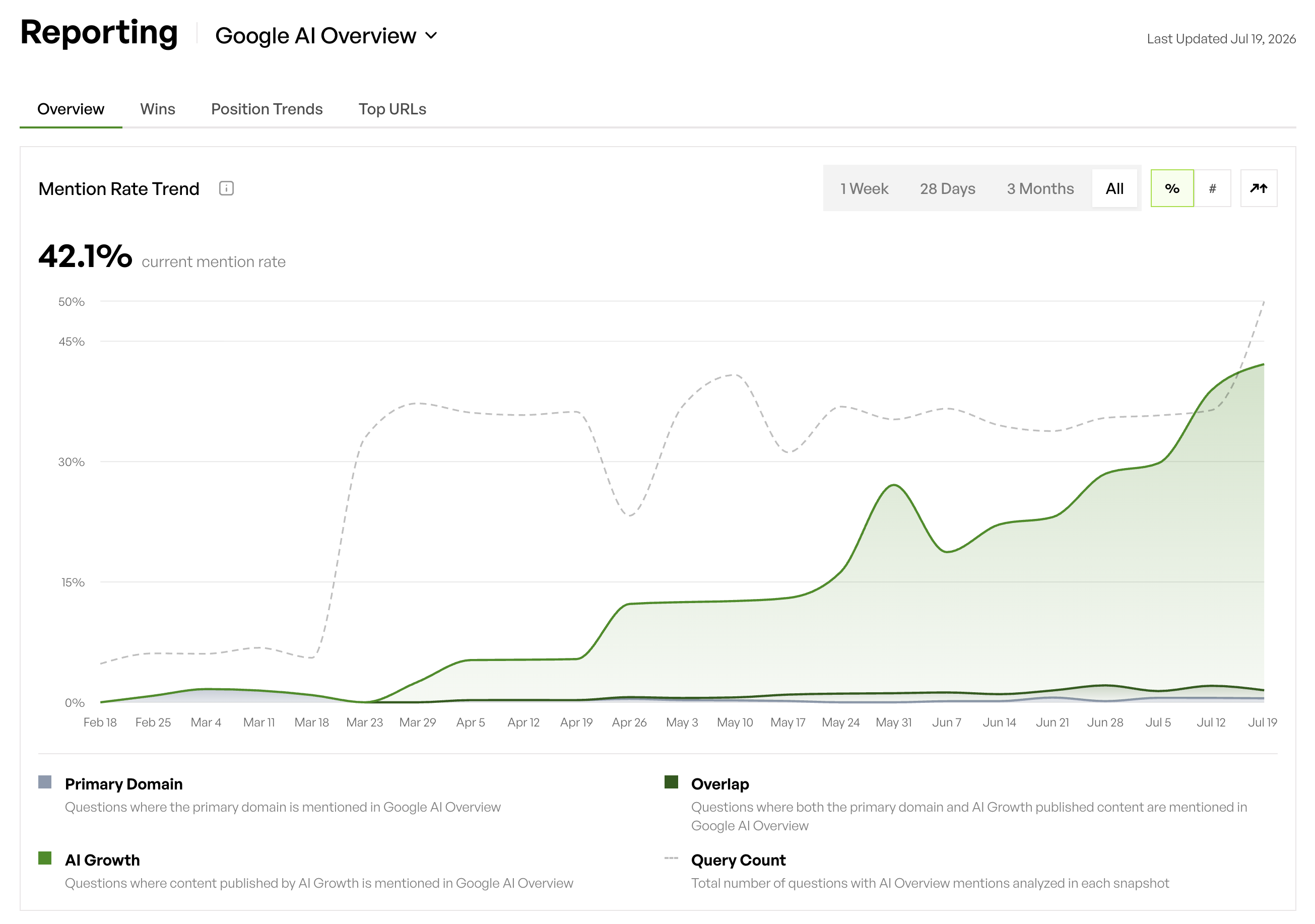
AI Growth Agent is the only headless production engine that maps the full universe of queries a software brand’s buyers actually ask, produces authoritative content validated against primary sources, ships every article with the complete traditional and agentic technical SEO stack, and reports the incremental visibility it generates week over week. Clients average more than 12,000 additional AI citations and mentions and over 100,000 additional bot visits in the first twelve weeks. The content stays alive, because it self-heals and updates over time instead of going stale. One engine replaces the SEO agency, the content tool, the web agency, the GEO monitor, the schema plugin, the analytics stack, and the PR firm.
Frequently Asked Questions
How do I optimize for AI search as a software company?
Software companies optimize for AI search across four layers. First, map the full universe of queries your buyers ask, including long-tail prompts that monitoring tools typically miss. Second, produce authoritative content in formats AI engines preferentially cite, such as listicles, comparison pages, how-to guides, and pricing guides with specific numbers. Third, ship every page with complete technical SEO, including structured HTML, rich schema markup across article, product, software application, and FAQ types, and agentic signals such as llms.txt, Blog MCP, and agent discovery endpoints. Fourth, track bot activity at the page level so you know which AI crawlers read your content and which pages they skip. Monitoring tools answer the fourth layer but leave the first three to the client, while a production engine handles all four.
Is SEO dead in 2026?
Traditional SEO is not dead, but its scope has narrowed. Google’s own documentation confirms that optimizing for generative AI search still counts as SEO, rooted in the same core ranking systems and retrieval-augmented generation. What has changed is that the 38% overlap mentioned earlier means a strategy built exclusively on organic rank misses the majority of AI citation opportunities, and that gap is widening as AI search accounts for 17% of B2B SaaS branded discovery, up from 4% in Q1 2025. The brands that treat traditional technical SEO as table stakes and layer agentic signals on top, including MCP endpoints, llms.txt, and agent discovery, are the ones accumulating citations across ChatGPT, Perplexity, and Google AI Mode simultaneously. SEO remains necessary but no longer sufficient.
What is the difference between a monitoring tool and a production engine for AI search?
A monitoring tool records whether a brand appears in AI answers for a set of tracked prompts. It reports citation frequency, mention rate, and share of voice but does not produce content, add schema markup, publish pages, or change what AI surfaces say. A production engine maps the brand’s full query universe, produces authoritative content against it, ships every article with the complete technical and agentic SEO stack, and reports the incremental visibility it generates. The distinction matters because citation rate improvement requires sustained content production at scale, not observation. Monitoring tells you the score, while a production engine moves it.
How long does it take to see AI citation results from a production engine?
Initial citation movement often appears within one to two weeks of publishing optimized content, with larger gains developing over three to four months as the content indexes and AI crawlers incorporate it into their retrieval layers. AI Growth Agent clients see their first article live within a week of kickoff and content indexing in as little as ten days. The standard engagement is a three-month pilot because indexing timelines vary by industry and query competitiveness, but bot traffic and impression lifts appear early. Clients average a 20% or greater lift in impressions across the first twelve weeks.
Why do software companies specifically benefit from AI search optimization?
SaaS is the highest-citation vertical in AI search. Attrifast’s 2026 study found SaaS content earned a median 5.1 citations per AI-generated answer, compared to 2.4 for healthcare, across 14,400 total observations on ChatGPT, Perplexity, Claude, and Gemini. Software pages earn this advantage because they typically contain comparison tables, named product entities, quantified performance claims, and modular sections that retrieval systems can isolate and attribute. Forrester’s 2025 B2B buyer research found that 94% of B2B buyers now use generative AI in their purchasing process, ranking it as the most-cited information source above vendor websites and sales representatives. For software companies, AI search already functions as the primary channel where buyers make decisions.
Conclusion
The best AI search optimization tools for software in 2026 fall into a clear hierarchy. Foundational visibility trackers, bot analytics platforms, content generation suites, and comprehensive SEO tools each address part of the problem but do not change what AI surfaces say. The brands winning citations at scale in 2026 run a production engine that maps the full universe, publishes authoritative content with the complete technical and agentic SEO stack, and reports the incremental visibility it generates week over week. Traditional search tools show you where your brand stands. AI Growth Agent makes your brand the answer.
Make your brand the answer—go from kickoff to your first published article in one week.