Written by: Mariana Fonseca, Editorial Team, AI Growth Agent
Key Takeaways
- Headless marketing uses one autonomous engine to map queries, publish self-healing content, and grow weekly visibility without adding headcount or agency dependencies.
- Traditional SEO retainers cost mid-market companies thousands to tens of thousands per month, with enterprise firms paying even more, while AI Overviews already appear on nearly half of all queries.
- Both the agency RFP route and DIY chatbot approach break at scale: agencies move slowly with junior staff, and chatbots cannot maintain consistent quality, schema, or citations across hundreds of articles.
- The four pillars of Search Intelligence, AI Analytics, Bot Tracking, and AI Ranking feed a single data backbone that turns market signals into prioritized content decisions and measurable leaderboard gains.
- AI Growth Agent replaces agency dependency with a fully autonomous headless engine; schedule a demo to see how quickly your first articles can go live.
The Real Cost of Replacing an SEO Agency
Replacing an SEO agency with an AI system starts with a clear view of what the agency actually costs. Mid-market companies in the US typically spend $2,500 to $10,000 per month on SEO retainers, with many sources citing ranges such as $2,500–$7,500 or $3,000–$10,000, while enterprise organizations commit $7,000 to $50,000 or more per month. Annualized, these costs can reach tens to hundreds of thousands of dollars per year before a single article ranks.
The timeline multiplies that cost. An agency RFP runs approximately three months. Onboarding, briefing, and first-asset production consume another three months. A brand that starts an agency engagement today will not have meaningful content in market until close to a year from now. Meanwhile, as noted earlier, AI Overviews dominate the search landscape, and AI Mode has crossed 1 billion monthly users. The leaderboard in AI search is being written now, not in twelve months.
The agency model also creates structural dependency. Many brands do not own their own site. The agency controls it, and every change becomes a negotiation. That dependency is the hidden cost no retainer line item captures.
Two Common Paths That Fail in AI Search
Most CMOs and operators reach a decision point once they take AI search seriously. Two options appear obvious, and both fail for the same structural reason.
The first is the agency RFP path. The timeline described above represents the optimistic version. Agencies are staffed by junior analysts who churn, operate on quarterly reporting cycles, and have no native capability in the AI surfaces where buyers now conduct research. The result is visible in the data: 73% of B2B websites experienced net traffic losses between 2024 and 2025, and the agencies managing those sites did not prevent it.
The second is the DIY chatbot path. A chatbot can produce one good article. The second article requires running the entire process again. Teams repeat rounds of review, maintain schema, adjust legal language, and watch quality drift from one piece to the next. One company produced approximately 300 articles this way. Not one was cited. The deep divide between what an engineer thinks content should be, what a marketer wants, and what robots need to cite it remains unsolved by a single model.
Both doors leave brands with stale content and no citations. Both depend on stitching together a stack of agencies, tools, and people. The agency path moves too slowly. The DIY path breaks at scale. Neither creates an AI SEO workflow that replaces agency operations end to end.
Four Search Intelligence Pillars That Drive Results
Monitoring tools that track a capped set of prompts only show whether a brand appears in a handful of AI answers. They do not produce content, own publishing, or act on the data. The four pillars that actually move the needle operate differently.
- Search Intelligence. This pillar builds a complete portrait of the traditional search landscape, including positioning, competition, search volume, and the structure of who is already winning. Every week, hundreds of real searches run in the client's space and agents process the signals, including title structures, forum discussions, “people also ask,” query fan-out, and competitor domains. The result is a current view of the battleground that is more up to date than Google Search Console.
- AI Analytics. This layer tracks brand value and consumer behavior across the full journey, from external touchpoints like Google and AI-tool queries through content consumption, demographics, and sentiment. 51% of B2B software buyers now start their research with an AI chatbot more often than with Google, so this view is essential for understanding where buyers actually are.
- Bot Tracking. This capability records every bot interaction, including traditional crawlers and AI training agents, across every crawl, citation, and training sweep. AI agents now generate 88% as much search traffic as humans. Brands that cannot see who is reading them cannot tell whether they are being read at all.
- AI Ranking. AI answers have no static ordered list, so order of mention and citation context become the new ranking. Where a brand appears in the answer, and how that position evolves week over week against the content plan, forms the new leaderboard.
These four pillars feed a single data backbone that turns the market into a diagnosis and the diagnosis into content decisions, rather than a set of disconnected dashboards. That backbone powers the operational workflow that replaces the agency entirely.
Seven Steps to Build Your AI SEO System
The 7-step replacement workflow takes a brand from agency dependency to a fully autonomous headless marketing engine.
- Kickoff week. A professional journalist interviews the client to build the brand manifesto with voice rules, factual references, deny lists, and personalization. The first articles and keyword topology are reviewed together so the engine generates content the client approves by the end of week one. The first article is typically live within one week of kickoff.
- Content topology. Agents ingest the manifesto and any unstructured material the client provides, then map the full query universe. A new account typically starts with 300 to 400 queries. Mature clients reach universes of 1,600 or more queries, with the system running 3,000 or more searches every week to refresh the snapshot.
- Search intelligence. Real-time Google and ChatGPT data serve as the objective function for which long-tail queries are worth pursuing. The engine identifies white space the client has not thought to defend and surfaces exactly who the top players are for each result.
- Content generation. A multi-agent orchestration across OpenAI, Anthropic, Gemini, Grok, Perplexity, Exa, and Firecrawl produces authoritative content in a single shot. Every claim, source, and quote is validated against evidence found online. Anti-hallucination checks run in cascade before anything ships. Output ranges from 2 to 50 articles per day per client.
- Site setup with reverse proxy. A fully configured site is live within the first week, styled to match the client's brand and connected through a reverse proxy rewrite under a subdirectory or subdomain. The client owns the property outright. No website agency, no RFP, and no dependency.
- Agentic technical SEO stack. Every article and every site ships with the full traditional and agentic technical SEO stack automatically, including rich schema markup, Blog MCP, llms.txt and llms-full.txt, instant indexing, autoredirects, 404 tracking, and agent discovery via /.well-known/. No technical skill is required from the client.
- Incremental visibility reporting. The engine publishes into a separate environment and reports only the visibility it actually generated, week over week, cross-referencing bot traffic, Google Search Console, and citation data.
AI SEO Workflow That Replaces an Agency Team
The engine maps the full universe of seed terms and long-tail queries from real-time Google and ChatGPT data. Robots search the long tail. 80% of AI-cited URLs do not rank in Google's top 100 for the same query, which means brands that focus only on head terms stay invisible to most of their own market.
Content production runs as a sophisticated orchestration, not a single model behind a prompt. The engine analyzes the specific search to decide what kind of content should exist, whether a guide, a listicle, a comparison, or a mix. It spawns parallel research agents to gather what a real journalist would need, validates every source, and runs a cascade of anti-hallucination checks across primary and external sources. Memory systems enforce brand voice, block unwanted language, and cite external research in APA-format citations. The same correction is never needed twice.
Mid-market agencies produce 10 to 20 articles per month at typical retainer costs. The headless engine produces 2 to 50 articles per day per client, up to approximately 500 per month, at a flat fee with no per-article charges, credit limits, or per-prompt billing.
Living Self-Healing Content and Agentic Technical SEO
Content remains active instead of shipped and forgotten. When the year turns, every article in a sector refreshes automatically. When Google Search Console signals that a page is losing ground, the engine updates it. Every article's relationships, performance, and bot and Search Console data are centralized so authority compounds instead of decaying. Pages not refreshed quarterly are 3x more likely to lose AI citations, and most commercial-stage AI citations come from pages updated within the past 12 months.
The agentic technical SEO stack ships with every package and requires no action from the client.
Traditional technical SEO at the article level includes:
- Highly structured HTML with full metadata on every asset
- Rich schema markup across article, author, reviews, local business, product, software application, and the full schema suite
- Internal linking that compounds authority across the universe
- Protected external linking marked noindex and nofollow
Traditional technical SEO at the site level includes:
- Proper sitemaps and a detailed robots.txt
- Automated web stories with a dedicated web-stories sitemap
- Real-time bot tracking showing exactly when ChatGPT cites the content
- Instant indexing, autoredirects, and 404 tracking
Agentic technical SEO includes:

- Blog MCP, compatible with Chrome 146 and other WebMCP-enabled browsers, with schema, manifest, discovery, and capability guidance exposed to agents
- OpenAI discovery and Agent Card guidance served via /.well-known/
- Natural language query parameters via /?s={query} that auto-trigger personalized, internally linked responses
- Markdown served to agent crawlers
- llms.txt and llms-full.txt published so AI surfaces can read the brand the way they need to
Many headless CMS sites have at least one critical AI crawlability issue, most commonly blocking PerplexityBot or GPTBot in robots.txt. The agentic technical SEO stack eliminates every one of those failure modes by default.
Incremental Visibility Reporting You Can Trust
The engine publishes into a separate environment so it can take credit only for the visibility it actually generates, never for visibility the brand already had. Reporting isolates exactly what AI Growth Agent contributed, week over week.
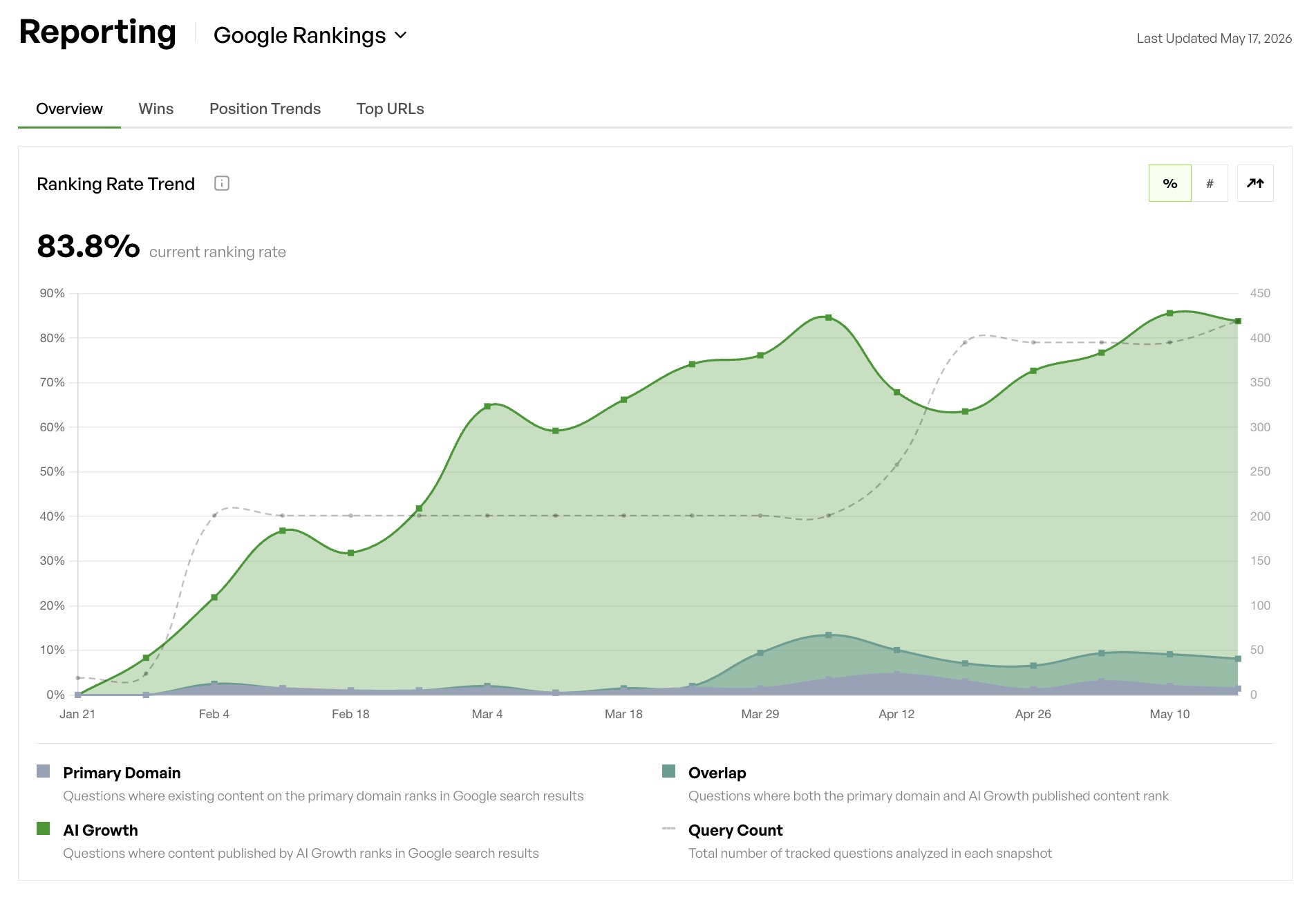
Three data streams feed the incremental visibility picture:
- Bot analytics tracking every bot that touches the blog, including the bot ChatGPT uses to cite sources
- Google Search Console as an independent audit of impressions, clicks, and average position
- Citation data cross-referenced against content plan execution
The engine doubles down on what indexes well and uses internal linking to lift what does not. This closed feedback loop matches what McKinsey describes as a defining competitive advantage that becomes structural once scaled. Agents execute strategies, evaluate performance data in real time, and automatically update internal playbooks.
Agency Versus Engine: Side-by-Side Comparison
| Criterion | Traditional SEO Agency | AI Growth Agent Headless Engine |
|---|---|---|
| Speed to first asset | 3-month RFP plus 3 months to first assets | First article live in approximately 1 week, with indexing in as little as 10 days |
| Cost structure | $3,000–$50,000+ per month retainer, plus $2,500–$10,000 per technical audit | Flat fee with no per-article charges, credit limits, or per-prompt billing |
| Content volume | 10–20 articles per month at mid-market retainer | 2–50 articles per day per client, up to approximately 500 per month |
| Technical SEO | Separate developer handoffs, plus $1,500–$7,500 per technical fix | Full traditional and agentic technical SEO stack included in every package, with no client engineering required |
| Site ownership | Agency frequently controls the site, creating client dependency on every change | Client owns the site outright from week one, and the reverse proxy rewrite requires no agency |
| Reporting | Quarterly or monthly dashboards with no isolation of incremental visibility | Weekly incremental visibility reporting isolating exactly what the engine generated, cross-referenced with bot traffic, Google Search Console, and citation data |
Real Client Outcomes From AI Growth Agent
Across the first twelve weeks, AI Growth Agent clients average more than 12,000 additional AI citations and mentions, over 100,000 additional bot visits, and a 20% or greater lift in impressions.
Standout results include:
- Leva Sleep is now the most mentioned retailer for adjustable beds in Canada. ChatGPT cites Leva Sleep content over 10,000 times per month. Deals of $40,000 to $50,000 closed in under three weeks from buyers who walked into the store carrying the blog and asking about specific features they had discovered through AI Growth Agent content.
- Breadless is now one of the most recommended healthy franchises in the US, ahead of CAVA, Rush Bowls, and Sweetgreen in its search universe. Google Search Console impressions grew approximately 30x in six months. ChatGPT cites eatbreadless.com over 45,000 times per month.
- Bisutti has 71% of its brand mention visibility driven by AI Growth Agent and is now the second most recommended events brand by AI in Brazil.
- Jota achieved a 190% or greater traffic increase from generated content over three months, with first citation within two weeks.
- One client's organic traffic grew approximately 50x.
“AGA's content didn't just drive traffic, it drove customers into our stores. In a matter of weeks, sales teams were closing deals ($40,000 to $50,000 in sales in under 3 weeks, to be exact) with buyers who discovered us through AI Growth Agent's articles.” — Matthew Timmins, CEO of Leva Sleep
“I've tried every monitoring platform and worked with every tool and agency out there to win visibility in AI Search. Nothing delivered results like AI Growth Agent.” — Adriano Meirinho, CMO & Co-Founder at Celcoin
Frequently Asked Questions
How long does it take to see results after replacing an SEO agency with AI Growth Agent?
The first article is typically live within one week of kickoff. Content has indexed in as little as ten days and often within two weeks. The standard engagement is a three-month pilot because indexing timelines vary by industry and competitive landscape, but clients consistently see movement early. Leva Sleep closed its first AI-sourced deals within three weeks. Jota achieved its first citation within two weeks and consolidated authority within a month. The contrast with a traditional agency, where the first assets arrive roughly six months after the RFP begins, is structural, not marginal.
Does replacing an SEO agency with this system require a technical team on the client side?
No. That outcome defines headless marketing. The engine provisions valid schema, the full WordPress plugin stack, robots.txt, sitemaps, automatic web stories, Blog MCP, agent discovery via /.well-known/, llms.txt and llms-full.txt, instant indexing, autoredirects, and 404 tracking automatically. The only integration step on the client's side is the reverse proxy rewrite that connects the blog to a subdirectory under the brand's domain. Setup documentation is generated for the client's specific host, whether Cloudflare, Vercel, or another provider. The internal team gives feedback in plain language and the system learns. No SEO specialist, no engineer, and no schema work are required.
How does incremental visibility reporting prove that results came from AI Growth Agent and not from existing brand authority?
AI Growth Agent publishes into a separate environment, which means it can isolate exactly what it generated rather than taking credit for visibility the brand already had. Reporting cross-references three independent data streams: per-article bot analytics tracking every bot that touches the blog including the bot ChatGPT uses to cite sources, Google Search Console as an independent audit of impressions and clicks, and citation data mapped against the content plan. The engine doubles down on what indexes well and uses internal linking to lift what does not. In a zero-click world where buyers rarely click through to verify AI answers, the clients who measure best capture source at the conversion moment, and they consistently see a lift in organic leads after starting.
What happens to content quality and brand voice when production scales to 50 articles per day?
Brand voice is enforced through a memory system that carries style rules, preferred terminology, words to avoid, and house conventions into every future generation. When a brand calls users “members” instead of “users,” that rule is configured once and respected everywhere. The manifesto built during kickoff week serves as the primary source of truth, and every claim, source, and quote is validated against evidence found online rather than a model's training data. Anti-hallucination checks run in cascade after every draft, re-extracting every claim and checking it against product pages, the manifesto, primary sources, and verified external sources. Any claim that cannot be backed up is removed or softened before the article moves further down the pipeline. The same correction is never needed twice because the system saves memories from every client review session.
Is AI Growth Agent suitable for regulated industries with legal and compliance requirements?
Yes. The engine supports legal disclaimers, dynamic claim prioritization for sensitive sectors, and validates every claim against evidence found online rather than a model's training data. Requirements are configured once during kickoff and applied to every future generation. Clients in finance, health, and other regulated fields can specify which classes of claim deserve the heaviest scrutiny, and the engine focuses its anti-hallucination checks there. Chicago-style superscripts apply fixed and dynamic disclaimers where the sector requires them. The journalist-led layer that shapes how content is produced brings the same rigor to regulated content that a senior editor would apply, without the timeline or cost of a human editorial team.
Conclusion: Take Control of Your AI Search Narrative
The evaluation criteria for replacing an SEO agency with an AI system reduce to four statements. The system must map the full query universe, not a capped handful of tracked terms. It must publish and self-heal content, not only monitor what exists. It must provision the complete technical and agentic SEO stack without requiring a technical team. It must prove incremental visibility week over week rather than taking credit for authority the brand already had.
The agency RFP path and the DIY chatbot path both fail those tests. The headless marketing engine passes all four. The brands cited in AI search this year are training the next generation of models with their own narrative. The brands that wait are training the next generation with whatever happens to be sitting on the open web.