Written by: Mariana Fonseca, Editorial Team, AI Growth Agent
Key Takeaways
- Agent-enabled sites isolate incremental visibility by publishing into a dedicated environment, which allows accurate attribution of AI citations, bot visits, and impressions.
- ROI uses the formula (Hard Savings + Revenue Lift + Soft Visibility Value − Engine Cost) / Engine Cost × 100, tracked monthly with three-month averages.
- Typical 12-week results include about 12,000 new AI citations, 100,000 additional bot visits, and a 20% impressions lift, with payback windows between 4 and 14 months.
- Common ROI mistakes include misattributing AI traffic as direct, counting existing visibility as incremental, and using attribution windows that are too short.
- AI Growth Agent delivers measurable ROI through living content and headless architecture. Book a demo to map your query universe and project site-specific returns.
2026 Benchmarks for Agent-Enabled Sites
Machine-mediated discovery dominates the web in 2026, which makes site-specific ROI measurement urgent. Bots generated 57% of web page requests on Cloudflare’s network by mid-2026, the first time machines have requested more pages than humans in the commercial internet’s history. Adobe data showed AI traffic to U.S. retail sites surged 269% year-over-year in March 2026 alone. BrightEdge projects AI agent activity will surpass human-driven search by the end of 2026.
Against that backdrop, typical results for agent-enabled sites across the first twelve weeks of deployment show a consistent pattern. AI citations and bot visits grow exponentially, while traditional metrics like impressions lift more gradually, which creates a compounding visibility advantage that accelerates over time.
| Metric | Typical Average (First 12 Weeks) | Standout Client Result |
|---|---|---|
| AI citations and mentions | +12,000 | Breadless: 45,000+ ChatGPT citations per month |
| Bot visits | +100,000 | Leva Sleep: 10,000+ ChatGPT citations per month |
| Impressions lift | +20% | Breadless: 30x lift in Google Search Console impressions over 6 months |
| Time to first indexing | As little as 10 days | Jota: first citation within 2 weeks |
| Payback window (typical) | 4 to 14 months | Leva Sleep: $40,000–$50,000 in deals closed in under 3 weeks |
These figures align with broader 2026 deployment data. IBM’s 2026 survey of 2,400 enterprise AI deployments reports a median ROI of 171% over 12 months for production AI agents. SoundHound AI’s June 2026 production study found 96% of organizations running agentic AI met or exceeded their ROI expectations.
The 3-Pillar Site ROI Model
A defensible ROI model for agent-enabled sites rests on three pillars, and each pillar captures a distinct category of value that the engine generates.
Hard savings are the most straightforward to calculate. An agency RFP runs approximately three months, then three more to produce the first assets. A single headless engine replaces the SEO agency, the content tool, the web agency, the GEO monitor, the schema plugin, the analytics stack, and the PR firm. The difference between that fully loaded stack cost and the engine’s flat fee becomes a direct bottom-line benefit that requires no attribution modeling.
Revenue lift is measured through incremental AI-referred sessions converted at your blended rate. This calculation becomes more valuable when you account for the quality difference, because AI-referred visitors often convert at higher rates than organic search visitors across B2B SaaS sites. Adobe Digital Insights data shows AI-referred traffic converted 31% better than non-AI traffic during the 2025 holiday season, with revenue per visit 32% higher than non-AI sources. Revenue lift calculations must apply a 40 to 60 percent attribution factor to avoid crediting AI visibility for demand driven by other brand awareness channels.
Soft visibility captures compounding brand presence that does not yet convert directly. Brands cited in AI Overviews earn 35% more organic clicks and 91% more paid clicks compared to non-cited competitors on the same queries. Citation rate, share of voice across AI platforms, and branded search lift act as the leading indicators. Zero-click searches reached 58.5% of U.S. searches in 2025, with high rates when AI Overviews appeared, which means soft visibility is not a vanity metric. It now functions as the primary channel through which most discovery occurs.
How to Calculate ROI for Agentic AI
ROI calculation for agentic AI on a site starts with four baseline inputs before any engine goes live. These inputs are fully loaded hourly cost per role, current time spent on automatable tasks, monthly task volumes, and a snapshot of existing bot visits, citations, and impressions. Without those baselines, every downstream figure becomes an estimate rather than a measurement.
The four-pillar data foundation that AI Growth Agent uses to ground every calculation covers Search Intelligence, AI Analytics, Bot Tracking, and AI Ranking. Search Intelligence tracks the traditional search landscape, including positioning, competition, and search volume. AI Analytics measures brand value and consumer behavior across the full journey. Bot Tracking records every crawl, citation, and training sweep from traditional and AI crawlers. AI Ranking monitors order of mention and citation context in AI answers, tracked week over week. Each pillar feeds a different line in the ROI model.
Site-specific examples show the difference between general agent ROI and agent-enabled site ROI. A content team spending 42% of hours on automatable tasks can calculate hard savings directly from hours recovered. The more significant value on an agent-enabled site comes from the citation flywheel. Ramp’s experiment found that pages with higher existing AI citation volumes were far more likely to have their content surfaced by LLMs, regardless of content format. That pattern creates a compounding return that accelerates as the content library grows.
5-Step ROI Formula Using Site-Specific Metrics
This walkthrough uses the metrics that agent-enabled sites can actually observe, including bot visits, citations, and incremental impressions.
- Set the baseline. Pull Google Search Console impressions, branded search volume, and bot visit counts from server logs for the 90 days before launch. Record the fully loaded monthly cost of every tool and agency the engine will replace.
- Measure incremental bot visits. After launch, compare bot visit counts from the engine’s dedicated environment against the pre-launch baseline. B2B SaaS websites typically receive between 750 and 4,000 AI page fetches per day, but much of that volume does not trigger Google Analytics sessions, so server log analysis is required.
- Track citation rate and share of voice. Count AI citations per month across ChatGPT, Perplexity, and Google AI Mode. Apply the AI Attribution Index, which uses detected AI referrals multiplied by a known multiplier of 2.5 to 3x to account for misattributed direct traffic, plus anomalous direct traffic to cited pages weighted by engagement score.
- Calculate revenue lift. Multiply incremental AI-referred sessions by your blended conversion rate and average deal value. Apply a 40 to 60 percent attribution factor. Use a 30 to 90 day attribution window to capture delayed conversions that occur after AI discovery.
- Run the formula. ROI = (Hard Savings + Revenue Lift + Soft Visibility Value − Engine Cost) / Engine Cost × 100. Report median and trailing three-month averages. Flag outlier weeks rather than presenting them as steady-state performance.
Leva Sleep: 3–12 Month Payback in Practice
Leva Sleep provides a concrete illustration of the formula in action. The team needed to establish leadership in the North American adjustable bed market and convert AI search visibility into revenue.
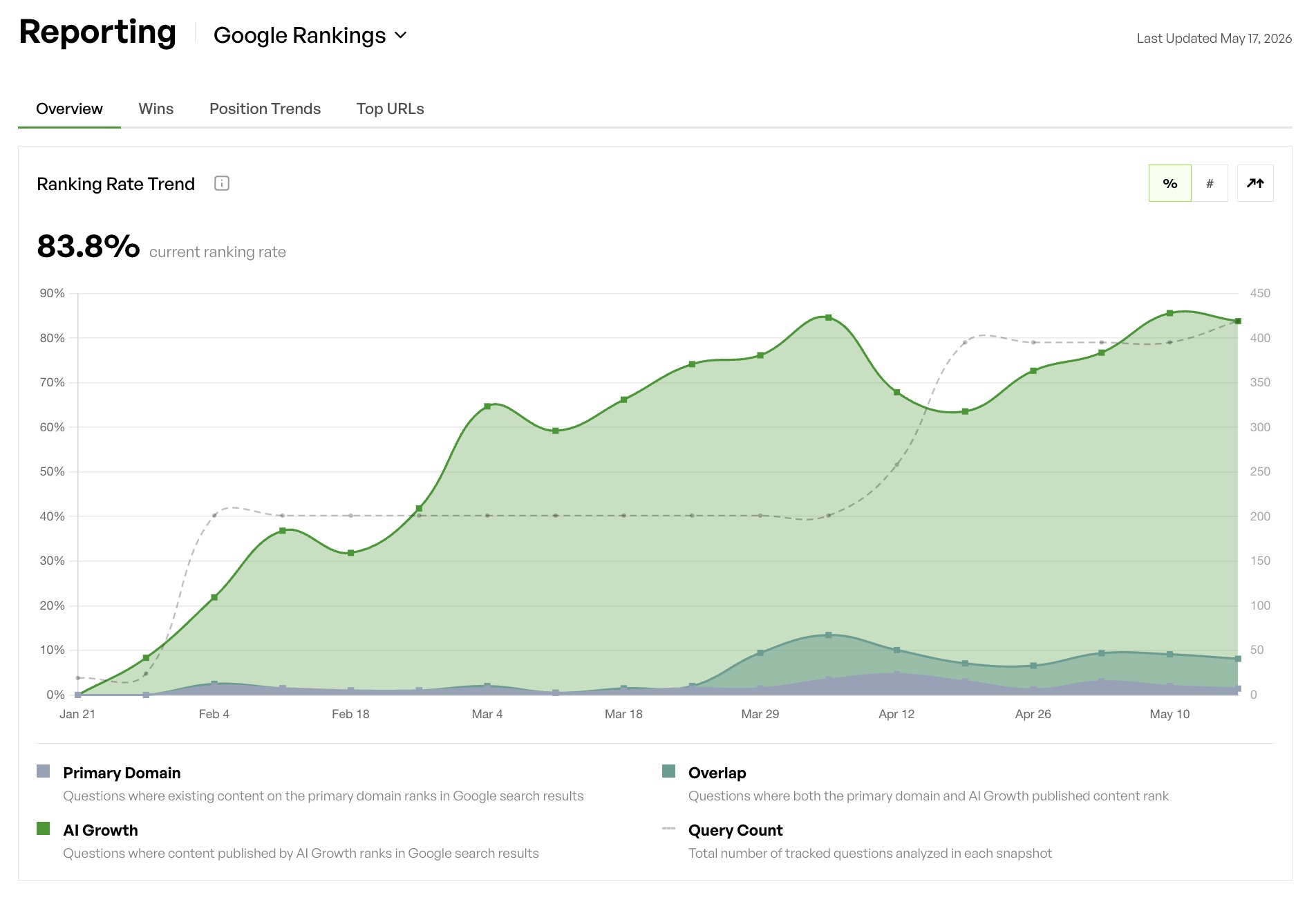
AI Growth Agent deployed AI-focused content targeting financing, setup, side-sleeper, back-pain, and anti-snoring queries across ChatGPT, Perplexity, and Google’s AI Mode. Within the first twelve weeks, Leva Sleep reached an 88% ranking rate in target queries and a 61% AI Overview mention rate. The site doubled Google Search Console impressions on AI Growth Agent content, and ChatGPT citations climbed above 10,000 per month.
The revenue line stayed direct and measurable. Sales teams closed $40,000 to $50,000 in deals in under three weeks from buyers who walked into the store carrying the blog and asking about specific features they had discovered through AI Growth Agent content. Matthew Timmins, CEO of Leva Sleep, confirmed: “AGA’s content didn’t just drive traffic, it drove customers into our stores. In a matter of weeks, sales teams were closing deals ($40,000 to $50,000 in sales in under 3 weeks, to be exact) with buyers who discovered us through AI Growth Agent’s articles.”
Plugging those figures into the formula means combining hard savings from replacing the prior agency stack, revenue lift from closed deals attributed to AI-referred buyers, and soft visibility from 10,000+ monthly ChatGPT citations that produce ongoing branded search lift. The payback window fell well within the 3 to 12 month range that 2026 deployment data from CallSphere confirms as the standard range across agent types.
Common ROI Mistakes to Avoid
The most consequential errors in agent-enabled site ROI measurement fall into four categories.
Misattributing AI traffic as direct. Analysis of 446,000 AI-referred visits found that 70.6% of AI traffic lands as “direct” in Google Analytics 4 because ChatGPT, Perplexity, and Claude strip or inconsistently pass referrer headers. Teams that read only GA4 measure roughly 30 to 40 percent of their actual AI-driven sessions and systematically understate ROI.
Claiming existing visibility as incremental. Publishing new content to the same domain as existing brand content makes it impossible to isolate what the engine generated. A dedicated publishing environment with its own bot tracking, cross-referenced against Google Search Console as an independent audit, fixes that problem.
Over-attributing branded search growth. A common error is assigning 100% of branded search growth to AI visibility while ignoring other brand awareness drivers such as PR campaigns and advertising. AI search typically accounts for only 40 to 60 percent of such growth, and a calibrated attribution factor is required for defensible reporting.
Using attribution windows that are too short. Using attribution windows of only 7 days misses delayed conversions that occur 2 to 3 weeks after AI discovery. Recommended windows are 30 to 90 days for assisted conversion and up to 180 to 365 days for pipeline and market share models. SEO-driven AI content typically takes 3 to 6 months to gain meaningful traction, so evaluation at 8 weeks likely understates value significantly.
How Headless Marketing and Living Content Compound ROI
Headless marketing provides the architecture that turns a one-time content investment into a compounding asset. The brand keeps its curated main site. AI Growth Agent stands up a separate, fully optimized blog the brand owns, connected through a reverse proxy rewrite under a subdirectory or subdomain. The engine writes, publishes, monitors, self-heals, and reports, with no agency in the loop.
The compounding mechanism operates on two levels. First comes living content, where every article updates and self-heals over time rather than going stale. When the year turns, every article in a sector refreshes automatically. This citation flywheel effect, which Ramp’s data confirmed earlier, means each new citation increases the probability of future citations. Authority compounds rather than decays.
Second, the agentic technical SEO stack ensures the content stays readable by the machines doing the citing. Every site AI Growth Agent publishes ships with Blog MCP, OpenAI discovery and Agent Card guidance served via /.well-known/, natural language query parameters at /?s={query}, Markdown served to agent crawlers, and llms.txt and llms-full.txt. Only a minority of sites have specific directives for ChatGPT-related bots, so most sites that treat AI agents like traditional bots remain invisible to the surfaces that now drive discovery. The technical stack becomes the difference between content that exists and content that gets cited.
Breadless illustrates the compounding effect at scale. Starting from a Google Search Console baseline of 387,000 impressions, the brand reached 12.3 million impressions over six months, a 30x lift, while ChatGPT citations grew to over 45,000 per month. The ROI on that trajectory does not follow a linear curve. Each citation trains the next generation of models with Breadless’s narrative, which widens the gap between the brand and competitors who are not publishing at the same rate or quality.
Frequently Asked Questions
What metrics should I track to measure agent-enabled site ROI?
The four metrics that matter most are AI citations and mentions per month, bot visits from server logs, Google Search Console impressions isolated to the engine’s dedicated environment, and branded search volume lift as a proxy for zero-click demand creation. These four map directly to the four-pillar data foundation of Search Intelligence, AI Analytics, Bot Tracking, and AI Ranking. Hard savings from replaced agency spend and revenue from closed deals attributed to AI-referred buyers complete the model. Tracking all six gives a CMO a defensible answer for the CEO every week.
How long does it take to see positive ROI from an agent-enabled site?
The first article typically goes live within a week of kickoff, with content indexing in as little as ten days. Meaningful citation volume and bot traffic lift become visible within the first 90 days. Full ROI realization, meaning the point at which cumulative revenue lift and hard savings exceed total engine cost, typically falls within 3 to 12 months depending on industry, competitive density, and average deal value. Content-heavy marketing deployments consistently achieve payback faster than internal process or engineering agent deployments because the revenue signal from AI-referred buyers is direct and measurable. The standard AI Growth Agent pilot runs for three months, which is sufficient to establish the citation trajectory and project the full-year return.
How is incremental visibility different from total visibility?
Total visibility includes every impression, citation, and bot visit the brand receives, including the baseline it held before any new engine was deployed. Incremental visibility covers only the portion generated by the engine itself, isolated by publishing into a separate environment and cross-referencing bot tracking, Google Search Console, and citation data. The distinction matters because brands that report total visibility as the engine’s contribution take credit for organic momentum they already had. Incremental reporting is the only way to produce a defensible ROI figure for a CEO or board, and it is the only way to know whether the engine is actually working or whether the brand is riding existing authority.
Why does zero-click search make traditional ROI models unreliable?
Traditional ROI models for organic content rely on click-through rates as the primary signal of value. Zero-click search breaks that model because the user receives the answer inside the AI surface and never visits the source. When an AI Overview appears, the zero-click rate typically runs high, which means the vast majority of discovery events leave no click trail in any analytics platform. A brand that measures only clicks measures a shrinking fraction of its actual influence.
The correct model replaces the single click metric with layered signals, including impressions and share of voice, branded search lift, assisted conversions with extended attribution windows, AI citations and mentions, and post-purchase survey data capturing source at the conversion moment. These signals together produce a reliable picture of demand that zero-click discovery generates even when no click is recorded.
Conclusion: Turning Agent Visibility into Defensible ROI
The ROI case for agent-enabled sites in 2026 rests on measurable evidence, not theory. Bot visits, AI citations, incremental impressions, and closed deals from AI-referred buyers all become trackable with the right data foundation and the right publishing architecture. The brands that calculate agent-enabled site ROI accurately are the ones that set clean baselines, publish into isolated environments, apply calibrated attribution factors, and use extended measurement windows that capture the full compounding effect of living content.
Traditional search tools show you where your brand stands. AI Growth Agent makes your brand the answer. The engine maps your full query universe, publishes authoritative living content, and reports the incremental visibility it generates week over week, so every number in your ROI model stays defensible. The leaderboard for AI search is being written this year, and brands that establish authoritative content now are training the next generation of models with their own narrative.
Schedule a demo to see if you’re a good fit and get your first article live within a week.