Written by: Mariana Fonseca, Editorial Team, AI Growth Agent
Key Takeaways for PE Operating Partners
- The $15,000-per-month SEO agency retainer has become a liability for 2026 exits because it produces no owned, transferable asset.
- Replacing agency spend with owned, AI-automated infrastructure turns variable cost into traceable EBITDA and a defensible digital asset that survives diligence.
- Four metrics determine whether a digital marketing model holds up in buyer diligence: implementation time, 12-month cash outlay, EBITDA attribution, and exit-readiness score.
- Traditional agency and in-house models lag on speed and ownership, while AI Growth Agent ships live content in about one week, with full client ownership.
- Schedule a consultation to see how owned AI infrastructure can replace your agency retainer in week one.
The $15,000-Per-Month Retainer Is a 90-Day EBITDA Decision
McKinsey’s February 2026 Global Private Markets Report states that the median EBITDA multiple paid by buyout firms reached a record 11.8x in 2025, which makes post-acquisition operational value creation essential for achieving target returns. At that multiple, every dollar removed from customer acquisition cost or converted from variable spend to owned infrastructure flows directly to enterprise value at exit. A $15,000 monthly agency retainer totals $180,000 annually and produces no owned asset, no traceable EBITDA line, and no digital infrastructure that survives a change of ownership. Operating partners therefore face a 90-day decision about which replacement model compounds equity value fastest before the exit window opens.
AI Growth Agent replaces your agency retainer with owned infrastructure in week one. Schedule a consultation to see how it works.
Four Evaluation Metrics That Survive Due Diligence
Digital marketing models only support the equity story when they perform against four specific diligence metrics.
- Implementation time. This is the interval from decision to first indexed asset. This metric matters because North Sea Strategic’s July 2026 framework requires a baseline captured at entry, which means the clock starts at close, not at the end of an RFP process. Any model that takes months to produce the first asset misses the window to establish that baseline.
- 12-month cash outlay. This is the fully loaded cost including salary, benefits, tools, ramp time, and turnover risk for in-house models, or total retainer plus integration costs for agency and platform models.
- EBITDA attribution. North Sea Strategic states that EBITDA contribution from digital channels must be traceable from channel cost through lead to closed deal to survive buyer diligence and be treated as an investment rather than an expense.
- Exit-readiness score. EY’s Private Equity Exit Readiness Study found that firms identify weak data and KPI reporting as the biggest finance issue at exit and struggle to reflect value creation initiatives accurately in reported EBITDA. Digital assets that are owned, documented, and independently auditable score highest.
Private Equity SEO Agency Cost vs. In-House: Side-by-Side Economics
The agency model and the in-house model share the same structural flaw: neither produces owned assets at the speed a 90-day value creation plan requires. The following comparison shows how these models differ on 12-month cost and key components.
| Model | 12-Month Cost (Typical) | Key Cost Components |
|---|---|---|
| Agency | $60,000–$720,000 | $5K–$60K monthly retainer, integration costs, reporting tools, management time |
| In-House | $113,000–$195,000+ | Salary, benefits, SEO tools, 3–6 month ramp, turnover risk, multiple hires for scale |
Agency retainers for mid-market SEO typically range from $5,000 to $10,000 per month, while enterprise agency partnerships range from $10,000 to $60,000 per month depending on scope. An RFP process can take several months before the first assets are produced, which means multiple months pass before any indexed content exists, and during that period the agency controls the site, the content, and the reporting. When the hold period ends, none of those assets transfer cleanly.
The in-house alternative carries its own cost structure. The fully loaded year-one cost of a single mid-senior in-house SEO hire includes gross salary, employer taxes and benefits, tools such as Ahrefs or Semrush, a three-to-six-month productivity ramp, and turnover replacement risk. A team capable of producing content at scale requires multiple hires, which pushes year-one cash outlay substantially higher before a single article indexes.
Many marketers struggle to determine which channels deserve credit for conversions. This attribution gap has real financial consequences, because companies without proper attribution models commonly misallocate up to 30% of their marketing budget. Agency reporting compounds this problem because agencies control the data and have structural incentives to overstate performance. For example, inherited agency reporting has at times masked that actual new customer acquisition cost was higher than shown, which led to capital allocation decisions based on incomplete information for two quarters.
Exit Readiness for Owned Digital Assets in Private Equity
Owned digital assets are valued by buyers because they survive ownership change and can lift valuation multiples. North Sea Strategic distinguishes paid search, which delivers provable EBITDA contribution within weeks but is treated by buyers as a variable cost because the contribution stops when spend stops, from organic search built through SEO, which creates owned digital assets that continue producing after spend ends.

EY recommends securing data readiness before exit to allow management to demonstrate a sustained track record of data-driven decision-making. A PE-backed international technology asset that improved its transaction data achieved a successful exit at a strong multiple. The parallel for digital marketing infrastructure is direct: owned content with documented indexing history, bot traffic data, and Google Search Console audit trails constitutes a traceable value creation narrative that survives diligence.
Research has found that companies with advanced AI capabilities in core operations can attract acquisition premiums in competitive strategic M&A processes compared to operationally similar peers without structured AI programs. McKinsey research indicates that companies which deploy AI early in the hold period can achieve higher exit multiples compared to those that begin AI programs later.
If your portfolio company is preparing for exit, see how AI Growth Agent fits your timeline.
EBITDA Impact of SEO Infrastructure
The EBITDA impact of SEO infrastructure depends entirely on whether the contribution is traceable. VCI Institute’s Digital EBITDA Bridge framework translates technology capabilities into enterprise value through five sequential layers: capability, operational metric, financial driver, EBITDA contribution in dollars, and enterprise value impact at the exit multiple. Margin improvements on a revenue base contribute to EBITDA, which at an exit multiple generates enterprise value.
The CAC reduction from owned organic infrastructure is the most direct EBITDA lever. Organic search averages $31 CAC compared with Meta at $53, Google Ads at $62, and paid creators at $65 for typical DTC ecommerce brands in 2025. Blended DTC ecommerce CAC has roughly doubled from approximately $48 in 2019 to approximately $87 to $92 by 2026, with the sharpest increases following Apple’s iOS 14.5 tracking changes. Every dollar removed from CAC through owned organic infrastructure flows directly to contribution margin and then to EBITDA.
Top-line growth that comes at the expense of margin does not build enterprise value for PE-backed brands, while growth that holds or improves unit economics does because EBITDA is what a buyer pays a multiple on at exit. AI-automated infrastructure that produces traceable organic leads at lower CAC than paid channels, with weekly reporting that isolates incremental contribution, is the only model that satisfies this requirement.
Head-to-Head Analysis: Speed, Cost, Attribution, and Ownership
The three replacement models diverge sharply on the four evaluation criteria. The table below shows how each model performs across speed, cost, attribution, and ownership.
| Criterion | Traditional Agency | In-House Team | AI Growth Agent |
|---|---|---|---|
| Speed | Several months for RFP and production | 3–6 month ramp to output | About one week to first live article |
| 12-Month Cost | $60K–$720K+ retainer and tools | $113K–$195K+ salaries and tools | Flat fee, replaces multiple vendors |
| Attribution | Opaque, agency controls reporting | Traceable if infrastructure exists | Weekly incremental reporting |
| Ownership | Zero, agency holds assets | Full, with headcount risk | Full, client owns site, content, and data |
Traditional SEO agency. Speed is the primary failure because an RFP can take several months before the first assets are produced. Attribution is opaque because the agency controls reporting. Ownership is zero, since the agency holds the site, the content relationships, and the institutional knowledge, so at exit the buyer inherits a dependency, not an asset.
In-house SEO team. Speed improves marginally over an agency but remains slow. The fully loaded year-one cost of a single mid-senior hire includes salary, benefits, tools and ramp time, and a team capable of producing content at the volume required for AI search visibility requires multiple specialists. Attribution is theoretically traceable but practically dependent on the retained staff, and at exit buyers discount EBITDA for key-person risk.
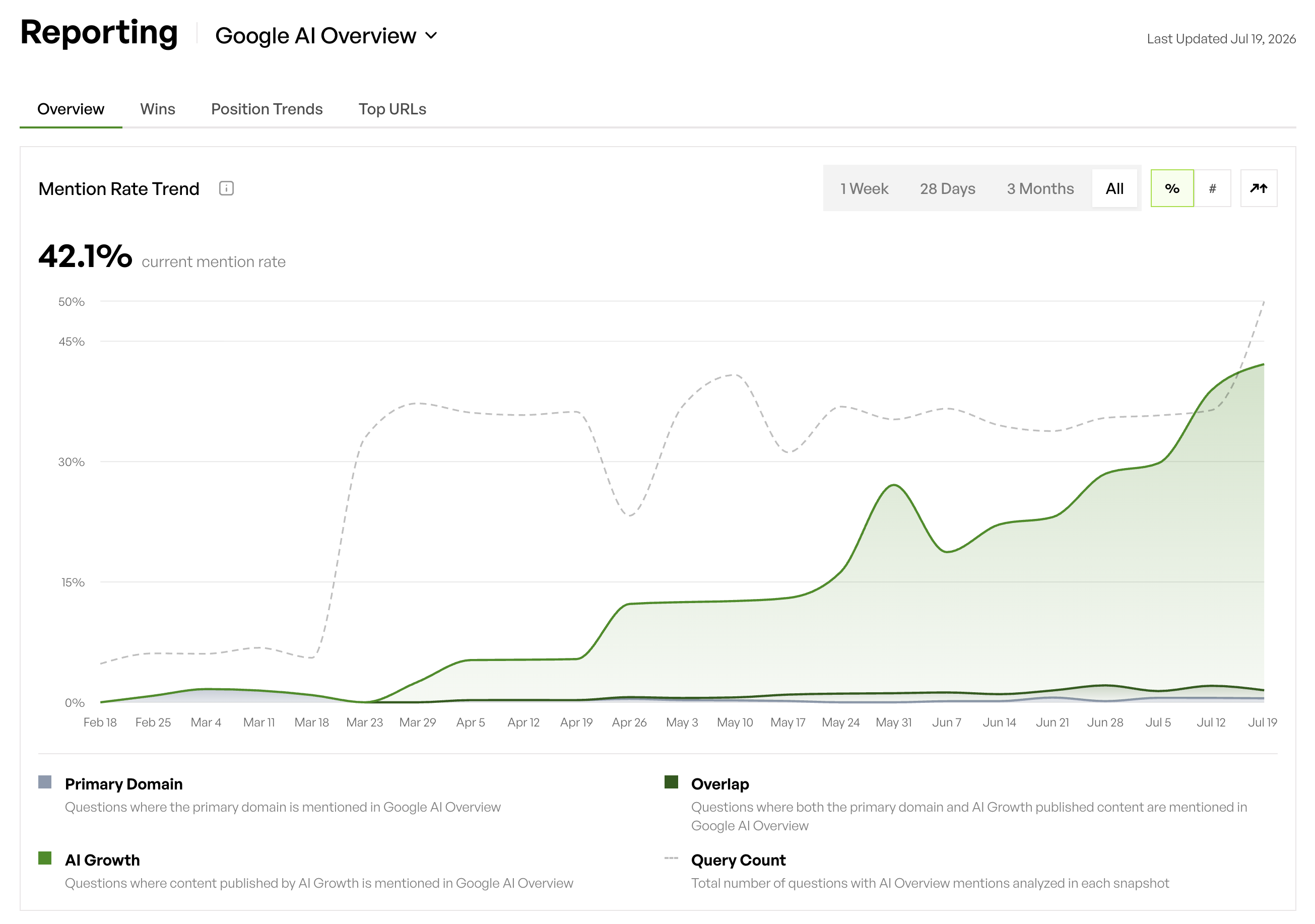
AI Growth Agent. The first article goes live within approximately one week of kickoff, with content indexing in as little as ten days. The client owns the site, the content, and the data, with no agency dependency. Incremental visibility is reported week over week, which isolates exactly what the engine generated rather than riding existing brand visibility. The full technical and agentic SEO stack, including schema, Blog MCP, llms.txt, agent discovery, and bot tracking, ships with every package at a flat fee with no per-article or per-prompt billing.
Balanced Option Framing: Strengths and Gaps of Each Path
Each model has a legitimate use case that depends on brand maturity and hold period. The agency model suits companies with no existing digital presence that need brand strategy before content execution, provided the operating partner accepts a six-to-twelve-month ramp and zero owned assets at the end of the retainer. The in-house model suits companies with exit timelines beyond three years and the budget to absorb year-one ramp costs, provided the team can be retained through the hold period. Neither model is viable for a portfolio company inside a 90-day value creation sprint.
The AI automation model has its own constraint: it requires a brand with an existing identity and a manifesto that the engine can use as ground truth. It is not a brand-building tool for a company with no defined market position. For mid-market and enterprise portfolio companies with an established identity, it is the only model that delivers owned assets, traceable EBITDA attribution, and exit-ready digital infrastructure within the first quarter of deployment.
Real-World Use Cases: 90-Day Outcomes
These tradeoffs show up clearly in real deployments across PE-backed companies during the first 90 days.
Companies that stayed with agency retainers through a hold period consistently reported the same diligence problem: the attribution issue described earlier, where inherited agency reporting masked true CAC, proved real and material.
Companies that built in-house teams reported a different problem. A $22 million B2B services company 14 months post-close discovered that a portion of its Google Ads spend went to branded terms that would have converted organically; after implementing attribution infrastructure, reallocating that budget generated more SQLs at the same spend level. The in-house model can work, but it requires attribution infrastructure that most mid-market companies do not have at close.
Companies using AI Growth Agent’s engine reported measurable outcomes within the first 90 days. Breadless, a healthy fast-casual franchise, achieved a 72% recommendation rate versus Sweetgreen’s 13% within 90 days, with ChatGPT citing eatbreadless.com over 45,000 times per month and Google Search Console impressions growing roughly 30x in six months. Leva Sleep closed $40,000 to $50,000 in deals in under three weeks from buyers who discovered the brand through AI Growth Agent content. Jota recorded a 190%+ traffic increase from generated content over three months.
Total Cost and Operational Ownership Across Models
The 12-month cash comparison across models requires fully loaded accounting. A comprehensive CAC calculation for private equity diligence includes media spend, creative development, personnel costs, and technology expenses. Incomplete cost accounting masks unsustainable unit economics that only become apparent post-acquisition.
For the agency model, the fully loaded 12-month cost at a $15,000 monthly retainer is $180,000, before integration costs, reporting tools, or the management time required to brief and review agency output. For the in-house model, a two-person team (one SEO specialist, one content editor) carries a fully loaded year-one cost of $113,000 to $195,000 plus tools, before accounting for the three-to-six-month productivity ramp during which output is minimal. For AI Growth Agent, the flat-fee model with no per-article or per-prompt billing replaces the SEO agency, the content tool, the web agency, the GEO monitor, the schema plugin, the analytics stack, and the PR firm in a single line item, with the client owning all content produced.
Guided Decision Framework: 90-Day Checklist for Operating Partners
Operating partners evaluating a replacement for an agency retainer can follow this sequence before the next LP meeting.
- Start by auditing the current agency contract for site ownership, content ownership, and data portability clauses. If the agency controls the site, that dependency must be resolved before exit.
- Next, capture a baseline of current organic visibility, bot traffic, and Google Search Console data. Following the EY framework mentioned earlier, this baseline supports a sustained track record that buyers can audit.
- Then quantify the current CAC by channel using fully loaded cost accounting. A healthy LTV:CAC ratio is typically 3:1 or higher, and ratios below this threshold signal unsustainable unit economics that buyers will penalize.
- After that, identify the exit timeline and map it to ramp time. If the hold period is under 24 months, the in-house model cannot ramp fast enough to contribute to the exit story, so the AI automation model becomes the only path that delivers owned assets and traceable attribution within the first quarter.
- With the model selected, stand up owned infrastructure in week one. AI Growth Agent is designed so the first published article goes live in roughly a week, with the client owning the site and all content.
- Finally, build the EBITDA bridge. VCI Institute’s Digital EBITDA Bridge requires explicit quantification of the operational metric improvement, the affected P&L line, the resulting dollar EBITDA contribution, and the enterprise value lift at exit multiple.
Risks, Limitations, and Tradeoffs
Each model carries specific risks that operating partners must factor into the value creation plan.
The agency model’s primary risk is dependency, because the agency controls the site, the content, and the institutional knowledge, which buyers treat as a liability at exit. The secondary risk is attribution opacity. Companies without proper attribution models commonly misallocate up to 30% of their marketing budget, and agency reporting is structurally incentivized to overstate channel performance.
The in-house model’s primary risk is headcount. Key-person risk at exit is a standard buyer discount, because buyers know that when key employees leave, the capability leaves with them. The secondary risk is the skill gap: producing content that AI surfaces find, trust, and cite requires a combination of journalistic rigor, technical SEO, and schema engineering that almost no single hire covers. This skill gap is particularly problematic because many PE firms are still integrating digital diligence into standard operating models, which means in-house teams often build to varying standards that only become visible during exit diligence.
The AI automation model’s primary risk is brand readiness. The engine requires a manifesto and an established identity to produce authoritative content, so companies without a defined market position need brand strategy before content execution. The secondary risk is indexing variability, because content has indexed in as little as ten days, but indexing timelines vary by industry and domain authority, and the standard engagement is a three-month pilot to allow the compounding effect to become measurable.
FAQ
How does replacing an SEO agency affect EBITDA during the hold period?
Replacing a $15,000 monthly agency retainer with owned AI-automated infrastructure converts $180,000 in annual variable spend into a fixed-cost investment that produces owned digital assets. Those assets continue generating organic leads after the hold period ends, which buyers treat as a contribution to enterprise value rather than a cost. The EBITDA impact appears through two mechanisms: direct cost reduction from eliminating the retainer, and CAC reduction from organic channels that deliver lower acquisition costs than paid alternatives. The contribution is traceable when the infrastructure includes weekly incremental visibility reporting, Google Search Console audit trails, and bot traffic data that document the chain from content investment to organic lead to closed revenue.
What do PE buyers examine in digital marketing infrastructure during due diligence?
Buyers examine four areas. First, they review asset ownership to see whether the company owns its site, its content, and its data, or whether an agency controls them. Second, they test attribution integrity by checking whether CAC calculations are fully loaded and whether the link from channel cost to closed revenue is documented in CRM. Third, they assess data readiness by asking whether KPI reporting is consistent, auditable, and granular enough to substantiate the equity story. Fourth, they evaluate AI capability, because acquirers now formally include AI capability assessment in their valuation process, and companies with documented AI operating models outperform their acquisition price expectations on EBITDA margins in the 24 months post-transaction. Digital infrastructure that is owned, documented, and independently auditable scores highest on all four dimensions.
How quickly can AI-automated SEO infrastructure produce results for a PE portfolio company?
AI Growth Agent is structured so the first published article goes live within approximately one week of kickoff, with content indexing in as little as ten days. The standard engagement is a three-month pilot, because indexing timelines vary by industry and domain authority, but clients see movement early. Across the first twelve weeks, clients average more than 12,000 additional AI citations and mentions, over 100,000 additional bot visits, and a 20%+ lift in impressions. For PE timelines, the critical advantage is that owned assets begin accumulating from week one rather than month six, which means the exit story includes a documented track record of compounding organic visibility rather than a retainer invoice with no associated asset.
What is the difference between an AI SEO platform and a traditional SEO agency for private equity purposes?
The structural difference is ownership and attribution. A traditional SEO agency holds the site, the content relationships, and the reporting, and the contribution stops when the retainer ends. An AI automation engine like AI Growth Agent stands up a site the client owns, produces content the client owns, and reports incremental visibility in isolation from existing brand visibility, so the EBITDA contribution is traceable and survives ownership change. The speed difference is equally significant. As discussed earlier, the RFP timeline alone can consume several months, while AI Growth Agent moves from kickoff to first published article in approximately one week. For a portfolio company inside a 90-day value creation sprint, only one of these timelines is viable.
Conclusion
Replacing an SEO agency retainer is an EBITDA and exit-readiness decision that belongs on the operating partner’s 90-day checklist. PwC’s Private Equity Trend Report indicates that PE firms are investing in digital transformation, and as noted earlier, early AI deployment during the hold period correlates with higher exit multiples. The agency model produces no owned assets and no traceable EBITDA line, and the in-house model cannot ramp fast enough for most hold periods. AI Growth Agent is the specialized AI-automation partner that delivers the full stack, owned site, living content, technical and agentic SEO, incremental visibility reporting, and bot tracking within week one at a flat fee, with the client owning everything produced.
Do not walk into your next LP meeting with an agency dependency on the books. Replace your retainer with owned infrastructure now.