Written by: Mariana Fonseca, Editorial Team, AI Growth Agent
Key Takeaways for PE AI Visibility
- Private equity firms earn AI citations when investment theses, case studies, and LP updates are structured for machine readability in ChatGPT, Perplexity, and Google AI Mode.
- Every claim needs verifiable data with a named subject, baseline value, end value, timeframe, and measurement method to compete with regulators and Tier 1 sources.
- Case studies earn citations when they follow a four-part proof block with a clear claim, metric, method, and attribution, plus named subjects and early metric placement.
- LP updates perform best as ungated HTML with FinancialService and Person schema, llms.txt, and current dateModified fields so AI crawlers can read and trust them.
- AI Growth Agent maps your full query universe, produces validated content, and launches a fully configured site in one week, so your firm controls its narrative in AI answers.
Core Inputs You Need Before AI Growth Agent Starts
A successful implementation depends on four concrete inputs before any content is produced.
- Firm manifesto. A single source of truth covering investment thesis, target company profile, value creation framework, and fund strategy. The engine validates every claim against this document.
- Primary-source URLs. Portfolio company pages, transaction announcements, and sector reports that serve as canonical references for metrics and outcomes.
- Deny lists. Topics, competitors, or claim types the firm will not publish, configured once and applied to every future generation.
- Real-time Google and ChatGPT data access. The universe map is built from live search signals, not historical keyword exports.
Roles stay fixed from the start. The CMO or IR head owns strategy and approves content. The operating partner supplies case metrics and transaction data. Compliance reviews any YMYL financial claims before publication.
With roles assigned, the next prerequisite is scope. The universe map should cover a broad range of queries across seed terms and long-tail children. A checklist review at this stage prevents the most common failure mode, which is launching content against a partial map and losing the majority of the conversation by default.
Mapping Every LP and Founder Prompt Your Firm Should Own
The mapping process captures the real prompts LPs and founders submit to AI engines, not only the head terms a firm pre-decided to defend. The sequence runs as follows.
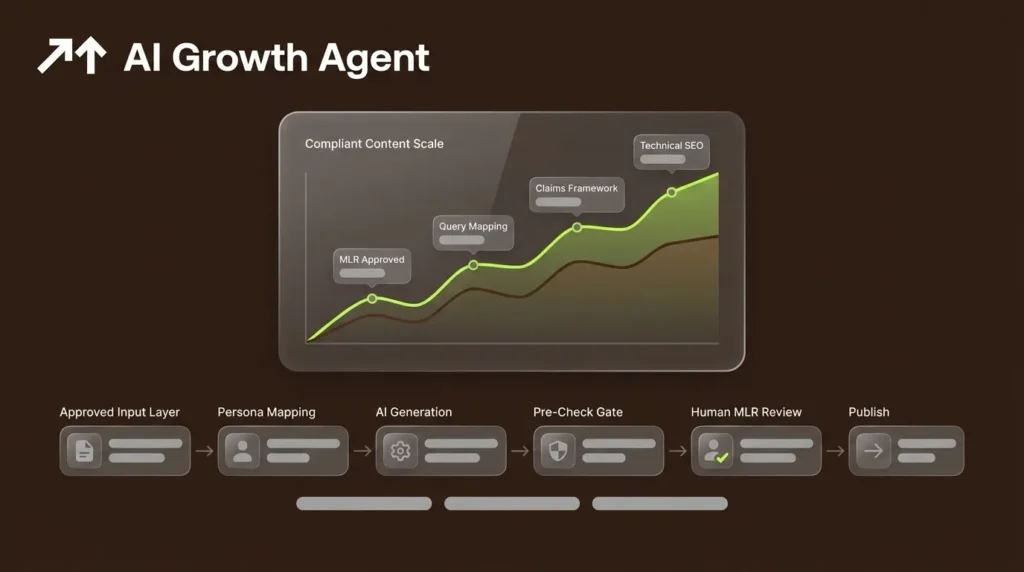
- Ingest the firm manifesto and all primary-source URLs into the Search Intelligence engine.
- Run 3,000+ weekly searches across real-time Google and ChatGPT data to build a live picture of the query landscape.
- Cluster results into seed terms, each with dozens of long-tail children beneath it. Mature client universes reach 1,600+ queries.
- Assign a baseline citation count to every seed term so movement is measurable from week one.
The IR head selects priority clusters based on fundraising and sourcing objectives. Thesis pages, portfolio case studies, sector reports, LP FAQ pages, “what we look for” pages, and team bios with transaction experience give AI systems factual, citable material to reference when recommending a firm to LPs or deal originators. Each of those content types maps to a distinct cluster in the topology.
Validation finishes when every seed has a baseline citation count and the topology covers the full range of queries a founder or LP would submit while researching the firm’s investment focus.
Map your firm’s full AI query universe in one week and start shaping the answers LPs see.
Rewriting Investment Theses So LLMs Can Cite Every Claim
Vague claims do not earn citations. AI engines on financial topics follow a strict citation hierarchy, and brand content often sits below regulators, Tier 1 press, and specialist financial media. The only viable response is to make every claim verifiable and easy to extract.
The before-and-after rewrite serves as the core technique. The table below shows how vague positioning statements turn into citation-ready claims once you add the five required data elements.
| Before | After |
|---|---|
| “We back strong teams.” | “We acquired a $12M revenue healthcare IT company and grew it to $28M in three years through two add-on acquisitions and sales-team expansion, measured via client CRM.” |
| “We create value across our portfolio.” | “We expanded EBITDA margins from 11% to 19% over 24 months at a 200-person industrial services company through procurement consolidation and route optimization, verified by audited financials.” |
Every rewritten claim requires five data elements: named subject, baseline value, end value, timeframe, and measurement method or source. This specificity requirement also means unsupported superlatives taint nearby claims, so any language like “best-in-class” or “market-leading” must be replaced with a backing number or removed.
The operating partner supplies the raw metrics, and the IR head verifies that every metric has a source link before the content enters the publishing pipeline. Beyond the metrics themselves, verifiable author credentials such as CFA, FRM, or CPA materially increase LLM citation likelihood for financial services content, so author schema with hasCredential markup is applied to every thesis page.
Structuring Case Studies into Proof Blocks AI Engines Trust
The structure that earns citations is not a narrative. It is a proof block, a modular unit that presents claim, evidence, method, and attribution in a format AI engines can extract and verify independently. Pages using structured proof blocks can achieve higher citation rates by AI engines than pages with only a claim and metric or narrative-only pages based on observational data. This approach works because it gives LLMs every element they need to cite your case study with confidence.
The four-part proof block structure is as follows.
- Claim. What changed, stated in one sentence.
- Metric. The number with unit and time window.
- Method. How it was measured, including the system and any limitations.
- Attribution. Who reported it and the verification date.
Each case study also needs a one-sentence data hook in the opening line. A 120 to 180 word standalone summary then restates the problem, approach, and result with all names and figures so engines can lift it whole. FAQPage schema sits alongside Article schema with a current dateModified field.
Case study pages with the metric presented early were cited more often than when the metric appeared later. Named-company case studies were cited more often than anonymized ones, and when anonymity is required, a precise descriptor such as “a 2,400-employee healthcare distributor in the Midwest” closes most of the gap. Restructured case study pages that were already indexed can receive their first AI citation within weeks.
Formatting LP Updates and Quarterly Narratives for AI Citation
LP updates that earn citations read as evidence-based, machine-readable pages instead of PDF-gated narratives. The sequence for each quarterly update is as follows.
- Apply style memories to enforce firm voice, preferred terminology, and legal disclaimer placement across every update automatically.
- Embed FinancialService and Person with hasCredential schema. The Alice Labs LLMO Citation Benchmark scores financial brands on six factors, with author credential markup and FinancialService schema completeness among the highest-leverage and least-implemented.
- Add llms.txt so AI surfaces can read the firm’s content in the format they require.
- Publish as ungated HTML. Many enterprise case studies remain gated behind lead-capture forms, rendering them invisible to AI crawlers. The optimal model is an open HTML page for citation paired with a gated PDF for internal distribution.
The CMO approves each update before publication. Bot traffic lift is tracked per article from day one, which gives the IR head a weekly view of which narratives AI training agents and citation crawlers are reading. PE firms with AI visibility report more inbound LP inquiries compared to those without measurable visibility.
Launching and Connecting an AI-Ready Site in One Week
The publishing architecture removes agency dependency entirely and keeps control with the firm. The sequence is as follows.
- Stand up a fully optimized blog styled to match the firm’s existing site, connected through a reverse proxy rewrite to a subdirectory under the firm’s domain. Nothing in the existing site structure changes.
- Provision Blog MCP, llms.txt, and llms-full.txt so AI surfaces can read and cite the content natively.
- Activate instant indexing, autoredirects, and 404 tracking through the WordPress plugin.
- Publish the first article. No technical team is required on the firm’s side.
The firm owns the site outright. No agency controls access, no RFP is required, and no year-long ramp slows progress. Private equity websites achieve better visibility in AI-driven search tools when content is modular, specific, well-formatted with descriptive headings and FAQ sections, and technically sound with schema markup and clean HTML hierarchy. Every article ships with that full stack live on day one. Once content is live, the focus shifts to tracking whether it earns citations and drives qualified inbound.
Launch your optimized AI-ready site and publish your first article within one week.
Measuring AI Citations, Bot Traffic, and Qualified Inbound
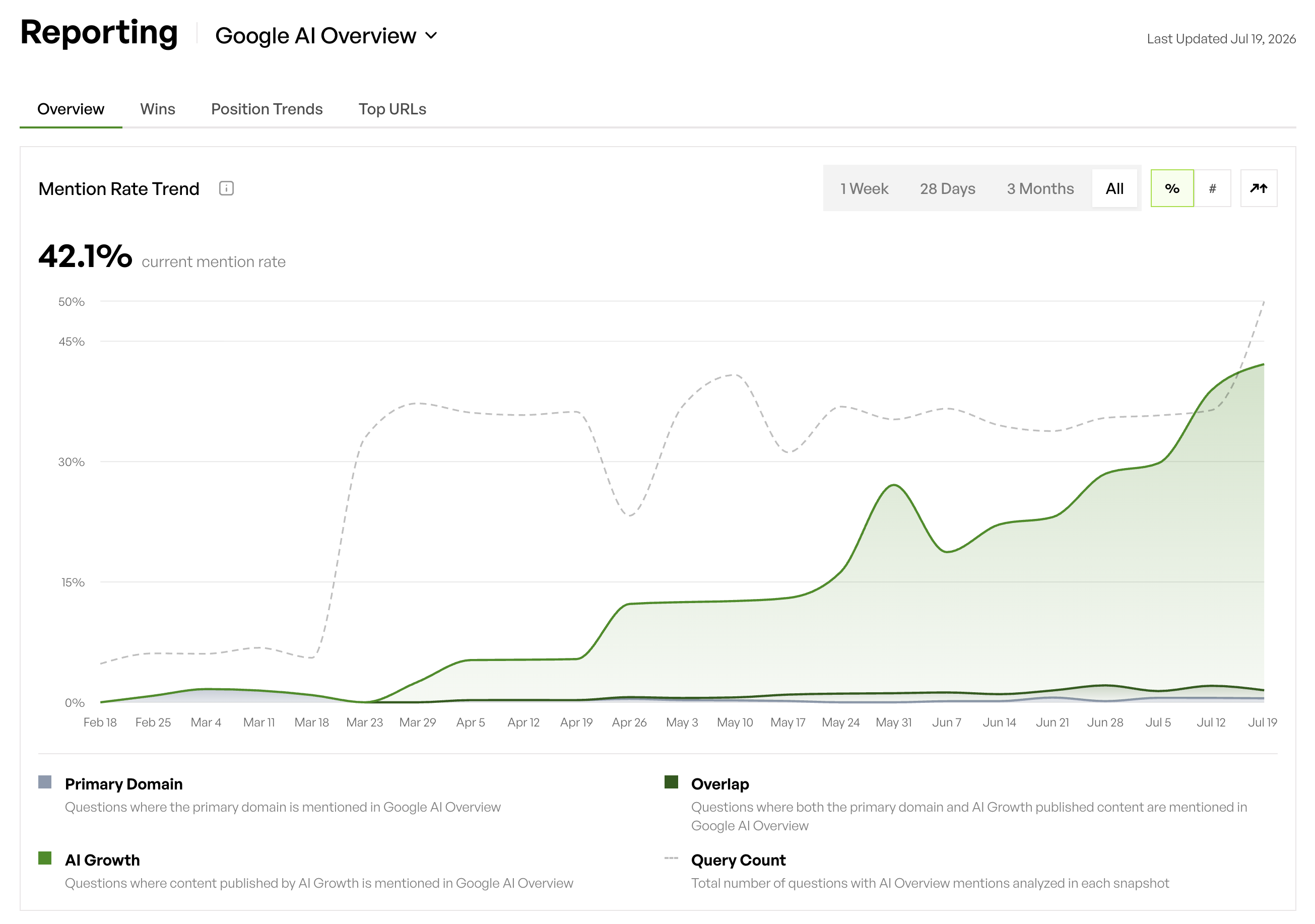
Generic rankings do not capture AI search performance. The metrics dashboard for a PE firm running this system tracks four core columns.
| Metric | Source | Cadence | Validation Benchmark |
|---|---|---|---|
| AI citations and mentions | Per-article bot logs, cross-referenced with ChatGPT citation crawler data | Weekly | Additional citations in first 12 weeks (average) |
| Bot visits | Separate environment bot tracking | Weekly | Additional bot visits in first 12 weeks (average) |
| Impressions lift | Google Search Console, isolated to AI Growth Agent content | Weekly | Lift in first 12 weeks (average) |
| Qualified inbound inquiries | Source captured at conversion, cross-referenced with content attribution | Weekly | Measurable lift in LP and founder inbound within 60-90 days |
Reporting is isolated to a separate environment so the firm takes credit only for visibility AI Growth Agent generated, never for visibility the firm already had. The IR head reviews the dashboard weekly. Most PE firms see measurable AI citation growth within 60 to 90 days of consistent optimization across content, schema, and third-party citation building.
Common Mistakes That Suppress AI Citation Rates
Four failure patterns account for most PE content that earns zero AI citations.
- Gated PDFs. AI crawlers cannot complete lead-capture forms, so any content behind a gate contributes zero citation value. Fix: publish an ungated HTML version alongside the gated PDF.
- Superlatives without baselines. As discussed in the thesis rewriting section, unverifiable superlatives taint adjacent claims. Fix: replace every superlative with a named metric, baseline, and timeframe.
- Anonymous case studies. As noted earlier, anonymous case studies underperform named ones. Fix: use named subjects where possible, and where anonymity is required, use precise descriptors including company size, sector, and geography.
- Stale dateModified fields. As mentioned in the case study structure section, stale dateModified fields hurt citation rates. Fix: living content self-heals and updates automatically, keeping dateModified current without manual intervention.
Advanced Scenarios That Need Extra Controls
Three scenarios require controls beyond the standard implementation.
YMYL financial content. Google classifies financial content under its strictest E-E-A-T standards, and LLMs default to regulator and central-bank sources over brand content on YMYL topics. PE firms must increase regulator-citation density by anchoring claims to Tier 1 sources including BIS, IMF, SEC, and FINRA where applicable, and apply Person with hasCredential schema to every named author. Compliance reviews every article before publication.
Multi-fund universes. Firms managing multiple strategies require separate topology maps per fund, with distinct deny lists and claim prioritization rules for each. The manifesto for each fund is maintained as a separate source of truth, and the engine applies the correct memory set to every generation.
EU AI Act disclosure. The EU AI Act classifies certain credit scoring and creditworthiness assessment AI systems as high-risk under Annex III, requiring firms to describe AI use cases with this classification for LLMs to cite them safely. Disclosure language is configured once as a legal disclaimer memory and applied automatically to every relevant article.
Frequently Asked Questions
How do private equity firms use AI for investor relations?
Current applications focus on drafting and summarizing LP communications, automating DDQ and RFP responses, and extracting data from documents. Many IR professionals use AI for IR work at least weekly, with drafting and summarizing content the leading use case, followed by DDQ and RFP automation and drafting investor emails and quarterly narratives. The less-developed opportunity is using AI to make the firm itself discoverable and citable when LPs and founders research GPs through ChatGPT, Perplexity, and Google AI Mode, which is where private equity AI content optimization applies.
What content types earn the highest AI visibility for LP and founder audiences?
The highest-impact content types are clearly articulated deal theses, portfolio company case studies with specific value-creation metrics, sector reports, LP-facing FAQ content, “what we look for” pages, and team bios with transaction experience. Thesis pages earn citations because they answer LP queries like “best growth equity firms in the Midwest” with verifiable, structured information. Case studies earn citations when they include a named subject, baseline and end values, a timeframe, and a disclosed measurement method. Content that is gated, anonymous, or built around superlatives without backing numbers earns no citations regardless of writing quality.
How long does it take for structured PE content to appear in Perplexity and Google AI citations?
Restructured case study pages that were already indexed can receive their first AI citation within weeks. New or newly de-gated pages typically take five to eight weeks. As noted in the measurement section, most firms see results within 60 to 90 days of consistent optimization across content, schema, and citation building. The first article is live within one week of kickoff, and content has indexed in as little as ten days. The standard engagement is a three-month pilot because indexing timelines vary by sector and competitive density.
Do private equity firms with AI visibility report more inbound LP inquiries?
PE firms with AI visibility report more inbound LP inquiries compared to those without measurable visibility. The mechanism is straightforward. Many institutional allocators now include AI tools in their initial GP research process, and a firm that does not appear in those answers is effectively invisible at the top of the funnel. A proprietary deal sourced through AI visibility also carries no banker fees and avoids the competitive dynamics of a brokered process, which represents meaningful value for a firm that typically pays transaction fees to intermediaries on brokered deals.
What schema improves citability of investment theses and case studies?
The baseline schema suite for PE content includes Article with a current dateModified field, FAQPage for LP and founder question content, FinancialService for the firm entity, and Person with hasCredential for named authors. Case studies should use Article or Report schema with Observation fields covering measuredProperty, observationDate, and measurementMethod rather than a non-existent CaseStudy type. A fully schema-marked case study page is retrieved and cited at a higher rate than an equivalent page without schema. Author credential markup and FinancialService schema completeness are among the highest-leverage and least-implemented factors in AI citation benchmarks for financial services content.
Conclusion: Take Narrative Control This Week
Traditional approaches leave a firm invisible to the agents that now decide which GPs appear in answers. Many asset management and private equity leaders are accelerating AI agent adoption and moving from pilots to production or integration, and FTI Consulting’s 2026 Private Equity AI Radar finds that AI deployment is beginning to create real performance separation among private equity funds. The leaderboard in AI search is being written now. Firms that establish authoritative, structured content this year are training the next generation of models with their own narrative, while firms that wait are training those models with whatever happens to be sitting on the open web.
AI Growth Agent maps the full universe of seed terms and long-tail prompts, produces authoritative content single-shot with every claim validated against primary sources, and stands up a fully optimized site the firm owns within one week. One engine replaces the SEO agency, the content tool, the web agency, the schema plugin, the analytics stack, and the PR firm, at a flat fee with no per-article charges or prompt limits.
Take control of your firm’s AI narrative and book a demo to see how the system works.