Written by: Mariana Fonseca, Editorial Team, AI Growth Agent
Key Takeaways for PE Teams
- AI search has replaced traditional diligence channels, and LPs now form opinions inside ChatGPT or Perplexity sessions before any meeting occurs.
- Entity optimization treats the fund and each portfolio company as distinct digital entities, each with its own schema, citations, and prompt coverage.
- Traditional SEO tools and monitoring platforms cannot handle the fund-vs-portfolio matrix or produce the content, schema, and third-party citations AI engines require.
- Effective programs map the full query universe, deploy entity-level schema, secure third-party citations, and prove incremental visibility week over week.
- AI Growth Agent delivers a single engine that maps, produces, and maintains entity control across your fund and portfolio companies, and you can see how it works in a live demo.
AI Search Reality for Private Equity Entity Control
PE-specific guidance for entity control in AI search does not exist in current search results. Most visible content on AI search visibility in financial services focuses on generic brand monitoring or broad B2B tactics. The fund-vs-portfolio matrix, the distinct entity requirements of a GP versus its portfolio companies, and the prompt library that covers LP due diligence queries alongside buyer evaluation queries remain unaddressed as a unified discipline.
The urgency rests on clear data. Forrester’s Buyers’ Journey Survey, 2025, of nearly 18,000 global business buyers found that 94% used AI during their most recent purchase process, with AI tools outranking vendor websites, sales reps, and product experts as the most meaningful information source for B2B purchase decisions. Forrester reported that B2B organic traffic has declined between 10% and 40% over the past year as AI answer engines replace traditional search.
The citation dynamic compounds this shift. AirOps 2026 analysis found that 85% of brand mentions in AI answers come from external domains versus 13.2% from brand-owned domains, and brands are 6.5 times more likely to be cited through third-party sources than through their own domains. An Ahrefs study of 75,000 brands found that branded web mentions correlate with AI citation visibility at 0.664, three times stronger than backlinks at 0.218. A fund that has not engineered its third-party citation footprint is, by default, absent from the answers LPs and buyers are reading.
You can see your current third-party citation footprint in a live demo, then decide how aggressively to close the gap.
How PE Teams Commonly Tackle AI Search Visibility
Most PE marketing and IR teams fall into one of two approaches when they try to address AI search visibility. Both approaches fail to meet the requirements of the fund-vs-portfolio matrix described earlier.
The first approach is a DIY chatbot stack. A team uses Claude or a similar model to draft content, publishes it manually, and attempts to maintain schema and technical SEO without engineering support. The output becomes inconsistent, the schema remains incomplete, and the content goes stale the day it ships. One company produced roughly 300 articles this way and not one was cited. For a PE firm managing entity-level content across a fund and multiple portfolio companies, this DIY path breaks down at the second article, long before the fiftieth.
The second approach is a monitoring-only tool. Platforms in this category track whether a brand appears for a capped set of prompts and report the result. They produce no content, deploy no schema, secure no third-party citations, and take no action on the data they surface. Research indicates that higher citation rates often depend on off-site authority signals from third-party publications that AI models can cross-reference, because on-site improvements alone rarely suffice. A monitoring tool cannot cross that threshold because it does not create the content or citations that move the number.
Neither approach handles the fund-vs-portfolio matrix described earlier. Neither maintains a prompt library, runs a 90-day citation audit, or proves incremental visibility week over week. Both leave the IR head or operating partner with a stitched stack of tools and no single engine owning the outcome.
You can replace that stitched stack with one engine in a consultation session tailored to your fund.
Five Criteria That Separate AI Search Tools for PE
Five evaluation criteria help PE teams distinguish tools that change AI visibility from tools that only report it.
- Universe coverage. The engine must map the full query universe for both the fund and each portfolio company, covering direct, comparative, and market-inquiry prompts without capping tracked terms. Forrester’s 2026 analysis found that 55% of B2B buyers used AI tools to compare vendors and 54% to research products before contacting any vendor, so the long tail of comparative and evaluative queries is where LP and buyer trust forms.
- Entity-level schema. The fund and each portfolio company require separate Organization, Brand, AboutPage, and Article schema deployments. Studies suggest that websites implementing comprehensive schema including Organization, Brand, and AboutPage types can be cited more frequently in AI results.
- Third-party citation sources. The engine must actively secure citations from sources AI models weight heavily. Analyses of AI citations show that earned and news media account for a substantial share of citation domain counts, which makes editorial coverage a primary pathway into AI answers.
- Prompt monitoring cadence. Weekly universe refreshes are required to detect shifts in how LPs and buyers phrase queries and to identify new competitive entries in AI answers before they compound.
- Incremental visibility proof. The engine must isolate the visibility it generated from the visibility the brand already had, reported week over week, so IR heads and operating partners can demonstrate ROI to fund leadership without ambiguity.
You can audit your prompt library against these five criteria in a consultation session and see where gaps exist.
Four Stages to Establish Entity Control
A structured implementation path moves a PE firm from invisible to cited across the fund-vs-portfolio matrix in a defined window. Four stages govern this work and create the foundation for ongoing control.
The first stage is entity mapping. The fund and each portfolio company are defined as separate digital entities with distinct seed terms, query universes, and audience intents. LP-facing fund queries and buyer-facing portfolio-company queries require separate prompt libraries because they answer different questions for different decision-makers. By 2026, effective private-market digital strategy requires separate but connected digital identities for the fund and each portfolio company, because LPs now demand fund-level performance views that include granular, structured portfolio-company exposure data.
The second stage is schema deployment. Entity-level schema is provisioned for every entity in the matrix, covering Organization, Brand, AboutPage, Article, and FAQ schema types. This structural layer reduces ambiguity during AI retrieval and increases citation eligibility.
The third stage is content production. Authoritative content is produced against the full query universe for each entity, with every claim validated against primary sources and structured for AI extraction. One B2B platform substantially increased its citation rate after restructuring its core pages and publishing new structured guides.
The fourth stage is a 90-day citation audit. Third-party citation sources are identified, targeted, and secured across earned media, industry databases, and structured directories. The 90-day window is the minimum required to see citation rate movement across the major AI engines, because AI citation updates can take from several days to several weeks.
You can begin your 90-day citation audit with a guided implementation session that follows these stages.
Maintaining AI Visibility After Initial Launch
Entity control requires ongoing management rather than a one-time deployment. AI surfaces update their citation pools continuously, competitors appear without warning, and content that was accurate at publication becomes stale as fund performance, portfolio composition, and market conditions change.
Weekly universe refreshes keep the query map current for every entity in the fund-vs-portfolio matrix. New long-tail queries surface as LP and buyer language evolves, and the prompt library must expand to cover them before a competitor fills the gap. Shadow’s analysis found that brands with active third-party trust signals are cited in 75% of AI answers versus 1% without them, so the citation gap between active and inactive programs compounds quickly.
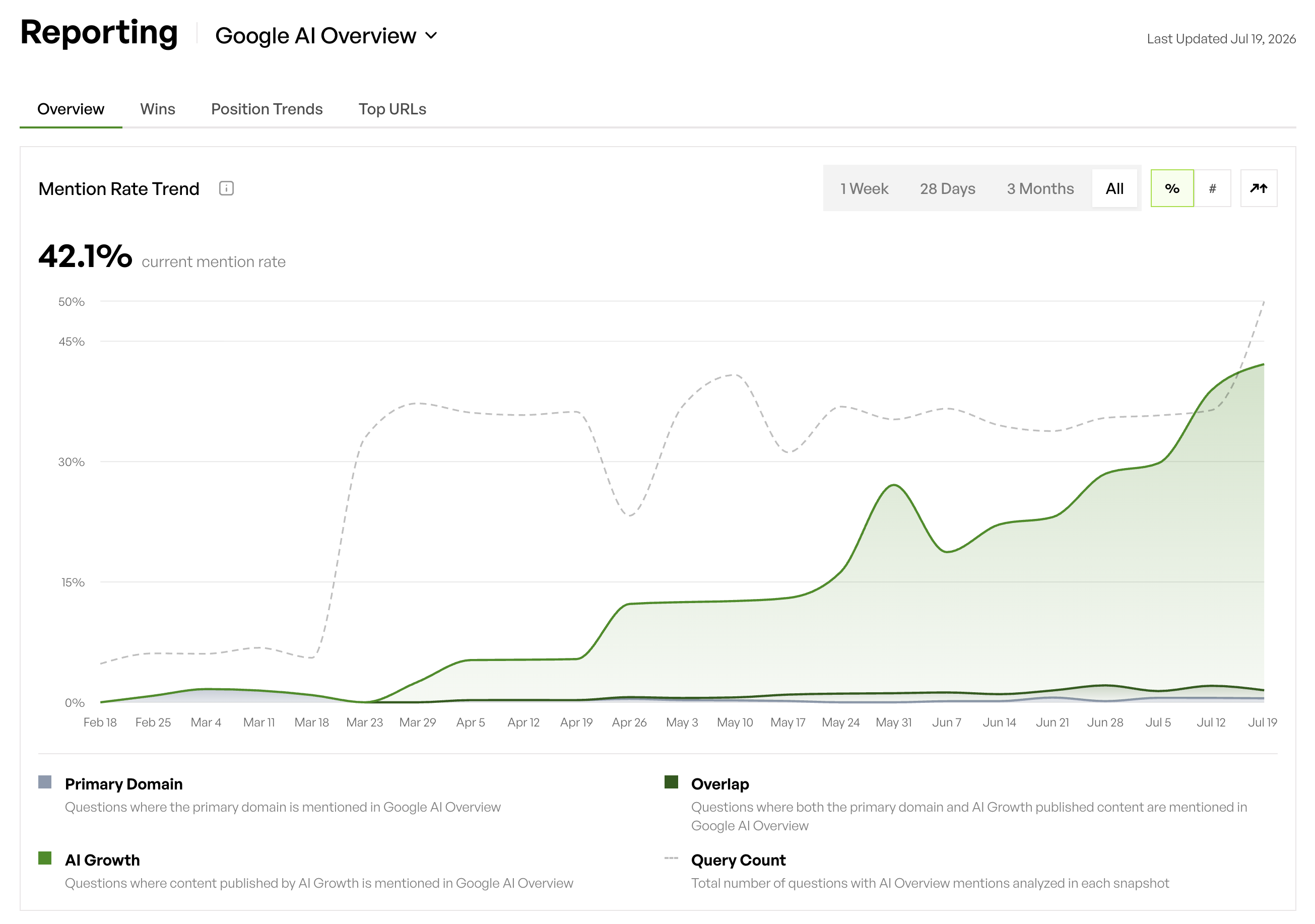
Bot-tracking dashboards surface every AI crawler interaction, including the specific bots ChatGPT and Perplexity use to cite sources. This visibility creates a direct line between what AI engines read and what they cite for specific queries. Without per-article bot tracking, reporting becomes a rearview mirror that shows outcomes without explaining causes.
Self-healing content updates address staleness automatically. When fund metrics change, when a portfolio company is acquired or exits, or when the year turns, content is refreshed rather than left to decay. Living content compounds authority over time instead of eroding it. Without this automatic refresh, stale content becomes a trust liability, because LPs who see outdated performance data or portfolio compositions that no longer exist will question the fund’s operational rigor.
You can view live bot-tracking dashboards for your fund and portfolio companies in a demo and see how self-healing content behaves in practice.
Three Common Risks in PE Entity Programs
Three recurring risks undermine PE entity control programs that do not run on a single engine.
Prompt caps create the first risk. Monitoring tools that bill per prompt force teams to choose which queries to track, leaving most of the LP and buyer query universe unmonitored. This creates a dangerous blind spot, because the queries a team does not track are precisely where a competitor or a misrepresentation can fill the answer unchallenged. The only mitigation is an engine that treats prompt count as a non-billed metric and maps the full universe by default.
Stale content creates the second risk. With LPs demanding greater transparency, a fund whose AI-cited content reflects outdated performance data or a portfolio composition that no longer exists creates a trust liability. As discussed in the ongoing visibility section, self-healing content that updates automatically is the mitigation.
Agency lock-in creates the third risk. When an agency controls the fund’s site, every content update, schema change, and technical fix becomes a dependency. The mitigation is owning the property outright, with the engine publishing to a site the fund controls, connected through a reverse proxy rewrite that does not touch the existing main site.
You can eliminate prompt caps and agency dependency in a consultation session that reviews your current stack.
Entity Control Playbook for PE Teams
The four-stage implementation path establishes the foundation for entity control. The following seven-step playbook translates that foundation into an operational sequence you can execute and maintain week over week across the fund-vs-portfolio matrix.
- Map the fund-vs-portfolio matrix. Define the fund and each portfolio company as separate digital entities with distinct seed terms, query universes, and audience intents. LP-facing and buyer-facing prompt libraries are built separately from this map.
- Secure third-party citations from Private Equity Info and earned media. As noted earlier, branded mentions outweigh backlinks by a factor of three in AI citation models. Target the specific third-party URLs already cited in AI answers for your highest-priority prompts, then execute targeted outreach to secure inclusion in those exact sources.
- Deploy entity-level schema. Provision Organization, Brand, AboutPage, Article, and FAQPage schema for every entity in the matrix. Pages with FAQ structured data appeared in Google AI Overviews at three times the rate of pages with equivalent content but no schema.
- Build a prompt library covering direct, comparative, and market-inquiry queries. Direct queries name the fund or portfolio company. Comparative queries position the entity against peers. Market-inquiry queries establish category authority. All three types are required for full LP and buyer coverage.
- Run a 90-day citation audit. Measure citation rate across ChatGPT, Perplexity, Google AI Overviews, and Google AI Mode for every entity in the matrix. Identify gaps and prioritize third-party source acquisition for the queries where competitors are cited and the fund is not.
- Activate self-healing content updates. Configure automatic refreshes for content tied to fund metrics, portfolio composition, and market conditions. Content that reflects the current state of the fund signals trust, while content that does not becomes a liability.
- Measure incremental visibility week over week. Report citation rate, bot traffic, and Google Search Console impressions as separate signals, and isolate what the entity control program generated from the visibility the fund already had.
You can launch your Entity Control Playbook with a guided implementation session that walks through each step.
Why One Engine Outperforms a Stitched Stack
A stitched stack of a monitoring tool, a content agency, a schema plugin, and a web vendor cannot manage the fund-vs-portfolio matrix at the speed AI search now requires. Each vendor operates on its own cadence, owns a different slice of the problem, and produces no proof of incremental visibility. The IR head or operating partner ends up coordinating dependencies instead of controlling the narrative.
A single headless engine replaces this stack. It maps the full query universe for every entity in the matrix, produces authoritative content validated against primary sources, deploys entity-level schema automatically, secures third-party citations, maintains the prompt library, runs the 90-day citation audit, and reports incremental visibility week over week. The fund owns the site, the content, and the relationship with the AI surfaces. No agency controls the property, no prompt cap limits the universe, and no content goes stale without a self-healing update.
Recent market outlooks note concentration among top-performing managers with strong DPI. The managers capturing that concentration are the ones LPs can find, trust, and cite in AI answers. Managers who are not visible in AI search are training the next generation of models with whatever happens to be sitting on the open web.
Traditional search tools show you where your brand stands. AI Growth Agent makes your brand the answer, and you can see if you are a good fit in a consultation session focused on your fund.
Frequently Asked Questions
What does entity optimization mean for a private equity firm specifically?
Entity optimization for a private equity firm means treating the fund and each portfolio company as separate digital entities, each with its own structured data, citation footprint, and prompt coverage. The fund answers LP due diligence queries about manager track record, team, and strategy. Each portfolio company answers buyer and market queries about the business, its category, and its competitive position. Collapsing both into a single undifferentiated web presence remains the default, and it explains why most PE firms are either absent from or misrepresented in AI answers. Entity optimization builds the distinct schema, content, and third-party citation signals that AI surfaces need to describe each entity accurately and cite it consistently.
Why cannot a PE firm’s existing SEO agency or monitoring tool handle AI search visibility?
Traditional SEO agencies were built to rank pages in blue-link results. They are not structured to produce the entity-level schema, third-party citation programs, or prompt libraries that AI search requires, and their production timelines move too slowly for weekly universe shifts. Monitoring tools track whether a brand appears for a capped set of prompts and report the result. They produce no content, deploy no schema, and secure no citations. Neither category handles the fund-vs-portfolio matrix as a unified discipline, and neither proves incremental visibility isolated from what the brand already had. The result is a stitched stack of vendors, each owning a slice of the problem, with no single engine accountable for the outcome.
How long does it take to see citation rate improvement in AI answers?
The timeline varies by engine and by the starting state of the fund’s entity signals. Content typically indexes within ten days to two weeks of publication. Perplexity citation updates occur five to ten days after indexing. ChatGPT updates take three to five weeks. A 90-day window serves as the standard measurement period for a citation audit because it captures the full cycle across all major engines. Firms that begin with no entity schema, no third-party citations, and no structured content can move from near-zero citation rate to meaningful coverage within that window, provided the program addresses on-site schema, content restructuring, and off-site citation acquisition in sequence rather than in isolation.
What third-party sources matter most for AI citation in private equity?
The sources AI models weight most heavily for professional and financial services entities include earned editorial coverage in business and trade media, structured database listings on platforms like Crunchbase and LinkedIn, industry analyst citations, and community discussions on platforms like Reddit and LinkedIn threads. For PE specifically, Private Equity Info and similar industry databases function as entity-validation sources that AI models cross-reference when forming answers about managers and portfolio companies. Consistent entity details across these sources, matching the fund’s own structured data, reduce entity confusion and increase citation likelihood. Press releases carry significantly less weight than earned editorial coverage and should not serve as a primary citation strategy.
What is the fund-vs-portfolio matrix and why does it require a separate engine?
The fund-vs-portfolio matrix, introduced in the market overview, is the full set of digital entities a private equity firm must manage in AI search: the fund itself as a GP entity, and each portfolio company as a distinct operating entity. Each entity has a different audience, a different query universe, and different citation requirements. LPs evaluating a manager ask about track record, team, strategy, and DPI. Buyers evaluating a portfolio company ask about the business model, market position, and competitive differentiation. A single content program or monitoring tool cannot serve both audiences simultaneously without collapsing the distinction between them. A separate engine that maps each entity’s universe independently, deploys entity-level schema for each, and maintains separate prompt libraries is required to control the narrative across the full matrix.