Written by: Mariana Fonseca, Editorial Team, AI Growth Agent
Key Takeaways
- Traditional PR retainers rely on slow RFPs, vanity metrics, and static deliverables that cannot keep pace with AI search demands.
- DIY chatbot approaches produce inconsistent, quickly stale content with no system to prove impact or maintain quality at scale.
- AI search now favors citation frequency and living content over blue-link rankings, which makes the old retainer model structurally obsolete.
- AI Growth Agent replaces the entire PR stack with a headless engine that maps queries, produces authoritative self-healing content, and reports incremental visibility week over week.
- Brands ready to control their narrative in AI answers can schedule a demo with AI Growth Agent and go live in about a week.
The Problem: The Two Wrong Doors Most Teams Walk Through
Most CMOs and founders who finally take AI search seriously see two options. Both options trap the brand.
The first is the agency route. An RFP runs roughly three months, then three more months to produce the first assets. Traditional PR retainer models deliver fixed monthly fees for hours or deliverables regardless of results, with monthly manual reports built on vanity metrics like impressions and AVE, not citation frequency or influenced pipeline. Traditional media monitoring tools have a 1-24 hour delay and miss 40% of mentions, while crises and narrative shifts now escalate in hours. Gut-feel topic selection often produces many assets that generate little or no media pickup. That pattern reflects a structural failure of the retainer model, not a personnel problem.
The second is the DIY chatbot path. Everyone has Claude. Producing one good article is possible. Producing the second requires running the entire process again, with more rounds of review, schema to maintain, legal language to get right, and quality that drifts from piece to piece. One company produced roughly 300 articles this way. Not one article earned a citation.
These two doors look like opposites. They create the same outcome. Both leave the brand with content that goes stale the day it ships and no system to prove what, if anything, that content generated.
The environment around those traps has shifted decisively. AI Overviews now appear in a growing share of Google searches, which fundamentally changes how users interact with results. Zero-click searches reached 58.5% of U.S. searches in 2025, with an average zero-click rate of 83% when AI Overviews appeared. This shift means most users never leave the search results page. Even more concerning for brands, 85% of brand mentions in AI answers originated from third-party pages rather than owned domains. Brands have lost control of their own narrative. The user gets the answer in the surface and never visits the source. Whatever the AI says is, for most people, simply the answer.
Traditional PR retainers were not built for a world where the citation is the ranking. They were built for a world of blue links, press placements, and monthly clip reports. That world is not coming back.
What Replaces Our PR Firm for AI Search?
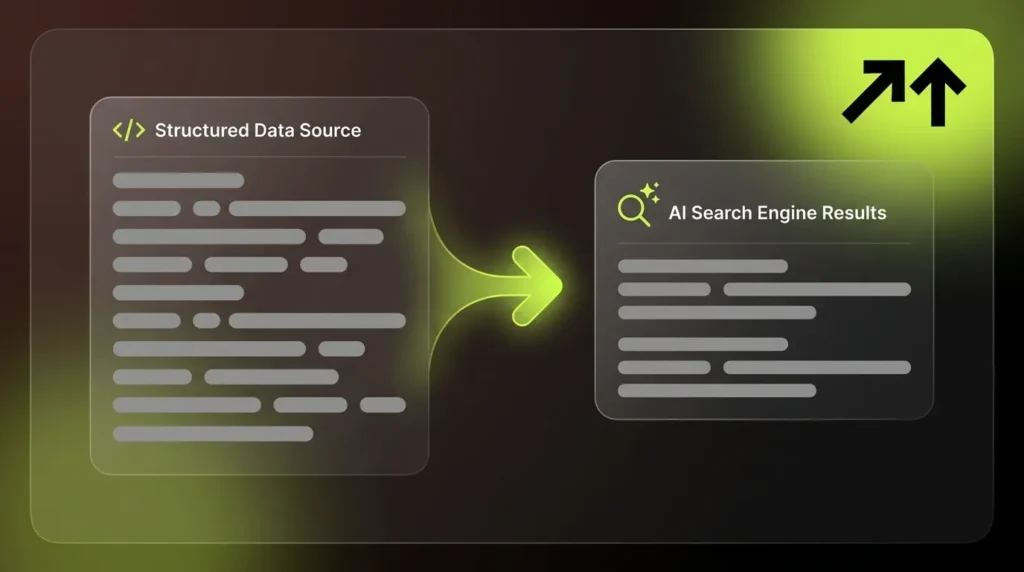
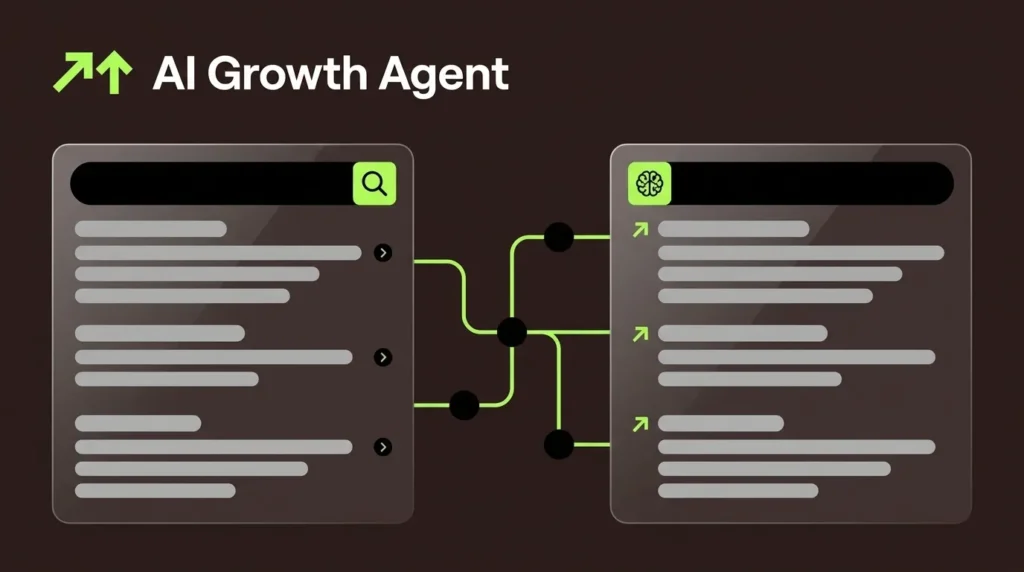
Traditional retainers and DIY approaches both fail in the AI search environment, so a different model must carry the load. AI Growth Agent’s headless marketing engine replaces the entire PR stack with one system. It maps the brand’s full universe of seed terms and long-tail queries from real-time Google and ChatGPT data, produces authoritative living content that validates every claim and source, stands up a fully optimized site the brand owns within the first week, and reports the incremental visibility it generates week over week. No RFP. No year-long ramp. No agency dependency.
The table below shows how the headless engine delivers faster time-to-market, greater scale, and measurable narrative control, three capabilities traditional retainers structurally cannot provide.
| Service Dimension | Traditional PR Retainer | AI Growth Agent Headless Engine |
|---|---|---|
| Time to first asset | ~6 months (3-month RFP + 3-month production) | First article live within ~1 week of kickoff |
| Content scale | Fixed deliverables per retainer | 2 to 50 articles per day per client, up to ~500 per month, single-shot from brand manifesto |
| Citation measurement | Monthly clip reports; impressions and AVE; no citation frequency tracking | Four-pillar data foundation: Search Intelligence, AI Analytics, Bot Tracking, AI Ranking; incremental visibility isolated week over week |
| Narrative control | Reactive; earned media pitches; static media lists updated quarterly | Upstream; living self-healing content across the full universe; llms.txt, Blog MCP, and agentic technical SEO so AI surfaces find and cite the brand’s own narrative |
| Site ownership | Agency often controls the site; every change is a dependency | Brand owns the fully optimized blog outright, connected via reverse proxy rewrite; no agency in the loop |
| Content freshness | Assets go stale the day they ship; no self-healing mechanism | Living content that self-heals and updates over time; stale articles refreshed automatically from Google Search Console signals |
These differences matter because AI search rewards speed, breadth of topical coverage, and consistent measurement. Citation frequency replaces clip counts as the core signal of visibility. Brands that still rent access to surfaces through agencies cannot fully control their narrative or adapt quickly when AI answers shift.
How AI Growth Agent Measures AI Citations
AI citation measurement uses a different framework than traditional PR reporting. Clip counts and AVE measure attention in a world of blue links. In a zero-click environment, the metrics that matter are citation frequency, citation context, share of voice, and incremental visibility isolated from what the brand already had.
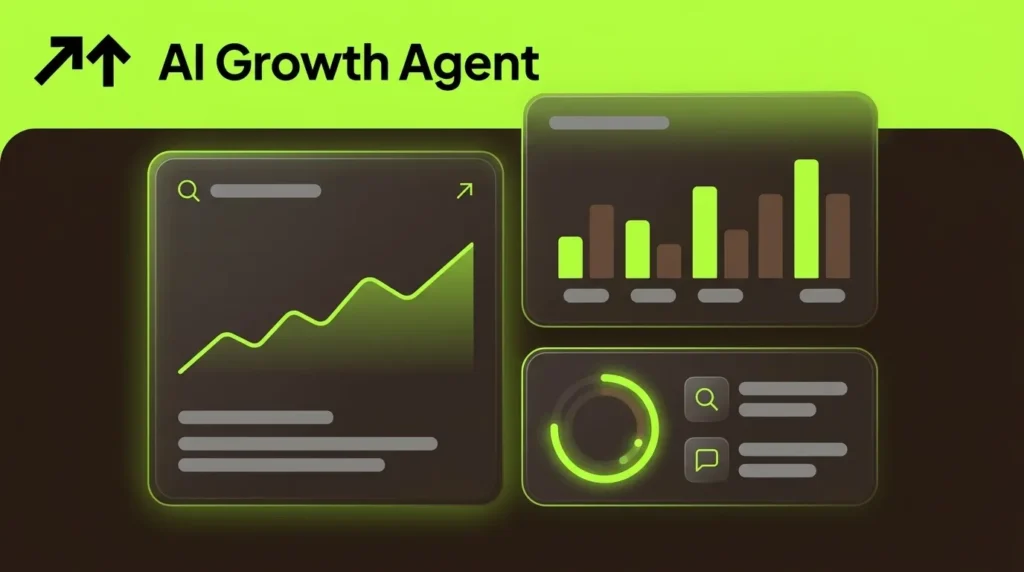
AI Growth Agent organizes measurement around four pillars that together form the data backbone for narrative control.
Search Intelligence provides a complete portrait of the traditional search landscape, including positioning, competition, search volume, and the structure of who is already winning. It runs hundreds of real searches in the brand’s space every week and has agents process the signals, including title structures, forum discussions, People Also Ask, query fan-out, and who is competing for each result.
AI Analytics tracks brand value and consumer behavior across the whole journey, from external touchpoints like Google and AI-tool queries through content consumption, demographics, and sentiment. For informational queries, AI engines cite sources frequently but mention brand names less often, so tracking both citation rate and mention rate is essential to understanding true share of model.
Bot Tracking records every bot interaction, traditional crawlers and AI training agents alike, including every crawl, citation, and training sweep. AI engines process sources at three distinct layers: consumed sources, referenced sources, and displayed citations. Bot-level tracking shows which layer a brand operates at and where it needs to move.
AI Ranking replaces the old idea of a ranking number. AI answers have no static ordered list, so order of mention and citation context become the new leaderboard. Where the brand appears in the answer, and how that position evolves week over week against the content plan, is what AI Growth Agent tracks and reports.
Incremental visibility reporting isolates exactly what the engine generated, separate from the visibility the brand already had. AI Growth Agent publishes into a separate environment so it can take credit only for what it actually produces, cross-referencing bot traffic, Google Search Console, and citation data that no single monitoring tool brings together.
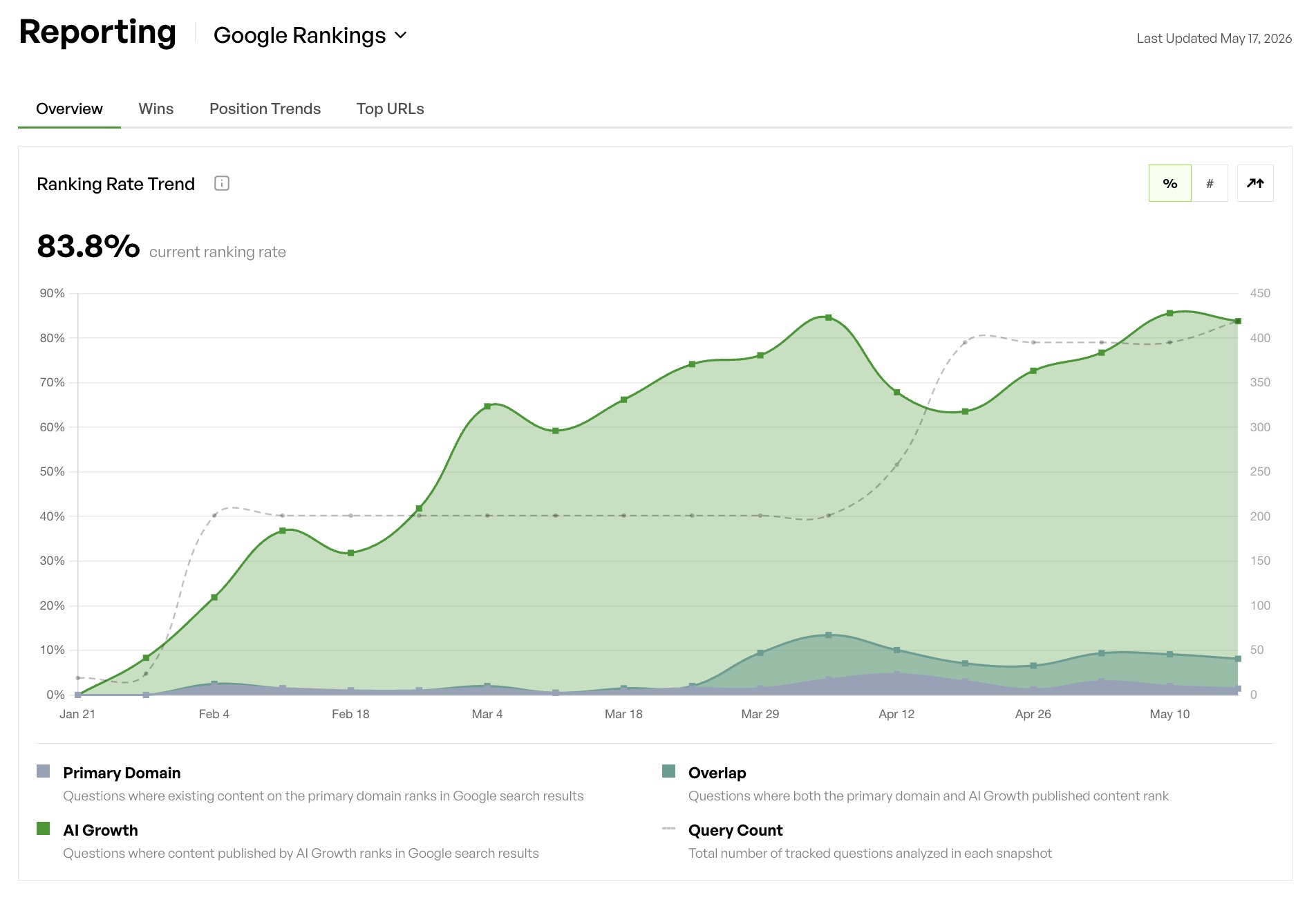
The Four-Pillar Data Foundation That Drives Narrative Control
The four pillars are not a dashboard. They are the decision engine behind every content move, because each pillar feeds data that directly determines which content gets created, updated, or retired.
Search Intelligence maps the universe. Every engagement starts with a Content Topology, a hierarchy of seed terms, each backed by real-time Google and ChatGPT data, with dozens of long-tail queries beneath each one. Real-time AI Overview and ChatGPT results serve as the objective function for which long-tail queries are worth pursuing. Comparative content can earn more brand mentions than informational content, so the topology highlights where comparative and decision-stage queries live in the universe, not just head terms a brand pre-decided to defend.
AI Analytics connects content performance to the full buyer journey. AI search traffic converts at 14.2% compared to Google organic’s 2.8%, which means a citation is worth roughly five times a traditional organic click. The analytics layer captures that downstream signal and connects it to the content decisions that produced it.
Bot Tracking makes the invisible visible. In the zero-click environment described earlier, knowing which AI training agents are reading which pages, and how often, is the only way to understand whether the brand’s narrative is being consumed before the citation decision is made.
AI Ranking tracks citation context, including where the brand appears in the answer, who it is grouped with, and what claim it is cited for. Pages with structured schema markup can see improved AI citation frequency compared to equivalent pages without schema. AI Growth Agent provisions that schema automatically on every article and every site, with no technical action required from the client.
Living, self-healing content ties the four pillars together. Every article’s relationships, performance, and bot and Search Console data are centralized. When something changes in the market, the engine responds. When the year turns, every article in a sector refreshes automatically. Authority compounds instead of decaying.
From Kickoff to First Article in One Week
The kickoff focuses on building a single source of truth and turning it into live content quickly. A journalist-led interview creates the brand manifesto, which the engine uses for every future generation. From the manifesto, AI Growth Agent maps the Content Topology, selects the first seed terms in the Content Planner, and produces the first authoritative articles. The client reviews the topology and first articles with the AI Growth Agent team to tune the model, so by the end of the first week the engine is generating content the client is comfortable approving.
The technical stack goes live in the same week. A fully optimized blog, styled to match the brand’s own pages, connects to the brand’s domain through a reverse proxy rewrite under a subdirectory or a subdomain. The WordPress plugin provisions bot tracking, Blog MCP, advanced robots.txt, a proper sitemap.xml, automatic web stories, instant indexing, autoredirects, and 404 tracking out of the box. llms.txt and llms-full.txt publish so AI surfaces can read the brand the way they need to. Agent discovery is served via /.well-known/. The brand owns the site outright from day one.
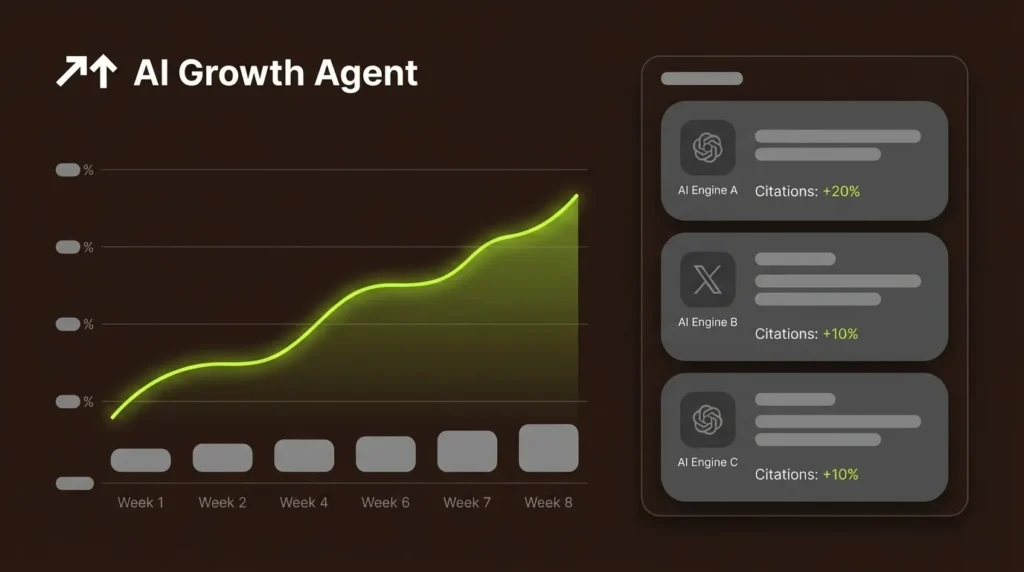
Across the first twelve weeks, clients average more than 12,000 additional AI citations and mentions, over 100,000 additional bot visits, and a 20%+ lift in impressions, with content indexing in as little as ten days. Those are averages, not guarantees, and they reflect a system that doubles down on what indexes well and uses internal linking to lift what does not.
AI-referred sessions jumped 527% between January and May 2025, with AI platforms generating 1.13 billion referral visits in June 2025 alone. The leaderboard for AI citations is being written now. Brands that establish authoritative content this year are training the next generation of models with their own narrative. Brands that wait are training the next generation with whatever happens to be sitting on the open web.
Start training AI models with your narrative instead of letting competitors define your category.
Conclusion: Make Your Brand the Answer
The retainer model’s structural failure, outlined at the start of this article, stems from a mismatch between where buyers now resolve trust and where traditional PR firms still invest effort. A majority of B2B buyers now use AI tools for discovery. Only about 14% of marketers actually track whether they’re being cited by ChatGPT, Claude, Gemini, or Perplexity. The gap between where buyers are looking and where brands are investing is the structural problem no retainer add-on can close.
The headless marketing engine closes that gap. One system maps the full universe of seed terms and long-tail queries, produces authoritative living content at scale, delivers the four-pillar data foundation that drives narrative control, and reports incremental visibility week over week. No RFP. No year-long ramp. No agency dependency. The brand owns the site, the content, and the relationship with the AI surfaces from day one.
Traditional search tools show you where your brand stands. AI Growth Agent makes your brand the answer.
Make your brand the answer buyers see—book a kickoff today.
Frequently Asked Questions
What exactly does a headless marketing engine replace in a traditional PR stack?
A headless marketing engine replaces every component of the traditional PR and marketing stack with a single system. That includes the PR firm, the SEO agency, the content tool, the web agency, the GEO monitor, the schema plugin, and the analytics stack. Instead of coordinating an editor, an SEO specialist, a designer, an engineer, and an outside agency through months of RFPs and onboarding cycles, one engine handles the keyword topology, content production, technical SEO, schema, bot tracking, publishing, self-healing, and incremental visibility reporting. The brand keeps its curated main site. The engine runs a fully optimized blog the brand owns, connected through a reverse proxy rewrite, and handles everything behind it without requiring any technical skill from the client’s team.
How do we measure whether AI citations are actually driving business outcomes?
Measurement in AI search requires tracking two distinct signals: citation rate, which is the percentage of tracked prompts where the brand’s domain appears as a source, and mention rate, which is the percentage of prompts where the brand name appears in the answer text. Together these define share of model. AI Growth Agent’s four-pillar data foundation adds bot tracking, which records every AI training agent crawling the brand’s content, and AI Ranking, which tracks order of mention and citation context week over week. Incremental visibility reporting isolates what the engine generated from what the brand already had, cross-referencing bot traffic, Google Search Console, and citation data. Clients who measure best capture source at the conversion moment and consistently see a lift in organic leads after starting, because AI-referred sessions arrive with pre-existing context from the AI answer and convert at significantly higher rates than traditional organic traffic.
Why can’t we just use a monitoring tool like Profound or Scrunch AI instead?
Monitoring tools tell you whether your brand appears for a capped set of prompts. They do not produce content, own publishing, or act on the data. A monitoring platform might track a defined set of prompts for your brand, but it is blind to per-article bot tracking, centralized Google Search Console signals, and the cross-referenced data that determines what to do next. The differentiator is not who has more data. It is that AI Growth Agent turns data into published, self-healing content and proves the incremental result. Monitoring is a rearview mirror. The headless engine is the steering wheel. Knowing your brand is missing from AI answers and having a system that changes what those answers say are two entirely different capabilities.
How long does it take to see results from AI search optimization?
The first article typically goes live within the initial week of kickoff. Content has indexed in as little as ten days and often within two weeks. The standard engagement is a three-month pilot, because indexing timelines vary by industry and competitive density, but clients see movement early. Across the first twelve weeks, clients average more than 12,000 additional AI citations and mentions, over 100,000 additional bot visits, and a 20%+ lift in impressions. These are averages drawn from real client outcomes, not guarantees, and results vary by market, content volume, and how competitive the brand’s universe is. The engine is self-correcting: it doubles down on what indexes well and uses internal linking to lift what does not, so performance compounds over time rather than plateauing after the first batch of content.
What does the kickoff process look like for a brand that has never done AI search optimization?
The kickoff begins with a journalist-led interview that builds the brand manifesto, the single source of truth the engine uses for every future generation. AI Growth Agent ingests any unstructured material the brand has, including PDFs, brand guidelines, and product pages, and maps the full Content Topology, a hierarchy of seed terms, each backed by real-time Google and ChatGPT data, with dozens of long-tail queries beneath each one. The client and AI Growth Agent team review the topology and first articles together to tune the model, configuring brand voice, factual references, deny lists, and personalization controls. By the end of the first week, the engine is generating content the client is comfortable approving, the technical stack is live, and the brand owns a fully optimized blog connected to its domain. Most clients run the engine on autopilot from that point. Clients with deeper review requirements use a studio interface to read each article, provide feedback, and steer it before publish, with the engine saving memories so the same correction is never needed twice.