Written by: Mariana Fonseca, Editorial Team, AI Growth Agent
Key Takeaways for CMOs in 2026
- Narrative control means publishing the content AI systems read, trust, and cite when customers ask about your brand or category.
- By 2026, brand visibility depends on citations inside AI answers rather than page rankings, with only 8% of users clicking through to verify.
- Traditional SEO metrics like keyword rankings and click-through rates cannot fully measure performance in AI search environments.
- Effective AI search performance relies on four connected data pillars: search intelligence, AI analytics, bot tracking, and AI ranking context.
- AI Growth Agent helps CMOs map brand universes, publish citable content at scale, and track incremental visibility—book a demo to see how the engine works for your team.
Traditional Search Versus AI Search in Practice
The mechanics of discovery have shifted, and traditional search metrics no longer describe brand performance accurately in 2026.
| Dimension | Traditional Search | AI Search |
|---|---|---|
| Primary success metric | Keyword ranking and click-through rate | Citation frequency and share of voice in AI answers |
| Zero-click rate | 68.01% of Google searches in the US ended without a click in early 2026 | 88–93% of AI Mode and Perplexity sessions end without a click |
| Referral traffic growth | Traditional organic traffic dropped 2.5% year-over-year | AI referrals to top websites grew 357% year-over-year in June, reaching 1.13 billion |
| Visitor conversion quality | Baseline organic conversion rate | AI-referred visitors convert at 4.4x the rate of traditional organic visitors |
Sources: Primary success metric (Adobe, 2026); Zero-click rate (Digital Applied, 2026); Referral traffic growth (GEO Metrics citing HubSpot, April 2026); Visitor conversion quality (Semrush via Onely, 2026).
AI search platforms drove 1.13 billion referral visits monthly in June 2025, a 357% increase from 2024. AI Overviews now appear in a substantial share of Google search results. Brands cited in Google AI Overviews earned 35% more organic clicks and 91% more paid clicks compared to those not cited. The question for a CMO is no longer whether AI search matters. It is whether the brand controls what AI search says.
The Two Wrong Doors CMOs Keep Choosing
Once a CMO commits to controlling that narrative, the path forward looks simple, yet the two most common approaches both fail.
The first is the agency route. An RFP often runs about three months. Production of the first assets takes another three months. That timeline approaches a year before anything goes live in a channel where AI search traffic has surged 527% year-over-year and the leaderboard is being written now. Agencies also move slowly. Forrester’s Predictions 2026 forecasts a 15% reduction in agency jobs in 2026 after an 8% cut in 2025, as the traditional model struggles to keep pace with AI-native execution.
The second is the DIY chatbot path. A team can produce one article with Claude or a similar tool. Producing the second requires repeating the entire process, with more reviews, schema maintenance, legal checks, and quality drift from piece to piece. One company produced roughly 300 articles this way. Not one was cited. The articles contained errors and gaps because no system surrounded the model: no universe mapping, no claim validation, no technical SEO, no self-healing.
Both doors leave the brand with content that goes stale the day it ships and a stack of agencies, tools, and people to coordinate indefinitely. Neither approach changes what AI answers say.
The Four-Pillar Data Foundation for AI Narrative Control
Large language model performance depends on four kinds of intelligence working together. Any team missing one of these pillars makes content decisions in partial darkness.
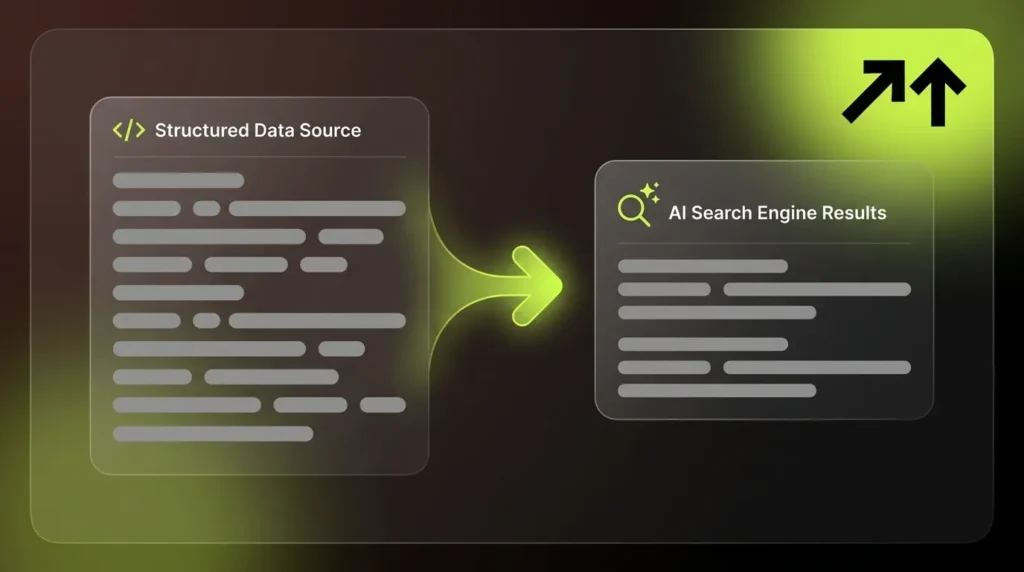
- Search Intelligence. A complete portrait of the traditional search landscape: positioning, competition, search volume, and the structure of who already wins each result. This baseline shows where the brand stands today. It reveals which domains and URLs win each query, where white space exists, and which competitors gain ground week over week.
- AI Analytics. While search intelligence reveals the competitive landscape, AI analytics captures how customers actually behave across the full journey. It covers external touchpoints like Google and AI-tool queries, content consumption, demographics, and sentiment. Many users now rely on AI for product research and recommendations, so behavioral data across AI surfaces becomes a required input for content decisions.
- Bot Tracking. AI analytics explains people, and bot tracking explains robots. This pillar captures every bot interaction, from traditional crawlers to AI training agents, including each crawl, citation, and training sweep. Approximately 9–25% of top websites block at least one AI crawler via robots.txt. Without bot tracking, a brand cannot tell whether AI systems read its content at all.
- AI Ranking. Bot tracking shows which agents read the content, and AI ranking shows how those agents present it. AI answers have no static ordered list, so order of mention and citation context become the new ranking. Higher ranking pages tend to receive more citations in AI answers. Where a brand appears in the answer, and how that position evolves week over week, forms the new leaderboard.
Together, these four pillars drive the content decisions that shape citation context: which queries to pursue, which formats earn citations, and which claims need validation. Only 14% of brands currently track AI or LLM citation visibility, even though 43% name AI optimization as a core 2026 strategy. The gap between intention and execution is where AI Growth Agent operates.
90-Day Action Checklist for CMOs
The following milestones reflect the standard pilot structure, based on average outcomes across the first twelve weeks: more than 12,000 additional AI citations and mentions, over 100,000 additional bot visits, and a 20%+ lift in impressions.
- Week 1: Kickoff and universe mapping. A journalist-led interview builds the brand manifesto, which immediately feeds the engine’s universe mapping. Using this manifesto as the foundation, the engine maps seed terms and long-tail queries from real-time Google and ChatGPT data, then produces and reviews the first articles. Within the same week, a fully optimized site the brand owns goes live, connected through a reverse proxy rewrite under the brand’s domain. No RFP. No agency dependency.
- Week 2: First indexing. Content often indexes in as little as ten days, so the second week focuses on tracking. Bot tracking activates across traditional crawlers and AI training agents. Schema, llms.txt, llms-full.txt, Blog MCP, and agent discovery endpoints go live from day one to give AI systems clean, structured inputs.
- Weeks 3 to 4: Content production at scale. The engine produces between 2 and 50 articles per day, targeting the long-tail queries that AI surfaces actually cite. Given that cited pages in ChatGPT often average well over a year of age, velocity becomes a structural advantage in building citation authority.
- Weeks 5 to 8: Citation context optimization. Incremental visibility reporting isolates what the engine generated versus existing brand visibility. Internal linking compounds authority across the universe. Self-healing activates as stale articles refresh in response to Google Search Console signals and bot-traffic data.
- Weeks 9 to 12: Universe expansion and scaled self-healing. The engine expands into additional seed terms based on citation performance data. Mature clients reach universes of 1,600+ queries. The system runs 3,000+ searches weekly to refresh the universe snapshot. Client proof: Breadless reached a 30x lift in Google Search Console impressions over six months, from 387,000 to 12.3 million, with ChatGPT citing eatbreadless.com over 45,000 times per month.
CMO Metrics Dashboard for AI Search
CMOs need metrics that explain change, not just status. The metrics below focus on what is shifting and what the engine generated. Seventy percent of CMOs say becoming an AI leader is a critical goal for 2026, yet 70% admit their internal processes are not mature enough to scale AI. This dashboard gives a defensible weekly answer for the CEO.
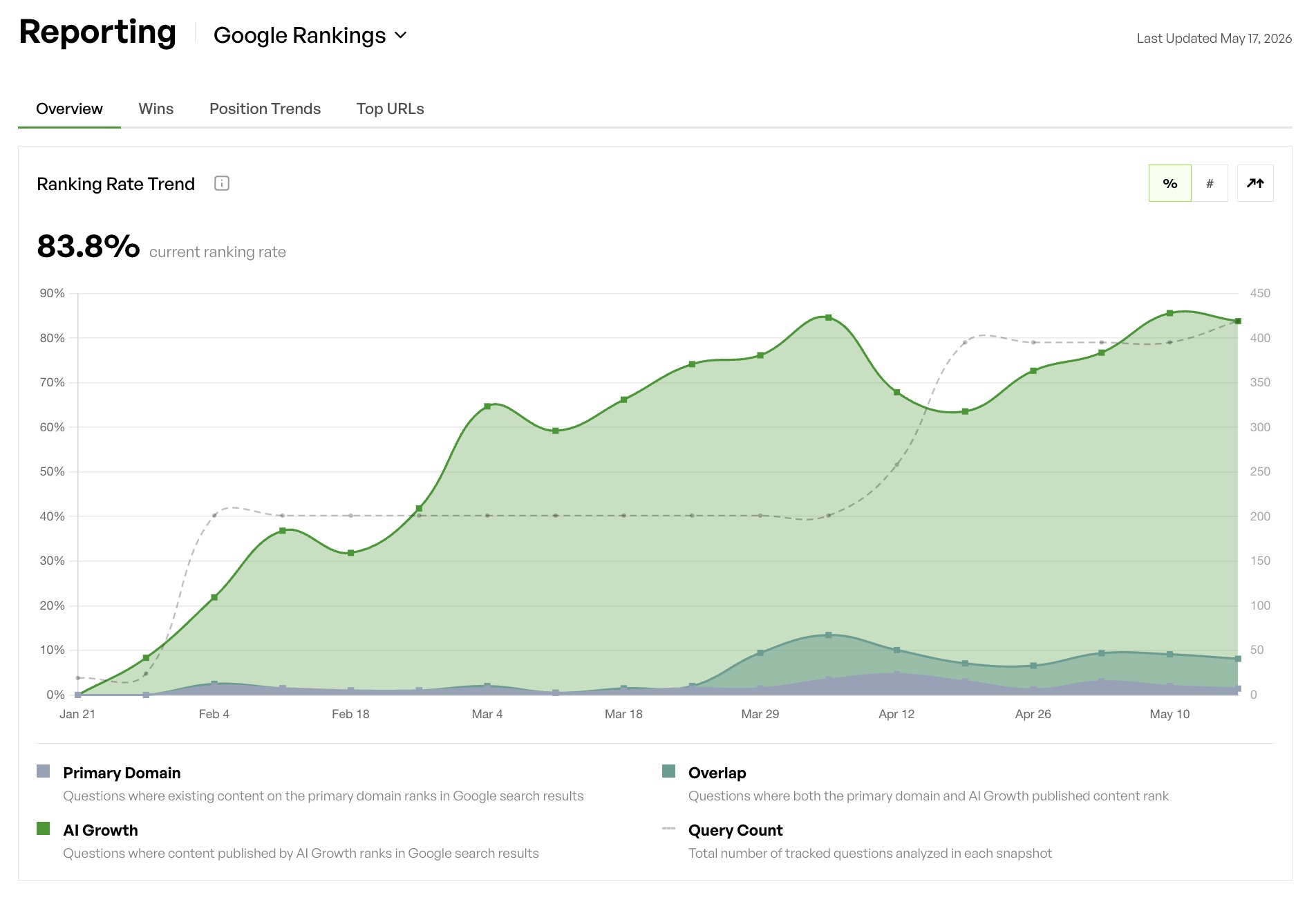
- Citation context. This metric shows where the brand appears in AI answers, which claims it is cited for, and which competitors it is grouped with. Citation context replaces the old idea of a single ranking number. Useful benchmarks for AI Share of Voice are under 15% (significant citation gap), 25–40% (competitive range in most categories), and above 40% (strong visibility).
- Incremental visibility. This view separates the visibility the engine generated from the visibility the brand already had. Leva Sleep doubled Google Search Console impressions on engine-produced content, with ChatGPT citations topping 10,000 per month. Incremental visibility connects AI search work directly to growth.
- Bot visits. This metric tracks every bot interaction per article, including GPTBot, OAI-Searchbot, PerplexityBot, and ClaudeBot. Clients average over 100,000 additional bot visits in the first twelve weeks. Chunked, quotable, schema-tagged pages receive 3–5x more citations in AI search results, so bot visits become an early signal of future citations.
- Impressions lift. Google Search Console impressions provide an independent audit of what the engine contributed. Clients average a 20%+ lift in impressions across the first twelve weeks. Arco (Geekie) saw a 22% rise in impressions and 25% in clicks within 28 days, tying AI search work to pipeline.
Monitoring tools tell a CMO whether the brand appears for a capped set of prompts, while this system changes what the answer is. Traditional tools such as GA4, Google Search Console, and rank trackers cannot measure AI citations because they only track sessions, blue-link impressions, and result-page positions. The metrics above require a system that produces the content, owns the publishing, and cross-references bot traffic, Search Console, and citation data in the same reporting view. Without this integrated approach, CMOs measure the wrong things or measure nothing while the narrative shifts beneath them.
Conclusion: Steering the Narrative
The discovery shift has moved marketing from blue links to AI answers that customers rarely verify. Buyers now receive a single synthesized answer that names brands, makes comparisons, and frames tradeoffs before any vendor site visit. The brands cited in AI search this year train the next generation of models with their own narrative. The brands that wait train the next generation with whatever happens to be sitting on the open web.
Headless marketing gives CMOs an architecture that makes narrative control executable at scale. It means marketing by and for the robots, with living and self-healing content, no added headcount, and one engine replacing the agency stack. Gartner’s 2025 CMO Spend Survey found that paid media accounts for 30.6% of marketing budgets, yet AI engines such as ChatGPT, Perplexity, and Gemini do not cite any paid, sponsored, or promoted content. Organic content compounds over time. AI search is the channel where the leaderboard is still being written.
The CMO who acts now controls the narrative. The CMO who waits inherits whatever the model already decided to say.
Frequently Asked Questions
What is the difference between narrative control and traditional reputation management?
Narrative control moves reputation work upstream, while traditional reputation management reacts after damage appears. Traditional reputation management responds to negative content, trying to suppress bad reviews or outrank damaging articles. Narrative control flips that sequence. It means producing the content that AI systems will use to describe a brand before a customer ever asks a question. In a world where customers resolve trust through generative AI and rarely click through to verify the answer, the brand that publishes citable, structured, validated content controls what the model says. The brand that relies on reactive tactics keeps responding to a narrative someone else set.
Why are traditional SEO metrics no longer sufficient for measuring AI search performance?
Traditional SEO metrics, including keyword rankings, domain authority, and click-through rates, measure performance in a ranked-link environment. AI search does not produce a ranked list of blue links. It produces a synthesized answer that cites sources the model trusts. A brand can rank on page one of Google and receive zero mentions in ChatGPT or Perplexity. The metrics that matter in AI search include citation frequency, share of voice, citation context, bot visits, and incremental visibility. These metrics require a system that produces content, tracks bot behavior, and cross-references multiple data sources in the same reporting view.
How does AI Growth Agent differ from GEO monitoring tools like Profound or Athena?
Monitoring tools track whether a brand appears for a capped set of prompts and act as a rearview mirror. They tell a CMO the brand is missing from AI answers and stop there, leaving the team to produce and publish content without a system to do it at scale. AI Growth Agent takes a different role. It maps the brand’s full universe of seed terms and long-tail queries from real-time Google and ChatGPT data, produces authoritative living content that validates every claim and source, stands up a fully optimized site the brand owns within the first week, and reports the incremental visibility it generates week over week. The content self-heals over time instead of going stale. Bot tracking covers every AI crawler, not just a capped prompt set. Incremental visibility reporting isolates exactly what the engine contributed, rather than taking credit for visibility the brand already had. Monitoring tools observe what is happening. AI Growth Agent changes what is happening.
What does a CMO need to prepare before starting with AI Growth Agent?
The preparation list stays short by design. The kickoff begins with a journalist-led interview that builds the brand manifesto, the single source of truth the engine uses to produce content, enforce brand voice, and validate claims. The CMO or their team brings the prompts and keywords they care about, any existing brand guidelines or product pages, and a clear sense of which parts of the market they want to win. The engine handles universe mapping, site setup, schema, technical SEO, agentic SEO endpoints, content production, bot tracking, and reporting. The internal team needs no technical skill. The only integration step on the brand’s side is the reverse proxy rewrite that connects the blog to a subdirectory under the brand’s domain. The entire onboarding process moves quickly, with content typically live within the first week and indexing often beginning within about ten days.
How long does it take to see measurable results in AI search?
The first article is typically live within a week of kickoff, and content often indexes within ten to fourteen days. Clients begin seeing citation activity and bot traffic early in the engagement. The standard pilot runs three months because indexing timelines vary by industry, and citation authority compounds over time rather than spiking immediately. Across the first twelve weeks, clients average more than 12,000 additional AI citations and mentions, over 100,000 additional bot visits, and a 20%+ lift in impressions. Standout outcomes include Jota reaching a 190%+ traffic increase from generated content in three months, Breadless achieving a 30x lift in Google Search Console impressions over six months, and Leva Sleep closing $40,000 to $50,000 in deals in under three weeks from buyers who discovered the brand through AI Growth Agent content.