Written by: Mariana Fonseca, Editorial Team, AI Growth Agent
Key Takeaways For Measuring AI Search ROI
- AI search visibility ROI relies on a three-layer measurement stack that separates visibility metrics, traffic data, and revenue attribution instead of relying on citation counts alone.
- GA4 custom channel groups capture only part of AI referrals, so the direct-traffic anomaly window becomes a critical proxy signal for hidden AI-driven visits.
- Self-reported attribution in CRM intake forms and sales scripts provides the only reliable method to capture zero-click AI influence that last-click attribution misses.
- Google Search Console’s Generative AI performance report provides leading visibility indicators but lacks clicks, CTR, and conversion data, so teams must correlate it with other metrics to prove ROI.
- AI Growth Agent combines content production and measurement so teams can move citation, traffic, and pipeline metrics using a single integrated platform.
Book A Demo With AI Growth Agent
How To Track AI Referrals In GA4
GA4 historically had no native AI channel in its default channel group, though Google added an “AI Assistant” default channel group in May 2026. Clicks that preserve a referrer header land under generic Referral. Clicks where the referrer is stripped land as Direct. Users who see a brand in an AI answer and then search for it on Google land as Organic Search. The custom channel grouping below recovers the identifiable layer.
Setup steps:
- Navigate to Admin → Data Display → Channel Groups.
- Create a channel named “AI Search” or “Gen AI Referrals.”
- Set the rule “Session source matches regex” to:
chatgpt\.com|chat\.openai\.com|perplexity\.ai|gemini\.google\.com|copilot\.microsoft\.com|claude\.ai - Drag the custom AI Search channel above the default Referral channel in priority order, because GA4 evaluates channel rules top-down and the first matching rule wins.
This setup is a 15-minute task. Once complete, the channel appears in Acquisition reports when the custom channel grouping is selected as the primary dimension.
The channel captures only part of what actually happens. Estimates suggest that 35% to 70% of AI referral sessions arrive without a referrer header and are filed as Direct traffic in analytics. That means the GA4 AI channel plausibly shows about half of the true AI-driven activity. Several mechanisms drive this gap.
ChatGPT’s paid accounts apply a noreferrer attribute to outbound links, so visits from paid ChatGPT users appear as Direct traffic. Google AI Overviews reach approximately 2 billion monthly users globally and generate zero identifiable AI referral signals in GA4, appearing identically to a standard Google organic search result click. In mid-2025, OpenAI began appending utm_source=chatgpt.com to desktop citation links, which makes some ChatGPT citation clicks traceable. Mobile app traffic and in-app webviews frequently strip headers before they reach GA4.
The practical implication is clear: treat the GA4 AI Search channel as a floor. The direct-traffic anomaly window, covered in the attribution section below, captures much of the remaining influence.
Unusual Direct traffic to deep pages, such as a specific article three levels down from a new user on a first session, provides the best available proxy for unattributed AI referral sessions. People do not type such URLs from memory.
Attrifast measured referrer pass-through rates by AI platform: Perplexity passes referrers 50–70% of the time, Gemini 40–60%, Claude 30–50%, ChatGPT 15–30%, and Google AI Overviews less than 3%. The largest AI search surfaces therefore perform worst at attribution.
For B2B SaaS companies, nearly half of what GA4 calls Direct may actually be AI-referred visitors who saw the brand in ChatGPT or Perplexity before typing the URL into a new tab.
As of May 2026, Google Analytics 4 added “AI Assistant” as a default channel group, with Google’s documentation explicitly naming ChatGPT, Gemini, Claude, Deepseek, Copilot, and Grok as covered platforms. Review whether this default channel already captures traffic before building a custom group, and confirm the two configurations do not double-count.
See How AI Growth Agent Tracks AI Referrals
How To Attribute Revenue To AI Search Without Last-Click
Last-click attribution remains structurally blind to AI-driven brand discovery. AI-driven brand discovery produces no observable event at the moment of exposure. It produces brand familiarity, category association, and inclusion in the consideration set. A buyer asks an AI tool for recommendations, sees the brand mentioned, searches the brand name on Google three days later, and converts via a paid brand ad. Last-click credits paid search while AI receives zero credit.
Self-reported attribution provides a reliable way to capture zero-click influence. The implementation has two components.
The first component is a CRM field. Add a required “How did you first hear about us?” field on intake forms, with “AI assistant” or “ChatGPT” as a selectable option alongside the standard channels. Because the goal is a single consistent data point rather than a survey, make the field required only on new opportunities and skip follow-up questions.
The second component is a sales script question. Train sales to ask on the first call: “Before you contacted us, did you see us mentioned in an AI tool or AI search result?” Log the answer in the CRM. Teams that build this into CRM intake accumulate the defensible proof points that make AI visibility budgets sustainable.
Once CRM data accumulates, the influenced revenue figure for the ROI formula draws on three inputs. The first input is self-reported AI attribution on closed-won deals. The second input is branded search lift correlated with content publication. The third input is a partial credit applied to pipeline where contacts had a confirmed AI touchpoint before converting. HubSpot’s worked example applies a 25% assisted credit to pipeline with confirmed AI touchpoints, which produces a conservative and defensible figure.
The direct-traffic anomaly window adds a third signal. According to Causality Engine, a steady climb in Direct traffic starting in late 2024 is often AI bleed rather than loyalty. Audit the Direct traffic trend over 24 months in GA4. When Direct grows above its pre-AI baseline, the gap provides a reasonable estimate of AI-influenced sessions that never produced a referrer header.
Branded search lift offers the most accessible proxy metric for most teams. Unexplained branded search spikes often trace back to AI visibility events. Track week-over-week branded search volume in Google Search Console and correlate spikes with content publication dates.
How To Use Google’s Generative AI Performance Report
Google launched Search Generative AI performance reports in Search Console on June 3, 2026, with dedicated reports for both Search and Discover. The worldwide rollout completed on August 31, 2026.
The report shows impressions within generative AI features on Search, including AI Overviews and AI Mode, broken down by pages, countries, devices (Search only), and dates with hourly through monthly granularity. The report covers AI Overviews and AI Mode, while experiments in Search Labs are excluded, and Discover has a separate Generative AI performance report.
The report omits several key elements. It does not show clicks, CTR, average position, query-level data, original prompts, answer position, or conversion value. The report is a filtered view of data already included in the regular Web search performance report, so the two reports should not be added together. Google Search Advocate John Mueller acknowledged that Search Console reporting for AI search is inadequate, and he attributed the shortcomings to the inherent complexity of AI search itself.
Fold this report into the dashboard as a leading indicator of AI visibility rather than a traffic or revenue metric. Track generative impressions over time, the number of pages receiving impressions, and the relationship between AI-visible pages and organic performance. Because matching click data for the same scope is not exposed, dividing ordinary Google Search clicks by dedicated AI impressions to calculate an “AI CTR” is invalid.
If the Generative AI performance report is missing from a Search Console property, the two likely causes are that the property has not received enough qualifying impressions or that the site has been excluded from Search generative AI features.
The full help center documentation is available at Google Search Console’s Generative AI performance report help page.
Measurement Variability In AI Answers
Run-to-run variability of AI answers creates a first-class measurement problem that almost no framework article addresses. A single prompt check does not qualify as a KPI. It behaves like a lottery ticket. The same prompt asked twice can retrieve different pages, cite different domains, and recommend different brands.
The research on this remains consistent and striking. A June 2026 study by Semrush and Kevin Indig ran 100 buyer-journey prompts through ChatGPT at minimal and high reasoning effort and found only 25.6% of cited domains overlapped between the two modes. SE Ranking’s study of 10,000 queries run through Google AI Mode three times on the same day found roughly nine in ten cited URLs changing between runs, with 21.2% of queries sharing not a single URL across the three runs.
Schulte et al.’s 2026 bootstrap convergence analysis recommends at least seven repeated runs per prompt per day for brand visibility and eight when source-level coverage matters. For sustained brand-level monitoring, the same authors recommend rolling aggregation over roughly two to four weeks.
The prescribed methodology uses a fixed panel of buying-intent prompts on a recurring schedule. Report the percentage of runs in which the brand appears per engine, and aggregate over two to four weeks. Report the metric as a rate, such as “cited in 47% of runs on this prompt cluster,” rather than as a binary present-or-absent screenshot. Because AI tools rarely return the same brand recommendations across runs, the appropriate signal is a mention rate rather than a ranking.
That variability also shows up at the market level, which means a single bad week does not justify killing the program. seoClarity’s analysis recorded citation volumes falling 86–94% across five markets between February and April 2026, then rebounding toward prior levels in May 2026. Single-week swings represent noise. Multi-week trends carry signal.
Get A Prompt-Tracking Baseline For Your Brand
What A Realistic AI Search ROI Timeline Looks Like
AI search visibility ROI operates on a longer cycle than paid media, with downstream revenue becoming defensible only after 90–180 days of sustained activity. HubSpot advises planning for 30–60 days before content improvements show up in citation rate changes, and 90–180 days before those citation gains translate into measurable pipeline influence. The month-by-month expectation curve, with the failure modes at each stage, keeps teams aligned.
Month 1: Content publication and indexing into AI training and retrieval systems. Content often indexes within two weeks. Failure mode: expecting citation data before content has indexed. Prompt checks run during this window do not measure program performance.
Month 2: Share-of-AI-voice metrics begin moving and early branded search lift appears. Failure mode: killing the program because a single prompt check shows no mention. What appears in one run today may not appear in the same run tomorrow. That pattern reflects measurement variability rather than program failure.
Month 3: Direct traffic and dark social signals become measurable, and pipeline survey data starts accumulating. Failure mode: treating the direct-traffic anomaly as unrelated noise instead of AI bleed.
Months 4–6: Correlated pipeline influence becomes visible in CRM data and the ROI case becomes defensible. Failure mode: over-attributing short-term movement to a single optimization. A rising citation share in a topic cluster can mean content improved, a competitor’s content dropped, or an AI model update shifted source preferences.
Months 6–9: Full program returns materialize. Failure mode: failing to refresh content, which causes citation decay. Content updated within 30 days receives 3.2x more citations than content older than 90 days, which makes freshness the strongest controllable citation variable.
If two or more leading indicators move in the right direction by day 60, leadership already has a credible story without waiting for pipeline data. The leading indicators to watch include branded search volume rising without a new paid brand campaign, direct traffic growing independently of email sends or paid pushes, share of AI voice improving month-over-month across the core prompt set, and citation rate increasing specifically on high-intent buying prompts.
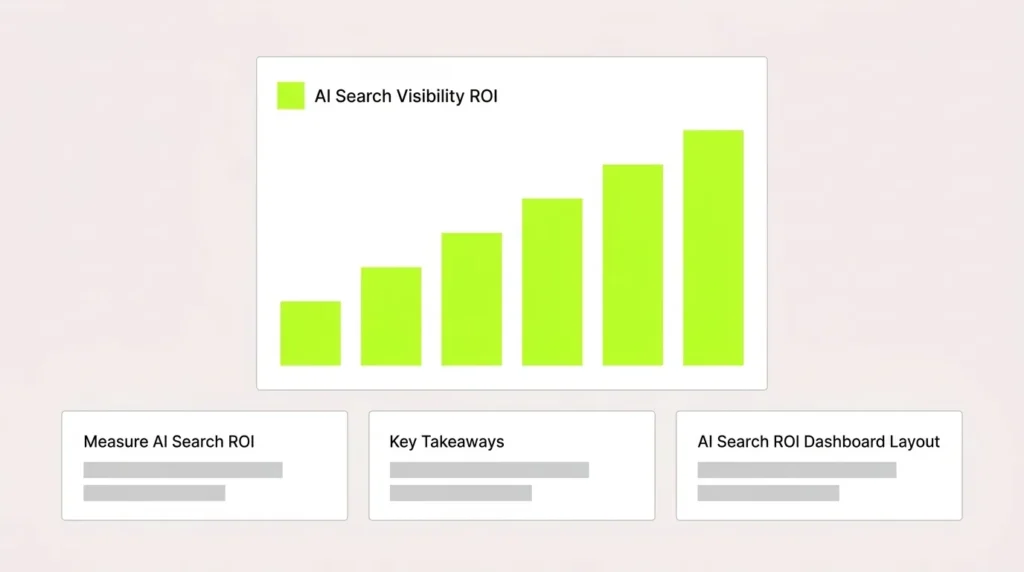
The AI Search ROI Dashboard Layout
The following layout names every metric and its source so the dashboard can be rebuilt from scratch. Tools required include GA4, Google Search Console, the CRM, and a method for tracking prompts across AI engines.
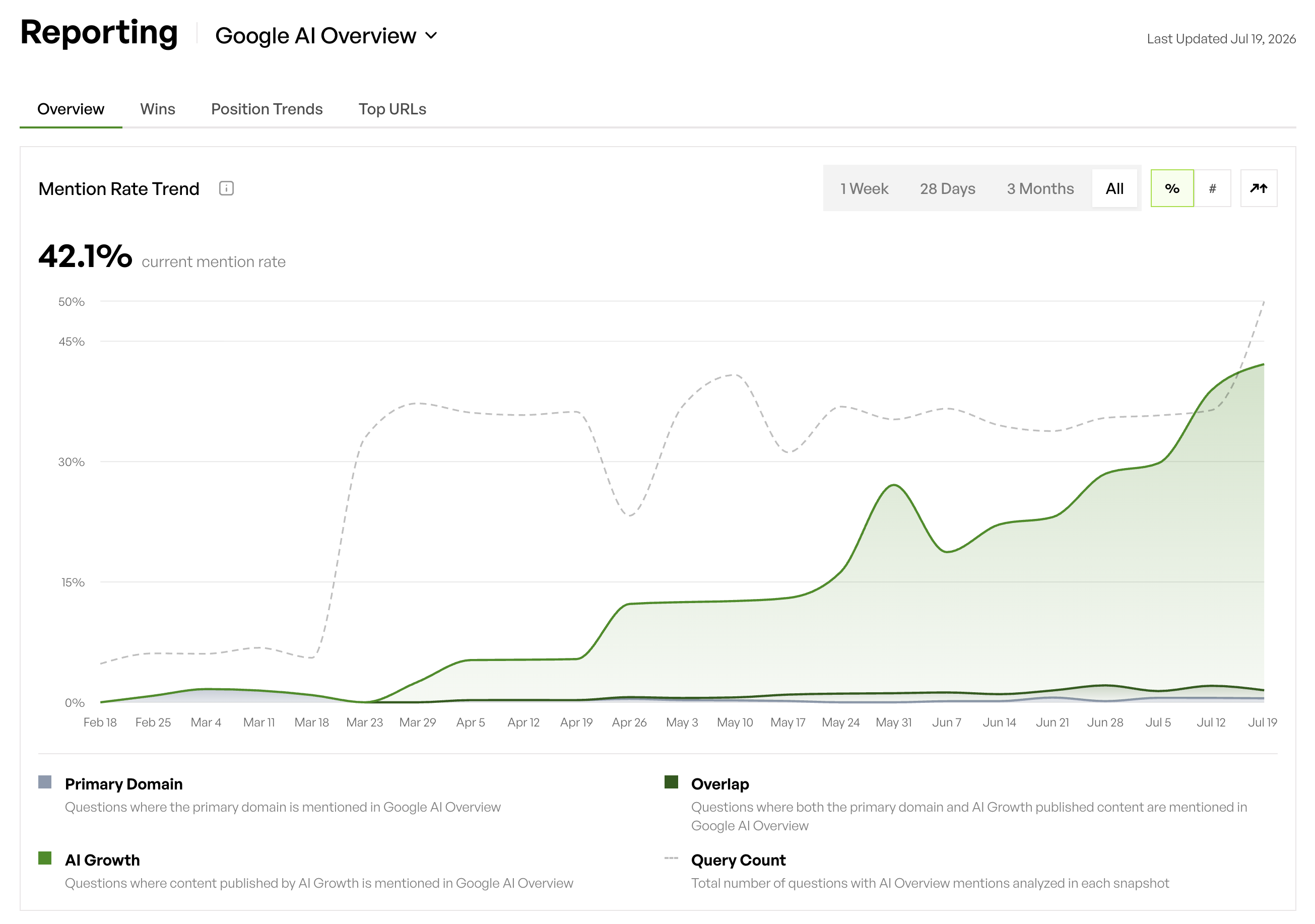
Row 1: Leading Indicators (Visibility)
- AI citation rate: percentage of tracked prompts where the brand is cited, sourced from manual prompt tracking or an AI visibility tool.
- Share of AI voice: brand mentions divided by total brand mentions across tracked prompts, sourced from the same tracking.
- Generative AI impressions: sourced from Google Search Console’s Generative AI performance report.
Row 2: Traffic And Behavioral Isolation
- AI referral sessions: sourced from GA4 custom channel group “AI Search.”
- Direct traffic to deep pages: sourced from GA4, filtered to exclude homepage and direct-intent paths such as contact, pricing, and demo pages.
- Branded search volume trend: sourced from Google Search Console.
Row 3: Pipeline And Revenue Attribution
- Self-reported AI attribution rate: percentage of new opportunities reporting an AI touchpoint, sourced from the CRM.
- AI-influenced pipeline: sourced from the CRM, filtered to opportunities with a confirmed AI touchpoint.
- Closed-won influenced revenue: sourced from the CRM, applying a partial credit to deals with an AI touchpoint.
No single method captures the full picture. The table below shows what each approach captures, where it stops, and why the three-layer stack is necessary.
| Measurement Approach | What It Captures | Primary Limitation |
|---|---|---|
| GA4 Custom Channel Group | AI referral sessions with intact referrer headers | Misses 35–70% of AI sessions filed as Direct |
| Self-Reported Attribution | Zero-click AI influence on new opportunities | Requires sales discipline and a CRM field on every new opportunity |
| Search Console Gen AI Report | AI impressions in Google surfaces (AI Overviews, AI Mode) | No clicks, CTR, or query data; inadequate for full attribution |
| Prompt Tracking | Citation rate and share of voice across tracked prompts | High run-to-run variability; requires repeated sampling over 2–4 weeks |
That stack gives you the measurement. It does not give you the content engine that moves the metrics. That gap is exactly what AI Growth Agent was built to close.
Why AI Growth Agent Is The Fastest Path To Defensible AI Search ROI
The measurement architecture described above only produces defensible ROI when the content driving AI visibility is actually being produced and maintained. Many programs break at this point. Monitoring-first tools meter prompts, hand back to-do lists, and leave the client to build, publish, and maintain everything. The measurement never closes the loop because the content engine sits outside the product.
AI Growth Agent inverts that model. Content creation sits at the core of the business. The engine maps a brand’s full universe across online search and produces authoritative content that validates every claim and source. It publishes on a site the client owns within the first week, then self-heals that content over time. Reporting isolates exactly what the engine generated rather than taking credit for visibility the brand already had.
AI Growth Agent commits to four metrics: brand mention rate, citation rate, Google Search Console impressions, and bot traffic. Across the first twelve weeks, clients average more than 12,000 additional AI citations and mentions, over 100,000 additional bot visits, and a 20%+ lift in impressions. Content often indexes within ten days, with the first article live within a week of kickoff.
The commercial model uses a flat fee with no per-article charges, credit limits, or per-prompt billing. Clients own all the content they produce. One engine replaces the SEO agency, the content tool, the GEO monitor, the schema plugin, the analytics stack, and the PR firm.
Client results illustrate the pattern. Leva Sleep is now the most mentioned retailer for adjustable beds in Canada, with ChatGPT citing Leva Sleep content over 10,000 times per month and $40,000 to $50,000 in deals closed in under three weeks from buyers who found them through AI Growth Agent content. Breadless is now one of the most recommended healthy franchises in the US, with Google Search Console impressions growing roughly 30x in six months and ChatGPT citing eatbreadless.com over 45,000 times per month. Exceeds.ai sources more than 55% of its traffic from generated content and is consistently recommended across Perplexity, ChatGPT, and Google’s AI Mode.
Traditional search tools show you where your brand stands. AI Growth Agent focuses on making your brand the answer.
Book A Demo To Review Your Measurement Stack
Frequently Asked Questions
How Long Before AI Search ROI Becomes Defensible?
In a 12-month longitudinal study of 127 brand GEO implementations (April 2024–April 2025), the median time-to-first-citation was 47 days, time-to-measurable-traffic was 78 days, time-to-pipeline was 112 days, and full ROI realization occurred at 90–180 days. The ROI case becomes defensible once correlated pipeline influence appears in CRM data, typically at 90–180 days. Leading indicators such as branded search lift and direct traffic often start moving within four to six weeks of consistent optimization work, according to HubSpot, which gives a credible interim story before pipeline data matures.
Who Should Own AI Search Measurement?
The CMO or VP of Marketing owns the dashboard and the ROI case. Sales owns the self-reported attribution question on the first call. No technical team is required when the measurement stack is built correctly. The GA4 channel group requires a brief admin task. The CRM field requires a single required intake field. The Google Search Console report requires no configuration beyond accessing the property.
What Tools Do I Need To Measure AI Search ROI?
Teams need GA4 with a custom AI Search channel group, Google Search Console with the Generative AI performance report, a CRM with a self-reported attribution field on new opportunity intake, and a method for tracking prompts across AI engines on a recurring schedule. An AI visibility tool can automate prompt tracking at scale. A manual panel of roughly 20 to 30 buying-intent prompts, run on a recurring basis such as weekly, provides a functional starting point.
Do I Need Technical Skills To Build The GA4 Channel Group?
The setup uses GA4 Admin configuration rather than code. Navigate to Admin, then Data Display, then Channel Groups. Create a custom channel group, add the regex for known AI referrers, and drag the new channel above the default Referral channel. No developer or agency support is required.
What Is A Good AI Citation Rate?
No universal benchmark exists. Citation rate varies by industry, prompt set, engine, and competitive density. Track your own trend over time rather than comparing to an absolute number. A rising citation rate on high-intent buying prompts is the signal that matters. Look for movement that exceeds a 3-to-5 percentage-point noise band and holds for at least three consecutive weeks within an 8-to-12-week measurement window. A single-week snapshot, high or low, does not provide a meaningful data point given documented run-to-run variability.
How Do I Avoid Survey Fatigue When Capturing Self-Reported Attribution?
Keep the question to one required field on new opportunities. Skip follow-up questions. Make it a selectable option rather than a free-text field. The goal is a single data point captured consistently across every new opportunity. One required field on intake, with “AI assistant” or “ChatGPT” as a named option alongside the standard channels, achieves that goal.
Book A Demo To Review Your AI ROI Dashboard
Conclusion: Build The Dashboard, Run The Discipline, Set The Curve
The measurement architecture now sits in front of you: the GA4 custom channel group, the self-reported attribution field, the Google Search Console Generative AI performance report, the prompt tracking cadence, and the three-layer dashboard that assembles them into a defensible ROI case. Build the dashboard this week. Run the attribution discipline from day one. Set a realistic expectation curve with leadership before the first month closes.
AI surfaces change. Model updates reshuffle citation patterns. Content freshness decays. Treat the discipline as a periodic review against a stable measurement protocol rather than a one-time build. The brands that prove ROI separate leading indicators from lagging proof and hold that separation consistently over time.
Book A Kickoff And See Your First Article Live Within A Week