Written by: Mariana Fonseca, Editorial Team, AI Growth Agent
Key Takeaways
- AI search monitoring tools track prompt coverage, citation frequency, and share of voice across ChatGPT, Google AI Overviews, Perplexity, and similar surfaces instead of traditional keyword rankings.
- Six selection criteria matter most: engines covered, prompt volume and refresh cadence, citation tracking depth, competitor visibility, geography and language support, and real cost at scale.
- Many tools hide real costs behind add-on pricing for extra engines or higher prompt volumes, and weekly refresh cadences often miss critical daily volatility in AI answers.
- Monitoring tools surface visibility gaps but leave an execution gap. Brands that win AI answers consistently produce and maintain the content models choose to cite.
- AI Growth Agent closes the monitoring-versus-execution gap by mapping the full universe of prompts, publishing self-updating content on a client-owned site, and driving measurable citation growth without per-prompt billing.
See how AI Growth Agent closes the execution gap
What AI Search Monitoring Actually Measures
AI search monitoring tracks brand appearance across AI surfaces such as ChatGPT, Google AI Overviews, Google AI Mode, Gemini, Perplexity, Microsoft Copilot, and Claude. It differs from traditional rank tracking. Traditional rank trackers focus on isolated keyword positions and provide a static snapshot of performance, built around a ranked list of URLs. AI visibility tools evaluate live answer-generation signals instead.
The unit of analysis is a prompt, not a keyword, and the core metrics prompt coverage, citation frequency, mention rate, recommendation rate, and share of voice are all measured across a defined prompt set. Presence alone does not tell the full story. Citation context matters just as much: where the brand appears in the answer, who it is grouped with, and what claim it is cited for. A Semrush analysis of 200,000 Google AI Overviews found the top organic result was used as a citation only 34% of the time on mobile and 46% on desktop, so ranking first in traditional search no longer guarantees inclusion in AI answers.
Answer volatility compounds the measurement problem. A SparkToro study found that the same AI query returns a different answer roughly 70% of the time, and two identical questions land on the same brand list less than 1 in 100 times. A tool that samples once a month is largely measuring noise.
What Are The Best AI Search Monitoring Tools? The Six Selection Criteria That Matter
The six criteria below separate tools built for AI search from tools that bolted AI tracking onto legacy rank trackers. Before comparing any specific product, apply these criteria to every tool under consideration, including AI Growth Agent.
- Engines Covered. The minimum credible set is ChatGPT, Google AI Overviews, Google AI Mode, Gemini, Perplexity, and Copilot. Only 14% of URLs cited by Google AI Mode rank in the traditional top 10, so a tool that covers only one or two surfaces gives a distorted picture of where a brand actually stands.
- Prompt Volume And Refresh Cadence. AI answer signals shift quickly, and daily data collection separates a purpose-built monitoring stack from a repurposed rank tracker. Weekly polling misses daily volatility in Perplexity and AI Overviews.
- Citation Tracking. A mention differs from a citation. Most teams only track direct URL citations, which undercounts AI presence and misses signals about where a brand has authority but is not getting explicit credit. The tool should distinguish mentions, owned citations, and source-level attribution.
- Competitor Visibility. Co-citation patterns reveal which brands AI surfaces group together. A tool that shows only the client’s own presence cannot answer the question that matters most: which competitors win the answers the client currently loses.
- Geography And Language. Multi-market brands need per-country, per-language tracking. Most entry plans cap geographic contexts sharply, and vendors rarely disclose the cost to unlock additional markets upfront.
- True Cost At Scale. The advertised entry price rarely matches the real price once full engine coverage is active. Prompt volume limits, per-engine add-ons, and seat fees compound quickly. The key question is what the tool costs when tracking the engines that matter at a prompt volume that reflects the brand’s full market.
The table below applies these criteria to the major tools in the category, including AI Growth Agent. Entry prices are consistently lower than the price of full engine coverage, and the gap widens as prompt volume grows.
| Tool | Best Fit | Engines Tracked (Entry Plan) | Pricing Model |
|---|---|---|---|
| Otterly.AI | Solo marketers and lean teams needing a low-cost entry point | 4 engines | $29/month (15 prompts); Claude and Gemini are paid add-ons |
| Peec AI | Mid-market teams needing multilingual tracking and unlimited seats | 3 engines | $95/month (50 prompts, 1 project); additional engines cost $35–$165/month per model depending on tier |
| Semrush AI Visibility Toolkit | SEO teams already on Semrush wanting AI coverage added to an existing workflow | 4 engines (base); more engines on enterprise plans | $99/month billed annually as a standalone add-on to Semrush |
| Profound | Enterprise teams needing deep analytics and agent crawl tracking | 1 engine at $99/month; 3 engines at $399/month; 10 engines on enterprise plans | $99/month Starter (ChatGPT, 50 prompts); $399/month Growth (3 engines, 100 prompts); enterprise custom |
| Scrunch (now a Sitecore company) | Enterprise teams already on Sitecore’s DXP stack | 4 engines on Core; more engines on enterprise plans | $250/month Core (125 prompts, 4 engines); enterprise custom |
| Promptwatch | Teams wanting all engines included without add-on fees, plus content publishing | All 11 tracked surfaces available on every paid plan | $95/month Essential (50 prompts, 6,000 tracked responses, 5 AEO articles); free plan tracks 10 prompts in ChatGPT |
| AI Growth Agent | Brands that need to move from monitoring to a content engine on a site they own | Maps the full universe across ChatGPT, Perplexity, Google AI Overviews, and AI Mode; prompt count is never a billed metric | Flat fee with no per-article charges, credit limits, or per-prompt billing; clients own all content produced |
A Qualitative Read Of The Main Tools By Use Case
Solo And Lean Teams: Otterly, LLMrefs, Peec AI, Nightwatch, SE Ranking, AI Growth Agent. Otterly.AI is bootstrapped, holds a 4.7/5 rating on G2 across 54 reviews, and starts at $29/month, which makes it the cheapest credible entry point. Engine coverage is the main watch-out. Claude costs an additional $29–$439/month depending on tier, and once a buyer wants full coverage, the effective price roughly doubles. LLMrefs tracks eleven AI surfaces including ChatGPT, Google AI Overviews, AI Mode, Gemini, Perplexity, Claude, Grok, Copilot, Meta AI, and DeepSeek, starting at $79/month with 500 prompts, but it reports on a weekly cadence rather than daily. Peec AI suits teams needing multilingual coverage and unlimited seats, and its add-on model means full engine coverage costs materially more than the advertised entry price. Nightwatch tracks across 107,000+ locations at zip-code level, a rare level of local precision, while Google AI Mode tracking is a $99/month add-on for 100 prompts. Lean teams that want monitoring plus a path to a content engine can also evaluate AI Growth Agent.
SEO Teams Expanding Into AI Visibility: Semrush, Ahrefs Brand Radar, AI Growth Agent. Both Semrush and Ahrefs are monitoring-first tools with 2026 action layers that still hand work back to a human. Semrush’s standalone AI Visibility Toolkit costs $99/month billed annually and tracks 25 prompts daily across ChatGPT, Google AI, Gemini, and Perplexity, with Grok and Claude reserved for enterprise plans. Ahrefs Brand Radar’s AI Visibility Index covers all platforms including Claude, with 2,500 checks per month, underpinned by a corpus of 460 million+ monthly prompts. Neither runs an end-to-end engine that produces, publishes, and maintains live content on a site the client owns. SEO teams that want that execution layer can treat AI Growth Agent as the next step.
Enterprise: Profound, Scrunch (Now Sitecore), Promptwatch, AI Growth Agent. Profound is the most visible enterprise name in the category. It raised to a reported $1B valuation in early 2026 and counts Fortune 500 companies including Ramp, US Bank, Indeed, MongoDB, and DocuSign among its users. The entry price can mislead. The $99/month Starter plan tracks ChatGPT only, and multi-engine coverage starts at $399/month. Scrunch was acquired by Sitecore on June 3, 2026, in a deal Bloomberg reported at approximately $225 million. That acquisition shapes any evaluation of Scrunch’s roadmap. As of early September 2026, no post-acquisition roadmap document had been published describing what Scrunch would look like in six or twelve months, and the execution loop being built connects to Sitecore’s DXP stack first, so non-Sitecore customers get monitoring and agent delivery without a full content execution story. Promptwatch includes all 11 tracked surfaces on every paid plan with no per-engine add-ons and adds crawler logs and automated content publishing to CMS platforms. Enterprise teams that want a dedicated content engine alongside monitoring can also consider AI Growth Agent.
The Add-On Pricing Trap And Refresh Cadence Risk
Two dynamics often turn a cheap tool into an expensive mistake. The first is the add-on pricing trap. Entry prices and real prices diverge once buyers unlock full engine coverage. Tracking additional AI engines beyond Peec AI’s core three costs roughly €20–30/month per engine as an add-on, so a Starter user wanting full coverage across Claude, Gemini, DeepSeek, and Grok pays nearly double the advertised €89/month price. An Otterly Standard plan with Claude and Gemini added works out to roughly $357/month, nearly double the $189 sticker price.
The second dynamic is refresh cadence risk. Weekly refresh at a daily-refresh price is a quiet 7x difference in data volume. Reddit’s share of ChatGPT Search citations collapsed from roughly 4% to half a percent on August 14, 2026, according to Promptwatch’s citation tracking. That shift happened quickly and illustrates why daily tracking matters more than a monthly PDF report.
The Monitoring-Versus-Execution Gap
Every tool in the table above reports what happened and hands the work back. They function as a rearview mirror. Most tools on the market are monitoring-only, showing where a brand stands without telling the team what to do about it. That pattern leaves a gap between a visibility score and the action needed to improve it. The 2026 action layers these tools added, such as draft agents that wait for approval and to-do lists the client still has to execute, validate the category while leaving the loop open.
Brands that win AI answers consistently produce and maintain the content the models cite. An SE Ranking study of 129,000 domains found that the number of referring domains predicted ChatGPT citations most strongly out of 20 signals measured. Schema-marked-up pages are cited more often than unstructured pages, and Article, BreadcrumbList, and HowTo schema correlate positively with citation rate. Citation outcomes depend on content and structural signals, not on which dashboard a team subscribes to.

AI Growth Agent focuses on this execution gap. It is the execution engine that maps the full universe of seed terms and long-tail queries from real-time Google and ChatGPT data. From there, it produces authoritative content that validates every claim and source, publishes to a site the client owns within the first week, and keeps that content updated over time. The difference is architectural. Monitoring-first tools meter prompts, and the action layers they added in 2026 still hand the work back to a human. AI Growth Agent was built the other way around, with content creation as the core of the business.
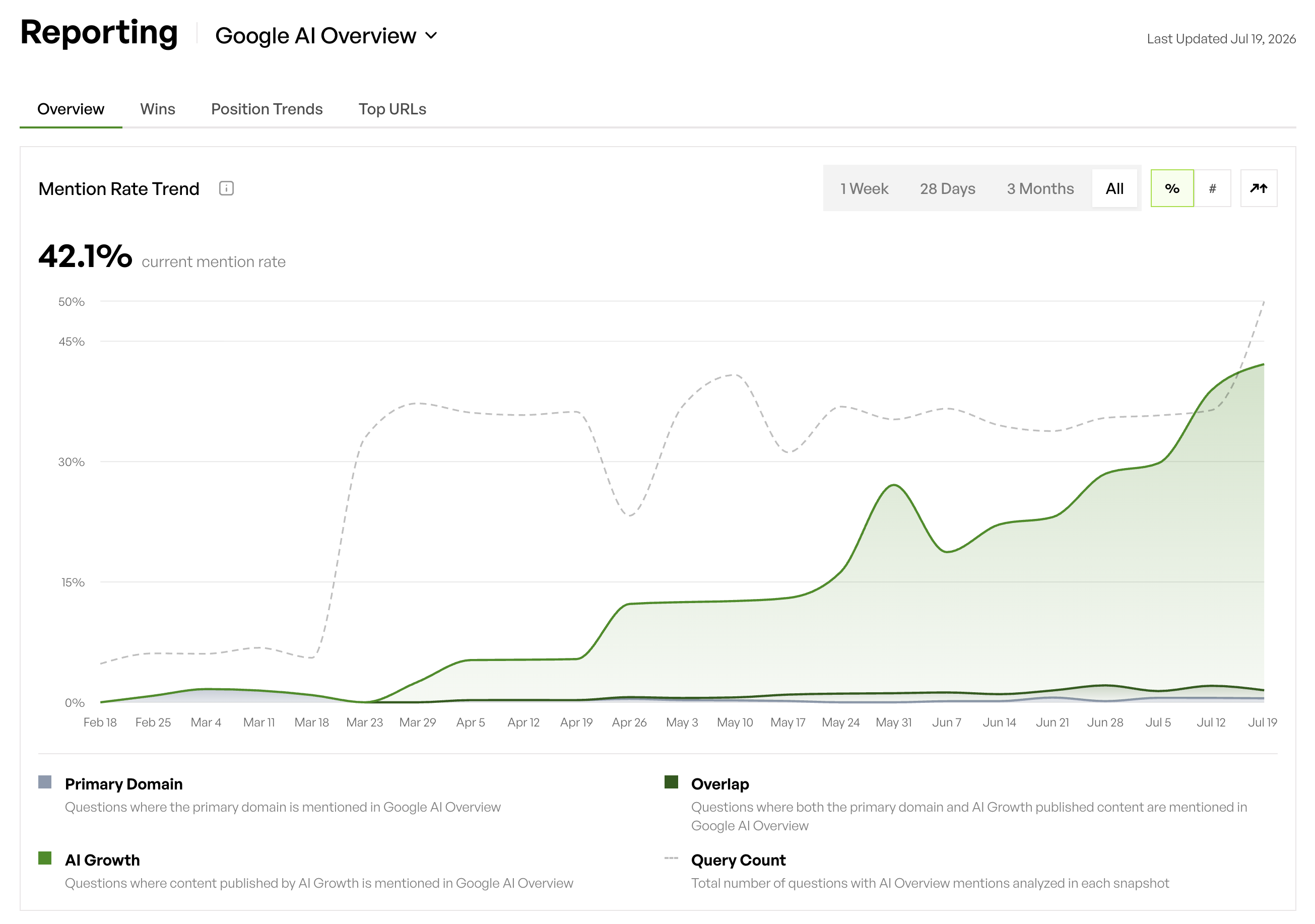
Across the first twelve weeks, clients average more than 12,000 additional AI citations and mentions and over 100,000 additional bot visits, with content indexing in as little as ten days. Google launched generative AI performance reports in Search Console on June 3, 2026, completing the rollout to all websites worldwide on August 31, 2026, and that reporting layer provides dedicated impression views for AI Overviews and AI Mode. Those reports confirm what is visible. AI Growth Agent changes what becomes visible.
How To Choose Based On Your Situation
The right tool depends on context, so match your choice to your current constraints and goals. Use the decision paths below as a shortcut.
- Solo Marketer Or Lean Team With A Limited Budget. Start with Otterly at $29/month or Promptwatch’s free plan. Run 15–30 priority prompts for four weeks to establish a baseline before committing to a higher tier. Confirm which engines matter most for your category before paying for add-ons. Teams that want a path from monitoring into a content engine can evaluate AI Growth Agent once the baseline is clear.
- SEO Team Expanding Into AI Visibility. If the team already uses Semrush or Ahrefs, the AI Visibility Toolkit or Brand Radar offers the lowest-friction entry. These tools remain monitoring-first, and acting on the findings still requires a human to drive every step. When the team needs execution that produces and maintains content directly, AI Growth Agent fits that workflow.
- Agency Managing Multiple Clients. Peec AI’s agency plans or Promptwatch’s agency tier offer per-client prompt structures. Evaluate whether the tool’s credit or prompt model scales economically across eight or more clients before signing. SE Visible, spun out of SE Ranking, is built for agencies with unlimited country coverage and white-label reporting. Agencies that want to deliver an execution layer, not just dashboards, can use AI Growth Agent as their content engine.
- Enterprise CMO Or Brand Director. Profound offers deep analytics and agent crawl tracking. Factor in that multi-engine coverage starts at $399/month, not $99/month. If the team already runs Sitecore’s DXP, Scrunch’s integration roadmap matters, but the loop that connects monitoring to published content is still being built and ties to Sitecore’s stack. Evaluate that roadmap risk explicitly. Enterprises that want a dedicated execution engine on a brand-owned site can treat AI Growth Agent as a primary option.
- Any Buyer Who Sees Content As The Real Constraint. Monitoring provides the right diagnostic but does not fix the underlying content gap. If the team lacks a system to produce, publish, and maintain authoritative content at scale, a monitoring dashboard will surface the problem and hand it back every week. At that point, the next step is a content engine such as AI Growth Agent.
What To Do After You Buy A Monitor
Buying a dashboard without a plan for action often leads to the same visibility problem six months later. Monitoring surfaces where a brand is absent or misrepresented, yet it does not change what the models say. Correcting an inaccurate AI answer works best when teams produce and structure the authoritative content and sources that models use to describe the brand. That approach focuses on upstream content rather than editing answers directly.
Teams need to produce and publish authoritative content in formats and structures the models can read, with the validation that earns citations. AI Growth Agent serves as the engine that turns diagnosis into live content on a site the client owns. It maps the full universe and produces content single-shot from a journalist-led manifesto process. Publishing includes the full technical and agentic SEO stack, and reporting isolates the incremental visibility the engine generates week over week from visibility the brand already had. The content behaves like a living system that updates over time instead of going stale. Pricing follows a flat-fee model with no per-article charges, credit limits, or per-prompt billing, so clients see their entire universe instead of a capped handful of tracked terms.
Frequently Asked Questions
What Are The Best AI Search Monitoring Tools?
The best tool depends on the buyer’s situation. For solo marketers and lean teams, Otterly at $29/month and Promptwatch’s free or $95/month Essential plan are the most accessible entry points. For mid-market teams needing multilingual coverage and unlimited seats, Peec AI is a strong fit, though full engine coverage costs more than the advertised entry price once add-ons are factored in. For SEO teams already on Semrush or Ahrefs, the AI Visibility Toolkit and Brand Radar add AI coverage to existing workflows. For enterprise buyers needing deep analytics and agent crawl tracking, Profound is the category leader, with multi-engine coverage starting at $399/month. Scrunch, now a Sitecore company following a June 2026 acquisition, suits enterprise teams already on Sitecore’s DXP stack, though its post-acquisition roadmap remains undocumented. For teams that need to move beyond monitoring into an execution engine, AI Growth Agent closes the loop monitoring tools leave open.
What Is The Most Accurate AI Search Tool?
Accuracy in AI search monitoring depends on methodology more than brand reputation. Key variables include how many times a tool runs each prompt per engine, whether it uses live UI simulation or API calls, and how frequently it refreshes. Tools that run each prompt only once produce weak signal because AI answers are non-deterministic and the same query can return a different answer the majority of the time. Tools that simulate real user sessions through the actual web interface capture what a real user would see, while API-only tools can report a brand absent when a signed-in session shows it present. Buyers should ask any vendor how many runs per prompt make up one data point, which collection method they use, and how they handle model-version drift. No tool can guarantee deterministic results, and visibility percentages work best as estimates tied to a defined prompt set and sampling method.
Is SEO Dead Now With AI?
Traditional SEO still acts as a prerequisite for AI visibility. Google AI Overviews draw the large majority of citations from pages that already rank in organic search, so crawlability, structured data, and topical authority still feed the models that generate answers. The change lies in the relationship between ranking and citation. Ranking first no longer guarantees inclusion in AI answers, and a page that ranks well organically can still be invisible across ChatGPT, Perplexity, and AI Mode. AI search adds a layer on top of SEO rather than replacing it. Brands that win AI answers combine a strong organic foundation with authoritative, structured content that AI surfaces can find, trust, and cite. Large language model optimization reshapes how customers consume information while building on the technical foundation that SEO established.
How Often Do AI Search Monitoring Tools Refresh Their Data?
Refresh cadence varies significantly across tools and tiers, and most vendors publish which engines they cover without disclosing their refresh cadence. Daily refresh is the standard for tools built specifically for AI search monitoring. Weekly refresh is common on entry plans and among SEO suites that added AI tracking later. The practical impact is material because citation distributions can shift within days, and a tool that samples once a week can miss volatility that changes a brand’s competitive position overnight. As noted earlier, the SparkToro finding that AI answers are non-deterministic means a monthly monitoring cadence is largely measuring noise. Buyers should treat refresh cadence as a total-cost-of-ownership variable alongside engine coverage and prompt limits, because weekly refresh at a daily-refresh price represents a 7x difference in data volume for the same subscription cost.
Conclusion: Choose The Framework, Not The Hype
The AI search monitoring market in 2026 consists of variations on a common dashboard pattern. Most tools track brand appearance across a metered set of prompts, report what happened, and hand the work back. The six criteria that matter are engines covered, prompt volume and refresh cadence, citation tracking, competitor visibility, geography and language, and true cost at scale. Apply those criteria before the demo, not after the contract.
The Scrunch acquisition by Sitecore, the add-on pricing structures at Otterly and Peec AI, and the single-engine entry trap at Profound are all material facts for any buyer evaluating this category in late 2026. The monitoring-versus-execution gap belongs on that list as well. A dashboard that surfaces where a brand is absent still leaves the content work to the team. Brands that win AI answers invest in the content models choose to cite and keep that content current. AI Growth Agent exists for teams that want monitoring and an execution engine in the same stack.