Written by: Mariana Fonseca, Editorial Team, AI Growth Agent
Key Takeaways
- Headless marketing separates your curated brand site from an autonomous, API-driven content engine that AI surfaces can discover and cite at scale.
- This approach maps the full universe of seed terms and long-tail queries, then publishes schema-complete, self-healing content to an owned site connected via reverse proxy.
- Traditional SEO stacks cannot keep pace with AI-mediated discovery, so headless marketing replaces agencies, monitors, and plugins with a single flat-fee engine.
- Clients gain incremental visibility reporting, full technical SEO automation, and ownership of both content and site without adding headcount or technical dependencies.
- Brands ready to control what AI says about them can book a demo with AI Growth Agent and see their first article live within a week.
The Discovery Shift From Blue Links To AI Answers
Discovery has shifted from ranking on Google and buying attention on Meta to getting cited inside AI answers. Field experiments have shown AI Overviews reduced organic clicks and increased zero-click behavior. The answer now arrives inside the surface, and most users never visit the source.
The behavioral gap compounds the structural one. Many people report skepticism toward AI answers, yet only a small percentage click through to verify them, so skepticism rarely becomes verification. When users accept AI answers without clicking through, whatever the AI says becomes the answer by default. That pattern makes the content the model cites the deciding factor in whether a brand exists in the conversation at all.
Every AI agent decision, grounding call, and recommendation output is a search event, which pushes total search volume up even as traditional query counts decline. The channel keeps growing. The brands that shape what the model says are the ones that win that growth.
If your brand is not being cited in AI answers today, it will not shape tomorrow’s conversations. See how AI Growth Agent publishes your first AI-ready article within a week.
Core Concepts For Headless Marketing In AI Search
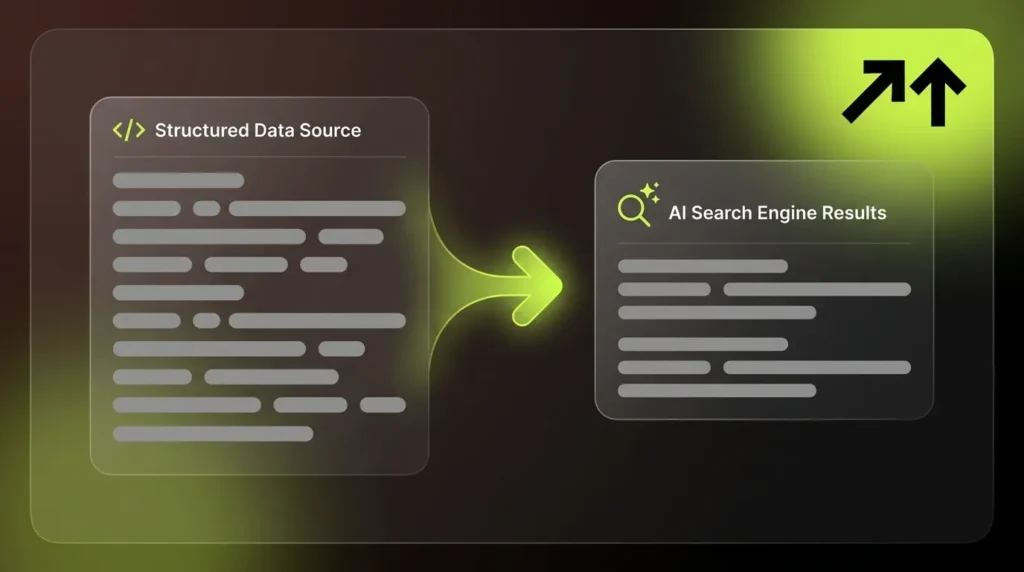
The body and head model. In headless architecture, the head is the presentation layer a human sees, and the body is the content engine running behind it. A headless CMS decouples the backend content repository from the frontend presentation layer, allowing any front-end platform to display content via REST APIs and GraphQL APIs. Headless marketing applies the same logic to brand presence in AI search, so the curated main site stays untouched while the engine publishes at scale behind it.
The universe. The universe is the full set of queries and prompts that describe a brand’s market, with head terms and long tail together. Most brands track a handful of head terms and lose the rest of the conversation by default.
Seed terms. Seed terms are the strategic anchor topics that organize the universe. Each seed term spawns dozens of long-tail queries underneath it.
The long tail. The long tail covers the vast majority of the queries customers actually ask. AI-cited URLs may not always rank in the first 10 organic results, which means AI surfaces pull citations from content that traditional rank tracking never surfaces. Brands that focus only on head terms stay blind to most of their own market.
Citation context. Citation context describes where the brand appears in an AI answer, who it is grouped with, and what claim it is cited for. This replaces the old idea of a single ranking number.
Large language model optimization (LLMO). LLMO is the discipline of writing and structuring content so that AI surfaces find it, trust it, and cite it. AI search prioritizes clarity and answer-first summarization, E-E-A-T signals, Q&A format, section structure with heading hierarchy, and structured data as top citation predictors across large-scale URL analyses.
Living and self-healing content. Living content updates automatically over time so the brand’s presence does not decay as the world changes. When the year turns, every article in a sector is refreshed. When Google Search Console signals stale performance, the engine responds and repairs it.
Incremental Visibility. Incremental Visibility reporting isolates the visibility a new effort actually generated, separate from the visibility the brand already had. Without this separation, brands take credit for momentum they did not create.
Now that you understand the universe, seed terms, and citation context, the next step is seeing how much of that universe your brand actually controls. See how AI Growth Agent maps your specific market and exposes gaps in your current coverage.
Current Market And Ecosystem Overview
These concepts matter because the traditional marketing stack was never designed to deliver them. The traditional marketing stack is a coordination problem. An SEO agency reads a dashboard back to the CMO. A content tool produces text that still needs a designer, an engineer, and a publisher. A web agency controls the site, so every change becomes a dependency. A GEO monitor reports that the brand is missing from AI answers and stops there. A schema plugin requires maintenance. An analytics stack requires interpretation. A PR firm runs on retainer and moves on a news cycle, not an AI training cycle.
AI search is not a single behavior but a directional shift toward AI-mediated discovery, comparison, and recommendation that happens before users visit brand interfaces, which makes findability by machines a structural business property rather than a marketing channel. The stack built for blue-link search cannot keep pace with that shift.
Studies have found that brand web mentions correlate more strongly with AI Overview visibility than backlinks, with brands earning significantly more AI Overview citations when they lead in web mentions. The signal AI surfaces trust most is not what the old stack was built to produce.
Headless marketing replaces this scattered stack with one engine. AI Growth Agent maps the universe, produces authoritative content, provisions the full technical and agentic SEO stack, publishes to an owned site, self-heals what goes live, and reports the incremental result. One flat fee covers everything, with no per-article charges, credit limits, or per-prompt billing.
If your current stack reports AI problems without fixing them, a single engine can replace that patchwork. Review your existing stack against a headless alternative in a working session.
Traditional Stack Versus Headless Engine In Practice
That claim of replacing the entire stack deserves scrutiny. The differences between traditional and headless approaches cluster around speed, coverage, control, and measurement, and these dimensions determine whether a brand can execute in AI search.
Speed to market. An agency RFP runs about three months, then three more to produce the first assets. AI Growth Agent goes from kickoff to first published article in about one week, with content indexing in as little as ten days.
Universe coverage. Traditional SEO tools track a pre-selected set of head terms, and GEO monitors cap prompt counts. AI Growth Agent maps hundreds of seed terms and the long-tail queries beneath them, refreshed every week, with prompt count never treated as a billed metric. Mature clients reach large universes of queries, and the system runs thousands of searches weekly just to refresh the snapshot.
Content quality and consistency. DIY chatbot production can yield one good article before quality drifts. Pure headless CMS adoption increases development costs significantly while worsening time-to-market because marketing teams lose WYSIWYG visual authoring and must wait for engineering deployments to preview or publish changes. AI Growth Agent’s multi-agent orchestration produces content single-shot, validates every claim and source, and saves memories so feedback never needs repeating.
Technical SEO. Tracking of AI crawler behavior found zero evidence of JavaScript execution by AI crawlers including GPTBot, ClaudeBot, PerplexityBot, and Meta’s ExternalAgent, which makes server-side rendering or static site generation a binary requirement for AI content discoverability. AI Growth Agent ships every article with clean HTML, full schema, Blog MCP, llms.txt and llms-full.txt, advanced robots.txt, and a proper sitemap.xml automatically. No plugin, no schema work, and no engineering hours are required on the brand’s side.

Ownership. Many brands do not own their own site because an agency controls it. AI Growth Agent stands up a site the client owns outright, connected through a reverse proxy rewrite or subdomain, with no agency in the loop.
Measurement. Traditional tools report on visibility the brand already had. Incremental Visibility reporting isolates exactly what AI Growth Agent generated, cross-referencing bot traffic, Google Search Console, and citation data that no single tool brings together.
If you need faster publishing, broader coverage, and clear attribution, a headless engine delivers all three in one move. Walk through a side-by-side comparison for your own stack.
Key Factors To Evaluate Before Choosing An Approach
Team capacity. The headless engine requires no technical skill from the client. The only integration step is the reverse proxy rewrite connecting the blog to a subdirectory under the brand’s domain. If the internal team is non-technical and used to depending on agencies for anything that touches code, that dependency disappears.
Technical complexity. Enterprise implementations of pure headless CMS typically run many months for a full replatform. AI Growth Agent’s headless marketing approach does not require a replatform, so the existing main site stays untouched.
Data quality. The engine is only as strong as the context behind it. A detailed kickoff interview and a complete manifesto produce better output than a sparse brief. The more the engine knows about the brand’s voice, facts, and deny lists, the more consistent and compliant the content becomes from day one.
Integration needs. The engine integrates with Google Search Console, Google Analytics with custom UTM parameters, and per-article bot tracking across every bot type. The CMS connection uses a reverse proxy rewrite, with setup documentation generated for the client’s host, whether Cloudflare, Vercel, or another provider.
Governance. Clients with deeper review requirements can use a studio experience to read each article, chat with it, and steer it before publish. The engine edits the article in place and saves memories so the same correction is never needed twice. Clients who prefer full autopilot can hand off to the AI Growth Agent team entirely.
Scalability. The engine produces multiple articles per day per client. Pricing is a flat fee, so scaling the universe does not scale the cost.
Cost model. Consumption-based SaaS pricing on pure headless platforms leads to compounding costs and common overage fees at enterprise scale, with some platforms having high annual contract values. AI Growth Agent’s flat fee model means clients see their entire universe instead of a capped handful of tracked terms.
Once you know your team capacity, risk tolerance, and budget, you can decide whether a headless engine fits your reality. Use a consultation session to stress-test the model against your constraints.
Typical Implementation Stages For AI Growth Agent
Implementation follows a dependency chain where each stage feeds the next. The kickoff captures brand context that informs universe mapping, which then defines what the provisioned site must support and what the first articles should cover.
Kickoff interview. A professional journalist interviews the client to build the manifesto. This material captures brand voice, factual references, deny lists, and the personalization needed to make content compliant by default. The kickoff is where the engine learns what the brand is, what it is not, and what it must never say.
Universe mapping. Agents ingest the manifesto alongside any unstructured material the client provides, including PDFs, brand guidelines, and product pages, and then map the client’s entire market. The result is a Content Topology, a hierarchy of seed terms, each backed by real-time Google and ChatGPT data, with dozens of long-tail queries beneath it. Real-time AI Overview and ChatGPT results act as the objective function for which long-tail queries are worth pursuing.
Site provisioning. AI Growth Agent stands up a fully optimized site within the first week, automatically decorated with every technical SEO best practice and styled to match the client’s own pages. The WordPress plugin ships with bot tracking, Blog MCP, advanced robots.txt, a proper sitemap.xml, and automatically generated web stories out of the box.
First published article. The engine writes, validates, and publishes the first article within about one week of kickoff, with indexing typically following within ten days to two weeks. The client reviews finished, ready-to-publish content and can give feedback in plain language. The engine updates the article in place and saves a memory so the same note is never needed twice.
Agentic technical SEO, live from day one. Studies of AI crawler behavior found that ChatGPT prioritizes HTML content in a majority of fetches, so serving clean HTML is a binary requirement. Every article ships with llms.txt and llms-full.txt, Blog MCP, OpenAI discovery and Agent Card guidance served via /.well-known/, and natural language query parameters that auto-trigger personalized, internally linked responses to agents passing a query straight into the URL.
If you want to see this sequence applied to your own brand, you can walk through a live implementation plan. Request an implementation review and see what your first week would look like.
Ongoing Management And Measurement
Content does not ship and go stale because the engine monitors two decay signals: calendar time and performance metrics. When the year turns, every article in a sector is refreshed automatically to maintain temporal relevance. When Google Search Console signals declining performance, the engine acts on that quality signal. Every article’s relationships, performance, and bot and Search Console data are centralized so authority compounds instead of decaying.
Bot tracking records every bot that touches the blog, including the bot ChatGPT uses to cite sources. Analysis of AI citations showed AI-cited content is fresher on average than traditionally ranked organic content, with the freshness premium varying significantly by platform. Living content stays fresh by design.
Incremental Visibility reporting isolates exactly what AI Growth Agent generated, week over week. The engine publishes into a separate environment so it can take credit only for the visibility it actually creates, never for visibility the brand already had. Clients watch results in the reporting view, in the Content Planner for which keywords and prompts are ranking, and through Google Search Console as an independent audit.
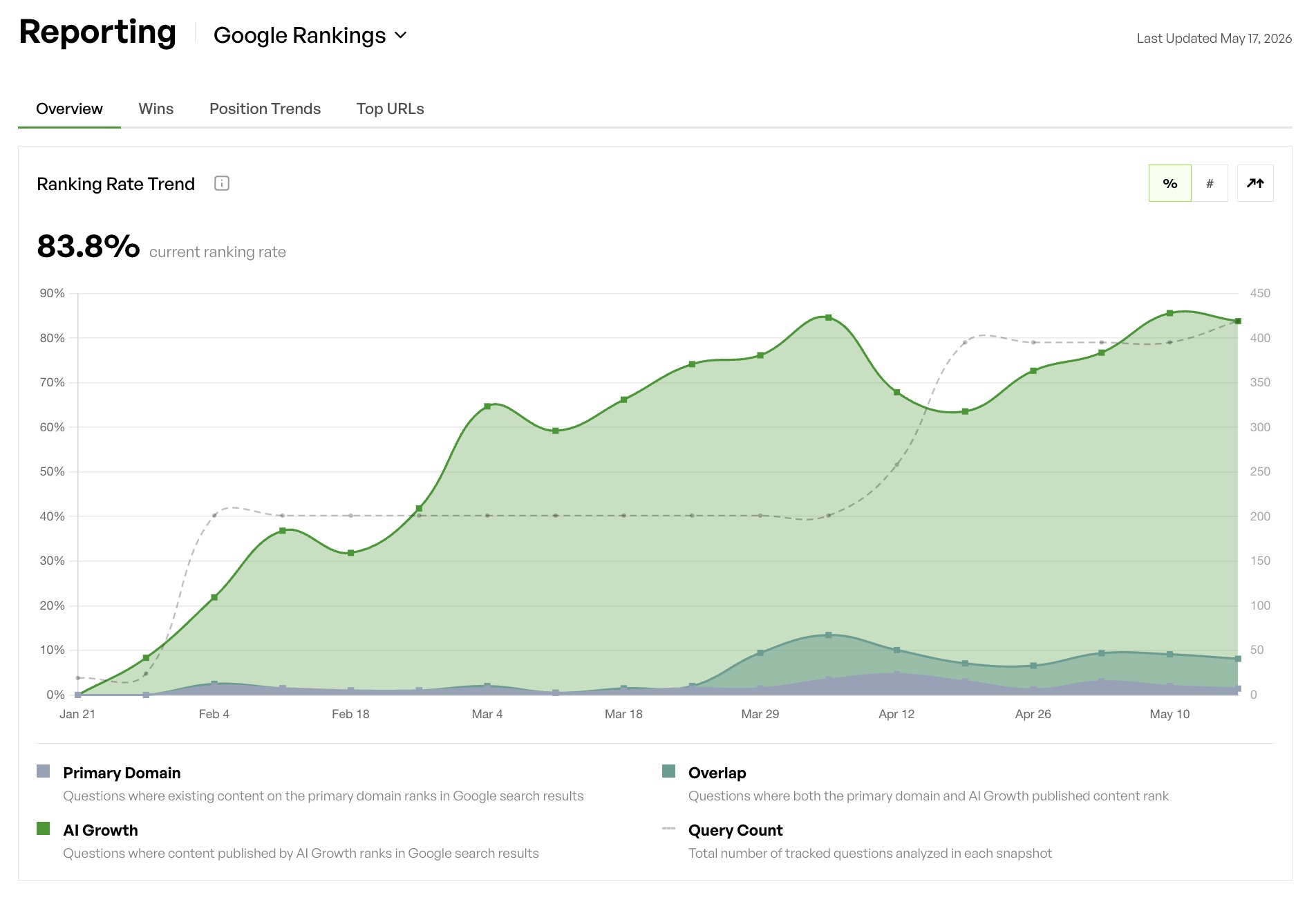
Clients have seen substantial increases in AI citations, bot visits, and impressions, with specific performance timelines detailed in the pilot metrics shared during onboarding. Some brands have also closed significant deals from buyers who discovered them through AI Growth Agent content.
If you need ongoing proof that AI content is compounding, not decaying, the reporting layer makes that visible. Preview the reporting views using anonymized client data.
Risks, Limitations, And Common Mistakes
Treating monitoring as action. GEO monitors and AI search tracking tools report that a brand is missing from AI answers, but they do not produce content, own publishing, or act on the data. The mistake is paying for the diagnosis and never filling the prescription. Monitoring functions as a rearview mirror, while the engine functions as the steering wheel.
The DIY chatbot trap. One company produced roughly 300 articles using a chatbot, and not one was cited, because the articles were full of errors and gaps. A chatbot can write one good article before the process must run again from scratch, and quality drifts from one piece to the next. A deep divide exists between what an engineer thinks the content should be, what a marketer wants, and what the robots actually need to cite it.
Hallucination concerns. AI Growth Agent layers anti-hallucination controls at every stage of generation. Every claim is re-extracted after drafting and checked against product pages, the manifesto, primary sources, and verified external sources. Any claim that cannot be backed up is removed or softened before the article moves further down the pipeline. The engine never relies on a model’s training data alone.
Assuming all AI content converges. When generic information can be summarized, recombined, and reproduced at negligible cost, originality becomes a structural advantage through original research, first-hand operational knowledge, proprietary data, and perspectives that cannot be trivially regenerated. The brand manifesto and the journalist-led layer create differentiation a generic tool cannot replicate. Long-tail strategies differ even within the same sector, so two competitors running AI content do not converge on the same answer.
Waiting. AI surfaces are still in their first generation, and the leaderboard is being written this year. Brands that establish authoritative content now are training the next generation of models with their own narrative. Brands that wait are training the next generation with whatever happens to be sitting on the open web.
If you see your team in any of these patterns, you can correct course before the gap widens. Use a consultation session to pressure-test your current approach against these risks.
Summary And Decision Support For Marketing Leaders
Headless marketing gives brands a way to control what AI says about them without adding headcount or assembling an agency stack. The brand keeps its curated main site. The engine maps the full universe, produces authoritative content, provisions the complete technical and agentic SEO stack, publishes to an owned site, self-heals what goes live, and reports the incremental result.
The decision criteria stay straightforward. If the internal team is non-technical and cannot deliver schema, technical SEO, or the things robots and agents need to cite a brand, the engine handles all of it. If the agency is slow, expensive, and not catching up to AI search, the engine replaces it. If monitoring tools are reporting problems without solving them, the engine solves them. If the brand does not own its own site, the engine stands one up in a week.
Marketing teams that adopt headless architecture now are positioning their content for AI-powered search visibility rather than only solving today’s distribution problems. The brands cited in AI search this year are training the next generation of models with their own story.
Run your marketing the way the brands cited in AI search are running it: headless, built for robots, and run without extra headcount. Book a kickoff with AI Growth Agent.
Frequently Asked Questions
What exactly is headless marketing and how is it different from headless commerce?
Headless commerce decouples the customer-facing storefront from the engine running the business. The frontend stays branded and curated, while the backend scales autonomously without dragging the brand experience with it. Headless marketing applies the same architectural logic to brand presence in AI search. The brand keeps its curated main site, the pages humans read and the marketing pages that convert. AI Growth Agent stands up a separate, fully optimized blog the brand owns, connected through a reverse proxy rewrite under a subdirectory or through a subdomain. The engine writes, publishes, monitors, self-heals, and reports. The brand decides what to win, in plain language, and the engine wins it. Nothing in the existing site structure has to change.
How long does it take to see results from headless marketing?
The first article is typically live within one week of kickoff, and indexing follows the timeline established during implementation. Results appear faster than traditional content marketing because publishing and technical SEO are automated. Across the first twelve weeks, clients average more than 12,000 additional AI citations and mentions, over 100,000 additional bot visits, and a 20% or greater lift in impressions. Some clients have seen substantial traffic increases from generated content over three months, while others have seen rises in impressions and clicks within the first month, with initial citations often appearing within weeks.
Who owns the content and the site that AI Growth Agent builds?
The client owns everything. The site, the content, the relationship with the AI surfaces, and the reporting all belong to the brand. AI Growth Agent stands up the property and runs the engine, but there is no agency lock-in and no dependency to manage. The reverse proxy rewrite connects the blog to the client’s domain, and the client can take the site with them. This is a deliberate design choice because many brands do not own their own site when an agency controls it. Headless marketing removes that dependency from day one.
Does headless marketing require a technical team on the brand’s side?
No. That is the point of headless. The engine provisions valid schema, the WordPress plugin, robots.txt, sitemaps, automatic web stories, Blog MCP, agent discovery via /.well-known/, llms.txt and llms-full.txt, instant indexing, autoredirects, and 404 tracking automatically. The only integration step on the client’s side is the reverse proxy rewrite that connects the blog to a subdirectory under their domain, with setup documentation generated for the client’s host. Everything else is included in every package. The internal team gives feedback in plain language while the system learns, and no engineering hours are required on the brand’s side.
How does AI Growth Agent handle brand voice and compliance requirements?
The kickoff interview builds the manifesto, the single source of truth for voice, facts, and positioning. On top of it, clients layer a full set of personalization controls: general and factual memories, style memories that carry voice rules such as preferred terminology and words to avoid, primary source URLs treated as canonical, legal disclaimers with Chicago-style superscripts applied where the sector requires them, and anti-hallucination steering that focuses the engine’s checks on the claim types that matter most for the client’s sector. These controls are configured once and applied to every future generation. When a brand calls users “members,” that rule is set once and respected everywhere. The engine edits in place and saves memories so the same correction is never needed twice.
If you need AI content that sounds like you and passes compliance review, these controls give you that safety net. Book a kickoff and see your first article live within a week.