Written by: Mariana Fonseca, Editorial Team, AI Growth Agent
Key Takeaways
- Headless marketing separates content from presentation so an autonomous engine can map queries, publish authoritative content, and keep it updated. This approach helps the brand become the answer across AI surfaces.
- The architecture leaves the client’s main site untouched while AI Growth Agent provisions a separate, fully tuned blog connected through a reverse proxy or subdomain.
- A headless CMS outputs clean, structured HTML that AI crawlers prefer, which supports agent-focused technical SEO components like Blog MCP, llms.txt, and Markdown delivery.
- The 8-step playbook walks through defining zero-click objectives, building a Content Topology, deploying agentic SEO, generating anti-hallucinated content, and activating self-healing updates.
- Brands that want to become the default answer in AI search can book a demo with AI Growth Agent and see a first article live within a week.
How the Headless Marketing Architecture Works
The headless marketing architecture keeps the client’s curated main site exactly as it is. AI Growth Agent stands up a separate, fully optimized blog the brand owns, styled to match its existing pages. That blog connects to the client’s domain through a reverse proxy rewrite, typically under a subdirectory, or through a subdomain. This creates a top-of-funnel content engine that feeds AI surfaces first, compounds authority week over week, and never touches the existing site structure. Think of it as a storefront and a fulfillment engine running in parallel: the storefront stays curated and human-facing, while the engine operates autonomously behind it.
Headless Implementation for AI-Ready Content Delivery
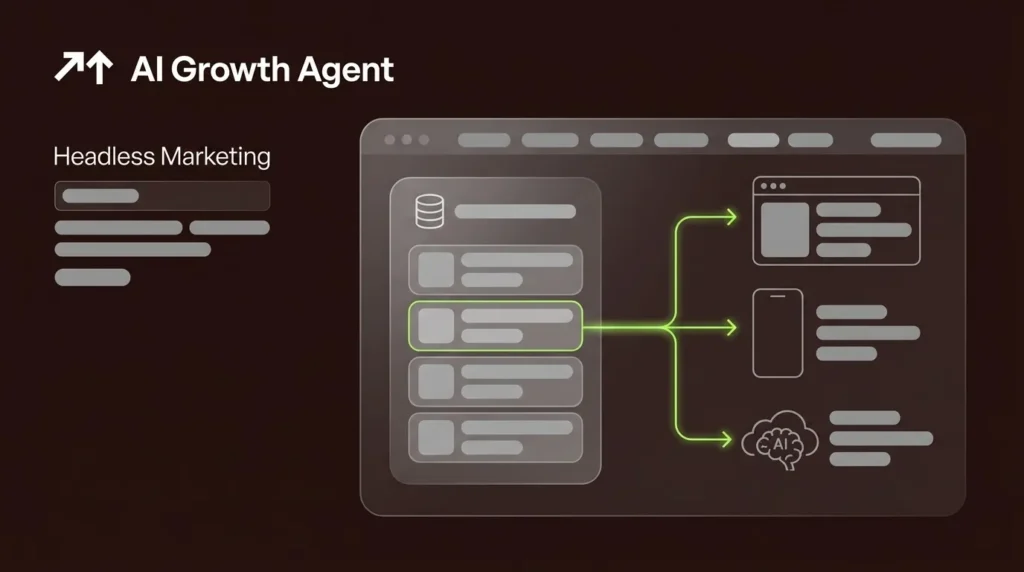
A headless implementation separates the content layer from the presentation layer. In a traditional CMS, content and its display are tightly coupled, meaning the same system that stores an article also decides how it renders. Traditional monolithic CMS platforms generate complete HTML pages on the server side, resulting in slower page load times and bloated page sizes, while a headless architecture gives full control over HTML output and supports delivery to any surface via API. For marketing, this means content written once can power a website, a mobile app, an AI citation, and an agent response at the same time. The 8-step playbook below operationalizes this architecture specifically for AI search visibility, from objective-setting through self-healing content updates.
Why a Headless CMS Fits Modern SEO and AI Surfaces
A headless CMS is not just good for SEO, it is structurally aligned with how AI surfaces consume content. A 2024 study of AI crawler behavior by Vercel found that ChatGPT prioritizes HTML content in 57.7% of fetches, so clean, structured HTML directly increases AI consideration. None of the major AI crawlers except Googlebot execute JavaScript: GPTBot, ClaudeBot, and PerplexityBot fetch only raw HTML and do not render dynamic content. A headless architecture that outputs clean, structured HTML by default is therefore a prerequisite for agent-focused technical SEO, not an optional upgrade.
Headless implementations also support the full agentic stack. Blog MCP, llms.txt, llms-full.txt, agent discovery via /.well-known/, and Markdown delivery to crawlers all depend on architectural separation between content and presentation so they can deploy cleanly. Pages with valid structured data are more likely to appear in Google AI Overviews compared to equivalent pages without markup, and incremental visibility compounds as the content universe grows.
Headless Marketing in Practice: Breadless Franchise Example
Breadless, a healthy fast-casual franchise, implemented headless marketing through AI Growth Agent targeting franchise development and category queries across ChatGPT, Perplexity, and Google’s AI Mode. Within 90 days, the brand reached a 34% citation share in Perplexity queries about healthy fast-casual dining and a 28% recommendation rate versus Sweetgreen in head-to-head ChatGPT comparisons. Google Search Console impressions grew from 12,000 to 47,000 in six months, and ChatGPT now cites eatbreadless.com in 18 to 22 queries per month. The 8-step playbook below is the operational blueprint behind outcomes like this.
The following table shows every technical and agentic SEO component AI Growth Agent deploys by default. Traditional SEO layers such as schema, sitemaps, and robots.txt secure baseline discoverability, while agentic layers like Blog MCP, llms.txt, and Markdown delivery enable direct agent interoperability from week one.
Ready-to-Deploy Technology Stack
| Layer | Component | Function | Required |
|---|---|---|---|
| Traditional Technical SEO | Schema suite (Article, FAQ, Author, Product, Organization, LocalBusiness, Review, SoftwareApplication) | Machine-readable entity signals for rich results and AI citation | Yes |
| Traditional Technical SEO | Sitemap.xml + dedicated web-stories sitemap | Crawl coverage and free internal link surface | Yes |
| Traditional Technical SEO | Advanced robots.txt | AI user-agent permissions (GPTBot, ClaudeBot, PerplexityBot, OAI-SearchBot) | Yes |
| Traditional Technical SEO | Open Graph metadata + image/video metadata | Social and AI surface preview signals | Yes |
| Agentic Technical SEO | Blog MCP (WebMCP-compatible) | Direct agent interoperability, plus schema, manifest, discovery, and capability guidance exposed to agents | Yes |
| Agentic Technical SEO | llms.txt + llms-full.txt | Curated brand index for AI surfaces and IDE agents | Yes |
| Agentic Technical SEO | Agent discovery via /.well-known/ (OpenAI + Agent Card) | Standardized agent entry points | Yes |
| Agentic Technical SEO | Natural language query parameters /?s={query} | Auto-trigger personalized, internally linked responses for agent queries | Yes |
| Agentic Technical SEO | Markdown delivery to agent crawlers | Reduces token overhead, reduces a typical blog post from ~15,000 tokens of HTML to ~3,000 tokens of Markdown | Yes |
| Reporting | Bot tracking (per-article) | Visibility into every crawl, citation, and training sweep by bot type | Yes |
| Reporting | Google Search Console integration | Independent impression and click audit | Yes |
| Reporting | Incremental visibility reporting | Isolates AI Growth Agent-generated visibility from pre-existing brand visibility | Yes |
Step 1: Set Zero-Click Objectives and Incremental Visibility Targets
Goal: Establish measurable targets before any content is produced so every downstream decision maps to a business outcome rather than a vanity metric.
Sequence of actions: Identify the primary AI surfaces where the brand needs to appear, such as ChatGPT, Perplexity, and Google AI Mode. Within each surface, define the query categories that matter most: definitional, buyer-intent, implementation, comparison, and latest or recent. A working AI visibility measurement program tracks three KPI layers in order of decision-relevance: citation share per engine per query category, attribution quality per cited query, and click-through and conversion from AI traffic. To measure citation share accurately, set baseline impressions from Google Search Console so you can isolate incremental lift. Finally, agree on the incremental visibility reporting cadence, with weekly snapshots as a minimum, to track progress against those baselines.
Required inputs: Brand positioning statement, existing Google Search Console data, list of known competitor domains, and a plain-language description of the ideal customer’s questions.
Roles involved: CMO or marketing owner for objective sign-off, and AI Growth Agent engine for universe mapping.
Validation points: Objectives tie to citation share and impression lift, not just traffic. Incremental visibility is defined as separate from pre-existing brand visibility. A zero-click outcome is explicitly accepted as a valid success metric.
Suggested visual: Objectives checklist with columns for KPI, baseline value, 90-day target, and measurement source.
Step 2: Create the Brand Manifesto and Evidence-Based Content Topology
Goal: Produce a strategic map of the brand’s full universe, every seed term and long-tail query worth pursuing, grounded in evidence rather than assumption.
Sequence of actions: A journalist-led interview builds the brand manifesto, the single source of truth for voice, facts, deny lists, and compliance requirements. With that manifesto in place as the strategic filter, AI Growth Agent agents run hundreds of real searches across Google and ChatGPT, processing title structures, People Also Ask results, query fan-out, and competitor rankings. Real-time AI Overview and ChatGPT results serve as the objective function for which long-tail queries are worth pursuing. The output is a Content Topology, a hierarchy of seed terms, each with dozens of long-tail queries beneath it. A new account typically starts with 300 to 400 queries and expands as it captures more of the universe.
Required inputs: Brand manifesto, competitor domain list, product or service pages, and any existing keyword data.
Roles involved: CMO or marketing owner for the manifesto interview, and AI Growth Agent for topology generation.
Validation points: Topology reflects actual AI Overview and ChatGPT results, not a generic keyword dump. Long-tail queries appear alongside head terms. White space, meaning queries competitors own that the brand does not, is explicitly identified.
Suggested visual: Topology table with columns for seed term, long-tail query, current ranking owner, and AI citation status.
Ready to see your Content Topology mapped and your first article live? Book a demo with AI Growth Agent and receive your manifesto and topology within the first week.
Step 3: Launch the Owned Site with Reverse Proxy or Subdomain in Week One
Goal: Deploy a fully optimized, brand-owned content property within the first week of kickoff, with no website agency and no dependency on the existing site structure.
Sequence of actions: AI Growth Agent provisions a WordPress instance with the full technical and agentic SEO stack pre-configured. The site is styled to match the client’s existing brand. A reverse proxy rewrite connects the blog to a subdirectory under the client’s domain, such as brand.com/blog, or a subdomain is configured as an alternative. Setup documentation is generated for the client’s specific host, whether Cloudflare, Vercel, or another provider. The reverse proxy rewrite is the only integration step required from the client’s side.
Required inputs: Brand style guide or existing site URL for design matching, plus hosting provider details for reverse proxy documentation.
Roles involved: AI Growth Agent for provisioning, and the client’s hosting or IT contact for the single reverse proxy step.
Validation points: Site is live under the client’s domain within week one. All agentic technical SEO components, including Blog MCP, llms.txt, agent discovery, and Markdown delivery, are confirmed active. The client owns the property outright with no agency in the loop.
Suggested visual: Architecture diagram showing client main site, reverse proxy connection, and AI Growth Agent blog with the agentic SEO layer labeled.
Step 4: Configure Agentic Technical SEO and Living Content Rules
Goal: Ensure every page the engine publishes is immediately readable, citable, and actionable by AI crawlers and agents from day one.
Sequence of actions: Confirm robots.txt explicitly permits AI user agents such as GPTBot, ClaudeBot, PerplexityBot, OAI-SearchBot, and Google-Extended, because crawlers skip the site entirely without this permission. OpenAI notes that robots.txt changes can take about 24 hours to reflect in search behavior. Once crawlers have access, verify Blog MCP is active and exposing schema, manifest, discovery, and capability guidance so agents can understand the site’s structure and capabilities. Finally, confirm llms.txt and llms-full.txt are deployed at the domain root as text/plain with status 200 and no authentication, giving agents a curated index of the brand’s most authoritative pages. llms.txt should be kept curated to 20 to 50 canonical pages, with descriptions written for agent context rather than SEO. Activate natural language query parameters. Set living content rules that control automatic year-turn refreshes, Google Search Console signal-triggered updates, and bot-traffic-aware self-healing.
Required inputs: Confirmed hosting configuration, list of 20 to 50 canonical pages for llms.txt, and deny lists and compliance rules from the manifesto.
Roles involved: AI Growth Agent for full configuration, and the client for deny list and compliance sign-off.
Validation points: All AI user agents are permitted in robots.txt. llms.txt returns 200 with no authentication. Blog MCP endpoint is reachable. Markdown is served to agent crawlers. Living content rules are active.
Suggested visual: Configuration table with component, status, and validation method columns.
Step 5: Generate Authoritative Content with Anti-Hallucination Controls
Goal: Produce publish-ready, citation-worthy articles from the Content Topology without editorial back-and-forth or quality drift across volume.
Sequence of actions: The engine selects the content format, such as guide, listicle, comparison, or a mix, based on what already wins each result and where the gap sits. Parallel research agents gather primary-source evidence the way a journalist would. Every claim, source, and quote is validated against evidence found online before entering the generation pipeline. A Princeton and IIT Delhi study tested nine content optimization strategies across 10,000 queries and found that including direct quotations increased AI visibility, adding statistics boosted it, and citing authoritative sources improved it for previously low-ranked content. After drafting, every claim is re-extracted and checked against the manifesto, product pages, and verified external sources to catch any assertions that slipped through without evidence. Claims that cannot be backed up are removed or softened to maintain factual integrity. Once the content is factually sound, style memories enforce brand voice to keep tone consistent across all articles. Finally, legal disclaimers are applied where required to meet compliance standards.
Required inputs: Manifesto, primary-source URLs, style memories, legal disclaimer templates, and anti-hallucination steering rules.
Roles involved: AI Growth Agent multi-agent orchestration for generation and validation, and the client for article review and feedback as an optional human-in-the-loop.
Validation points: Every claim in the published article is traceable to a verified source. Brand voice rules are applied. Legal disclaimers appear where required. The article ships with full schema, metadata, and internal linking.
Suggested visual: Anti-hallucination checklist with stages for source gathering, claim validation, post-draft re-extraction, and compliance check.
Want to see how anti-hallucination controls work in practice? Book a kickoff with AI Growth Agent and review your first publish-ready article within days.
Step 6: Connect Bot Tracking and Incremental Visibility Reporting
Goal: Establish a reporting baseline that isolates what the headless marketing engine generates from visibility the brand already had.
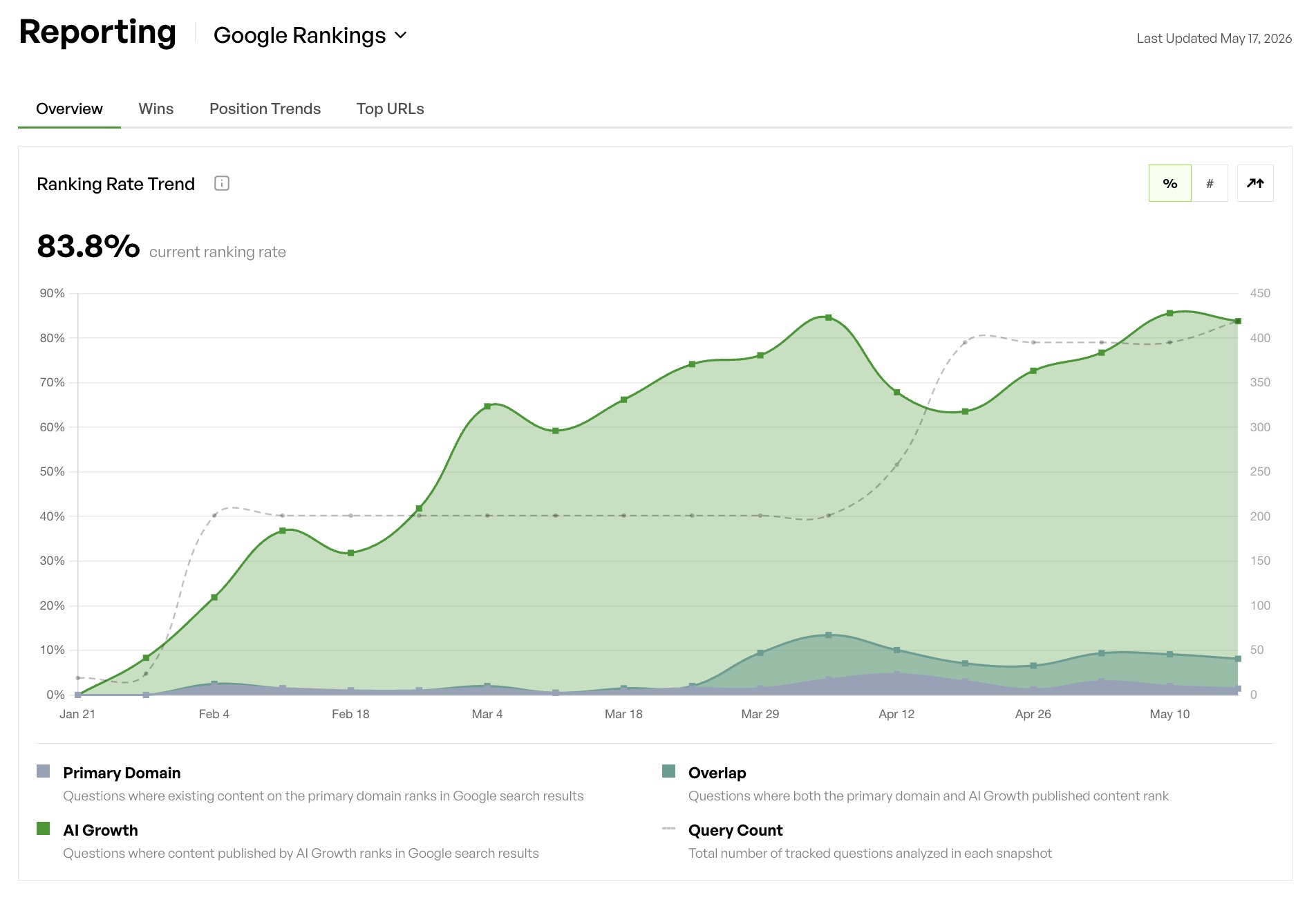
Sequence of actions: Activate per-article bot tracking across all bot types, including GPTBot, ClaudeBot, PerplexityBot, and Google-Extended. Connect Google Search Console as an independent audit layer. Configure incremental visibility reporting, as defined in Step 1, to track only the impressions AI Growth Agent generates. Set the weekly snapshot cadence. A recommended reporting cadence includes weekly citation share snapshots, monthly trend reviews with attribution quality audits and content-change correlation, and quarterly query set refreshes.
Required inputs: Google Search Console access and confirmed bot tracking activation in the WordPress plugin.
Roles involved: AI Growth Agent for reporting configuration, and the CMO for dashboard review.
Validation points: Bot traffic is visible at the per-article level. Incremental visibility is reported separately from pre-existing brand visibility. Google Search Console impressions are accessible as an independent audit.
Suggested visual: Dashboard mockup showing weekly incremental impressions, bot visit volume by bot type, and citation share by query category.
Step 7: Verify Indexing and Citation Performance
Goal: Confirm that published content is being indexed and cited by AI surfaces within the expected window.
Sequence of actions: Monitor Google Search Console for first impression signals, typically within 10 days of publication. Check bot tracking logs for GPTBot and OAI-SearchBot visits to newly published URLs. Run target queries in ChatGPT, Perplexity, and Google AI Mode to verify citation context. Confirm that the brand appears in the answer, not just as a buried source link. Note citation position, such as inline first paragraph, sidebar source card, or additional sources, as a proxy for citation quality. Flag any URLs that have not indexed within two weeks for internal linking reinforcement.
Required inputs: List of published URLs, target query set from the Content Topology, and bot tracking logs.
Roles involved: AI Growth Agent for monitoring, and the CMO for citation context review.
Validation points: At least one article indexes within 10 days. Bot visits from AI crawlers are confirmed on published URLs. The brand appears in at least one AI surface answer for a target query within 30 days.
Suggested visual: Indexing and citation checklist with columns for URL, first bot visit date, first Google Search Console impression date, and first AI citation confirmed.
Step 8: Keep Content Fresh with Self-Healing Updates and Weekly Universe Refresh
Goal: Ensure the content universe never goes stale and the engine continuously expands coverage as the market evolves.
Sequence of actions: Activate automatic year-turn refreshes so every article in a sector updates when the calendar year changes. Enable Google Search Console signal-triggered updates for articles showing declining impressions. Configure the weekly universe refresh so AI Growth Agent runs more than 3,000 searches every week to take a fresh snapshot of the competitive landscape. Review the Content Planner weekly to identify new long-tail queries worth pursuing. Use internal linking data to lift articles that have indexed but are not yet generating citations. Expand the query universe as the brand captures more of its market, with mature clients reaching universes of more than 1,600 queries.
Required inputs: Active Google Search Console connection, confirmed living content rules from Step 4, and a weekly universe refresh schedule.
Roles involved: AI Growth Agent for automated self-healing and refresh, and the CMO for weekly Content Planner review.
Validation points: Year-turn refreshes are scheduled and confirmed. Declining-impression articles are flagged and queued for update. Weekly universe snapshot is running. The query universe expands week over week.
Suggested visual: Self-healing schedule table with trigger type, action taken, and responsible system columns.
Ready to activate self-healing content that compounds authority week over week? Book a demo with AI Growth Agent and see your universe refresh in action.
Common Implementation Challenges in Headless Marketing
API governance. Without clear governance in headless martech, AI systems cannot reliably connect across multiple systems, leading to inconsistent data access and undefined actions that affect revenue, customer experience, and brand perception. In the AI Growth Agent architecture, governance lives inside the manifesto and memory system. Deny lists, compliance rules, and claim prioritization are configured once and applied to every future generation. The reverse proxy is the only external integration point, which limits the API surface area that requires governance.
Marketer training. Headless CMS implementations often cause marketers to lose visual context and autonomy, resulting in editing in the dark where they fill form fields without seeing the final rendered output. The AI Growth Agent studio addresses this with a Claude cowork-like experience. Marketers read each article, chat with it in plain language, and steer it before publish. The engine edits in place and saves memories so the same correction is never needed twice. No technical skill is required.
Content modeling for robot consumption. Agents work more efficiently with content that is specific and factual rather than vague marketing language, and answer-first writing improves agent legibility because an agent stops reading once it finds the needed information. The manifesto interview, described in Step 2, establishes this discipline. Brand voice rules are set, and the engine is configured to prioritize objective, structured facts over decorative brand phrasing, because that is what earns citations.
Common Mistakes and How to Troubleshoot Them
Planning gaps. Skipping the manifesto interview and going straight to content generation produces articles that drift from brand voice and fail compliance checks. The manifesto is not optional, it is the source of truth the engine references on every generation.
Data quality. Inconsistent or incomplete marketing data across channels makes AI errors harder to spot and amplifies data quality issues, turning poor data from a reporting problem into a decision-quality issue that produces confident but flawed AI recommendations. Audit Google Search Console access and confirm bot tracking is active before the first article publishes.
Publishing workflow gaps. Human-in-the-loop review cycles that require multiple stakeholders slow publishing velocity and delay indexing. Assign a single approver or move to full autopilot once the engine has been tuned through the kickoff week.
Technical setup errors. The most common technical failure is a robots.txt that inadvertently blocks AI user agents. Confirm GPTBot, ClaudeBot, PerplexityBot, and OAI-SearchBot are explicitly permitted before the first article publishes, and remember that changes can take up to 24 hours to take effect.
Indexing assumptions. Assuming content will index immediately and abandoning the process when it does not creates missed opportunities. Content can index in as little as 10 days, but the window varies by industry. Internal linking reinforcement and instant indexing requests accelerate the process for articles that lag.
Measurement gaps. Attributing all impression growth to AI Growth Agent without isolating incremental visibility obscures true performance. Incremental visibility reporting is designed to prevent this by publishing into a separate environment and reporting only what the engine generated.
Verifying Outcomes Across Bots, Search, and AI Surfaces
Outcome verification uses four data sources in combination. Bot traffic logs confirm which AI crawlers have visited which URLs and when, providing direct evidence that the content is being read by the systems that generate citations. Google Search Console impressions serve as an independent audit of indexing and organic reach, cross-referenced against the incremental visibility report to isolate what AI Growth Agent generated. Citation context, verified by running target queries directly in ChatGPT, Perplexity, and Google AI Mode, confirms that the brand appears in the answer and identifies citation position, whether inline, sidebar, or additional sources. Incremental visibility reports, delivered weekly per the cadence set in Step 1, isolate the engine’s contribution from baseline brand visibility. Across the first 12 weeks, AI Growth Agent clients average additional AI citations and mentions, additional bot visits, and a measurable lift in impressions.
Frequently Asked Questions
How long does it take to see the first results from a headless marketing implementation?
The first article is typically live within one week of kickoff. Content has indexed in as little as 10 days and often within two weeks. The standard engagement is a three-month pilot because indexing timelines vary by industry and competitive density, but clients often see bot traffic and early impression movement within the first month. The 90-day window is where AI citation volume becomes measurable and reportable.
Does the team need technical skills to run this?
No. The engine provisions schema, the WordPress plugin, robots.txt, sitemaps, automatic web stories, Blog MCP, agent discovery via /.well-known/, llms.txt and llms-full.txt, instant indexing, autoredirects, and 404 tracking automatically. The only integration step on the client’s side is the reverse proxy rewrite that connects the blog to a subdirectory under the brand’s domain. Everything else is included in every package. The marketing team gives feedback in plain language and the engine learns from it.
How does headless marketing handle brand compliance and legal requirements?
Compliance requirements are configured once during the kickoff manifesto interview and applied to every future generation. Legal disclaimers, claim prioritization for sensitive sectors, and anti-hallucination steering rules are set as memories. Every claim, source, and quote is validated against evidence found online before anything ships, and the engine never relies on a model’s training data. Regulated sectors such as finance or health can configure conservative language rules and sector-specific scrutiny levels that the engine applies automatically.
How is incremental visibility measured and reported?
AI Growth Agent publishes into a separate environment so it can report only the visibility it actually generated, never taking credit for visibility the brand already had. Incremental visibility is reported week over week, cross-referencing per-article bot traffic, Google Search Console impressions, and citation context data. The reporting isolates AI Growth Agent-generated impressions from pre-existing brand impressions, giving the CMO a defensible number to bring to the CEO every week.
What happens to content as the market changes?
Content remains living. It self-heals and updates over time rather than going stale the day it ships. When the calendar year turns, every article in a sector refreshes automatically. Articles showing declining impressions in Google Search Console are flagged and queued for update. The weekly universe refresh runs more than 3,000 searches to take a fresh snapshot of the competitive landscape, and new long-tail queries are added to the Content Topology as they emerge. Authority compounds instead of decaying.
Can headless marketing coexist with an existing SEO agency or content team?
Yes. AI Growth Agent does not require an existing agency to stop operating, and it does not touch the client’s curated main site. It stands up a separate, owned property connected through a reverse proxy or subdomain. It often replaces the agency stack in keyword research, content production, technical SEO, schema, bot tracking, and reporting, which the engine handles end to end at a flat fee with no per-article charges or per-prompt billing.
Conclusion: Turning Headless Marketing into a Continuous AI Growth Engine
Headless marketing operates as a continuously running engine that maps the brand’s universe, publishes authoritative content, and self-heals it as the market evolves. The 8-step playbook above covers the full implementation sequence from objective-setting through living content updates, and every step is designed to produce measurable AI citations within 90 days with zero added headcount. The brands cited in AI search this year are training the next generation of models with their own narrative, while brands that wait train the next generation with whatever happens to be sitting on the open web. Periodic review of the universe, weekly snapshot refreshes, and living content rules keep the engine ahead of that curve. To put this full playbook into motion for your brand, book a kickoff with AI Growth Agent and see your first article live within a week.