Written by: Mariana Fonseca, Editorial Team, AI Growth Agent
Key Takeaways
- Headless marketing for ecommerce separates the storefront from an autonomous backend engine that maps queries, produces validated content, and feeds AI surfaces at scale.
- The three-layer architecture (intelligence, content, and technical) replaces fragmented agency workflows with one engine that self-heals and updates living content without added headcount.
- Traditional stacks require six to twelve months and multiple vendors to publish assets, while headless marketing delivers the first indexed articles in as little as one week.
- Headless marketing ships complete agentic SEO, schema, llms.txt files, and bot-structured pages on day one so AI surfaces can find, trust, and cite brand content.
- Schedule a consultation with AI Growth Agent to replace slow, fragmented stacks with one autonomous engine that controls your brand narrative across AI search.
The Three-Layer Architecture Powering Headless Ecommerce Marketing
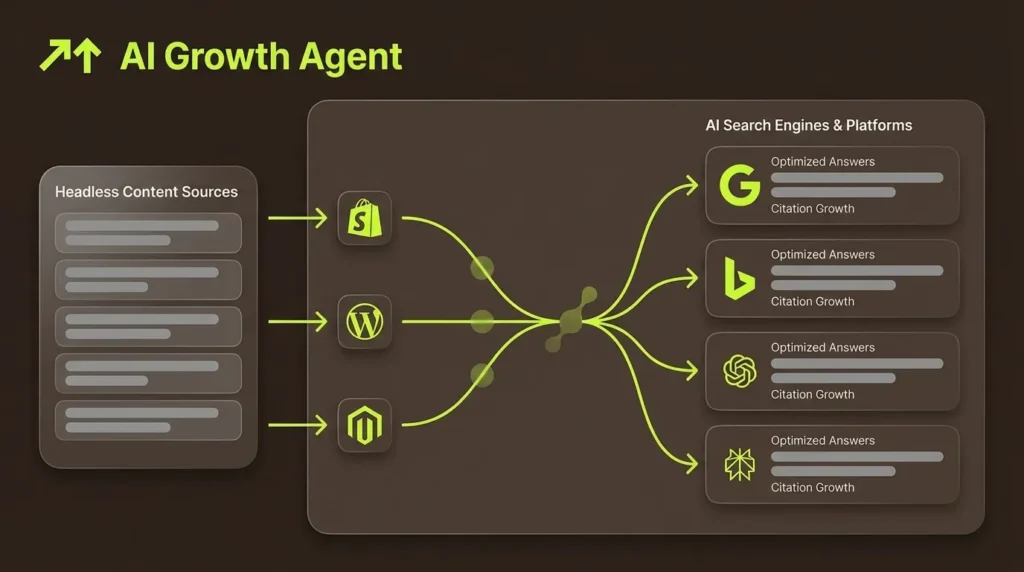
The architecture has three layers. The first is the intelligence layer, a continuous map of the brand’s full universe of seed terms and long-tail queries. It refreshes weekly from real-time Google and ChatGPT data so the engine always knows which queries are worth pursuing and which competitors are winning them.
The second is the content layer, a multi-agent orchestration that produces authoritative, validated, schema-decorated articles in a single shot. Anti-hallucination checks cascade across primary and external sources before anything publishes. Content stays living, which means it self-heals and updates over time instead of going stale the day it ships.
The third is the technical layer, a fully prepared, brand-owned site connected through a reverse proxy rewrite. It ships with traditional technical SEO and agentic technical SEO out of the box. That includes Blog MCP, llms.txt and llms-full.txt, agent discovery via /.well-known/, natural language query parameters, Markdown served to agent crawlers, rich schema across the full suite, automated web stories, instant indexing, and real-time bot tracking. No engineering hours are required from the brand’s side.

These three layers replace what a traditional ecommerce marketing stack assembles through agencies, tools, and headcount. Instead of coordinating multiple vendors, the brand defines its target universe in plain language and the engine handles the work autonomously.
Why Traditional Ecommerce Marketing Stacks Break Under AI Search
The traditional stack for ecommerce marketing is a coordination problem. An SEO agency handles keyword research. A content agency produces articles. A web agency owns the site. A schema plugin sits unmaintained. A GEO monitor tracks a capped set of prompts. A PR firm manages earned media. Each vendor has its own briefing cycle, its own contract, and its own definition of done.
The result is a structure that is too slow and too fragmented for the channel that now decides discovery. An agency RFP runs roughly three months, then three more months to produce the first assets. The realistic window from decision to first live article is close to a year. The moment something shifts in AI search, the whole structure falls behind again.
The do-it-yourself alternative is not faster. Producing one article with a chatbot is possible. Producing the second means running the entire process again, with quality that drifts from one piece to the next. One company produced roughly 300 articles this way and not one was cited. The deep divide between what an engineer thinks content should be, what a marketer wants, and what robots actually need to cite it is not something a single tool resolves.
Both paths leave the brand with content that goes stale, a site it may not even own, and no proof of what the investment actually generated.
Six Key Differences Between Traditional and Headless Ecommerce Marketing
The six categories below describe the operational reality of running ecommerce marketing at scale. Each one highlights a structural gap in the traditional stack that headless marketing closes.
Setup Speed: From Decision to First Published Asset
A traditional stack requires an RFP, agency selection, onboarding, briefing, and at least one round of revision before the first asset publishes. The realistic timeline from decision to first live article is six months to a year, assuming no scope changes or personnel turnover on the agency side.
Headless marketing compresses that to one week. AI Growth Agent conducts a journalist-led interview to build the brand manifesto, maps the keyword topology from real-time data, and publishes the first articles within the first week of kickoff. Content often indexes within about ten days. The brand owns the site from day one, with no agency in the loop and no dependency to manage.
For mid-market to enterprise ecommerce operators competing in AI search, the difference between six months and one week is not a convenience. It decides whether the next generation of models learns from the brand’s own narrative or from whatever happens to be sitting on the open web.
Operational Efficiency: Daily Throughput Without Extra Headcount
A traditional content operation at scale requires an editor, an SEO specialist, a researcher, a designer, and an engineer working in coordination. An agency replaces some of those roles but adds briefing overhead and a review cycle that caps throughput at a handful of articles per month per retainer.
Headless marketing removes that team structure. AI Growth Agent produces between two and fifty articles per day per client, up to roughly five hundred per month, through a multi-agent orchestration across OpenAI, Anthropic, Gemini, Grok, Perplexity, Exa, and Firecrawl. Models are selected by task and by language. The brand’s internal team gives feedback in plain language and the engine saves memories so the same correction is never needed twice. No additional headcount is required on the brand’s side.
Quality Control: Consistent Voice at Any Volume
Quality in a traditional stack degrades with volume. Junior analysts churn at agencies. Briefing documents drift. Voice rules are applied inconsistently from one writer to the next. At fifty articles, the brand’s content no longer sounds like one voice.
Headless marketing enforces consistency through the manifesto and a layered memory system. Style memories carry voice rules, preferred terminology, and words the brand never uses. The system applies these rules to every future generation. Anti-hallucination controls cascade through primary sources, the manifesto, and verified external research before anything ships. Every claim, source, and quote is validated against evidence found online, not a model’s training data. Output stays consistent at any volume because the rules live in the architecture, not in individual editors.
Technical Depth: Agentic SEO and AI-Surface Readiness
Traditional stacks treat technical SEO as a separate workstream. A schema plugin sits unmaintained. Robots.txt is set once and forgotten. Agentic technical SEO, the layer that makes content readable and citable by AI surfaces, rarely appears at all because most agencies and tools were not built for it.
Headless marketing ships the full technical stack on day one. Every article and every site AI Growth Agent publishes includes highly structured HTML, full metadata, rich schema across the complete suite, internal linking, sanitized external linking, proper sitemaps, a detailed robots.txt, automated web stories, real-time bot tracking, instant indexing, autoredirects, and 404 tracking. On the agentic side, every package includes Blog MCP compatible with Chrome 146 and other WebMCP-enabled browsers, OpenAI discovery and Agent Card guidance via /.well-known/, natural language query parameters that auto-trigger personalized responses for agents, Markdown served to agent crawlers, and llms.txt and llms-full.txt so AI surfaces can read the brand the way they need to. None of this requires action from the client.
Team Involvement: Who Actually Runs the Work
In a traditional stack, the brand’s internal team acts as the coordination layer. They brief the SEO agency, review the content agency’s drafts, chase the web agency for site changes, and reconcile reporting from four different dashboards. The team spends more time managing vendors than running marketing.
In headless marketing, the brand’s team defines the target universe and reviews finished articles. The engine handles everything else. Clients can run on full autopilot through the AI Growth Agent team or use a human-in-the-loop review mode where they read each article, chat with it, and steer it before publish. Either way, no technical skill is required. The only integration step on the brand’s side is the reverse proxy rewrite that connects the blog to a subdirectory under the domain.
Scalability: Universe Coverage and Self-Healing Content
A traditional stack scales by adding headcount or agency retainers. Both add cost linearly and neither addresses the long tail, which holds the majority of buyer queries, because manual operations default to head terms they already know to defend.
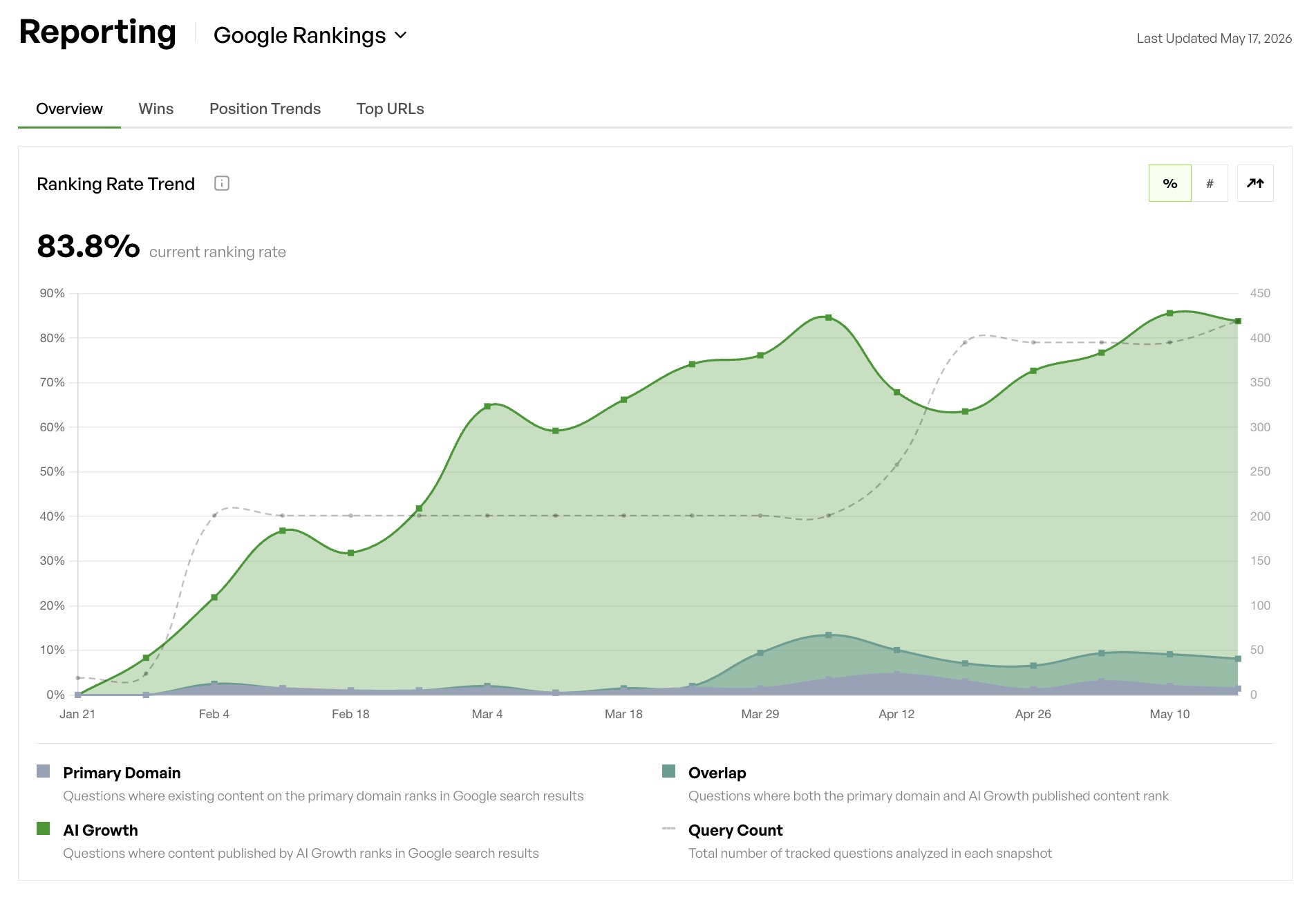
Headless marketing scales the universe, not the team. A new AI Growth Agent account typically starts with three to four hundred queries and expands as it goes after more of the universe. Mature clients reach universes of more than 1,600 queries, with the system running over 3,000 searches every week just to refresh the snapshot. Content stays living and self-heals over time, and when the year turns, every article in a sector refreshes automatically. Authority compounds instead of decaying.
Best-Fit Use Cases for Mid-Market and Enterprise Ecommerce
Headless marketing for ecommerce fits operators who already have a brand identity and need to control the narrative around it at scale. The clearest fit is a mid-market or enterprise ecommerce company with an established product catalog, a non-technical internal marketing team, and a CEO or board asking why the brand is not showing up in AI answers.
It also fits ecommerce operators in competitive categories where the long tail of buyer queries is large and fragmented, such as adjustable beds, healthy food franchises, or specialty supplements.
Operational Model and Long-Term Compounding
The operational model uses a flat fee with no per-article charges, credit limits, or per-prompt billing. Clients own all the content they produce. Pricing never penalizes a client for seeing more of the universe, which reverses the logic of monitoring tools that cap prompts and charge more to see further.
The long-term dynamic compounds. Paid media buys conversions, but the moment spend stops, visibility disappears. Headless marketing builds organic presence in a channel the brand owns, where content keeps working long after it publishes. The brands establishing authoritative content now are training the next generation of models with their own narrative. The brands that wait are training those models with whatever happens to be sitting on the open web.
Risks and Limitations of Headless Marketing
Headless marketing is not the right architecture for a brand that needs a single bespoke landing page or a one-time campaign asset. It is a system for sustained universe coverage, and its value compounds over time rather than delivering a single output.
Indexing takes time and varies by industry. The standard engagement is a three-month pilot because the full compounding effect of living content requires the engine to build authority across the universe, not just publish a first batch. Brands that expect overnight ranking for head terms in highly competitive categories need to calibrate expectations against the realistic timeline for authority to accumulate.
The brand’s manifesto is the primary source of truth, and the quality of the kickoff interview shapes the quality of everything the engine produces. Operators who invest in a thorough kickoff get a more differentiated output than those who treat it as a formality.
Decision Framework: When Headless Marketing Is the Right Move
Choose headless marketing for ecommerce when the brand already has an identity and the problem is narrative control, not brand introduction. Choose it when the internal team is non-technical and cannot deliver schema, agentic SEO, or the structures AI surfaces need to cite the brand. Choose it when the traditional agency stack is too slow, too expensive, or too disconnected from AI search to keep pace with the channel.
Stay with a traditional stack when the brand’s primary need is a single bespoke build, a one-time campaign, or a highly regulated asset that requires legal review at every step before any automation is appropriate. Headless marketing supports legal disclaimers and claim prioritization for sensitive sectors, but it operates as an ongoing engine, not a one-off production service.
The clearest signal that headless marketing is the right move is a CEO asking why the brand is not showing up in AI answers and a team that has no credible path to change that without adding headcount or waiting a year for an agency to ramp.
Frequently Asked Questions
What is headless marketing for ecommerce, and how is it different from headless commerce?
Headless commerce decouples the customer-facing storefront from the backend commerce engine so the frontend stays branded while the backend scales independently. Headless marketing applies the same architectural logic to brand presence in AI search. The brand keeps its curated main site. A separate, fully prepared blog runs autonomously behind it, producing and self-healing content for the AI surfaces that decide what customers find. The two concepts share the same decoupling principle but operate in different layers. Headless commerce handles transactions. Headless marketing handles discovery and narrative control.
How does headless marketing for ecommerce improve AI citation performance?
AI surfaces cite content they can find, trust, and parse. Headless marketing addresses all three requirements at once. The intelligence layer identifies which long-tail queries are worth pursuing using real-time AI Overview and ChatGPT results as the objective function. The content layer produces authoritative articles with every claim validated against primary sources so the AI trusts what it reads. The technical layer ships Blog MCP, llms.txt and llms-full.txt, agent discovery, rich schema, and Markdown served to agent crawlers so the surface can pull from the content in the formats it needs. The result is content that earns citations instead of content that looks good to a human visitor but stays invisible to a bot.
What does a headless marketing for ecommerce setup require from the brand’s internal team?
The only integration step on the brand’s side is the reverse proxy rewrite that connects the blog to a subdirectory under the domain. Everything else, including schema, the WordPress plugin, robots.txt, sitemaps, automated web stories, Blog MCP, agent discovery, llms.txt and llms-full.txt, instant indexing, autoredirects, and 404 tracking, is included in every package and requires no action from the client. The internal team participates in the kickoff interview to build the brand manifesto, reviews finished articles, and gives feedback in plain language. The engine saves memories so the same correction is never needed twice. No technical skill is required.
How long does it take to see results from headless marketing for ecommerce?
The first article is typically live within a week of kickoff, with indexing often following within about ten days. The standard engagement is a three-month pilot because indexing timelines vary by industry and the full compounding effect of living content requires the engine to build authority across the universe over time. Clients see movement early, and the brands that establish authoritative content in the first months are the ones training the next generation of AI models with their own narrative rather than leaving that space to competitors.
Can headless marketing for ecommerce replace an existing SEO agency relationship?
It replaces the keyword research, content production, technical SEO, schema work, and reporting that an SEO agency typically handles, at a fixed price rather than a retainer, and without the six-to-twelve-month ramp. It also removes the dependency where an agency controls the brand’s site. The brand owns the property outright from day one. For ecommerce operators already questioning whether their agency is keeping pace with AI search, headless marketing provides an architecture that closes the gap without adding headcount or waiting another year for results.
Conclusion: One Engine to Control Your Ecommerce Narrative
The traditional agency and tool stack for ecommerce marketing was built for a world where blue links decided discovery. That world is changing quickly. AI surfaces now answer buyer questions without a click, and what those systems can find, trust, and cite decides whether a brand appears in the conversation at all.
Headless marketing for ecommerce replaces the fragmented stack with one autonomous engine. It maps the full universe of queries, produces living bot-structured content at scale, ships the complete technical and agentic SEO stack on day one, and reports the incremental visibility it generates week over week. The brand keeps its curated main site. The engine runs behind it and wins the narrative across every AI surface that matters.
As noted earlier, the window to train AI models with your brand’s narrative is closing. The leaderboard is being written this year, and the brands that move now will own the conversation in the next generation of AI search.