Written by: Mariana Fonseca, Editorial Team, AI Growth Agent
Key Takeaways
- Client AI visibility strategy maps seed terms and long-tail queries from real-time Google and ChatGPT data, then publishes authoritative content that wins citations across AI surfaces.
- Over 50% of B2B buyers now start research in AI chatbots, and zero-click behavior means brands must become the cited answer or lose visibility entirely.
- The 4-phase framework of baseline audit, evidence-backed content production, third-party citation strategy, and share-of-voice measurement replaces limited monitoring tools with full-universe execution.
- 90-day roadmaps and incremental KPI reporting isolate program-generated visibility from existing brand equity, creating defensible proof that drives client retention.
- AI Growth Agent maps your client’s full universe and wins citations at scale. Book a demo to get started.
Why Client AI Visibility Strategy Matters in 2026
Buyer discovery has already shifted into AI surfaces. G2’s April 2026 Answer Economy Report, surveying 1,076 B2B software buyers, found that 51% now begin vendor research in an AI chatbot more often than in Google, up from 29% 11 months prior. Forrester’s 2026 Buyers’ Journey Survey of nearly 18,000 global business buyers found that generative AI and conversational search now rank as the most meaningful vendor research source, with twice as many buyers naming AI their top channel over any alternative.
Zero-click behavior compounds this shift. Pew Research Center’s analysis of 68,879 Google searches found that when an AI summary appeared, users clicked a traditional result in just 8% of visits. Buyers get the answer inside the surface and never visit the source. For most people, whatever the AI says becomes the answer.
Citation origin data shows why production now matters more than monitoring. Research indicates that most AI brand mentions originate from third-party pages rather than brand-owned websites. Monitoring tools that track a capped set of prompts without producing content cannot close that gap. A client AI visibility strategy built on production, publishing, and incremental reporting can, and that strategy rests on a four-phase framework that maps the full universe, produces citation-worthy content, activates third-party validation, and measures incremental share of voice.
Book a demo to see how AI Growth Agent maps your client's full universe and wins citations at scale.
The 4-Phase AI Visibility Audit Framework
Winning AI citations requires seeing all four intelligence layers that shape what an AI surface says about a brand. Each pillar serves a distinct diagnostic purpose, and together they reveal why a brand appears or does not appear in AI answers. The table below maps each pillar to its function and deliverable, showing how the four layers progress from raw positioning data to the new leaderboard metric that replaces traditional rank.
| Pillar | What It Measures | Key Output | Why It Matters |
|---|---|---|---|
| Search Intelligence | Traditional search landscape: positioning, competition, search volume | Actionable universe diagnosis | Establishes the raw situation before content decisions are made |
| AI Analytics | Brand value and consumer behavior across the full journey | Sentiment and demographic map | Connects AI touchpoints to downstream conversion signals |
| Bot Tracking | Every crawl, citation, and training sweep by AI agents | Per-article bot interaction log | Confirms whether content is actually being read by AI systems |
| AI Ranking | Order of mention and citation context in AI answers | Week-over-week position trend | Replaces the static rank number with the new leaderboard metric |
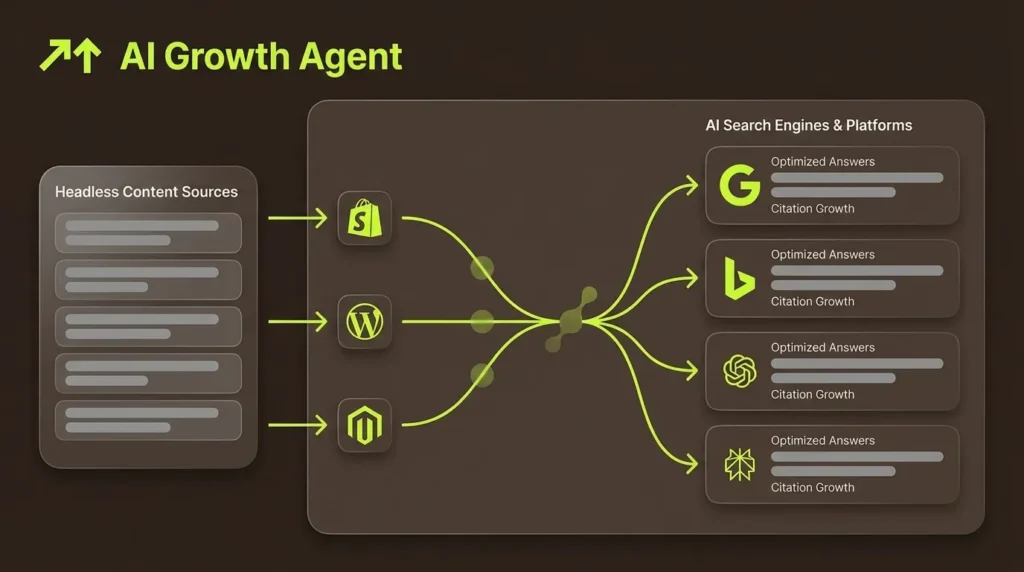
Most monitoring tools cap clients at a small set of tracked prompts, so they only ever see the slice of their market they already thought to ask about. A full-universe engine maps hundreds of seed terms and the long-tail queries beneath them, refreshed every week, with prompt count never treated as a billed metric.
Phase 1: Baseline Audit With 50 to 100 Prompts
Phase 1 establishes the starting position across all four pillars before any content is produced. A structured prompt selection process prevents the common mistake of auditing only head terms while losing the long-tail conversation by default.
- Identify three to five seed terms that anchor the client's market, drawn from the client's own language and from real-time Google and ChatGPT data.
- Expand each seed term into ten to twenty long-tail queries using AI Overview fan-out patterns and "people also ask" signals.
- Run the full prompt set across ChatGPT, Perplexity, Google AI Mode, and Gemini on the same day to capture platform-level divergence. Only 11% of domains are cited by both ChatGPT and Perplexity, so platform-level breakdowns are essential.
- Log citation rate, order of mention, and cited source domain for every prompt-platform combination.
- Run each prompt three to five times per cycle so results can be treated as a distribution rather than a single observation.
- Map competitor citation share across the same prompt set to establish the competitive baseline, then use that map as the input for content and third-party decisions in later phases.
Get your client's baseline audit started within a week so you can begin proving incremental movement against a clear starting line.
Phase 2: Content and Schema Requirements for Citation
Phase 2 turns the gaps revealed in the baseline audit into a concrete production plan. The audit highlights specific long-tail queries where competitors are cited and the client is not, along with platforms where citation share lags. Content then targets the queries with the largest citation deficits and the strongest buyer intent signals. Three content principles govern citation-worthy production at scale.
Evidence-based long-tail content. The Princeton/Georgia Tech/IIT Delhi GEO study across 10,000 queries found that using quotation marks around claims produced a 41% visibility improvement, including specific statistics produced a 31% improvement, and citing authoritative external sources produced a 28% improvement. Every article must validate each claim and source against evidence found online rather than relying on a model's training data. Evidence alone, however, cannot sustain visibility if the page goes stale.
Living, self-healing content. Pages not updated quarterly are 3x more likely to lose citations. Content must update automatically as the world changes, not go stale the day it ships. Even fresh, evidence-backed content still fails if AI crawlers cannot read it.
Agentic technical SEO. The full technical stack ships with every article: structured HTML, rich schema across article, author, organization, product, and review types, Blog MCP, llms.txt and llms-full.txt, OpenAI discovery via /.well-known/, and natural language query parameters. AI crawlers including GPTBot, OAI-SearchBot, and ClaudeBot do not execute JavaScript, so content must be rendered server-side to be visible to AI systems. Every article published through AI Growth Agent's engine meets this requirement automatically, which keeps evidence-backed, self-healing content fully legible to AI.
Phase 3: Third-Party Citation Strategy for Clients
Phase 3 extends beyond owned content because owned content alone cannot win AI citations at scale. A Foundation x AirOps analysis of 5.1 million AI responses and 57.2 million citations found that only 10.15% of citations pointed to brand-owned domains, meaning nearly 90% of AI citations come from off-site sources. A third-party citation strategy for clients addresses this gap across three channels that reinforce the on-site work from Phase 2.
Digital PR and earned media. Analyses show a strong correlation between Tier 1 earned media coverage and AI visibility. Pitching original research and data-backed thought leadership to industry publications creates the third-party corroboration AI systems treat as legitimacy signals.
Review ecosystems. Citations from review sites are the top confidence-inspiring signal for B2B buyers in an AI answer. A systematic review solicitation program targeting G2 and TrustRadius, focused on reviews that mention specific features, use cases, and measurable outcomes, supplies extractable data points for AI comparative answers.
Entity grounding. B2B SaaS companies with clean entity definitions and consistent information across sources tend to appear more often in comparative queries than competitors with fragmented presence. Organization schema with sameAs links connecting to Wikidata, Wikipedia, LinkedIn, and Crunchbase grounds the brand entity across the knowledge graph.
Phase 4: AI Citation Share of Voice Measurement
Phase 4 measures how often and how prominently the brand appears in AI answers. AI answers have no static ordered list, so order of mention and citation context become the new ranking. Share of voice measurement tracks the client's citations as a percentage of all tracked brand citations across the same prompt set, broken out by platform and by intent cluster.
A Citation Rate above roughly 40% and Share-of-Model leadership within a tracked competitor set are the most defensible 2026 benchmarks, as top Google results are often cited by ChatGPT. Citation quality scoring assigns weighted points by prominence. A primary recommendation scores higher than a supporting linked mention, which scores higher than a passing reference. This prevents raw mention volume from masking positioning problems.
90-Day AI Visibility Roadmap
The 90-day roadmap structures delivery into three 30-day phases, each with specific deliverables and measurable outcomes.
Days 1 to 30: Baseline and Foundation. Complete the 50 to 100 prompt baseline audit across all four AI platforms. Stand up the fully optimized owned site with the complete technical and agentic SEO stack live. Publish the first articles targeting the highest-priority long-tail gaps identified in the audit. Establish the KPI dashboard with week-one baselines for mention rate, citation share, bot traffic, and Google Search Console impressions.
Days 31 to 60: Content Velocity and Third-Party Activation. Scale content production against the full long-tail universe, targeting the seed terms with the largest citation gaps. Launch the third-party citation program across review platforms and earned media channels. Begin entity grounding work. Run the prompt set weekly and report citation share movement against the baseline.
Days 61 to 90: Compounding and Incremental Proof. Self-heal early articles based on bot tracking and Search Console signals. Expand the prompt universe as new long-tail queries surface. Deliver the 90-day incremental visibility report isolating exactly what the program generated, separate from visibility the brand already had.
Client AI Visibility KPIs
The KPI dashboard for a client AI visibility retainer tracks four primary metrics, each reported on a weekly cadence.
- Mention rate: The percentage of tracked prompts where the brand name appears in the AI-generated answer. A healthy B2B brand should appear in a substantial share of category prompts and most branded comparison prompts.
- Citation share: The brand's citations divided by total citations for all tracked brands across the same prompt set, reported by platform and by intent cluster.
- Bot traffic: Every bot interaction logged per article, including the bot ChatGPT uses to cite sources, tracked separately from human organic traffic.
- Incremental visibility: Week-over-week reporting that isolates the visibility the program generated, cross-referenced against Google Search Console and bot tracking data, never taking credit for visibility the brand already had.
ChatGPT referral traffic converts at 15.9% compared to 1.76% for traditional organic search, which makes citation presence a revenue-relevant metric that connects directly to pipeline outcomes in executive reporting.
How to Package AI Visibility Services
Agencies can turn the four-phase framework into a flat-fee ongoing retainer through a structured productization process. The steps below build on each other so the service feels cohesive and renews reliably.
- Define the prompt universe for the client in the kickoff week, starting with three to four hundred queries and expanding as the program matures. This universe becomes the foundation for every downstream activity, from article topics to third-party pitches and KPI definitions.
- Scope the retainer around four workstreams: monitoring, content production, third-party citation activation, and reporting. Because the prompt universe defines what you track, each workstream needs named deliverables with frequency, an owner, and measurable outputs tied back to specific prompt clusters.
- Price the retainer as a flat fee with no per-article charges, credit limits, or per-prompt billing. Flat-fee pricing removes the artificial ceiling that caps prompt tracking and content production, so the program can scale with the client's actual market instead of an arbitrary limit.
- Deliver the first article within one week of kickoff and the first indexing within ten days. Early movement against the prompt universe builds trust before the first monthly report.
- Report incremental visibility week over week, isolating what the program generated from visibility the brand already had. This separation creates the proof that drives renewal and supports executive conversations.
- Include the full technical and agentic SEO stack in every package. Schema, Blog MCP, llms.txt, bot tracking, and instant indexing are not add-ons, they are table stakes for citation eligibility.
See how to package this as a high-margin retainer that clients renew because incremental visibility reporting shows exactly what they are paying for.
Common Mistakes and Troubleshooting
Common mistakes in client AI visibility programs fall into two categories: strategic gaps and technical failures.
Strategic gaps to avoid:
- Tracking only head terms and missing the long-tail queries where AI citations are actually won
- Relying on owned content alone without a third-party citation strategy
- Reporting raw mention counts without citation share or competitive context
- Treating schema as a standalone citation lever rather than one component of a broader entity grounding strategy
- Conflating mentions with citations in reporting, which leads to misreading performance
Technical failures to check:
- Client-side JavaScript rendering that makes content invisible to AI crawlers
- Missing or misconfigured robots.txt that blocks GPTBot, OAI-SearchBot, or ClaudeBot
- Absent llms.txt and llms-full.txt files that prevent AI surfaces from reading the brand correctly
- Schema markup that mismatches visible page content, which signals untrustworthiness to AI systems
- Content that has not been updated in over 90 days, which increases citation loss risk by the 3x factor noted earlier
Frequently Asked Questions
How long does it take to see results from a client AI visibility strategy?
The first article is typically live within one week of kickoff, with content indexing in as little as ten days. Meaningful citation rate movement is generally measurable within 60 to 90 days as content accumulates and third-party citation work takes hold. The standard engagement is a three-month pilot because indexing timelines vary by industry, and clients usually see directional movement in bot traffic and Google Search Console impressions well before the 90-day mark.
Who owns the content and the site produced through the program?
The client owns the site and all content outright. AI Growth Agent stands up a fully optimized blog connected to the client's domain through a reverse proxy rewrite or subdomain. The client's existing main site is not touched. There is no agency dependency on the content or the property, and the client retains everything if the engagement ends.
How is incremental AI visibility measured separately from existing brand visibility?
AI Growth Agent publishes into a separate environment so it can report only on the visibility it actually generates, never taking credit for visibility the brand already had. Incremental reporting cross-references per-article bot tracking, Google Search Console impressions, and citation data week over week. This produces a defensible proof of contribution that separates program-generated visibility from organic brand equity, which is the metric that matters most for client retention and executive reporting.
What technical requirements does the client need to meet?
The only integration step on the client's side is the reverse proxy rewrite that connects the blog to a subdirectory under their domain. Everything else, including the full technical and agentic SEO stack, ships automatically with every package. The client's internal team needs no technical skill. Schema, Blog MCP, robots.txt, sitemaps, llms.txt, instant indexing, autoredirects, and bot tracking are all provisioned and maintained by the engine.
How does this approach differ from a GEO monitoring tool?
Monitoring tools track whether a brand appears for a capped set of prompts and stop there, as described earlier in the framework section. They tell the client they are not showing up and leave them to solve it. AI Growth Agent maps the full universe of seed terms and long-tail queries, produces authoritative evidence-based content against each gap, publishes with the complete technical stack, and reports the incremental visibility generated week over week. The difference is between observation and execution, with monitoring tools acting as a rearview mirror and a full-universe production engine serving as the steering wheel.
Conclusion: Turning AI Mode Scale Into Client Visibility
The leaderboard for AI citations is being written this year. 69% of B2B buyers chose a different software vendor than they originally planned because of AI chatbot guidance, and 33% purchased from a vendor they had never heard of before. Brands that establish authoritative content now are training the next generation of models with their own narrative. Brands that wait are training the next generation with whatever happens to be sitting on the open web.
A client AI visibility strategy built on the four-phase framework, the 90-day roadmap, and incremental KPI reporting gives agency principals and in-house marketing leaders the architecture to win citations at scale. Monitoring alone remains insufficient. Production, publishing, third-party citation activation, and weekly proof of incremental visibility form the four pillars that replace the traditional SEO and PR stack with a single headless marketing engine.
The prompt universe, the content, and the reporting cadence should be reviewed and recalibrated at least quarterly as AI Mode continues to scale and new surfaces emerge. Brands that treat this as a living program rather than a one-time audit will compound authority while competitors remain invisible.
Book a demo with AI Growth Agent and see your client's first article live within a week.