Written by: Mariana Fonseca, Editorial Team, AI Growth Agent
Key Takeaways
- Franchise content production with AI works only when a governance-first foundation protects brand equity while still allowing scale across every location.
- The seven-step approval workflow with clear roles and SLAs creates the operational backbone for compliant local content at scale.
- Localization must protect non-negotiable brand elements while giving franchisees controlled flexibility for market-specific content, schema, and AEO signals.
- The 70/30 rule, structured video repurposing, and AEO schema best practices together cut production costs, increase output, and improve AI citation rates when paired with human checkpoints.
- AI Growth Agent delivers this governance framework, brand manifesto, and compliant content engine in week one, so you can book a demo and see it working across your franchise system.
Franchise AI Content Governance Framework
Governance creates the structure that lets franchise content scale without eroding brand equity. Brand governance is the system of rules, workflows, tools, and guardrails that keeps a brand consistent as more people create content across teams or locations.
A franchise AI governance policy template typically includes these elements:
- Content ownership matrix. The brand owner controls master templates, regional content creators customize within guardrails, and franchisees personalize pre-approved content.
- Locked versus editable fields. Role-based permissions lock logos, fonts, colors, layouts, and legal disclaimers at the object level while regional or franchise teams edit only designated fields such as names, locations, or localized copy.
- AI tool authorization list. The policy specifies which AI systems are approved for each content type, with the brand manifesto set as the primary source of truth for every generation.
- Anti-hallucination controls. Every claim, source, and quote must be validated against evidence found online before content moves to review.
- Audit trail requirements. Version history, approval timestamps, and exception logs are maintained for every piece of content that exits the workflow.
- Governance review cadence. Brand guidelines operate as a living system with reviews at least twice per year, quarterly content audits, and governance metrics tied to revenue impact and risk reduction.
Franchisors with the most polished brand guidelines are not always the ones that scale successfully. The systems that make compliance effortless usually separate the leaders from the rest. These systems turn governance into an automated quality gate instead of a manual review burden. AI Growth Agent delivers that system in week one, with the brand manifesto, keyword topology, and first compliant articles live before a traditional agency finishes its RFP. See how this governance framework applies to your franchise system and book a demo.
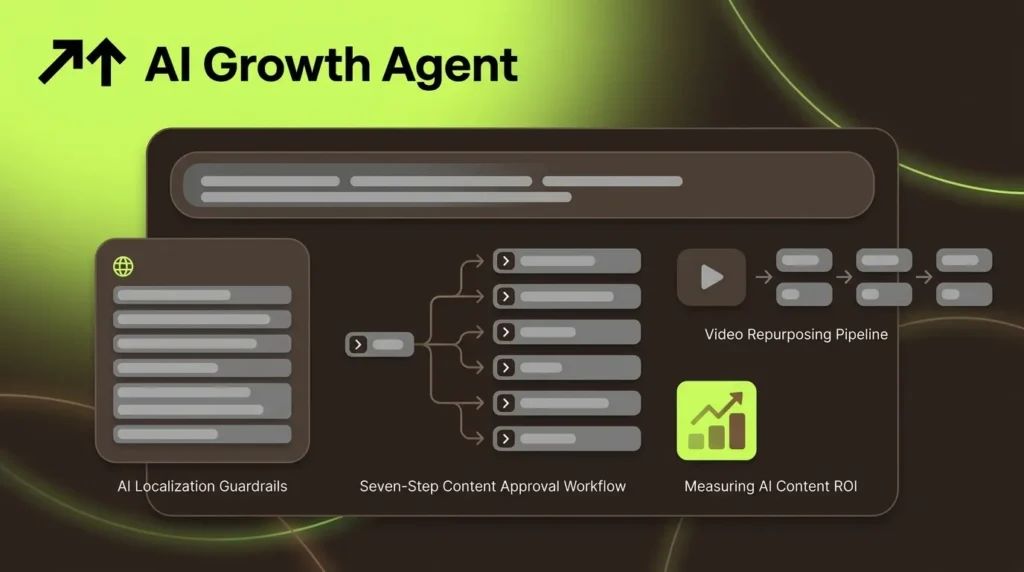
AI Localization Guardrails for Franchise Networks
AI localization for franchises adapts centrally produced content to each location’s market, service area, and community while preserving non-negotiable brand elements. Franchisors should rely on pre-approved, localizable asset libraries that let franchisees customize within set parameters rather than create from scratch, including social media post templates, paid ad creative, Google Business Profile content, local landing page modules, email templates, and print assets.
A franchise AI localization framework typically runs on four guardrails:
- Locked core, open local fields. National offer structure, brand voice, and legal disclaimers stay locked. Event promotions, store hours, locally relevant imagery, and regional offers within approved rules remain editable by franchisees.
- Schema localization per location. Every location page needs customized LocalBusiness JSON-LD schema with precise legal name, coordinates, verified contact information, and accurate opening hours. The schema section below covers the full implementation details.
- AEO-localization discipline. AEO-localization cites local authorities, answers locally asked questions in local phrasing, and uses local units, standards, and regulatory bodies. This approach differs from simple translation or generic localization.
- inLanguage schema signal. Adding the inLanguage property to every JSON-LD block provides one of the strongest signals that content is properly localized for AI engines.
Seven-Step Franchise AI Content Approval Workflow
A clear AI content approval workflow defines what AI can draft and what brand, legal, or local operators must still approve. Every role, SLA, and escalation path is documented before content production starts. A clean multi-location AI content approval workflow explicitly assigns who drafts, who reviews for brand, who reviews for local fit, who publishes, and what escalation occurs if no one responds on time.
The expanded seven-step workflow with roles and SLAs looks like this:
- Tier classification (Brand Owner, same day). Every content request is classified as Tier 1 low risk, Tier 2 medium risk, or Tier 3 high risk before drafting begins. Tier 1 covers updates such as hours or service-area references, refreshing page sections with already-approved brand language, or republishing structured local variants with fixed templates. Tier 2 covers new landing page drafts, new offer framing, testimonial placement changes, or stronger conversion copy on location pages. Tier 3 covers regulated claims, pricing statements, guarantee language, or franchise-wide positioning shifts.
- AI draft generation (Content Creator, within 24 hours). AI generates content using the brand manifesto and approved primary sources as ground truth. Every claim is validated against evidence found online before the draft advances.
- AI draft review (Content Creator, within 24 hours). AI draft review confirms that the draft is on-topic, follows the brief, and contains no obvious hallucinations or filler sections.
- Brand review (Brand Operations Lead, 24–48 hours for Tier 2, multi-step for Tier 3). Brand review confirms that the voice matches the company, the page does not overpromise, and the CTA fits the actual buying process. Tier 1 content receives auto-approval through locked templates.
- Local operator review (Franchisee or Regional Manager, 24–48 hours for Tier 2). Local review confirms that the content reflects what customers in that market actually ask, that local service details are accurate, and that the branch owner would stand behind the page.
- Legal and compliance sign-off (Legal Counsel, next scheduled review or expedited path for Tier 3). Legal counsel involvement is specifically recommended for naming decisions, architecture changes, and expansion into regulated markets with different regulatory environments. Realistic SLAs follow patterns such as routine asset requests within same day to 24 hours, new asset creation within existing guidelines in 2–3 business days, and brand council review for edge cases at the next monthly meeting with an expedited path for time-sensitive items.
- Publish QA (Content Creator or Brand Operations Lead, same day as approval). Publish QA verifies that links, schema, buttons, and contact paths are correct, that the approved version reached production, and that the URL matches the content plan.
Get this workflow implemented inside your franchise system within the first week and book a demo.
Applying the 70/30 Rule to Franchise Content
The 70/30 rule gives franchise teams a practical starting point for AI oversight. AI handles roughly 70 percent of routine, data-heavy, and rule-based content work, while humans focus on the remaining 30 percent that requires judgment, ethics, and final accountability. No regulation, industry standard, or peer-reviewed study mandates a specific 70/30 AI-human split; the ratio is an informal heuristic that emerged from management folklore rather than any formal origin or citation, yet it works as a useful governance pattern for franchise content teams building initial discipline.
Use this checklist to apply the 70/30 model in franchise content:
- Start with 100 percent human review. The 70–30 model recommends a crawl-walk-run adoption pattern: internal validation with 100 percent human review first (months 1–3), then risk-based review (months 3–6), then customer-facing automation with exception routing and ongoing monitoring after at least six months of internal operation.
- Define mandatory human review categories. Six output categories always require human review regardless of AI confidence scores or automation rate: legal commitments and contract language, medical treatment recommendations, regulatory filings and compliance certifications, personnel decisions, specific statutory or case law citations, and outputs about events after the model’s training cutoff.
- Set error thresholds before expanding automation. Human-in-the-loop best practices include setting error thresholds such as 95 percent accuracy before automating lead scoring, tracking rework metrics to signal inadequate readiness, regularly auditing outputs for demographic bias or ethical red flags, and documenting reasons for human overrides to improve the system over time.
- Apply anti-hallucination controls at every tier. Decide which claim types receive the heaviest scrutiny, such as pricing, ingredient, or guarantee language, and configure the AI system to validate those claims against primary sources before any draft advances to review.
- Place human checkpoints on irreversible actions. For autonomous AI agents, effective oversight replaces percentage splits with targeted human checkpoints on irreversible actions, external-facing customer or public communications, money movement, exceptions, and final accountability rather than reviewing every step.
Franchise Video Repurposing Pipeline for Local Scale
A structured video repurposing pipeline lets franchises turn one master recording into dozens of compliant, localized assets. This approach removes the per-video production cost that usually makes multi-location video unscalable under traditional agency models. Marketers who repurpose content often report higher ROI, and AI-driven repurposing workflows can cut production costs by up to 65 percent while significantly increasing content output.
The one-to-many pipeline for franchise video includes these stages:
- Source recording (60–90 minutes). A single pillar recording, such as a product walkthrough, franchisee interview, or thought leadership session, is structured with modular segments and clear transitions for AI clip detection.
- AI analysis layer. The AI analysis layer transcribes, detects scenes, identifies highlights, and tags topics to feed all downstream derivatives.
- Parallel pipelines. Run separate text and clip pipelines from the same source file. Pipeline A (text and search) uses transcription plus AI article generation. Pipeline B (social) uses highlight detection to extract moments exported as vertical clips with auto-framing for TikTok, Reels, and Shorts.
- Derivative asset set per recording. One pillar video can generate 20 or more derivative pieces across short-form video, blog posts, email newsletters, quote graphics, Twitter/X threads, audiograms, SEO descriptions, chapter markers, and FAQ entries, supporting a content multiplication ratio of 15–25x.
- Localization layer. The localization stage covers multilingual dubbing with lip-sync for avatar presenters, subtitle generation and translation, on-screen text localization for CTAs and disclaimers, and transcreation to adapt hooks and idioms to local culture.
- Human approval checkpoints. Human approval checkpoints in an AI video pipeline sit after strategy and positioning, script selection and claim validation, automated editing review for pacing and brand compliance, and native-language localization review for cultural fit and regulatory accuracy.
A simple weekly production schedule for one master recording might look like this:
- Monday: Record the pillar video and run AI transcription and indexing (3–4 hours).
- Tuesday: Edit the long-form asset and complete the brand review checkpoint (2–3 hours).
- Wednesday: Extract clips and audio derivatives, then complete pacing and brand compliance review (1.5–2 hours).
- Thursday: Generate written content derivatives including blog posts, newsletters, and FAQ entries (1.5–2 hours).
- Friday: Publish and schedule all derivatives with localized schema and CTAs (1 hour).
Measuring AI Content ROI for Multi-Location Brands
Franchise systems need per-location attribution to measure AI content ROI accurately. Aggregated network reporting hides performance gaps by market, which makes it harder to see which locations to replicate and which to fix. AI-referred traffic can convert at higher rates than organic blue-link traffic; franchises should track AI-referred leads as a distinct attribution bucket.
Use this weekly metrics framework for franchise AI content ROI:
- AI citation count per location. Track how many times each location’s content is cited by ChatGPT, Perplexity, and Google AI Mode per week using bot analytics.
- Bot visits per location. Measure total bot visits to location-specific content, segmented by bot type, including AI training agents and traditional crawlers.
- Impressions lift. Monitor week-over-week change in Google Search Console impressions attributed to AI-focused content, separated from pre-existing brand visibility.
- Local pack visibility rate. Track the percentage of monitored keywords where a location appears in the top three map results.
- Organic lead volume per location. Count phone calls, form submissions, and appointment bookings generated purely from organic search.
- Cost per qualified lead per location. Use this as the headline metric for franchise local SEO performance, trended monthly, where a qualified lead meets sales-acceptance criteria rather than simply filling a form.
- Approval turnaround time. Track approval turnaround time, asset compliance rate, partner or franchise adherence, number of governance exceptions, and ticket or request volume as core governance KPIs.
- Content production cost reduction. Measure how AI-assisted workflows reduce content production costs while maintaining quality through hybrid human-AI editing processes.
Franchises can classify locations into Tier 1 (top-three positions with healthy AI visibility and reviews), Tier 2 (positions 4–10 with partial AI presence), and Tier 3 (not ranking, failing review or NAP thresholds) to guide budget reallocation and performance dashboards. Only 19 percent of content marketers track AI-specific KPIs, which means franchise systems that instrument this measurement framework now hold a structural advantage over those that do not.
Franchise AEO Schema Best Practices
Answer Engine Optimization schema gives AI surfaces the structured data they need to parse, trust, and cite franchise content at the location level. Pages with clean structure paired with schema markup earn 2.8 times higher AI citation rates than poorly structured pages.
These schema priorities are ready to implement on franchise location pages:
- LocalBusiness JSON-LD per location. Every location page must feature customized LocalBusiness JSON-LD schema containing the precise legal name of the franchise location, exact latitude and longitude coordinates, a verified telephone number, accurate localized opening hours including seasonal variations, the areaServed property to define geographical boundaries, and the sameAs property linking to the location’s specific social media profiles.
- Organization schema on the corporate homepage. Implement Organization schema on the homepage with company name, URL, logo, contact points, social profiles, and the sameAs property linking to Wikipedia, Wikidata, LinkedIn, Crunchbase, and industry association profiles to help AI disambiguate the brand.
- FAQ schema on every location page. Even though Google restricted FAQ rich results for most sites in 2023, FAQ schema remains critical for AI search platforms like ChatGPT and Perplexity, which rely heavily on structured FAQ data for citations, provided the schema matches visible on-page content exactly.
- Article schema with mainEntityOfPage. Include the mainEntityOfPage property in Article or TechArticle schema to connect the article to its canonical URL, along with headline, author as a Person object with credentials, datePublished, and dateModified.
- inLanguage on every JSON-LD block. Add the inLanguage property to every JSON-LD block, matching the page’s hreflang, to send a strong localization signal for AI engines. This property should appear on every schema type, not just LocalBusiness.
- Schema validation monitoring. Broken markup that silently blocks content from being interpreted by AI is the most frequent schema error. Set up Search Console alerts for schema warnings instead of relying only on plugins.
AI Growth Agent provisions the full schema suite, including Article, FAQ, LocalBusiness, Organization, Review, Product, Author, and Software Application schema, automatically on every published asset, so the franchise team does not need to manage schema manually.
Downloadable Corporate AI Governance Policy Template
A corporate AI governance policy template gives franchise marketing directors a documented, auditable foundation for every AI content decision across the network. Treat the template as a living document, reviewed at least twice per year and updated whenever AI tools, content tiers, or regulatory requirements change.
The template covers these sections, which franchise teams can populate with their specific tools, roles, and SLAs:
- Policy scope and effective date. Define which locations, content types, and AI tools fall under the policy.
- Role definitions and permissions matrix. Clarify responsibilities for the brand owner, brand operations lead, regional content creators, franchisee end-users, legal counsel, and brand council, with access levels for each.
- Content tier classification criteria. Document definitions of low, medium, and high risk with examples specific to the franchise system.
- Approved AI tools and prohibited uses. List authorized platforms, prohibited content categories, and the requirement that the brand manifesto serves as primary source of truth.
- Anti-hallucination and claim validation requirements. Specify mandatory validation steps before any draft advances to review, with sector-specific scrutiny rules for regulated claims.
- Approval workflow and SLA table. Capture the seven-step workflow with role assignments and turnaround time commitments per tier.
- Non-negotiable brand elements list. List non-negotiable brand elements that must remain standardized, including primary logo and usage rules, brand color palette, typography, brand voice and tone, legal disclaimers, core service positioning, national offer structure, and trademarked taglines.
- Governance metrics and review schedule. Define KPIs, reporting frequency, and the annual brand review with scorecard and audit plan.
AI Growth Agent builds this policy into the brand manifesto during kickoff week so governance lives inside the content engine instead of drifting in a separate document. Get your corporate AI governance policy built into the engine from day one and book a demo.
Frequently Asked Questions
What is the difference between franchise AI content governance and standard brand guidelines?
Standard brand guidelines document visual and voice standards for human creators. Franchise AI content governance goes further by defining which AI tools are authorized, what the AI can generate without human review, how claims must be validated before content advances, and who holds accountability at every approval checkpoint. Governance also covers operational infrastructure, role-based permissions, tiered approval workflows, audit trails, and measurable compliance metrics. These elements turn brand guidelines from a static reference into an enforced system. Without governance, AI content scales at the speed of the model. With governance, it scales at the speed the brand can control.
How does the 70/30 rule apply specifically to franchise content production?
In a franchise content context, the 70/30 rule acts as a starting governance pattern rather than a fixed requirement. AI handles drafting, localization variants, schema generation, and routine content refreshes that follow approved templates and brand manifesto rules. Human reviewers focus on brand voice alignment, local accuracy, regulated claims, and any content that is external-facing or irreversible once published. The practical implementation follows a crawl-walk-run sequence. Teams start with 100 percent human review in the first three months while the AI system is calibrated to the brand. They then move to risk-based review in months three through six as error rates are confirmed. After at least six months of internal operation and documented accuracy thresholds, automation expands. Mandatory human review always applies to legal commitments, regulatory filings, and any claims about events after the model’s training cutoff.
How many assets can a franchise realistically produce from one video recording using an AI repurposing pipeline?
A single 60 to 90-minute pillar recording processed through a structured AI repurposing pipeline can yield 20 to 50 publishable assets. These assets can include short-form vertical clips for TikTok, Reels, and YouTube Shorts, a long-form blog post, email newsletter content, quote graphics, audiogram clips, FAQ entries, and localized variants of each for individual franchise markets. The actual output depends on the quality and structure of the source recording. A 30-minute focused recording typically yields 5 to 7 usable assets. A 90-minute deep-dive recording can yield up to 15 assets before quality drops into filler content. Teams that script pillar videos with modular segments and marked extraction points before recording consistently reach the higher end of the production ratio. Running separate text and clip pipelines from the same source file, instead of relying on a single tool, produces stronger output across both written and video derivatives.
Which schema types matter most for franchise AI citation performance?
LocalBusiness JSON-LD is the highest-priority schema type for franchise location pages because it gives AI engines verified location data, service area boundaries, and contact information for each branch. Organization schema on the corporate homepage helps AI disambiguate the brand across its full location network. FAQ schema on location pages remains a strong citation driver for ChatGPT and Perplexity even though Google restricted FAQ rich results for most sites in 2023. Article schema with the mainEntityOfPage property connects content to its canonical URL and supports author authority signals. The inLanguage property on every JSON-LD block acts as a strong localization signal for multilingual franchise markets. Broken schema that silently blocks AI interpretation remains the most common implementation failure, so Search Console alerts for schema warnings help catch these errors before they spread across hundreds of location pages.
Conclusion: Control the Narrative or Lose It
Franchise content production with AI but without governance creates a brand liability at scale, not a strategy. The governance-first playbook in this article, centralized policy, tiered approval workflows, the 70/30 human-oversight discipline, one-to-many video pipelines, AEO schema at the location level, and weekly metrics tied to AI citations and local lead generation, forms the operational foundation that separates franchise systems compounding authority from those generating content that no AI surface will prioritize.