Written by: Mariana Fonseca, Editorial Team, AI Growth Agent
Seven-Step System To Shape What AI Says About Your Brand
- AI search optimization for reputation management replaces reactive monitoring with a proactive seven-step system that shapes your narrative before models improvise their own.
- Brands cited inside AI Overviews earn 35% more organic clicks and 91% more paid clicks than non-cited brands on the same query.
- Success requires auditing current AI perception, mapping the full query universe, restructuring content for extraction, building third-party citations, deploying agentic technical SEO, implementing living self-healing content, and measuring incremental visibility.
- Technical elements like FAQPage schema, llms.txt files, Blog MCP, and agent discovery endpoints dramatically increase the likelihood of AI citation and brand control.
- Take control of your brand narrative in AI search with AI Growth Agent. Book a demo today.
Audit Current AI Perception With Structured Prompts
An AI perception audit creates a scored baseline of what models actually say about your brand, based on observable answers and citations. You record the provider, prompt, date, model, answer, and citations for each response instead of guessing at hidden model beliefs.
Build a prompt set that covers four query types, each revealing a different dimension of AI perception. Branded discovery questions such as “What should I know about [brand]?” test factual accuracy and basic positioning. Category-fit questions such as “What are the best solutions for [use case]?” show whether models treat you as a credible option. Trust and comparison questions such as “Is [brand] reputable?” and “[Brand] vs. [competitor]” expose sentiment and competitive framing. Factual verification questions covering pricing, integrations, and certifications highlight hallucination risk where wrong details can damage trust.
Run each prompt across ChatGPT, Perplexity, Gemini, and Google AI Overviews, recording the platform, model, date, full answer text, and all citation URLs before scoring. Score each response across five dimensions: accuracy, category fit, audience fit, proof, and risk. Run the same high-intent queries at least five to ten times across different sessions to calculate a Visibility Percentage that accounts for non-deterministic model behavior, since only 30% of brands that appear in an AI-generated answer show up again in the very next response to the exact same query.
| Prompt Type | Example | What It Reveals | Score Dimension |
|---|---|---|---|
| Branded discovery | “What is [brand] and what does it do?” | Factual accuracy, completeness | Accuracy |
| Category fit | “Best tools for [use case]” | Recommendation position | Category fit |
| Trust | “Is [brand] reputable?” | Sentiment, citation support | Risk |
| Comparison | “[Brand] vs. [Competitor]” | Competitive framing | Proof |
| Factual verification | “What does [brand] cost in 2026?” | Hallucination risk | Accuracy |
Step 1 checklist:
- Define a prompt set of 20 to 50 questions across all four query types.
- Run each prompt a minimum of five times per platform.
- Record platform, model, date, full answer, and all cited URLs.
- Label each material claim as correct, incorrect, incomplete, outdated, or unverified.
- Score each response across accuracy, category fit, audience fit, proof, and risk.
- Identify ghost citations where the engine links to a brand URL but omits the brand name.
- Map gaps back to owned-page clarity, third-party proof, or competitor context.
Map the Full Universe of Seed Terms and Long-Tail Queries
Query mapping defines the market conversation you want AI to use when it talks about your brand. Most teams track a few head terms and miss the long-tail prompts that real people and agents actually use.
The universe is the full set of queries and prompts that describe your market, from seed terms to conversational questions. Robots search the long tail, and more than 70% of AI-powered search users ask top-of-funnel questions to learn about a category, brand, product, or service. Use real-time AI Overview and ChatGPT search results as the objective signal for which long-tail queries matter.
For each seed term, analyze title structures, “people also ask” clusters, query fan-out, and competing domains. A mature query universe often reaches 1,600 or more queries, with the system running 3,000 or more searches every week to refresh the snapshot and keep pace with shifting language.
| Query Layer | Example | Volume Characteristic |
|---|---|---|
| Seed term | “adjustable beds” | High volume, high competition |
| Mid-tail | “best adjustable beds for back pain” | Moderate volume |
| Long-tail | “adjustable bed financing options Canada 2026” | Low volume, high intent |
| Conversational | “what adjustable bed do chiropractors recommend for side sleepers” | Very low volume, agent-native |
AI surfaces prioritize conversational, long-tail queries over seed terms because they mirror natural language prompts. Seed terms carry generic intent and heavy competition, while conversational prompts expose specific needs that models can answer with precise, cited passages.
Step 2 checklist:
- Identify 50 to 100 seed terms that anchor your market.
- Expand each seed term into long-tail queries using real-time AI Overview and ChatGPT data.
- Analyze “people also ask” clusters and query fan-out for each seed.
- Map competitor domains and top-ranking URLs for each query cluster.
- Identify white space where no authoritative content exists.
- Prioritize queries where AI surfaces already generate answers without citing your brand.
- Refresh the universe snapshot weekly as the market evolves.
Restructure Content for Extraction and Machine Citation
Once you know which queries matter, you need content that AI can easily extract, quote, and trust. AI surfaces operate on passages, not whole pages, so your reputation is built from fragments instead of full narratives.
If those fragments lack structure, models skip your content or pull partial context that misrepresents your brand. Clear headings, short scoped sections, and answer-led writing give models reliable evidence to cite. Answer-first content that states the conclusion in the opening sentence of each section, combined with HTML data tables for comparisons, often earns more AI citations than prose-only explanations.
Schema markup acts as infrastructure for machine trust. The data backs this up: FAQPage schema is associated with 2.4x overrepresentation on AI-cited pages and lifts citation probability 20–30% (or up to 3.2x in one study) versus pages without it. Beyond schema, agent-ready readability relies on llms.txt and llms-full.txt files so AI surfaces can crawl your content in the format they prefer, Blog MCP for direct interoperability with AI search agents, and agent discovery served via /.well-known/ so agents passing queries receive tailored, internally linked responses.
| Technical Element | Primary Benefit | Implementation Format | Priority |
|---|---|---|---|
| FAQPage schema | 2.4x overrepresentation on AI-cited pages | JSON-LD in page head | 1 |
| Article + Author schema | E-E-A-T signals, named attribution | JSON-LD in page head | 2 |
| Organization schema with sameAs | Entity resolution across platforms | JSON-LD sitewide | 3 |
| llms.txt and llms-full.txt | AI surface readability | Root directory files | 4 |
| Blog MCP + agent discovery | Agent interoperability | /.well-known/ endpoints | 5 |
Step 3 checklist:
- Implement FAQPage schema with answers of 40 to 60 words, each containing at least one specific data point.
- Add Article and Author schema to every content page with named, credentialed attribution.
- Deploy Organization schema sitewide with sameAs links to LinkedIn, Wikipedia, and Crunchbase.
- Connect schema entities with stable @id references across Organization, Person, and Article types.
- Publish llms.txt and llms-full.txt in the root directory.
- Serve Blog MCP with schema, manifest, discovery, and capability guidance for agents.
- Expose OpenAI discovery and Agent Card guidance via /.well-known/.
- Validate all schema using Google’s Rich Results Test before publishing.
- Ensure all schema is server-side JSON-LD, not injected via client-side scripts.
Build Third-Party Citations and Review Signals That Models Trust
Third-party proof convinces AI that your claims are credible. Models treat brand-owned statements as promotional unless multiple independent sources confirm them.
An Ahrefs study of 75,000 brands showed that brand mentions across independent sources correlate 0.664 with AI citation probability, compared to just 0.218 for backlinks. The citation surface extends far beyond your own domain and includes reviews, forums, listicles, and partner directories.
Studies of AI brand recommendations show that third-party sources provide most of the backing for brand picks, while brand-owned sites contribute a smaller share. Perplexity cited review sites in 0.6% of responses across 1,905 tracked prompts (June–July 2026), which means review platforms alone rarely carry the narrative. What matters more is volume and recency: 50 or more reviews act as a credibility threshold, and a steady flow of recent reviews carries more weight than older ones.
| Citation Source Type | AI Engine Reliance | Action Required | Cadence |
|---|---|---|---|
| Review platforms (G2, Trustpilot, Yelp) | ~48% of third-party citations in brand queries | Solicit recent, detailed reviews | Monthly |
| Reddit and community forums | 42% of all brands measured backed by Reddit | Participate authentically in relevant threads | Weekly |
| Third-party listicles and comparisons | 85% of brand mentions in some AI response sets | Earn placements on top-10 lists in category | Quarterly |
| Partner and integration directories | 43% of citations from partner ecosystem sources | List on partner directories and integration pages | Quarterly |
Step 4 checklist:
- Audit current review volume and recency on G2, Trustpilot, Google Business Profile, and Yelp.
- Build a systematic review solicitation process targeting 50 or more recent reviews.
- Identify the top-10 listicles in your category that AI engines cite and pursue placements.
- Secure partner directory listings and integration page mentions.
- Participate in Reddit threads and community forums relevant to your category.
- Maintain consistent brand name, category description, and audience positioning across all third-party profiles.
- Update Wikipedia or Wikidata entries where applicable with sourced, accurate information.
- Monitor which third-party domains AI engines cite most for your category queries.
Deploy Agentic Technical SEO That Bots Actually Read
Technical infrastructure ensures that the citations you earn can be discovered, crawled, and trusted by AI systems. The third-party proof you built in Step 4 only matters when crawlers can reach and interpret your owned content correctly.
Traditional technical SEO remains table stakes. Every content page needs structured HTML, full metadata including Open Graph titles and descriptions, rich schema markup, internal links that compound authority, and clean external linking. The AI search channel adds a second layer that most brands still lack.
The robots.txt policy should separate AI search and retrieval bots such as OAI-SearchBot, Claude-SearchBot, PerplexityBot, and Googlebot from training bots such as GPTBot, ClaudeBot, and Google-Extended. This separation gives you control over visibility versus model training use. Honest freshness signals including visible last-updated dates, accurate sitemap lastmod, and IndexNow pings tell AI crawlers that the content reflects the current state of the world. Pages not updated quarterly are three times more likely to lose citations in AI Overviews and featured snippets.
| Technical SEO Layer | Element | Bot Benefit | Client Action Required |
|---|---|---|---|
| Traditional site-level | Sitemap.xml, robots.txt, canonical tags | Crawl efficiency and indexation control | None (provisioned automatically) |
| Traditional article-level | Schema, Open Graph, internal links | Entity resolution and passage retrieval | None (provisioned automatically) |
| Agentic | Blog MCP, /.well-known/ endpoints, llms.txt | Agent interoperability and direct citation | None (provisioned automatically) |
| Freshness | IndexNow pings, auto-refresh, lastmod | Current narrative in next training sweep | None (self-healing) |
Step 5 checklist:
- Confirm all essential content is server-rendered HTML, not dependent on client-side JavaScript.
- Implement a robots.txt that separates retrieval bots from training bots.
- Deploy a sitemap.xml with accurate lastmod dates and a dedicated web-stories sitemap.
- Enable IndexNow pings for instant indexing on new and updated content.
- Set up autoredirects and 404 tracking to prevent authority decay.
- Publish natural language query parameters via /?s={query} so agents receive personalized, internally linked responses.
- Serve Markdown to agent crawlers alongside standard HTML.
- Implement automated web stories for every article to generate free internal links.
- Track every bot interaction including AI training agents via server-side bot analytics.
Implement Living Self-Healing Content That Stays Current
Content freshness directly affects how AI represents your brand. Content that ships and then goes stale becomes a liability because models favor recent, authoritative sources when answering questions about you.
Pages updated within the last 90 days receive substantially more AI citations than older pages, with one analysis showing a median AI citation age of 148 days versus 493 days for Google results. Recency now acts as a ranking signal in AI search in a way it rarely did in traditional SEO, so your narrative must keep pace with reality.
Living content means three concrete practices. First, every article refreshes automatically when the world changes, including annual updates when the year turns. Second, Google Search Console signals and bot-traffic data trigger targeted refreshes on articles that are losing citation share or impressions. Third, every article’s relationships, performance, and indexing data live in one system so internal linking can redistribute authority across the universe instead of letting strong pages sit in isolation.
| Content State | Trigger | Action | Outcome |
|---|---|---|---|
| New article | Query gap identified in universe map | Produce and publish with full technical stack | New citation surface created |
| Stale article | GSC impressions declining or year change | Auto-refresh with current data and updated schema | Citation share maintained |
| Underperforming article | Bot traffic low, citation rate below threshold | Internal linking lift and content restructure | Authority redistributed across universe |
| Hallucination detected | Audit identifies inaccurate AI output | Update owned source and third-party profiles | Corrected narrative propagates to AI surfaces |
Step 6 checklist:
- Establish a content refresh cadence triggered by GSC signals and bot-traffic data.
- Automate annual updates across all articles in each sector when the year turns.
- Centralize every article’s performance, bot data, and indexing status in one view.
- Use internal linking to redistribute authority from high-performing to underperforming articles.
- Validate every claim, source, and quote against current primary sources before each refresh, including review and third-party data already in your ecosystem.
- Apply anti-hallucination checks post-refresh to confirm accuracy before republishing.
- Monitor citation share weekly and trigger targeted refreshes when share declines.
- Maintain brand voice and style memories so every refresh reflects current positioning.
Measure Incremental Visibility and Revenue Impact
Measurement shows how much new visibility and revenue AI search actually creates for your brand. The main challenge is attribution because AI answers change from run to run.
A January 2026 SparkToro report found less than a 1% chance that ChatGPT or Google’s AI will return the exact same list of brand recommendations when the same prompt is run 100 times. Point-in-time snapshots miss this variability. Probabilistic tracking across a large prompt set, segmented by platform, topic, and funnel stage, and measured week over week against a fixed baseline, provides a more stable view.
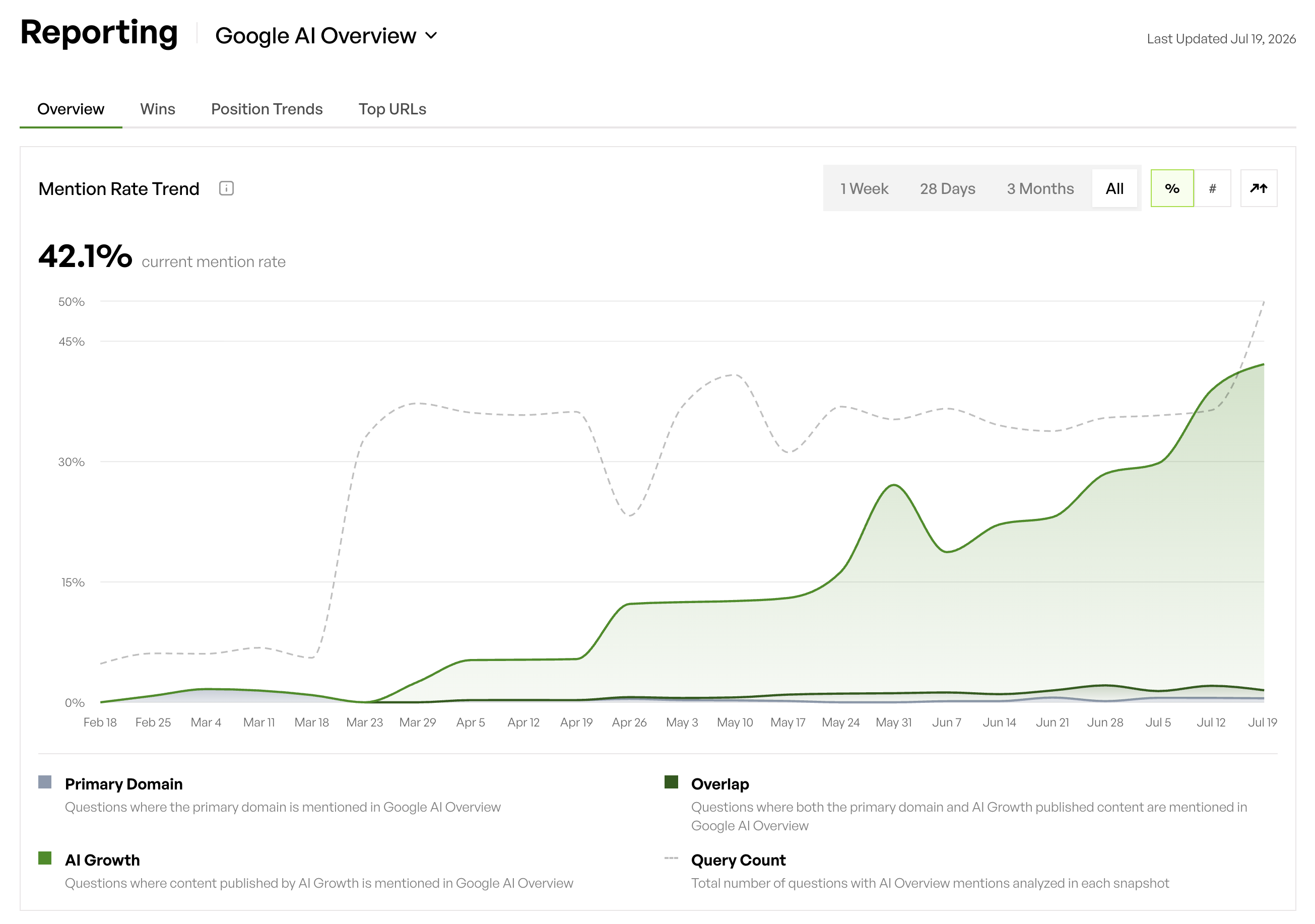
Incremental visibility reporting isolates what the new content system generated, separate from the visibility you already had. Publishing into a separate environment, cross-referencing bot traffic, Google Search Console impressions, and citation data, and tracking the six core metrics below gives executives a clear answer on return. This matters because brands cited inside AI Overviews earn 35% more organic clicks and 91% more paid clicks than non-cited brands on the same query, so citation share influences both traffic and revenue.
| Metric | Definition | Benchmark (Established Brands) | Tracking Cadence |
|---|---|---|---|
| Citation Frequency Rate (CFR) | % of tracked prompts where brand is cited | 15–30% target | Weekly |
| Share of Voice (CSOV) | Brand mentions vs. competitors on same prompt set | Above 25%, leaders at 35–45% | Weekly |
| Bot visits | AI crawler and training agent visits to owned property | AI Growth Agent clients average +100,000 in first 12 weeks | Weekly |
| GSC impressions (incremental) | New impressions attributable to new content only | AI Growth Agent clients average +20% lift in first 12 weeks | Weekly |
| Sentiment score | % of AI mentions that are positive vs. neutral vs. negative | Baseline established at audit; track directional shift | Monthly |
| Response Position Index (RPI) | Average position of brand mention within AI answer | Above 7.0 | Monthly |
Step 7 checklist:
- Define a query universe of 20 to 50 revenue-driving natural-language questions as the measurement baseline.
- Run each prompt a minimum of five times per platform to account for non-deterministic model behavior.
- Track Citation Frequency Rate, Share of Voice, bot visits, and GSC impressions weekly.
- Segment all metrics by platform rather than blending across ChatGPT, Perplexity, Gemini, and Google AI Overviews.
- Cross-reference bot traffic logs with citation data to confirm which content is being read and cited.
- Use Google Search Console as an independent audit of incremental impressions and clicks.
- Track conversion rate from AI-sourced traffic separately from organic to measure revenue impact.
- Report week over week against the fixed baseline established at kickoff, not against pre-existing brand visibility.
Frequently Asked Questions
How long does it take to see results from AI search optimization for reputation management?
The first article typically goes live within a week of kickoff, and content often indexes within ten to fourteen days. Citation share and bot traffic usually begin to move in the first month, although timelines vary by industry and competition. The standard engagement runs as a three-month pilot so indexing and iteration can stabilize, and clients commonly see measurable lifts in Google Search Console impressions and bot visits early in that window. Breadless saw a 30x lift in Google Search Console impressions over six months, and Jota recorded a 190% traffic increase from generated content over three months.
Who owns the content and the site?
The client owns the site and all content outright. AI Growth Agent stands up a fully optimized blog connected to the client’s domain through a reverse proxy rewrite, usually under a subdirectory, or through a subdomain. The client’s curated main site remains untouched. There is no agency dependency, no lock-in, and no content that disappears if the engagement ends. This design keeps the engine headless and autonomous while the brand retains full ownership of the property and the narrative.
What technical dependencies does the client need to manage?
The only integration step on the client’s side is the reverse proxy rewrite that connects the blog to a subdirectory under their domain. Everything else, including schema, the WordPress plugin, robots.txt, sitemaps, web stories, Blog MCP, agent discovery via /.well-known/, llms.txt and llms-full.txt, instant indexing, autoredirects, and 404 tracking, is provisioned automatically and included in every package. The internal team needs no technical skill, and setup documentation is generated for the client’s specific host, whether Cloudflare, Vercel, or another provider.
How is AI search optimization for reputation management different from traditional reputation management or SEO monitoring?
AI search optimization for reputation management focuses on producing the content that AI surfaces will cite, in the structures models can read and verify. Traditional reputation management is reactive and monitors what is being said, then tries to suppress or bury negative signals. Traditional SEO monitoring reports where your brand ranks but does not create the passages that AI agents quote. AI search optimization operates upstream by generating validated, citation-ready content that shapes answers before buyers ask. Monitoring tools act like a rearview mirror, while a content-first system functions as the steering wheel that directs the narrative.
How do you prevent content from hallucinating or going stale over time?
Two systems work together to keep content accurate and current. Anti-hallucination controls run at every stage of generation, prioritizing claims from the brand manifesto and primary sources, scraping and verifying every external source before use, and re-extracting each claim after drafting to compare it against product pages, primary sources, and vetted external references. Any claim that cannot be backed up is removed or softened before publication. In parallel, content behaves as a living asset that self-heals over time based on Google Search Console signals and bot-traffic data. When the year turns, every article in a sector refreshes automatically so the library reflects the current state of the world instead of the day it was written.
Conclusion: Turn AI Search Into a Reputation Engine
AI search optimization for reputation management functions as a seven-step system rather than a monitoring dashboard. Step one audits current AI perception with a structured prompt set across ChatGPT, Perplexity, Gemini, and Google AI Overviews. Step two maps the full universe of seed terms and long-tail queries using real-time AI data as the objective function. Step three restructures content for extraction with FAQPage schema, Article and Author schema, llms.txt, Blog MCP, and agent discovery. Step four builds the third-party citation layer across review platforms, community forums, listicles, and partner directories. Step five deploys agentic technical SEO so bots can crawl, interpret, and trust your content. Step six implements living, self-healing content that stays fresh and accurate. Step seven measures incremental visibility and revenue impact so you can prove the business case and keep improving the system.