Written by: Mariana Fonseca, Editorial Team, AI Growth Agent
Key Takeaways For AI-Era PR Buyers
- PR services are shifting from traditional media placements to AI-era strategies that earn brand mentions and citations inside AI-generated answers from ChatGPT, Perplexity, and Google AI Mode.
- AI-era PR services include AI visibility auditing, reputation monitoring, generative PR, executive authority building, entity management, citation-ready content, integrated digital PR and SEO, AI crisis communications, and AI search measurement.
- Earned media accounts for 84% of AI citations, so placements in AI-cited outlets create far more value than backlink-focused campaigns.
- Buyers should evaluate agencies using a six-point checklist covering AI surfaces tracked, citation reporting, publishing surface ownership, factual correction processes, prompt metering, and contract measurement commitments.
- AI Growth Agent replaces multiple vendors by mapping queries, producing authoritative content, standing up an owned site, and reporting incremental visibility week over week.
Book a demo with AI Growth Agent
Pre-AI Vs. AI-Era PR: What Actually Changed
The shift from pre-AI to AI-era PR changes five dimensions: the goal, the target surfaces, the primary metric, the workflow, and who owns the publishing surface. The table below shows how each dimension works today.
| Dimension | Pre-AI PR Playbook | AI Search Era PR Services |
|---|---|---|
| Goal | Drive referral traffic and backlinks from individual articles | Earn brand mentions, entity recognition, and source citations inside AI summaries |
| Target Outlets and Surfaces | High Domain Authority media placements | Outlets, podcasts, and forums frequently crawled and cited by ChatGPT, Perplexity, and Google AI Mode |
| Primary Metric | Reach, impressions, and referral traffic | Citation frequency, brand sentiment, generative visibility, and source prominence |
| Workflow | Standalone press releases and manual pitching | Integrated earned, owned, and shared campaigns optimized for crawler extraction and LLM citation |
| Who Owns the Publishing Surface | The media outlet or the agency | The brand, on a site it owns and controls |
Take control of your AI narrative
AI-Era PR Services Buyers Should Expect
AI-era PR services cover the strategy, content, and measurement work that makes a brand discoverable, citable, and accurately represented across AI-generated answers from ChatGPT, Perplexity, Google AI Mode, and AI Overviews. These services blend earned-media authority building with technical work that helps large language models retrieve and cite your content.
- AI Visibility Auditing: Benchmark how a brand appears when queried across ChatGPT, Perplexity, Gemini, and Google AI Mode, tracking which competitors win recommendations and which sources are cited. Deliverable: A baseline visibility report showing citation share, mention rate, and competitive positioning across five AI surfaces.
- AI Reputation Monitoring: Track how AI systems describe a brand over time, including sentiment, accuracy, and narrative drift. Deliverable: A weekly sentiment and accuracy dashboard that flags misrepresentations and outdated claims before they spread.
- Generative PR: Produce and place authoritative content structured so AI engines can easily reference and cite the brand. Deliverable: A monthly content calendar with citation-ready assets mapped to high-intent queries.
- Executive Authority Building: Position named executives as recognized experts whose quotes and bylines AI systems cite. Deliverable: Author schema implementation plus a thought-leadership placement plan targeting outlets AI systems already cite.
- Entity and Narrative Management: Align brand terminology, executive bios, and factual claims across owned and earned surfaces so AI models recognize the brand as one stable entity. Deliverable: An entity consistency audit with corrective actions across Wikipedia, LinkedIn, Crunchbase, and industry directories.
- Citation-Ready Content: Write and structure content with direct answers, statistics, and primary-source citations that AI systems can extract and attribute. Deliverable: Answer-forward articles with FAQ schema, statistics, and named sources, published on a site the brand owns.
- Digital PR and SEO Integration: Combine earned-media placements with technical SEO so the brand ranks in traditional search and appears in AI answers. Deliverable: A unified keyword and query map covering both Google rankings and AI citation opportunities.
- AI Crisis Communications: Monitor and correct AI-generated misinformation about a brand during reputational challenges. Deliverable: A rapid-response protocol with corrective content deployed to high-authority sources within 48 hours.
- AI Search Measurement: Report the four core AI metrics alongside traditional reach metrics. Deliverable: A monthly report that isolates incremental visibility generated by the PR program.
Get found across online search without managing another tool or agency
Key PR Trends Reshaping 2026 Buying Decisions
Three developments in 2026 are reshaping how buyers evaluate PR services. The first is measurement. Google’s generative AI performance reporting in Search Console rolled out to all websites worldwide as of August 31, 2026, though individual properties may still not see a report if they lack sufficient generative AI impressions.
Where the report appears, it shows impressions for AI features and gives buyers a free way to see whether their brand appears in AI-generated answers. This creates the first platform-native measurement surface for AI visibility. It also belongs in every contract as a reporting requirement.
The second development is the rapid launch of AI-search offerings. The 2026 agency practice launches reported via PR Newswire show the market moving fast. SPM Communications launched Engineered Brand Discovery on May 21, 2026, a full-service offering that tracks prompt responses from five large language models daily and reports visibility score, mention rate, rank, and source citations. 5W PR expanded its crisis and Generative Engine Optimization services on April 14, 2026, positioning GEO as a reputation-management capability.
These launches signal that AI-era PR now operates as a named service line rather than an experiment. The third development is buyer risk. A 2026 survey of 602 US-based marketing and PR professionals by Scribewise and Scrunch found that 71% of agencies offering GEO spend more time explaining it than doing it, and only 41% of teams can turn AI visibility data into action.
The service exists, while the operational capability to deliver it still lags. Buyers now need a clearer evaluation framework.
Shape how AI systems describe your brand
How Digital PR Drives AI Visibility
Earned media drives most AI citations today. Muck Rack’s May 2026 “What Is AI Reading?” report, analyzing more than 25 million links from ChatGPT, Claude, and Gemini, found that earned media accounts for 84% of all AI citations, while paid and advertorial content represents just 0.3%. The finding has held between 82% and 89% across three editions of the study since July 2025, which shows a stable pattern rather than a one-off spike.
The mechanism is straightforward. AI systems draw on a broader source ecosystem than traditional search rankings. They synthesize information from journalism, forums, review platforms, and third-party publications, then cite the sources they can most confidently link to a retrieved claim.
A June 2026 study analyzing 167,551 URL-grounded citations across 128 brands found that 85.7% of LLM brand citations pointed to sites the brand did not own, while only 14.3% came from the brand’s own properties. Earned media becomes AI citation fuel because it provides the cross-source corroboration that AI citation logic checks for. A brand mentioned positively across multiple non-affiliated sources is more likely to appear in AI answers than a brand relying on its own website alone.
Practitioners care about results. Digital PR moves AI visibility only when placements land in sources AI systems already cite. The work is earned media in the right outlets, structured so AI systems can extract and attribute the claim, not more press releases. Brand mention frequency across the web correlates with LLM citation at r=0.664, making it roughly three times more predictive of AI citations than backlink count at r=0.218.
Run your marketing the way AI-cited brands run theirs
How To Evaluate A PR Agency For AI Search
Use this six-point checklist before you sign a contract. It turns vague AI-search promises into concrete requirements.
Six-Point Evaluation Checklist:
- Which AI surfaces do they track? Demand ChatGPT, Perplexity, Google AI Mode, and AI Overviews at minimum. If an agency tracks only one or two, its visibility data will miss where your buyers actually search.
- How do they report citations? Ask for citation frequency, source prominence, and sentiment accuracy rather than mention counts alone. Mention counts alone cannot show whether the brand is cited as a source or merely name-dropped.
- Do they own the publishing surface or depend on the client’s? The agency should stand up a site the client owns. That structure creates a clean environment for testing and long-term control.
- How do they handle factual correction and anti-hallucination? Ask for their process for identifying and correcting AI-generated misinformation. A 2026 Scribewise and Scrunch survey found that 56% of marketing and PR professionals worry their brand may be misrepresented in AI search results, and 50% say they have observed it happen in the past 12 months.
- Is prompt or query count a billed metric? If yes, the agency is metering your visibility. The full universe should be mapped instead of a capped handful of tracked terms.
- What do they commit to measuring in the contract? The four core AI metrics should appear alongside traditional reach and impressions.
Contract Questions To Ask Before Signing:
- What is the first-90-days deliverable?
- How do you isolate incremental visibility from visibility the brand already had?
- What happens when AI systems misrepresent the brand?
- Who owns the content and the site?
These contract questions expose a deeper architectural difference. Monitoring-first tools meter prompts, and their 2026 action layers still hand the work back to a human. They tell you what to fix and hand back a queue. None closes the loop of mapping, publishing, and self-healing on a site the client owns. A June 2026 Semrush study of 481 marketers found that only 22% say their SEO and AI search efforts are fully integrated, and only 9% say they can measure all the metrics that matter. A real AI-era PR service closes that operational gap.
See how AI Growth Agent delivers the whole loop on a site you own
What To Expect In The First 90 Days Of AI-Era PR
Days 1 To 30: Foundation And Baseline
- Complete an AI visibility audit across ChatGPT, Perplexity, Google AI Mode, and AI Overviews.
- Map the brand’s full universe of seed terms and long-tail queries.
- Stand up a fully optimized site the client owns, with schema, sitemaps, and agent discovery files live within the first week.
- Publish the first citation-ready articles.
Days 31 To 60: Content Production And Citation Building
- Produce authoritative content against high-priority long-tail queries.
- Secure earned-media placements in outlets AI systems already cite.
- Begin weekly citation tracking and sentiment monitoring.
Days 61 To 90: Optimization And Reporting
- Refresh content based on Search Console and bot-traffic signals.
- Report incremental visibility using the four core AI metrics.
- Identify white space and expand the universe map.
Measurement Model:
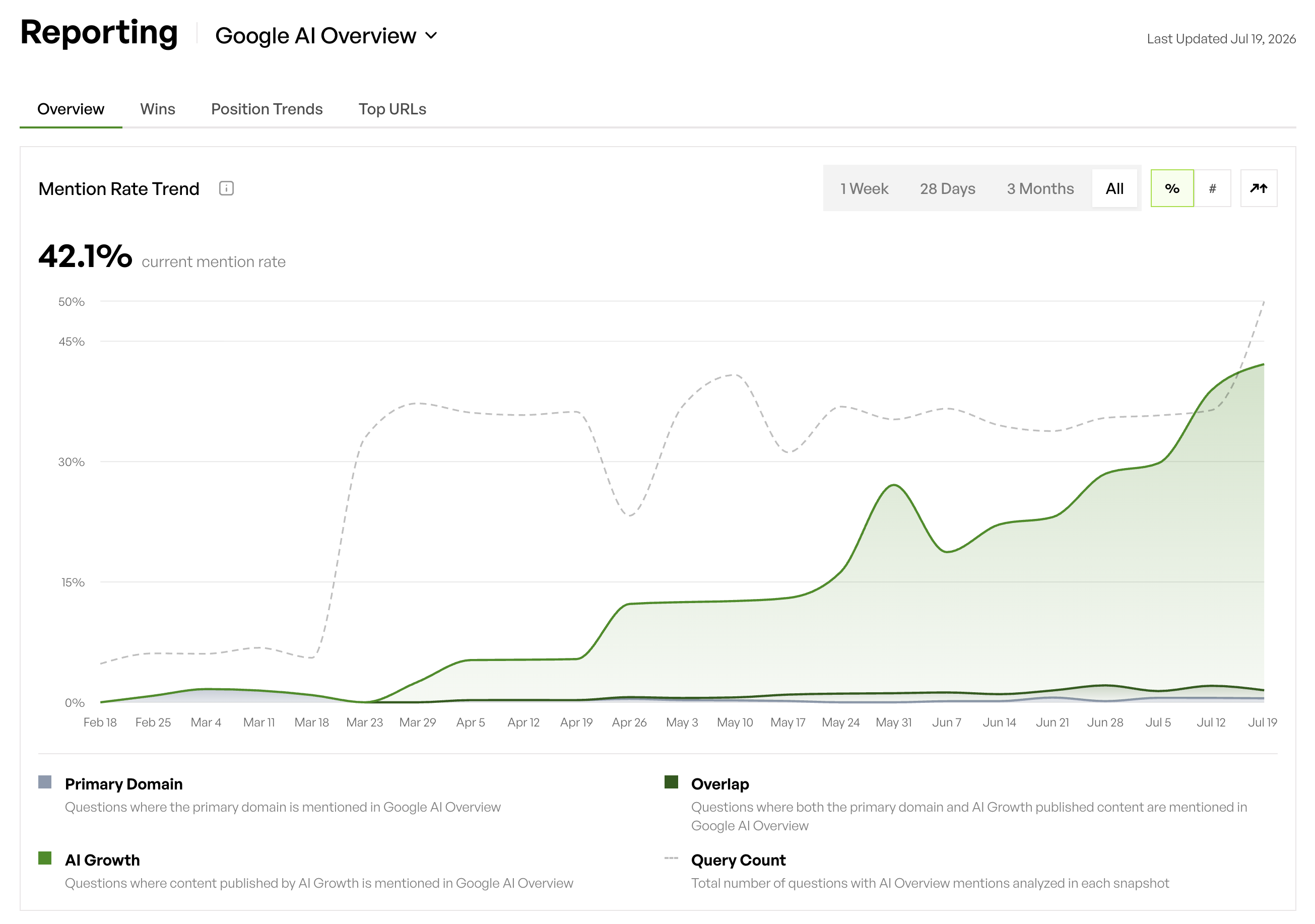
- Citation Frequency: How often the brand’s content is cited as a source in AI answers.
- Brand Sentiment: How AI systems describe the brand, classified as positive, neutral, or negative.
- Generative Visibility: The brand’s share of voice across AI-generated answers for category-defining prompts.
- Source Prominence: Where the brand appears in the answer and which sources are cited alongside it.
Book a kickoff and see your first article live within a week
Buyer Risks In Today’s PR Market
Each problem below represents a concrete buyer risk. These patterns affect whether your investment produces measurable AI visibility.
- Agency Rebrands Without Capability: Agencies rename their press-release retainer as an AI-search offering without building the technical or content capability to deliver it. Buyer risk: paying for a rebrand that delivers no measurable result. The 2026 Scribewise and Scrunch survey found that 71% of agencies offering GEO spend more time explaining it than doing it.
- Prompt-Metered Monitoring Sold As Strategy: Monitoring tools cap the number of prompts a client can track, then charge more to see further. Buyer risk: seeing only the slice of the market you already thought to ask about.
- No Ownership Of The Publishing Surface: Agencies depend on the client’s existing site or a rented platform, which leaves the client with no owned asset and limited control. Buyer risk: every change becomes a dependency, and the agency effectively controls the narrative.
- No Way To Isolate Incremental Visibility: Without a separate publishing environment, no one can tell whether the PR program generated new visibility or simply took credit for visibility the brand already had. Buyer risk: paying for results you cannot prove. The Semrush operational gap study found that 49% of marketers cite measuring AI’s impact on pipeline or revenue as a top challenge.
Get a defensible answer for your CEO every week
Where AI Growth Agent Fits In Your Stack
AI Growth Agent acts as the engine that maps the brand’s full universe of seed terms and long-tail queries. It produces authoritative content that validates every claim and source, stands up a fully optimized site the client owns within the first week, and reports the incremental visibility it generates week over week.
It replaces seven vendors: the SEO agency, the content tool, the web agency, the GEO monitor, the schema plugin, the analytics stack, and the traditional PR firm. The PR firm here means the slow, retainer-heavy earned-media vendor, not the forward-thinking agency that runs AI Growth Agent on behalf of its own clients.
Pricing uses a flat fee with no per-article charges, credit limits, or per-prompt billing. Clients own all the content they produce. The engine operates at Level 4 autonomy. It plans, executes, handles its own errors, and surfaces only exceptions so the human can manage by exception while the engine runs the program.
Across the first twelve weeks, clients typically see measurable gains in citation frequency and bot traffic, along with faster indexing and early content wins. Individual case studies, such as Breadless and Leva Sleep, provide specific performance details on request.
See how AI Growth Agent makes your brand the answer
Frequently Asked Questions
How Do I Tell A Real AI-Search PR Capability From A Rebranded Press-Release Retainer?
Ask for the deliverable, not the promise. A real capability includes a baseline AI visibility audit across at least four AI surfaces, a mapped universe of queries, citation-ready content published on a site the client owns, and weekly reporting on citation frequency and sentiment. A rebranded retainer produces press releases and a dashboard that shows whether you appear for the handful of prompts you already thought to track.
The structural test is ownership. Ask who owns the publishing surface and who owns the content. If the answer is the agency or a rented platform, the capability does not meet AI-era standards.
What Should I Put In The Contract?
Require reporting on citation frequency, brand sentiment, generative visibility, and source prominence. Specify which AI surfaces are tracked, with ChatGPT, Perplexity, Google AI Mode, and AI Overviews as the minimum. Confirm that prompt count is not a billed metric and that the client owns the content and the publishing surface.
Include a first-90-days deliverable schedule with named outputs at each stage. Ask how the agency isolates incremental visibility from visibility the brand already had, and require that answer in writing before signing.
How Is AI-Era PR Measured?
The four core metrics are citation frequency, brand sentiment, generative visibility, and source prominence, alongside traditional reach and impressions. Google Search Console can serve as an independent audit of impressions and search visibility and belongs in every reporting stack as a free verification layer.
How Fast Should Results Appear?
The first article is typically live within a week of kickoff. Content has indexed in as little as ten days and often within two weeks. Citation improvements typically appear within four to eight weeks, with brand mention frequency building over three to six months.
The standard AI-era PR engagement is a retainer with a minimum commitment of six to twelve months, with AI visibility programs specifically requiring six to nine months to move citation share, because indexing timelines vary by industry and competitive density. Brands that see the fastest results stand up an owned publishing surface immediately rather than waiting to optimize an existing site.
Why Does Owning The Publishing Surface Matter?
When an agency controls your site or publishes on a rented platform, every change becomes a dependency and every result is harder to verify. You cannot isolate what the PR program generated from visibility you already had because there is no separate environment to measure against.
An owned publishing surface solves both problems. It gives you an asset you control outright and gives the measurement framework a clean baseline. When the agency relationship ends, the content, the site, and the visibility stay with you rather than disappearing with the retainer.
Schedule a demo to see if we’re a fit