Written by: Mariana Fonseca, Editorial Team, AI Growth Agent
Key Takeaways
- AI search visibility depends on making content easy for engines like ChatGPT, Perplexity, and Google AI Overviews to access, trust, and cite.
- The sequence of work matters. Start with crawlability and entity consistency, because every later step relies on them.
- Many teams jump to schema and content volume before confirming that AI crawlers can reach the site at all.
- The practical order is crawlability, entity consistency, direct-answer content structure, schema markup, earned mentions, and measurement.
- AI Growth Agent automates this full loop, from query sourcing to self-healing content, and reports measurable visibility gains week over week.
Book A Demo With AI Growth Agent
The Techniques In Priority Order
Crawlability and entity clarity sit at the foundation of AI search visibility. Every other technique depends on them. Schema on a page that OAI-SearchBot cannot fetch has no effect, and content for an ambiguous brand entity rarely earns citations. The sequence below follows dependency and realistic return on effort.
- Crawlability: allow OAI-SearchBot and audit for blanket blocks
- Entity consistency across the site, profiles, and directories
- Direct-answer content structure for retrieval
- Schema markup applied to visible content
- Earned third-party mentions on independent domains
- Measurement: a fixed prompt set run before and after each change
The first three techniques usually deliver most of the early lift. Regulated and local businesses often need to adjust the order of schema and earned mentions, which the sections below explain in detail.
See The Priority Order In Action
How To Improve AI Search Visibility: Crawlability First
AI search visibility starts with crawler access. If OAI-SearchBot, GPTBot, and Google-Extended cannot fetch a page, no downstream work can produce a citation. These three crawlers power ChatGPT Search indexing, model training, and Google’s generative features, and each one needs its own robots.txt rule.
Implementation Detail. OpenAI operates four distinct crawlers with independent robots.txt tokens: GPTBot for model training, OAI-SearchBot for real-time indexing behind ChatGPT Search, ChatGPT-User for live user-triggered fetches, and OAI-AdsBot for ad landing page validation. OpenAI’s crawler documentation confirms that the GPTBot and OAI-SearchBot settings are independent, so a rule targeting one does not affect the other. The two tokens are governed independently, so you can allow search indexing while withholding training consent. The configuration looks like this:
User-agent: OAI-SearchBot Allow: / User-agent: GPTBot Disallow: /
OpenAI publishes machine-readable IP range files at openai.com/searchbot.json for OAI-SearchBot and at openai.com/gptbot.json for GPTBot. OpenAI’s official guidance recommends referencing these JSON files instead of maintaining static IP lists, because crawler infrastructure changes over time.
Verification Step. Grep server logs for the OAI-SearchBot and GPTBot user-agent tokens. Pull the requesting IP from each matching line and cross-reference it against OpenAI’s published range files. A request claiming to be OAI-SearchBot that does not originate from a currently published CIDR prefix should be treated as unverified and likely spoofed, since user-agent strings can be forged. Because published ranges can change, repeat this verification against the current feed.
Common Invisible Failure. A blanket block-all-OpenAI-bots rule inherited from a 2023-era robots.txt template is one of the most common causes of missing ChatGPT citations in 2026. OAI-SearchBot did not exist when those templates were written, so the rule silently blocks a crawler the template author never intended to exclude. Because search and retrieval run through separate agents and indexes, the site drops out of ChatGPT’s cited answers even when GPTBot has already trained on the same pages.
Entity Consistency Across The Site, Profiles, And Directories
Consistent entity signals give AI retrieval systems confidence to cite a brand. Conflicting names, descriptions, or categories across the site, LinkedIn, review platforms, and directories create low-confidence evidence that models tend to ignore. Machine Relations Research identifies inconsistent cross-domain identity as a structural limit on citation confidence and shows how contradictory signals weaken the corroboration chain.
Implementation Detail. Use one exact company name everywhere, including the homepage, About page, author bios, LinkedIn, Google Business Profile, and every directory listing. Align the Organization schema sameAs properties to those same profiles so the structured data layer reinforces the same entity chain the retrieval system already reads. AI systems use cross-source consistency as a reliability signal when deciding whether to cite or recommend a brand, so fragmented or contradictory signals create structural invisibility risk.
Verification Step. Ask ChatGPT directly what the company does and compare its description against the About page. Any drift between the two reveals an entity signal problem. This method surfaces inconsistencies that top organic results may not show, because it uses the AI system’s own retrieval output as the diagnostic.
Direct-Answer Content Structure For Retrieval
Direct-answer structure makes content easy for AI engines to extract. AI answer engines retrieve candidate passages, not full pages, so each section must stand alone as a complete answer. A Semrush study found that clarity and summarization formats correlate with a +32.83% increase in citations, and Q&A format content correlates with a +25.45% citation lift, because explicit questions and headings mirror how buyers phrase queries.
Implementation Detail. Use a simple pattern in every section: claim, evidence, source, interpretation. State the answer first. Support it with facts. Cite the source. Explain what it means for the reader. Keep paragraphs short. Avoid pronouns that replace key entities within a passage, because a retrieval system pulling a single chunk cannot resolve a pronoun that refers to a noun several paragraphs earlier.
Verification Step. Pull any single H2 section out of the page and read it on its own. If it fails to answer a complete question without surrounding context, it will not be extracted. This thirty-second test catches the most common structural failure in content written for traditional SEO rather than AI retrieval.
Schema Markup Done Correctly
Schema markup strengthens signals that already exist on the page. It rarely works as the first move. According to DeepSmith’s evidence-ranked analysis, the schema types with the clearest impact on AI citation are BreadcrumbList and FAQPage, each near a 46% observed citation rate. Organization, WebSite, and Article follow at roughly 44% each. BreadcrumbList’s raw rate likely reflects the authority of the sites that ship breadcrumbs rather than the markup’s own contribution. FAQPage JSON-LD is repeatedly identified as the highest-impact schema type for AI citation because it makes question-and-answer content explicitly machine-readable, while Organization schema with sameAs supports entity disambiguation.
Implementation Detail. Schema must describe visible content. Google’s developer documentation on structured data states that marked-up content must appear on the page itself. Marking up FAQs or claims that do not appear in the body text violates this requirement and can result in manual actions. Apply FAQPage schema only to questions and answers that a reader can see.
Verification Step. Run the page through Google’s Rich Results Test and confirm every marked-up property maps to text a reader can see. Schema that validates in the tool but describes invisible content creates compliance risk instead of value.
Schema helps retrieval systems confirm what a page covers, but it cannot fix blocked crawlers or unclear entities. That dependency explains why schema appears fourth in this sequence instead of first.
Earned Third-Party Mentions Versus Self-Published Pages
Earned mentions on independent domains often move AI visibility more than extra pages on the brand’s own site. AI retrieval systems treat multiple independent references as corroboration. An Ahrefs study of 75,000 brands found that brand web mentions correlate 0.664 with AI Overview visibility, roughly three times stronger than backlinks, which correlate 0.218. A brand that publishes hundreds of pages on its own domain without independent mentions builds a single-source entity chain that retrieval systems struggle to trust.
Implementation Detail. Focus on review platforms, analyst mentions, and industry roundups. Review platforms such as G2, Capterra, and TrustRadius carry disproportionate weight in AI citation decisions because they combine structured product data, verified user reviews, and editorial rigor, and a refreshed review platform profile can begin influencing AI citations within days. Keep entity claims identical across every third-party mention so corroboration compounds instead of conflicting.
Verification Step. Check whether the brand appears on at least three independent domains with consistent entity claims and matching founder or key-individual attribution. Machine Relations Research recommends a minimum of three independent domains for effective entity chain coverage, with diminishing returns after four to five well-maintained domains.
How To Measure AI Search Visibility
Consistent measurement turns AI search work into a trackable program. Use a fixed prompt set across engines before and after each change. A single sample from a variable system creates noise. Asking the same question three times in one afternoon often changes which brands are named and in what order, so a one-off report cannot be compared to a prior period.
Implementation Detail. Freeze a set of twenty to forty real buyer prompts drawn from search queries, sales calls, and support tickets. Run each across ChatGPT, Perplexity, Gemini, and Google AI Overviews in a logged-out session. Record presence, citation, and recommendation separately, because each level requires a different fix: presence means the engine named the brand, citation means it linked to the domain, and recommendation means it named the brand as the preferred answer.
Verification Step. Run the same prompt set three times per measurement cycle and report a range instead of a single number. Machine Relations Research recommends a minimum of three measurements per query per platform over a rolling seven-day window, with five to seven measurements as the ideal. A presence figure reported as a range across three runs is more defensible than a precise-looking single value.
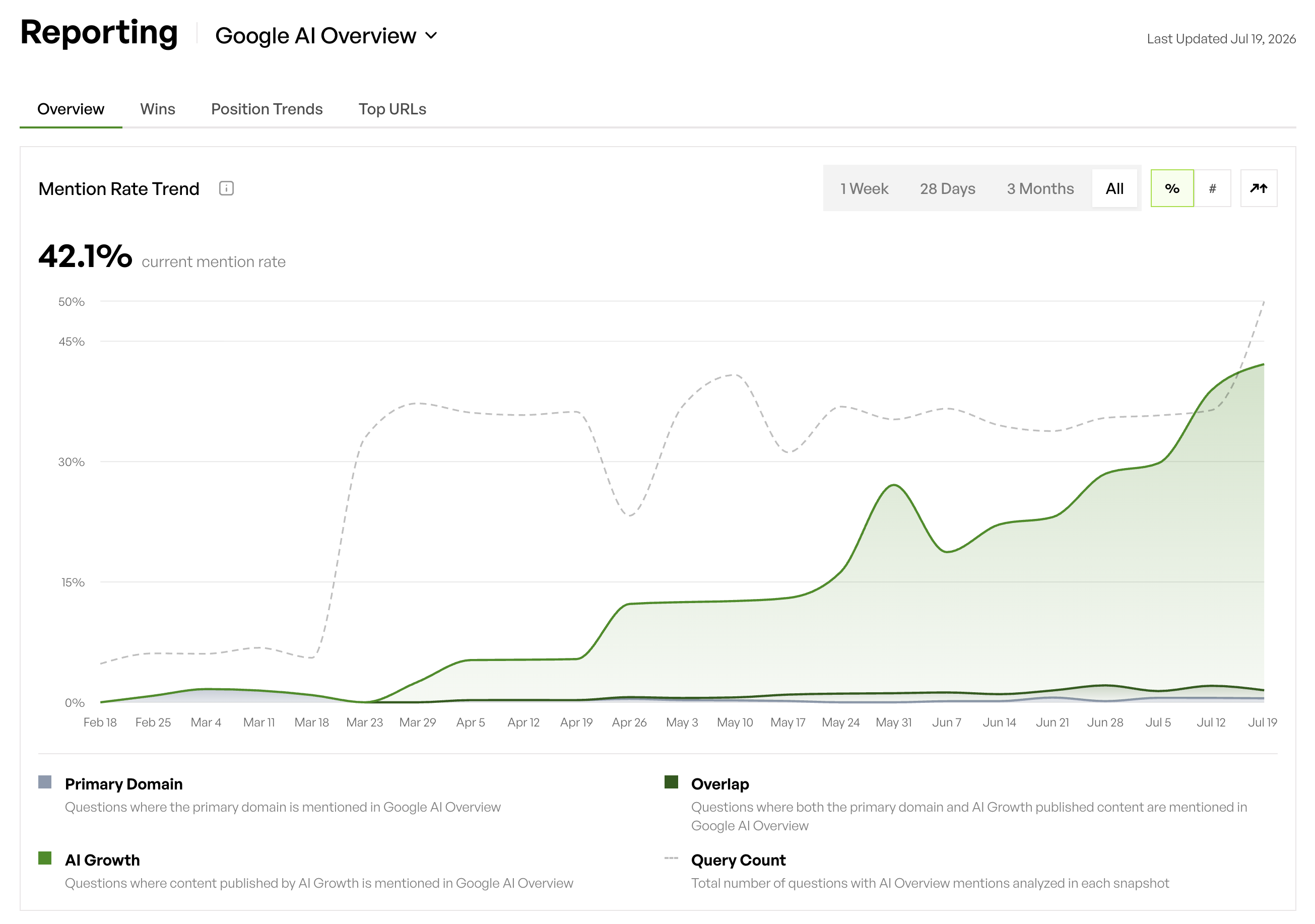
If you prefer not to run the prompt set by hand, several dedicated trackers can automate it. Peec AI, Profound, Otterly.ai, and Am I Cited, plus AI visibility features in Semrush and Ahrefs, cover most use cases. A practical dashboard combines GA4 for AI referral traffic, a dedicated visibility tool for mentions and citation share, server logs for crawler activity, and CRM data for assisted conversions. These tools show where your brand stands, while AI Growth Agent focuses on changing the underlying answers.
What Is The 80/20 Rule In AI Search Prioritization?
The 80/20 rule in AI search prioritization states that crawlability, entity clarity, and direct-answer structure drive most early gains. Schema markup, earned mentions, and measurement extend and confirm those gains. As established earlier, schema on a page OAI-SearchBot cannot fetch produces no citation benefit.
Teams with limited capacity should confirm crawler access, audit entity consistency, and restructure key pages for direct-answer extraction before working on schema or third-party mentions. Citation selection favors pages with clear entity signals, structured data, short extractable answers, and claims that can be verified across sources, but none of those factors matter if the retrieval pipeline cannot access the page.
How The Priority Order Shifts For Regulated And Local Businesses
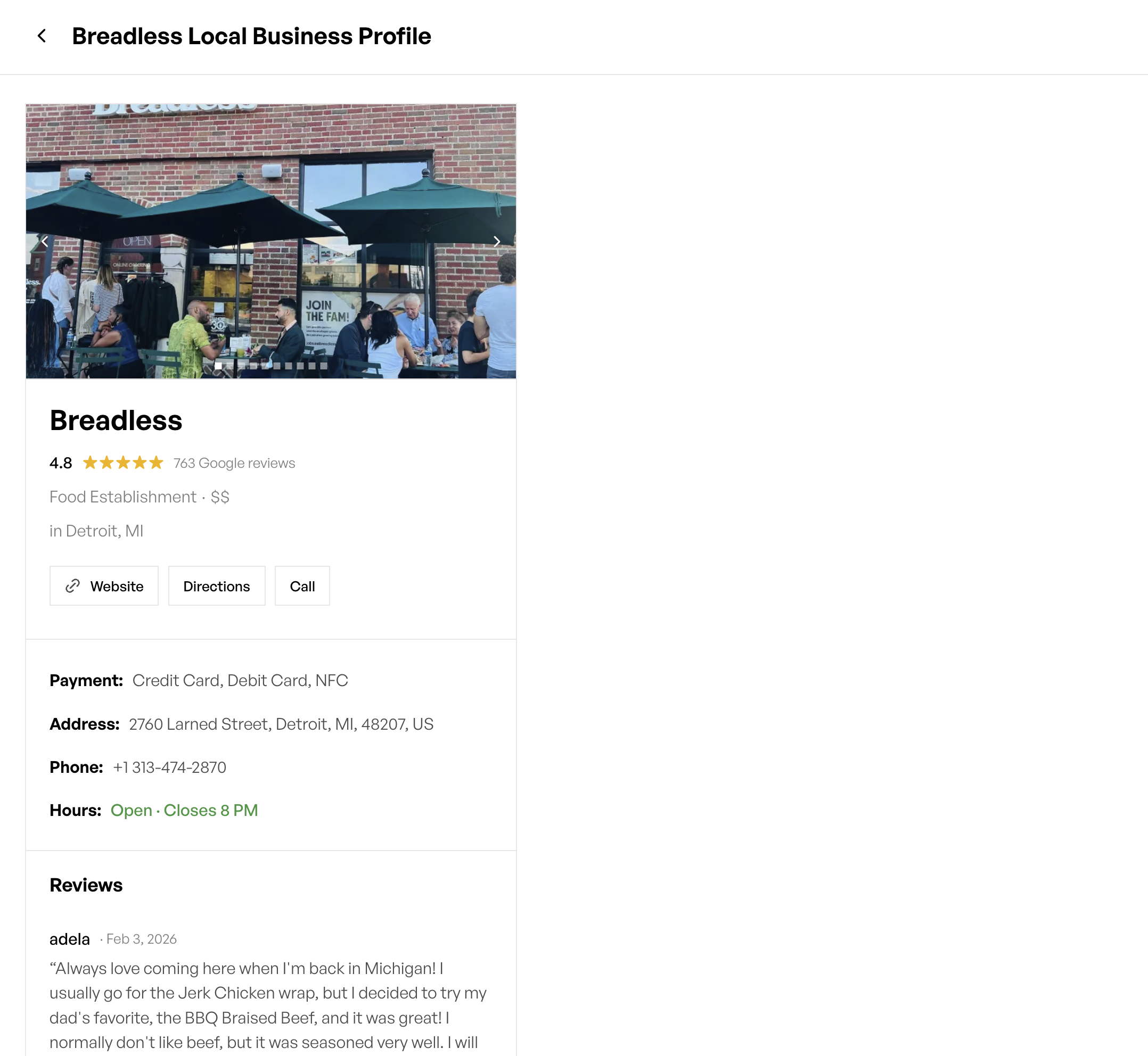
Local businesses need consistent location entities and LocalBusiness schema earlier in the process. A location entity that appears differently across Google Business Profile, Apple Maps, Yelp, and the owned site creates the same corroboration failure as an inconsistent brand name. For local businesses, entity consistency work extends to NAP data across every directory, and LocalBusiness schema should ship alongside Organization schema rather than later.
Regulated sectors such as finance, healthcare, and legal services must treat compliance as a core part of AI search work. Disclaimers need to appear on the page itself, not only in terms-of-service documents, because AI retrieval systems read visible content. A claim that appears without its required disclaimer creates compliance risk that schema and content volume cannot offset. For these sectors, schema and compliance review move ahead of pure content volume, because a cited page with a missing disclaimer scales legal exposure. Conservative claim language also reduces the chance that AI systems will absorb and amplify an unqualified assertion across thousands of responses.
Frequently Asked Questions
How Long Does It Take To See Results From AI Search Optimization?
Crawlability and entity fixes can produce measurable changes in AI crawler activity within days of deployment, because OAI-SearchBot re-crawls pages on a rolling basis. In a controlled 300-page deployment, its first request arrived 2 hours 18 minutes after launch and it covered only 13.7% of pages in the first 24 hours. Full coverage took a multi-day window. Content changes take longer, because pages need to be re-crawled, re-indexed, and incorporated into the retrieval pipeline before citation rates move. A realistic window for observing the first citation movement after a content or schema change is four to eight weeks on the fastest AI surfaces, while durable citation share often takes three to six months.
Who On The Team Should Own AI Search Visibility?
AI search visibility spans technical, content, and brand work. Technical owners handle robots.txt, schema, and server log analysis. Content teams handle passage structure, direct-answer formatting, and FAQ sections. Brand and communications teams handle entity consistency and third-party mention strategy. In practice, the CMO or marketing lead should own the outcome and coordinate across these functions, because no single specialist controls all three. Teams that assign AI search visibility only to the SEO manager often fix the technical layer and miss the entity and content layers.
Do I Need A Separate Tool For AI Search Visibility Measurement?
A dedicated AI visibility tool helps, but the starting point is simple. Begin with a frozen prompt set and a GA4 AI referral segment, which cost nothing and take under an hour to set up. Start server log analysis of AI crawler tokens before any site changes, because this data cannot be reconstructed later. A dedicated tool adds value once the prompt set is frozen and the baseline is established, because it automates sampling and tracks citation share across competitors.
Does Blocking GPTBot Hurt AI Search Visibility?
Blocking GPTBot withholds training consent but does not remove a site from ChatGPT’s cited search answers, because search and retrieval run through OAI-SearchBot, not GPTBot. The two crawlers have independent robots.txt tokens and independent functions. A site can block GPTBot while allowing OAI-SearchBot and remain fully eligible for ChatGPT citations. As noted in the crawlability section, a blanket block that catches OAI-SearchBot removes the site from cited answers entirely.
How Do I Know If My Schema Is Actually Working?
The validation method matches the earlier schema section. Run the page through Google’s Rich Results Test and confirm every marked-up property maps to visible text. Schema that validates in the tool but describes content that does not appear on the page violates Google’s structured data requirements and can result in a manual action. Beyond validation, watch for rich result appearances in Google Search Console’s Enhancement reports and track whether citation rates in your fixed prompt set change after schema deployment. Schema usually acts as a supporting signal that confirms what the page covers rather than a primary driver of retrieval.
Conclusion: Make Your Brand The Answer
The order of work determines how much impact each technique delivers. Crawlability unlocks every other move. Entity consistency gives retrieval systems confidence to cite the brand. Direct-answer structure makes content extractable. Schema confirms what the page covers. Earned mentions corroborate the entity chain. Measurement shows whether the system is improving. Reversing this order often produces heavy effort with little verifiable output.
AI Growth Agent runs this full loop as an autonomous engine. It maps the brand’s universe of seed terms and long-tail queries from real-time Google and ChatGPT data, produces authoritative content validated against primary sources, and publishes to a site the client owns with a complete technical and agentic SEO stack. The system self-heals content over time so the brand’s narrative stays current as the world changes. It runs the full loop from query sourcing to self-healing redirects and reports the incremental visibility it generates week over week, so results stay provable.
The brands cited in AI search this year are training the next generation of models with their own narrative. The brands that delay allow the next generation to train on whatever happens to be sitting on the open web.