Written by: Mariana Fonseca, Editorial Team, AI Growth Agent
Key Takeaways
- Entity-based JSON-LD uses stable @id identifiers and bidirectional links to create a machine-readable graph that AI systems can traverse across an entire domain.
- The five core schema types, Organization, Person, FAQPage, Article, and Service, should be implemented in sequence so each new node references previously defined entities.
- Accurate sameAs links, consistent @id values, and visible on-page content are mandatory to avoid trust-signal failures after Google’s March 2026 update.
- FAQPage schema delivers the highest citation probability for Q&A content because it supplies pre-structured pairs that AI models can extract directly.
- See how AI Growth Agent provisions and maintains the full bidirectional entity graph for your brand on autopilot.
Core Requirements Before You Add Schema
Confirm a few technical basics before you add any schema type. First, every target page needs a stable, canonical URL that serves as the entity’s @id. This identifier becomes the anchor that other schema types reference across the site. Second, all claims in the JSON-LD must match visible on-page content, because Google penalizes invisible schema where markup describes information users cannot see on the page. Third, you need access to the document <head> to insert JSON-LD, which remains Google’s recommended structured data format after the March 2026 update. Fourth, set up a validation workflow using Google’s Rich Results Test and Schema Markup Validator so you catch errors before any block goes live.
How the Five Schema Types Work Together
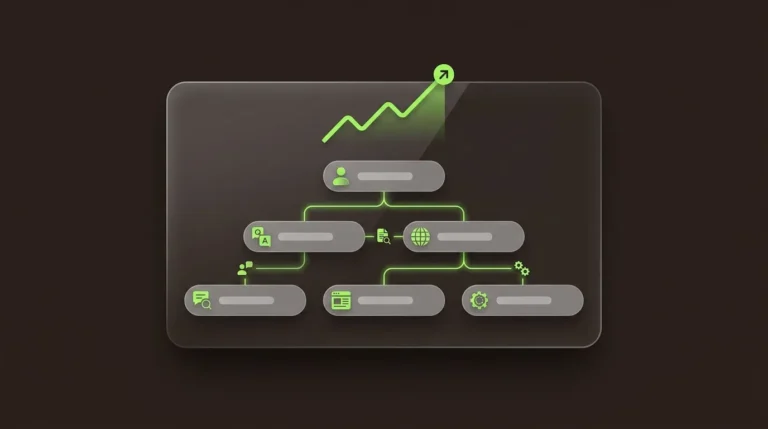
The five schema types below are sequenced deliberately. Organization schema anchors the entity graph at the domain level. Person schema attaches author authority to that anchor. FAQPage schema surfaces Q&A content for direct extraction. Article schema provides publication context for every content page. Service schema closes the commercial loop. Each step introduces a bidirectional @id link back to a previously defined entity. By step five, the full graph is internally consistent and externally verifiable.
@id values assigned consistently to primary entities and referenced across pages let AI systems construct a unified bidirectional entity graph for the domain instead of treating each page as an isolated signal. That graph is what separates a schema implementation that earns citations from one that merely passes validation.
Step 1: Organization Schema as Your Root Entity
Organization schema acts as the root node of the entity graph. Every other schema type on the domain will reference it, so you should implement it correctly before any other step.
Implementation
- Place the following JSON-LD block in the
<head>of the homepage and every sitewide template. - Set
@idto a stable URL fragment such ashttps://yourdomain.com/#organization. - Populate
sameAswith verified external profiles: Wikidata, LinkedIn, Crunchbase, and any Wikipedia entry. - Add the
knowsAboutproperty listing the topical areas the organization covers. - Validate with Google’s Rich Results Test before deployment.
The JSON-LD example below shows a complete Organization schema that follows these implementation steps.
{ "@context": "https://schema.org", "@type": "Organization", "@id": "https://yourdomain.com/#organization", "name": "Your Company Name", "url": "https://yourdomain.com", "logo": { "@type": "ImageObject", "url": "https://yourdomain.com/logo.png" }, "sameAs": [ "https://www.linkedin.com/company/your-company", "https://www.wikidata.org/wiki/Q_YOURENTRY", "https://www.crunchbase.com/organization/your-company" ], "knowsAbout": [ "AI search optimization", "entity-based JSON-LD", "large language model optimization" ] } Common Mistakes
Omitting sameAs links is the most damaging error at this step. Organization and Person schema with SameAs identifiers pointing to authoritative external sources can be a high-leverage implementation for AI Mode citation performance. A second common error is using a different @id value on interior pages, which breaks the bidirectional graph.
Verification
Run the homepage URL through Google’s Rich Results Test. Confirm the Organization entity resolves with no errors and that all sameAs URLs return HTTP 200.
AI Citation Lift
Step 2: Person Schema for Author Authority
Person schema attaches named author authority to the Organization node established in Step 1. Every content page that carries a byline should reference a Person entity whose worksFor property points back to the Organization @id.
Implementation
- Create a dedicated author page at a stable URL such as
https://yourdomain.com/authors/jane-doe/. - Set the Person
@idto that URL with a fragment, for examplehttps://yourdomain.com/authors/jane-doe/#person. - Set
worksForto reference the Organization@idfrom Step 1. - Populate
sameAswith the author’s LinkedIn profile and any Wikipedia or Wikidata entry. - Add
knowsAboutandhasCredentialto signal topical expertise.
The JSON-LD block below illustrates a Person schema that connects cleanly to the Organization entity.
{ "@context": "https://schema.org", "@type": "Person", "@id": "https://yourdomain.com/authors/jane-doe/#person", "name": "Jane Doe", "url": "https://yourdomain.com/authors/jane-doe/", "jobTitle": "Head of Content Strategy", "worksFor": { "@type": "Organization", "@id": "https://yourdomain.com/#organization" }, "sameAs": [ "https://www.linkedin.com/in/janedoe", "https://www.wikidata.org/wiki/Q_JANEENTRY" ], "knowsAbout": [ "schema markup for AI search", "entity-based JSON-LD", "bidirectional @id linking schema" ], "hasCredential": { "@type": "EducationalOccupationalCredential", "name": "Certified SEO Specialist" } } Common Mistakes
Using a generic author name with no external sameAs links produces a Person node that AI systems cannot resolve to a real-world entity. Person schema fields including alumniOf, hasOccupation, and links to professional profiles serve as credential-verifying signals that explicitly verify author expertise and authority for AI systems.
Verification
Validate the author page URL in Google’s Rich Results Test. Confirm the worksFor reference resolves to the correct Organization @id.
AI Citation Lift
Person schema acts as the technical implementation of E-E-A-T signals that AI systems use to assess source trustworthiness.
Step 3: FAQPage Schema for Direct Q&A Answers
FAQPage schema provides AI systems with pre-structured Q&A pairs that can be directly extracted and cited. Use it on any page where a question-and-answer block appears as primary content.
Implementation
- Identify pages where FAQ content is the primary content type, not a supplementary sidebar.
- Set the FAQPage
@idto the canonical URL of that page. - Link the
publisherproperty to the Organization@idfrom Step 1. - Ensure each
Questionnode carries the exact text visible on the page. - Validate that every
acceptedAnswertext matches visible on-page content.
The JSON-LD example below shows a compliant FAQPage implementation with two Q&A pairs.
{ "@context": "https://schema.org", "@type": "FAQPage", "@id": "https://yourdomain.com/faq/", "url": "https://yourdomain.com/faq/", "publisher": { "@type": "Organization", "@id": "https://yourdomain.com/#organization" }, "mainEntity": [ { "@type": "Question", "name": "What is entity-based JSON-LD?", "acceptedAnswer": { "@type": "Answer", "text": "Entity-based JSON-LD is a structured data format that describes real-world entities as machine-readable nodes connected by explicit relationships using stable @id identifiers." } }, { "@type": "Question", "name": "Which schema markup types earn AI citations?", "acceptedAnswer": { "@type": "Answer", "text": "Organization, Person, FAQPage, Article, and Service schema types are the five highest-priority implementations for AI search citation in 2026." } } ] } Common Mistakes
Applying FAQPage schema to pages where FAQ content is secondary, such as a product page with a small accordion at the bottom, violates Google’s post-March 2026 eligibility rules. The March 2026 core update tightened eligibility to pages where schema describes primary content.
Verification
Confirm each Question and acceptedAnswer text string appears verbatim in the visible page body. Run the URL through Google’s Rich Results Test.
AI Citation Lift
FAQPage schema has the highest citation probability among all schema types for Q&A content because it provides AI models with pre-structured Q&A pairs that can be directly extracted and cited. Even after Google deprecated FAQ rich results in May 2026, AI systems continue to use FAQPage markup to identify direct Q&A content when generating answers.
Step 4: Article Schema Connecting Authors and Brand
Article schema supplies AI models with structured metadata on authorship, publication dates, and publisher context for every content page. It connects the Person node from Step 2 and the Organization node from Step 1.
Implementation
- Apply Article schema, or the
BlogPostingsubtype for blog content, to every editorial page. - Set
@idto the canonical URL of the article with a fragment, such ashttps://yourdomain.com/article-slug/#article. - Set
authorto reference the Person@idfrom Step 2. - Set
publisherto reference the Organization@idfrom Step 1. - Populate
datePublishedanddateModifiedwith ISO 8601 dates that match visible on-page timestamps.
The JSON-LD snippet below shows a typical Article schema block wired into the broader entity graph.
{ "@context": "https://schema.org", "@type": "Article", "@id": "https://yourdomain.com/best-schema-markup-types-for-ai/#article", "headline": "Best Schema Markup Types for AI: The 2026 Implementation Guide", "url": "https://yourdomain.com/best-schema-markup-types-for-ai/", "datePublished": "2026-06-14", "dateModified": "2026-06-14", "author": { "@type": "Person", "@id": "https://yourdomain.com/authors/jane-doe/#person" }, "publisher": { "@type": "Organization", "@id": "https://yourdomain.com/#organization" }, "about": { "@type": "Thing", "name": "Schema markup for AI search" } } Common Mistakes
Leaving dateModified static after content updates creates a trust signal failure. Inconsistent schema data, such as an outdated date field, triggers immediate trust signal failure and prevents content from being used in AI Overviews.
Verification
Confirm datePublished and dateModified match the timestamps visible on the page. Validate the author and publisher @id references resolve correctly in the Schema Markup Validator.
AI Citation Lift
Step 5: Service Schema for Commercial Clarity
Service schema closes the commercial loop by describing what the organization offers in machine-readable terms. It connects back to the Organization node and gives AI systems the entity clarity needed to cite the brand in commercial and comparison queries.
Implementation
- Apply Service schema to each core service or product category page.
- Set
@idto the canonical URL of the service page with a fragment. - Set
providerto reference the Organization@idfrom Step 1. - Populate
serviceType,description, andareaServedwith values that match visible page content. - Add
hasOfferCatalogif the service page lists multiple offerings.
The JSON-LD example below shows a Service schema block that describes a core offering and its catalog.
{ "@context": "https://schema.org", "@type": "Service", "@id": "https://yourdomain.com/services/ai-search-optimization/#service", "name": "AI Search Optimization", "url": "https://yourdomain.com/services/ai-search-optimization/", "serviceType": "Large Language Model Optimization", "description": "Autonomous entity graph provisioning, validation, and maintenance for AI search citation at scale.", "provider": { "@type": "Organization", "@id": "https://yourdomain.com/#organization" }, "areaServed": { "@type": "Place", "name": "Global" }, "hasOfferCatalog": { "@type": "OfferCatalog", "name": "AI Visibility Services", "itemListElement": [ { "@type": "Offer", "itemOffered": { "@type": "Service", "name": "Entity Graph Provisioning" } } ] } } Common Mistakes
Using a generic serviceType value that does not match the page’s primary content topic weakens the topical authority signal. The knowsAbout property creates a topical authority signal that AI Mode uses when selecting sources for specific query categories, and Service schema must align with those declared topical areas to reinforce the signal.
Verification
Confirm the provider reference resolves to the Organization @id. Validate the service page URL in Google’s Rich Results Test and confirm no errors on the areaServed or hasOfferCatalog nodes.
AI Citation Lift
Advanced Entity Graph Maintenance in Practice
Implementing the five schema types above produces a functional entity graph. Keeping that graph accurate over time is where most teams fail, and where the gap between manual implementation and autonomous maintenance becomes decisive.
When the same entity is described inconsistently across pages and structured outputs, the inconsistency itself becomes a trust signal that AI systems use to evaluate trustworthiness. A Service page updated with a new offering but whose schema still references the old service name creates a mismatch that AI systems detect and penalize.
Mature organizations are moving toward write-time guardrails and paragraph-level reconciliation grounded in governed entity data so contradictions are caught before they become customer-facing answers. For most mid-market and enterprise teams, that level of discipline requires an autonomous system rather than a manual review cycle.
Advanced scenarios that require ongoing graph maintenance include adding new authors whose Person nodes must be linked to the Organization and to their published Article nodes, launching new service lines whose Service nodes must reference the correct provider @id, updating dateModified on every Article node when content is refreshed, and propagating the sameAs updates discussed in Step 1 when the organization earns new external profile entries.
AI Growth Agent provisions valid schema across the full suite, including Article, FAQ, Organization, Person, and Service, automatically and keeps it current as the brand evolves, with no technical skill required from the client and no schema plugin to configure. The engine also ships agentic technical SEO on top of the schema layer: Blog MCP, llms.txt and llms-full.txt, OpenAI discovery via /.well-known/, instant indexing, and self-healing content that updates when Google Search Console signals indicate decay.
The brands that will hold AI citation positions through 2026 and beyond are not the ones that implemented schema once and moved on. They are the ones running a living entity graph that updates in step with their content, their services, and the AI systems reading them.
Frequently Asked Questions
What is the difference between entity-based JSON-LD and standard schema markup?
Standard schema markup describes a single page in isolation. Entity-based JSON-LD assigns a stable @id to each real-world entity, such as an organization, a person, or a service, and uses properties like author, publisher, and worksFor to link those entities across every page on the domain. The result is a graph that AI systems can traverse to understand who created the content, who publishes it, and what the organization offers, rather than reading each URL as a disconnected signal.
Do AI systems like ChatGPT and Perplexity read JSON-LD directly?
The evidence is mixed. Controlled testing has shown that Google’s Gemini-powered AI Mode and AI Overviews respond most directly to JSON-LD schema, while other platforms appear to benefit indirectly through improved organic rankings and rich results that feed into their retrieval pipelines. The practical conclusion for 2026 is that schema markup is a prerequisite for AI citation, not a guarantee, and its value compounds when combined with authoritative content, bidirectional entity linking, and agentic technical SEO layers like llms.txt and Blog MCP.
Why does bidirectional @id linking matter for AI citation?
AI systems evaluate whether the same entity is represented consistently across an entire digital footprint, not just on individual URLs. When an Article node references a Person @id, and that Person node references an Organization @id, and the Organization node carries sameAs links to Wikidata and LinkedIn, the AI system can resolve the full chain of trust in a single graph traversal. Without bidirectional linking, each page is an isolated signal with no chain of authority connecting it to the brand’s verified identity.
How does AI Growth Agent maintain schema markup over time without adding headcount?
AI Growth Agent provisions the full schema suite automatically at the article and site level, including Organization, Person, FAQPage, Article, and Service schema, and keeps every node current as content is updated, new authors are added, and service offerings change. The engine cross-references Google Search Console signals and bot-traffic data to detect decay and trigger updates. The only integration step required from the client is the reverse proxy rewrite that connects the blog to a subdirectory under their domain. Every package includes the full technical and agentic SEO stack with no plugin configuration and no engineering hours on the client side.
Is schema markup alone sufficient to earn AI citations in 2026?
Schema markup is necessary but not sufficient. AI systems prioritize relevance, topical authority, and semantic clarity alongside structured data. Schema accelerates entity resolution and increases citation probability, but it must be paired with authoritative content that validates every claim, agentic technical SEO layers that make the content readable by AI crawlers, and a living maintenance process that keeps the entity graph consistent as the brand evolves. Brands that implement schema once and leave it static will see gains erode as competitors maintain fresher, more coherent entity graphs.
Conclusion: Turning Your Schema Graph into a Durable Moat
The five schema types covered in this guide, Organization, Person, FAQPage, Article, and Service, form a bidirectional entity graph that gives AI systems the entity clarity, topical authority, and trust signals needed to cite a brand in generated answers. Implementation is the starting point. Maintenance is the competitive moat.
Manual schema maintenance at scale is not a sustainable model for mid-market and enterprise brands. The entity graph must update in step with every new author, every new service, every refreshed article, and every new sameAs profile the organization earns. That discipline requires an autonomous engine, not a quarterly audit.
AI Growth Agent is the only engine that provisions, validates, and maintains the full bidirectional JSON-LD entity graph alongside the complete agentic technical SEO stack, including Blog MCP, llms.txt, instant indexing, and self-healing content, at a flat fee with no per-article charges and no schema plugin to manage. The first article is live within a week. The entity graph is current from day one.