Written by: Mariana Fonseca, Editorial Team, AI Growth Agent
Key Takeaways for Replacing HubSpot
- HubSpot Marketing Hub Professional costs $890 per month plus a $3,000 onboarding fee in 2026, which pushes many SMBs to cheaper options.
- Zoho CRM and EngageBay provide all-in-one CRM and marketing automation at far lower prices, with entry tiers around $14 per user per month.
- Pipedrive works best for sales-led teams focused on pipeline management, while Salesforce Essentials fits companies growing toward mid-market complexity.
- AI Growth Agent replaces the HubSpot marketing stack with a headless engine focused on AI search visibility and narrative control.
- Schedule a consultation with AI Growth Agent to see which alternative fits your team size and goals.
1. Zoho CRM for Feature-Rich Budget Coverage
Zoho CRM Standard starts at approximately $14 per user per month on annual billing, with a Professional tier at roughly $23 per user per month that unlocks Blueprint process automation. For teams that need broader coverage, Zoho One’s Standard All-Employee plan bundles 50+ apps including CRM, email marketing, projects, accounting, and helpdesk for $37 per user per month when billed annually, which delivers full-stack coverage at a fraction of equivalent HubSpot Professional plans.
Zoho CRM earned a 98/100 score in ITQlick’s 2026 evaluation for enterprise-grade features like Blueprint process automation, Canvas no-code customization, and Zia AI lead scoring and deal prediction, alongside 8,000+ apps via Zapier. The main tradeoff for SMBs is interface complexity. The breadth of the Zoho suite can overwhelm small teams that want a fast, opinionated setup instead of a highly configurable platform.
Zoho CRM fits budget-conscious teams of 3 to 20 people that need sales, marketing, and service in one place without paying for a premium platform. Budget-constrained buyers seeking the most features per dollar are often directed to Zoho CRM Standard or Professional, which include workflow rules and scoring at lower tiers than many competitors.
| Plan | Annual Price (per user/mo) |
|---|---|
| Standard | ~$14 |
| Professional | ~$23 |
| Zoho One (suite) | $37 |
2. Pipedrive for Sales-First Pipeline Management
Sales-led teams that want a simpler, pipeline-focused tool often choose Pipedrive instead of a broad all-in-one suite. Pipedrive restructured its lineup in 2025 to four tiers, now offering Lite, Growth, Premium, and Ultimate on annual billing. Pipedrive has no permanent free plan and offers only a 14-day trial with no credit card required. AI features appear in every tier, with AI-powered report creation available from Lite and AI-powered multi-email tools from Premium upward.
Pipedrive achieved SoftwareReviews scores of 9.0–9.1/10 in 2026 with strong visual drag-and-drop pipeline management and an AI Sales Assistant for win-probability prediction. Its main limitation is marketing automation depth. Pipedrive suits businesses where the primary use case is sales pipeline management and activity-based selling workflows rather than broader marketing automation or customer service capabilities. The Campaigns add-on exists but does not match the depth of a dedicated marketing automation platform.
Pipedrive works best for sales-led teams of 1 to 15 people that prioritize pipeline visibility and rep adoption over marketing automation. Sales-focused teams that care most about pipeline management are often advised to use Pipedrive Lite or Growth, which offer strong pipeline UX and high sales rep adoption rates according to G2 2025 data.
| Plan | Annual Price (per seat/mo) | Monthly Price (per seat/mo) |
|---|---|---|
| Lite | $14 | $19 |
| Growth | $24 | $34 |
| Premium | $49 | $64 |
| Ultimate | $69 | $89 |
Compare these pricing tiers against your current HubSpot spend in a free consultation.
3. Salesforce Essentials for Scaling Toward Mid-Market
Salesforce Essentials serves small teams that expect to grow into mid-market complexity and want to start on the same platform. Salesforce Sales Cloud pricing starts at $25 per seat per month on the Starter Suite on annual billing, rising to $100 on Pro Suite, $175 on Enterprise, and $350 on Unlimited. For SMBs evaluating the entry tier, the Starter Suite covers basic pipeline, contact management, and reporting, but deeper-feature Salesforce implementations carry higher overhead, with projects for enterprises often taking 3 to 6 months.
Salesforce Sales Cloud leads the 2026 CRM market with a score of 9.42/10 according to Lunoo’s consensus ranking. It offers deep customization, workflow automation, and an integration ecosystem of 10,000+ apps and 1,000+ prebuilt AI agents via AgentExchange. The practical limitation for SMBs is administrative overhead. Salesforce deployments commonly require a dedicated admin with annual fully loaded costs ranging from roughly $80,000 to $140,000, which makes the true total cost of ownership far higher than the per-seat price suggests.
Salesforce Essentials suits SMBs that anticipate rapid scaling into mid-market complexity, already operate in a regulated industry requiring SOC 2, ISO 27001, HIPAA, FedRAMP, or PCI DSS compliance, or need to connect to an existing Salesforce ecosystem. Teams under 15 people with straightforward pipelines usually find the administrative burden and cost structure mismatched to their needs.
Consolidated Feature Comparison for SMB Buyers
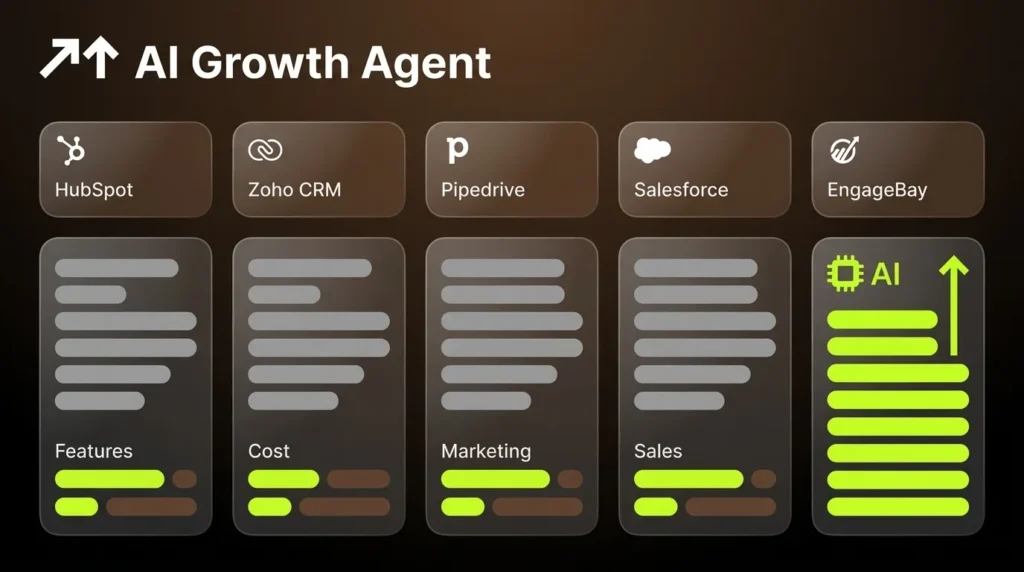
The table below compares Zoho CRM, Pipedrive, and Salesforce Essentials across four dimensions that matter to SMB buyers. Marketing automation depth varies significantly across these platforms and appears in prose where direct unit comparison is not possible.
| Attribute | Zoho CRM | Pipedrive | Salesforce Essentials |
|---|---|---|---|
| Marketing Automation | Broad coverage across sales, marketing, and service, Zia AI included | Sales-focused, Campaigns add-on available | Enterprise marketing via separate Marketing Cloud, not included in Essentials |
| Sales Pipeline | Multiple custom pipelines, Blueprint automation on Professional (~$23/user/mo) | Unlimited custom pipelines, drag-and-drop board, revenue forecast view from $14/user/mo | Advanced customizable forecasting, Enterprise tier (~$165/user/mo) required for full custom forecasting |
| Analytics | Zia AI deal prediction and Canvas no-code reporting | AI Sales Assistant for win probability, core reporting often needs add-ons | Einstein AI, deep customization, dedicated admin typically required |
| Integrations | 8,000+ apps via Zapier | 500+ marketplace integrations | 10,000+ apps via AppExchange, 1,000+ prebuilt AI agents via AgentExchange |
4. EngageBay for Low-Cost All-in-One Coverage
EngageBay delivers a strong budget all-in-one option with a free plan covering marketing automation, sales CRM, helpdesk, and live chat for up to 250 contacts and 15 users, with paid plans staying in the low double-digits per user. This structure makes it the closest all-in-one equivalent to HubSpot at a far lower price, without the contact-based overage charges that often push SMBs off HubSpot.
EngageBay’s core strength is breadth at low cost. Marketing automation, a visual deal pipeline, a helpdesk, and live chat all sit inside a single subscription. The limitation is depth. Teams that need advanced multi-touch revenue attribution, sophisticated segmentation, or enterprise-grade reporting will find EngageBay’s feature ceiling lower than HubSpot Professional or Salesforce. It also does not suit teams that plan to scale beyond roughly 50 users without hitting feature gaps.
EngageBay fits early-stage SMBs of 1 to 20 people that need marketing automation, CRM, and support tooling in one place and cannot justify HubSpot’s pricing cliff. It works especially well for teams moving off HubSpot Starter that want to keep the all-in-one model without absorbing the Professional tier’s mandatory onboarding fee.
See how EngageBay’s all-in-one model compares to your current stack in a personalized demo.
5. AI Growth Agent for AI Search and Narrative Control
AI Growth Agent is not a CRM. It replaces the entire HubSpot marketing stack, including the SEO agency, the content tool, the web agency, the GEO monitor, the schema plugin, the analytics stack, and the PR firm, with one headless engine at a flat fee. There are no per-article charges, credit limits, or per-prompt billing, and clients own all the content they produce.
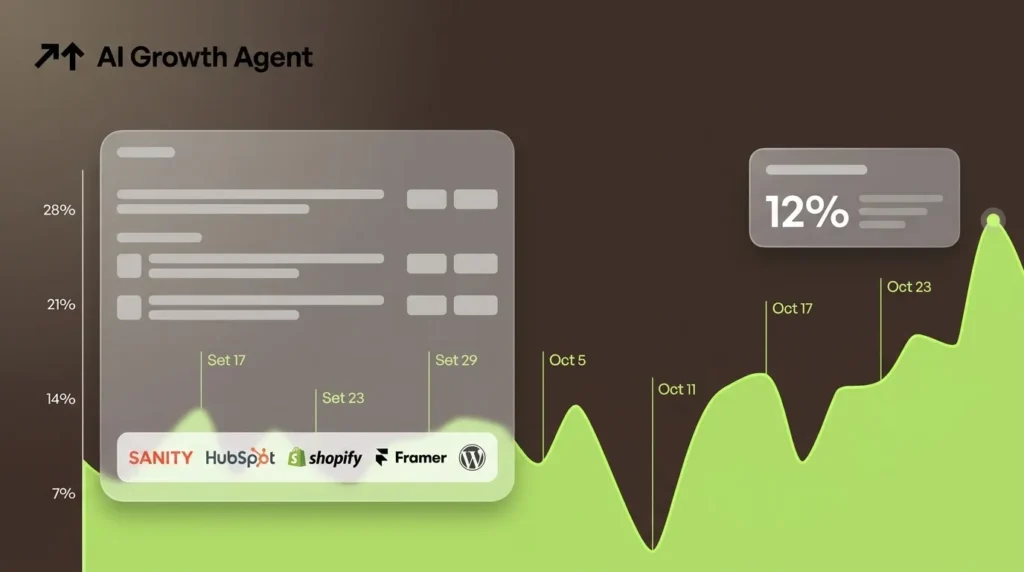
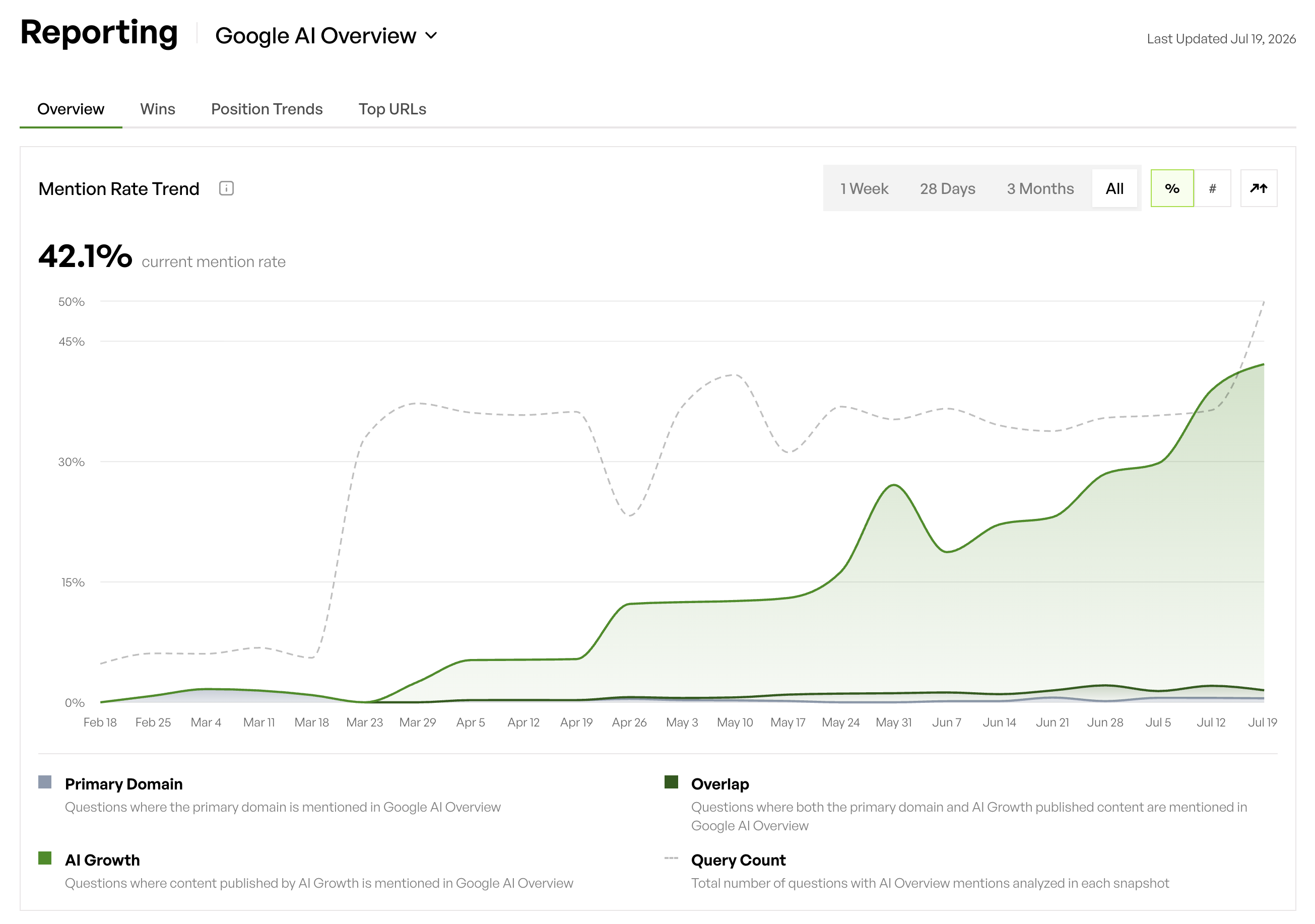
AI Growth Agent focuses on the layer traditional tools cannot reach, which is narrative control in AI search. Customers now resolve trust through ChatGPT, Perplexity, and Google’s AI Mode, and what those systems can find, trust, and cite often decides whether a brand appears in the conversation at all. AI Growth Agent maps a brand’s full universe of seed terms and long-tail queries from real-time Google and ChatGPT data, produces authoritative content that validates every claim and source, stands up a fully optimized site the client owns within the first week, and reports the incremental visibility it generates week over week. Across the first twelve weeks, clients average more than 12,000 additional AI citations and mentions, over 100,000 additional bot visits, and a 20%+ lift in impressions.
AI Growth Agent suits SMB founders, CEOs, and marketing leads who already solved their sales pipeline with a CRM and now need to control what AI says about their brand. It also fits teams that spend on HubSpot’s content and SEO features and see limited return, because content is the entire product here, not one feature inside a large platform.
Get your first AI-optimized article live within a week by seeing the engine in action.
Decision Framework for Choosing a HubSpot Alternative
The right alternative depends on team size and primary goal, so start with those two inputs before diving into pricing details.
| Team Size | Primary Goal | Best Fit |
|---|---|---|
| 1 to 5 people | Sales pipeline, fast setup | Pipedrive Lite |
| 3 to 20 people | All-in-one CRM, marketing, and support at low cost | EngageBay or Zoho CRM Standard |
| 5 to 30 people | Sales pipeline with structured automation | Pipedrive Growth or Zoho CRM Professional |
| 10 to 50 people | Full CRM suite with broad integrations, scaling toward mid-market | Zoho One or Salesforce Essentials |
| Any size | Full narrative control in AI search, replacing the marketing agency stack | AI Growth Agent |
A practical note on sequencing helps avoid wasted effort. A 2026 CRM evaluation framework from Viewpoint Analysis recommends starting with the primary use case before comparing platforms. This workflow-first approach is reinforced by Brightfield’s 2026 framework, which advises defining the three workflows needed on day one and treating scale as a reality check rather than a goal. Following this logic, most SMBs need a CRM for pipeline and a separate engine for AI search visibility, and these are complementary choices rather than substitutes.
Conclusion: Match the Tool to the Job
HubSpot’s pricing complexity and feature gaps are real, and the alternatives in this guide address them across a range of team sizes and budgets. Zoho CRM and EngageBay cover the all-in-one need at a fraction of the cost. Pipedrive is the cleaner choice for sales-led teams. Salesforce Essentials suits teams building toward mid-market complexity. None of these tools control what AI search says about a brand when a customer asks, which is the gap AI Growth Agent was built to close by replacing the entire marketing stack with one headless engine that produces authoritative content, manages technical SEO, and proves the incremental visibility it generates week over week.
Get your first AI-optimized article live within a week by booking a demo.
Frequently Asked Questions
What is the real total cost of HubSpot for a small business in 2026?
The base price of HubSpot Marketing Hub Professional is $890 per month on annual billing, plus a mandatory $3,000 onboarding fee. Contact-based overage charges increase costs as contact lists grow beyond the base tier. A five-person team adding Sales Hub Professional at $90 per seat per month and a $1,500 onboarding fee can exceed $2,000 per month before any add-ons. Most mid-market B2B teams on HubSpot Professional tiers spend $12,000 to $50,000 per year once hubs, seats, contacts, and onboarding fees are combined. The median small business on HubSpot Pro uses fewer than 25% of the features they pay for, including predictive lead scoring, custom event reporting, multi-touch revenue attribution, and A/B-tested CTAs.
Can a small business migrate from HubSpot to a cheaper CRM without losing marketing automation?
A small business can migrate successfully with the right tool selection and planning. EngageBay includes marketing automation, a sales CRM, helpdesk, and live chat in a single subscription starting with a free plan for up to 250 contacts and 15 users. Zoho One’s Standard All-Employee plan bundles 50+ apps including CRM, email marketing, projects, accounting, and helpdesk for $37 per user per month when billed annually. ActiveCampaign Plus starts at $49 per month for 1,000 contacts with visual automation, lead scoring, and CRM, which delivers comparable email automation depth to HubSpot Marketing Pro at a significantly lower cost. The migration itself carries risk, and many CRM failures stem from poor initial configuration rather than choosing the wrong platform, so defining the three workflows needed on day one before selecting a tool reduces that risk materially.
What does AI Growth Agent do that a CRM alternative cannot?
CRM alternatives address sales pipeline management and marketing automation, while AI Growth Agent focuses on what AI systems say about a brand when a customer asks. It replaces the SEO agency, the content tool, the web agency, the GEO monitor, the schema plugin, the analytics stack, and the PR firm with one headless engine at a flat fee. The engine maps a brand’s full universe of seed terms and long-tail queries from real-time Google and ChatGPT data, produces authoritative content that validates every claim and source, stands up a fully optimized site the client owns within the first week, and reports incremental visibility week over week. In the first twelve weeks, clients see the visibility gains described earlier, with over 12,000 new citations and 100,000+ bot visits, because the engine continuously produces and refines content without manual intervention. A CRM tracks and manages existing pipeline, while AI Growth Agent builds the top-of-funnel presence that fills it through AI search.
How should a founder with under $5M in revenue decide between these alternatives?
A founder under $5M in revenue should start with the primary workflow, not the feature list. If the immediate need is tracking deals and managing a sales team, Pipedrive Lite at $14 per seat per month or Zoho CRM Standard at approximately $14 per user per month covers that need without the overhead of a full platform. If the need is all-in-one marketing automation, CRM, and support at the lowest possible cost, EngageBay’s free plan or low-double-digit paid tiers are the starting point. If the need is controlling what ChatGPT, Perplexity, and Google’s AI Mode say about the brand, that is a separate problem that no CRM solves, and AI Growth Agent is the only engine built specifically for it. Most founders under $5M in revenue need both a CRM and an AI search presence engine, and these tools work together rather than replacing each other.
What is headless marketing and how is it different from using a CRM with a content feature?
Headless marketing is the architecture of decoupling the brand’s curated main site from the engine that builds its presence in AI search, similar to how headless commerce decouples the storefront from the backend. The engine writes, publishes, monitors, self-heals, and reports without requiring a content team, an SEO agency, or a web agency. Marketing by and for the robots means the content is structured for the AI surfaces that read, cite, and act on it, not for a human visitor scrolling through a blog. Marketing with no headcount means one engine replaces the stack of agencies and tools that used to do this work manually. A CRM with a content feature, such as HubSpot’s AI content tool, caps prompts, produces content that tends not to rank with brand mentions, and treats content as one feature inside a large platform. In headless marketing, content is the entire product, and the engine handles schema, bot tracking, technical SEO, and self-healing automatically, with no technical skill required from the client.