Written by: Mariana Fonseca, Editorial Team, AI Growth Agent
Key Takeaways for Medtech AI Search
- AI search optimization for medtech means structuring and validating clinical-buyer content so AI models can find, trust, and cite it when clinicians and procurement teams ask device-comparison or interoperability questions.
- Four pillars, Search Intelligence, AI Analytics, Bot Tracking, and AI Ranking, replace traditional keyword-to-ranking SEO with citation context and incremental visibility tracking.
- Regulatory-safe validation against FDA and CE primary sources, physician-reviewer schema, and MedicalDevice or MedicalWebPage markup act as essential prerequisites for earning default AI citations.
- Legacy SEO suites, GEO monitors, and DIY chatbots cannot map the full clinical-buyer-question universe or produce living, self-healing content at scale without adding headcount.
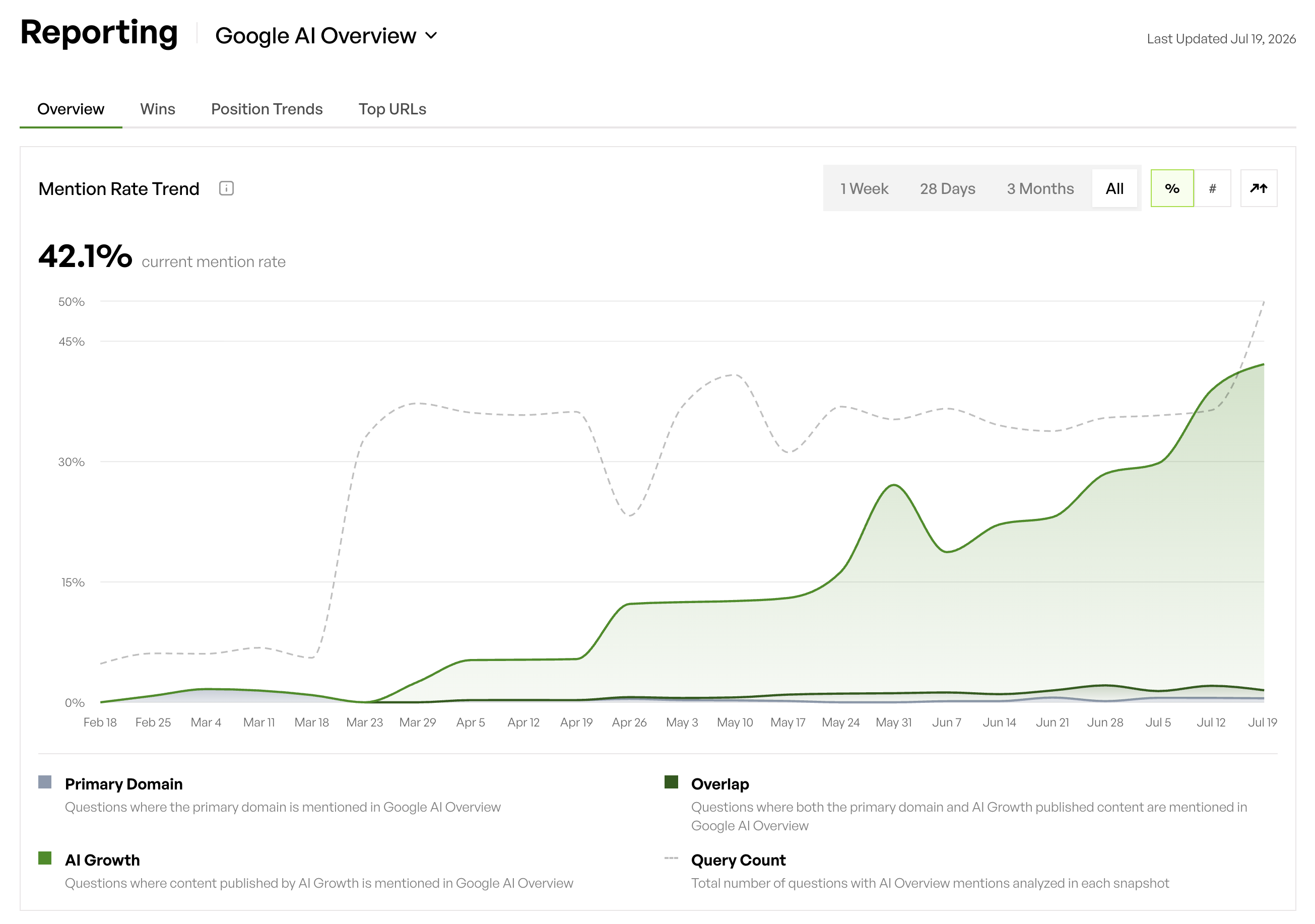
- AI Growth Agent delivers a single autonomous engine that maps the clinical-buyer universe, validates claims, and earns 12,000+ AI citations in 90 days. See how the autonomous engine works in your medtech vertical with your first article live within a week.
The Four Pillars That Replace Keyword-to-Ranking SEO
Static keyword rankings have no equivalent in AI search. When a procurement director asks ChatGPT which FHIR R4-compliant device platforms support USCDI v3 data classes, the model synthesizes an answer from whatever it can find and trust. Four kinds of intelligence determine whether a medtech brand appears in that answer.
Search Intelligence maps the full traditional search landscape for a medtech brand, including positioning, competition, search volume, and who already wins device-comparison and interoperability queries. It converts a raw situation into an actionable diagnosis.
AI Analytics tracks brand value and clinical-buyer behavior across the whole journey, from external touchpoints like Google AI Mode and ChatGPT queries through content consumption, demographics, and sentiment among clinicians and procurement teams.
Bot Tracking records every bot interaction, traditional crawlers and AI training agents alike, including every crawl, citation, and training sweep. Longer, more specific healthcare queries often trigger AI Overviews, so the long-tail clinical questions procurement teams actually ask are the ones most likely to surface AI-generated answers, and bot tracking shows whether those answers cite your brand.
AI Ranking replaces the static ordered list with citation context. It shows where the brand appears in the answer, what claim it is cited for, and how that position evolves week over week against the content plan.
The following table illustrates how each pillar plays out in concrete medtech scenarios, which clinical-buyer questions it answers, and which legacy tool it replaces.
| Pillar | Medtech Example | Clinical Buyer Question Addressed | What It Replaces |
|---|---|---|---|
| Search Intelligence | Device comparison query mapping across radiology and cardiology | Which AI-enabled imaging devices are FDA-cleared for Class II use? | Monthly keyword rank report |
| AI Analytics | Clinician sentiment on interoperability documentation | Does this platform support FHIR R4 and USCDI v3 in production? | Web analytics pageview counts |
| Bot Tracking | ChatGPT citation sweeps on FDA explainer pages | What does the FDA say about predetermined change control plans for AI devices? | Google Search Console impressions only |
| AI Ranking | Citation context in device-comparison answers | How does this device compare to cleared alternatives in neurology? | Position 1–10 rank tracking |
See all four pillars in action on your medtech brand, and get live Search Intelligence, AI Analytics, Bot Tracking, and AI Ranking data in your first consultation.
Current Medtech Stack Limits and Better Solution Paths
The medtech marketing stack most organizations rely on today was built for a different channel. Legacy SEO suites like Semrush and Ahrefs supply keyword and rank data but produce no content, publish nothing, and have no AI search engine. GEO monitors like Profound and Athena track whether a brand appears for a capped set of prompts but stop there, leaving the organization to produce and publish content with no system to do it at scale. DIY chatbots can draft one article, yet the second requires running the entire process again, and quality drifts from one piece to the next.
The alternative uses headless-marketing architecture. A single autonomous engine maps the full clinical-buyer-question universe, validates every claim against FDA and CE primary sources, publishes with full technical and agentic SEO, and self-heals content over time without adding headcount.
The table below compares the four most common solution paths medtech organizations evaluate, and shows how each performs on time-to-content, regulatory validation, and measurable citation lift.
| Solution Path | Time to First Clinical Content | Regulatory-Safe Validation | Citation Lift (12 Weeks) |
|---|---|---|---|
| Internal team + agency RFP | 9–12 months | Manual, inconsistent | Not measured |
| Monitoring-only tools | No content produced | None | None |
| DIY chatbot | Days (one article) | None, hallucination risk documented | Not measured |
| Single autonomous engine (AI Growth Agent) | About 1 week | Cascade anti-hallucination checks against primary sources | 12,000+ average AI citations |
The hallucination risk in the DIY column is not theoretical. A 2026 Lancet audit of 2.5 million biomedical papers found a more than 12-fold rise in fabricated citations from 2023 to 2025. Content that cannot be validated against primary sources is not just ineffective in medtech AI search, it also creates regulatory and reputational liability.
Strategic, Technical, Operational, and Financial Factors to Evaluate
Medtech AI search optimization carries requirements that generic GEO tools and content agencies are not built to meet. Evaluating a solution path requires checking each of the following, starting with the most critical factor, regulatory compliance.
Regulatory alignment is the first gate because any content that overstates FDA clearance or CE marking creates legal liability before it ever earns a citation. The FDA’s AI-Enabled Medical Devices List identifies AI-enabled devices authorized for marketing in the United States, and the safest public-facing content mirrors FDA’s own device category language and avoids implying authorization beyond what the agency has publicly identified. In the EU, AI systems that are safety components of medical devices regulated under MDR or IVDR are automatically classified as high-risk under the EU AI Act, and CE marking claims in public content must specify the exact intended use, clinical context, and version covered by the certification.
Physician-reviewer schema forms the second gate. Bylines naming a clinician with credentials, specialty, and registration body, plus a separate named clinical reviewer and stated review date, receive higher citation rates in AI responses than anonymous or marketing-bylined content, and content with no identifiable clinical author is treated as marketing-tier rather than evidence-tier and is rarely cited in clinical query responses.
Structured data acts as the third gate. A combined schema stack of Organization, Article, FAQPage, Product, and MedicalDevice or MedicalWebPage improves medtech citation potential by AI assistants, and entity linking via SameAs schema to authoritative sources such as the NIH or FDA reinforces credibility for AI models.
A regulatory and technical requirements checklist for medtech AI search optimization includes:
- FDA classification and cleared indications verified and mirrored in all public content
- CE marking claims limited to certified intended use, clinical context, and version
- Named physician byline with credentials, specialty, and registration body
- Named clinical reviewer separate from author, with stated review date
- MedicalDevice and MedicalWebPage schema with lastReviewed, reviewedBy, and specialty fields
- SameAs entity links to FDA, NIH, or relevant guideline bodies
- FAQPage schema for common procurement and interoperability questions
- Epic-integration and FHIR R4 documentation in machine-readable formats
- Fixed-fee pricing with no per-prompt billing that caps universe visibility
- Anti-hallucination cascade validated against primary sources before publication
Typical Implementation Stages for a 90-Day Pilot
A medtech LLMO engagement follows a defined sequence from kickoff to measurable citation lift. The table below maps the 90-day pilot milestones, and shows how quickly each stage delivers tangible outputs, from your first published article in week one to measurable citation lift by week twelve.
| Stage | Timeline | Milestone | Output |
|---|---|---|---|
| Kickoff interview and manifesto | Days 1–3 | Brand voice, deny lists, regulatory parameters captured | Manifesto and keyword topology |
| Universe mapping and first articles | Days 4–7 | Clinical-buyer-question universe mapped, first articles reviewed | First article published (as noted in the solution comparison) |
| Indexing and bot tracking | Days 10–14 | Content indexed, bot traffic and citation sweeps visible | First AI citations and bot visit data |
| Expansion and self-healing | Weeks 3–8 | Universe expands, stale content refreshed on GSC signals | Growing citation context across device and interoperability queries |
| 90-day pilot measurement | Week 12 | Incremental visibility isolated and reported | The citation lift described earlier (12,000+ on average); 20%+ impressions lift |
Start your 90-day pilot and move from kickoff interview to your first published medtech article in under seven days.
Ongoing Management as a Self-Healing Loop
Clinical content decays faster than content in most other sectors. FDA guidance documents update frequently, and the FDA Digital Health Center of Excellence maintains guidance documents on digital health content, including multiple final and draft guidances that address AI-enabled device software functions, cybersecurity, and lifecycle management, so any regulatory claims must be verified against the most recent versions. A static content model cannot keep pace.
The self-healing loop works as a continuous refresh cycle. Google Search Console signals and bot-traffic data trigger automatic content updates when articles show indexing decay or when a training sweep reveals a citation gap. Plain-language client review allows medtech marketing teams to give feedback without technical skill, and the engine saves memories so the same correction is never needed twice. When the year turns, every article in a sector refreshes automatically, and authority compounds instead of decaying.
Risks to Avoid in Medtech AI Search
Even organizations that select the right solution architecture can fail if they overlook medtech-specific risks. Three failure modes are specific to medtech AI search optimization and are not addressed by generic GEO tools, so teams often miss them until they create regulatory or reputational damage.
The first risk involves unsupported regulatory claims. As noted in the requirements checklist, marketing or AI-facing content about software as a medical device should avoid broad statements such as “CE marked” unless the content also specifies the exact intended use, clinical context, version or configuration, and limitations covered by the certification. AI models trained on content that overstates regulatory status will cite that overstatement, which creates downstream liability.
The second risk involves stale documentation behind forms. Medtech and health-tech buyers increasingly ask whether FHIR, HL7v2, X12, C-CDA, or proprietary APIs are actually in production, not merely listed on marketing pages. Interoperability documentation locked behind gated forms stays invisible to AI crawlers and earns no citations.
The third risk involves capped-prompt monitors that miss long-tail clinical questions. Treatment queries trigger AI Overviews 100% of the time and symptom queries 93% of the time, and the clinical-buyer questions that drive procurement decisions are overwhelmingly long-tail. A monitoring tool that tracks 50 or 100 prompts remains blind to the vast majority of the conversation.
Decision Criteria Recap for Medtech Teams
A medtech AI search optimization solution must satisfy each of the following to be viable for mid-market to enterprise deployment.
- Maps the full clinical-buyer-question universe, not a capped set of tracked prompts
- Validates every claim against FDA, CE, and primary-source documentation before publication
- Implements MedicalDevice, MedicalWebPage, FAQPage, and Article schema with physician-reviewer fields
- Produces living, self-healing content that refreshes on GSC and bot-traffic signals
- Tracks all four pillars: Search Intelligence, AI Analytics, Bot Tracking, and AI Ranking
- Delivers measurable incremental visibility isolated from pre-existing brand equity
- Operates at a fixed fee with no per-prompt billing that limits universe coverage
- Requires no technical headcount from the client’s marketing team
Frequently Asked Questions
How quickly can medtech content earn AI citations from clinicians?
Content can begin earning AI citations within two to four weeks of publication when it is structured correctly and indexed promptly. The first article is typically live within one week of kickoff, and indexing occurs in as little as ten days. The citation timeline depends on the specificity of the clinical-buyer question being targeted, the quality of primary-source validation in the content, and whether the page carries physician-reviewer schema with a named clinician byline, credentials, and review date. Long-tail clinical questions, those seven words or longer, trigger AI Overviews at high rates in healthcare, so well-structured content targeting specific device-comparison or interoperability queries can earn citations faster than broad head-term content. The standard 90-day pilot produces an average of more than 12,000 additional AI citations and mentions across the engagement.
What regulatory evidence must appear in AI-optimized medtech pages?
AI-optimized medtech pages must include the device’s FDA classification, such as Class I, II, or III, the specific clearance or approval pathway used, most commonly 510(k) for moderate-risk Class II devices, the authorized indications for use, and any applicable predetermined change control plan status under the Food and Drug Omnibus Reform Act of 2022. For EU-facing content, pages must specify the exact intended use, clinical context, and version covered by CE marking, and must not imply certification beyond what the conformity assessment covers. Pages addressing AI-enabled devices should reference the FDA’s AI-Enabled Medical Devices List and the relevant FDA Digital Health Center of Excellence guidance documents, including the draft guidance on AI-enabled device software functions lifecycle management issued January 2025 and the final guidance on marketing submission recommendations for predetermined change control plans issued August 2025. All regulatory claims must be verified against the most current versions of these documents before publication, because the FDA updates its digital health guidances frequently. Content that overstates regulatory status creates citation liability, and AI models trained on that content will propagate the overstatement.
How does physician-reviewed schema affect citation rates?
Physician-reviewed schema directly affects whether AI engines classify content as evidence-tier or marketing-tier. Content with no identifiable clinical author, no clinical reviewer, no review date, and no clinical-credential disclosure is treated as marketing-tier and is rarely cited in clinical query responses. Content with the physician-reviewer schema described earlier, including a named clinician byline, credentials, specialty, registration body, separate reviewer, and review date, receives substantially higher citation rates. Studies show that content with expert bylines and professional credentials generates more AI citations than equivalent content without attribution. E-E-A-T authority signals appear in 96% of AI Overview citations, and author credentials serve as a core component of that signal set. For B2B medtech content targeting procurement teams and clinicians, the citation lift from physician-reviewed schema compounds with regulatory-and-clinical-evidence summaries, peer-reviewed publication references, and named-customer case studies, all of which AI engines treat as verifiable and traceable.
Which MedicalDevice or MedicalWebPage schema fields improve AI visibility?
For MedicalDevice schema, the highest-value fields for AI visibility are intendedUse, which describes the clinical purpose in language that mirrors FDA authorized indications, contraindications, category mapped to a medical taxonomy, and linked MedicalCondition entities that connect the device to the conditions it addresses. Adding Review and AggregateRating schema alongside MedicalDevice markup surfaces clinical validation signals for AI crawlers evaluating high-stakes health queries. SameAs entity links to authoritative sources such as the FDA or NIH reinforce credibility for AI models by giving them an explicit entity to anchor against when synthesizing answers.
For MedicalWebPage schema, the highest-value fields are reviewedBy, which names the person or organization that reviewed the content, lastReviewed, which records the date the content was last verified for accuracy, medicalAudience, which specifies whether the page targets patients, clinicians, or medical researchers, and specialty, which identifies the medical specialty the content relates to. Although Google has no dedicated rich result for MedicalWebPage, these properties reinforce credentialing and freshness signals that health content algorithms evaluate as part of E-E-A-T quality systems. A combined schema stack of Organization, Article, FAQPage, Product, and MedicalDevice or MedicalWebPage, with explicit About and Mentions properties to remove ambiguity for AI systems, represents the full implementation for medtech pages targeting clinical-buyer queries.
Conclusion: Control the Narrative in AI Answers
The clinical-buyer-question universe is being answered by AI surfaces right now. A March 2026 survey found that 81% of physicians use AI in their practices, more than double the 2023 rate, and AI-sourced healthcare sessions have surged substantially year-over-year. The brands cited in those answers are training the next generation of models with their own narrative. The brands that wait are training the next generation with whatever happens to be sitting on the open web.
The four-pillar foundation of Search Intelligence, AI Analytics, Bot Tracking, and AI Ranking replaces the static keyword-to-ranking model with citation context and incremental visibility. Regulatory-safe validation against FDA and CE primary sources, physician-reviewer schema, MedicalDevice and MedicalWebPage markup, and living self-healing content form the structural prerequisites for earning default citations from clinicians and hospital procurement teams. A single headless engine delivers all of it without adding headcount or agency dependencies.
Traditional search tools show you where your brand stands. AI Growth Agent makes your brand the answer. Make your brand the answer clinicians see, and start earning AI citations within your first week.