Written by: Mariana Fonseca, Editorial Team, AI Growth Agent | Last updated: August 19, 2026
Key Takeaways
- AI search engines like Google AI Mode, Perplexity, and ChatGPT now deliver single citation-backed answers that bypass traditional clicks and weaken legacy rank tracking.
- Traditional SEO dashboards cannot measure citation visibility, bot interactions, or AI-driven brand presence, so brands miss the four pillars of modern search intelligence.
- Generative Engine Optimization (GEO) depends on entity authority, structured data, verifiable claims, and living content that updates itself to earn citations in AI-generated answers.
- AI Growth Agent replaces agencies, content tools, GEO monitors, and analytics platforms with a headless engine that maps query universes, produces validated content, and reports incremental citation visibility weekly.
- Brands ready to win citations on autopilot can schedule a consultation session with AI Growth Agent to map their brand’s universe and start earning AI visibility quickly.
Generative Engine Optimization in Plain Language
Generative Engine Optimization (GEO) structures and validates content so AI systems find it, trust it, and cite it. GEO works in natural language and replaces keyword-centric ranking tactics with evidence-backed long-tail coverage, entity authority, and machine-readable signals that earn citation context. Traditional SEO asks what position a page holds. GEO asks whether the brand appears in the answer and which claim it is cited for. The Princeton, Georgia Tech, and IIT Delhi GEO study found that GEO strategies improved AI citation visibility by up to 40% versus baseline content. That gap is the strategic opportunity brands are capturing or conceding right now.
AI Growth Agent uses a broader frame called large language model optimization (LLMO), which treats content as input for AI reasoning rather than pages to rank. This shift matters because LLMO works at the level of claims, entities, and structured facts instead of keyword strings.
The Problem: Rankings Versus Citations in AI Search
Buyer behavior has shifted toward AI answers, and the change is measurable. Seer Interactive’s analysis of 25.1 million organic impressions across 42 organizations found that click-through rate on queries with AI Overviews dropped from 1.76% to 0.61%, a relative decline of about 61%. SparkToro’s analysis of U.S. Google searches in early 2026 found that 68% ended without a click.
The citation pool is heavily concentrated. A consolidated analysis of 680 million citations across ChatGPT, Google AI Overviews, Perplexity, Gemini, and Claude found that the top 15 domains capture 68% of all AI citation share. Most cited URLs do not rank in Google’s top 10.
Rank tracking has become a lagging indicator. An Ahrefs study of 863,000 keywords showed that top-10 organic pages’ share of Google AI Overview citations fell from 76% to 38% between July 2025 and March 2026. A brand that optimizes only for traditional rankings now chases a metric that no longer predicts whether buyers encounter it.
The winner-takes-most pattern in AI answers intensifies this risk. AI search results typically feature three to seven brand mentions per answer, varying by engine from 3.1 in Google AI Overviews to 7.3 in Google AI Mode. This creates a citation leaderboard where the top few brands receive repeated mentions and compounding visibility. Brands outside that group remain invisible to buyers who rely on AI for discovery.
The Measurement Gap: Why Traditional SEO Dashboards Miss What Matters
Legacy SEO tools were built for ranked blue links. They report keyword positions, domain authority, and organic sessions. None of these metrics tells a CMO whether their brand is cited in AI answers, which bots crawl their content, or how their citation context compares to competitors in synthesized responses.
Four kinds of intelligence now shape what AI surfaces say about a brand, and traditional dashboards miss all four.
- Search Intelligence maps the full traditional search landscape, including positioning, competition, search volume, and current winners. Legacy tools show fragments of this picture, capped at a tracked term set, instead of a complete universe refreshed weekly.
- AI Analytics covers brand value and consumer behavior across the full journey, from external touchpoints like Google and AI queries through content consumption, demographics, and sentiment. Standard analytics platforms report sessions and conversions but cannot see AI-mediated discovery that happens before those visits.
- Bot Tracking records every bot interaction, including traditional crawlers and AI training agents, with each crawl, citation, and training sweep. Without visibility into which bots read its content and when, a brand cannot know whether AI systems ingest its material. Adobe research notes that agentic traffic from systems like GPTBot and PerplexityBot shapes buyer decisions before human visitors reach a site, often appearing as direct traffic and leaving no trace in standard dashboards.
- AI Ranking replaces static ordered lists with citation context. It tracks where a brand appears in an AI answer, which claim it is cited for, and how that position changes week over week. Key AI SEO KPIs in 2026 include AI Overview inclusion rate, entity visibility, citation frequency, topical authority coverage, and AI-driven conversion signals, none of which appear in a traditional rank tracker.
Monitoring-only tools such as Profound, Athena, Peec AI, and Scrunch AI show whether a brand appears for a capped set of prompts. That is observation, not execution. They reveal gaps in AI answers but provide no system to close them. AI Growth Agent takes a different role. It produces the content, owns the publishing, and acts on all four data pillars in the same week.
How AI Search Reshapes SEO Strategy in 2026
AI search now affects how teams plan, create, and measure content across the entire funnel.
Keyword strategy. Keyword research in 2026 evaluates intent, topical fit, and AI citation potential alongside volume and competition. Head-term informational volume is flowing into AI Overviews, which reduces click yield. The long tail, which holds most real buyer questions, is where AI surfaces operate and where citation opportunity concentrates. Pages ranking for both the main query and at least one related fan-out query are 161% more likely to be cited in AI Overviews. Pages ranking for four or more related queries earn more than triple the citation rate.
Content structure. A Surfer study of 57,000+ URLs found that cited pages cover 62% more facts than non-cited pages. Pages with ten or more key facts were cited at more than double the rate of pages with fewer than five. This fact-density advantage matters because AI systems extract claims rather than evaluate keyword placement, and early keyword positioning showed near-zero correlation with citation likelihood. Content now needs atomic, verifiable facts instead of keyword-dense paragraphs.
Technical requirements. Technical SEO in 2026 confirms that AI crawlers such as GPTBot, PerplexityBot, ClaudeBot, and Google’s AI Mode are not blocked in robots.txt and maintains an llms.txt file. Schema markup has become a baseline requirement. Pages with FAQPage schema earn a 41% Google AI Overviews citation rate versus 15% for pages without it (Onely), which shows how strongly AI systems favor structured data.
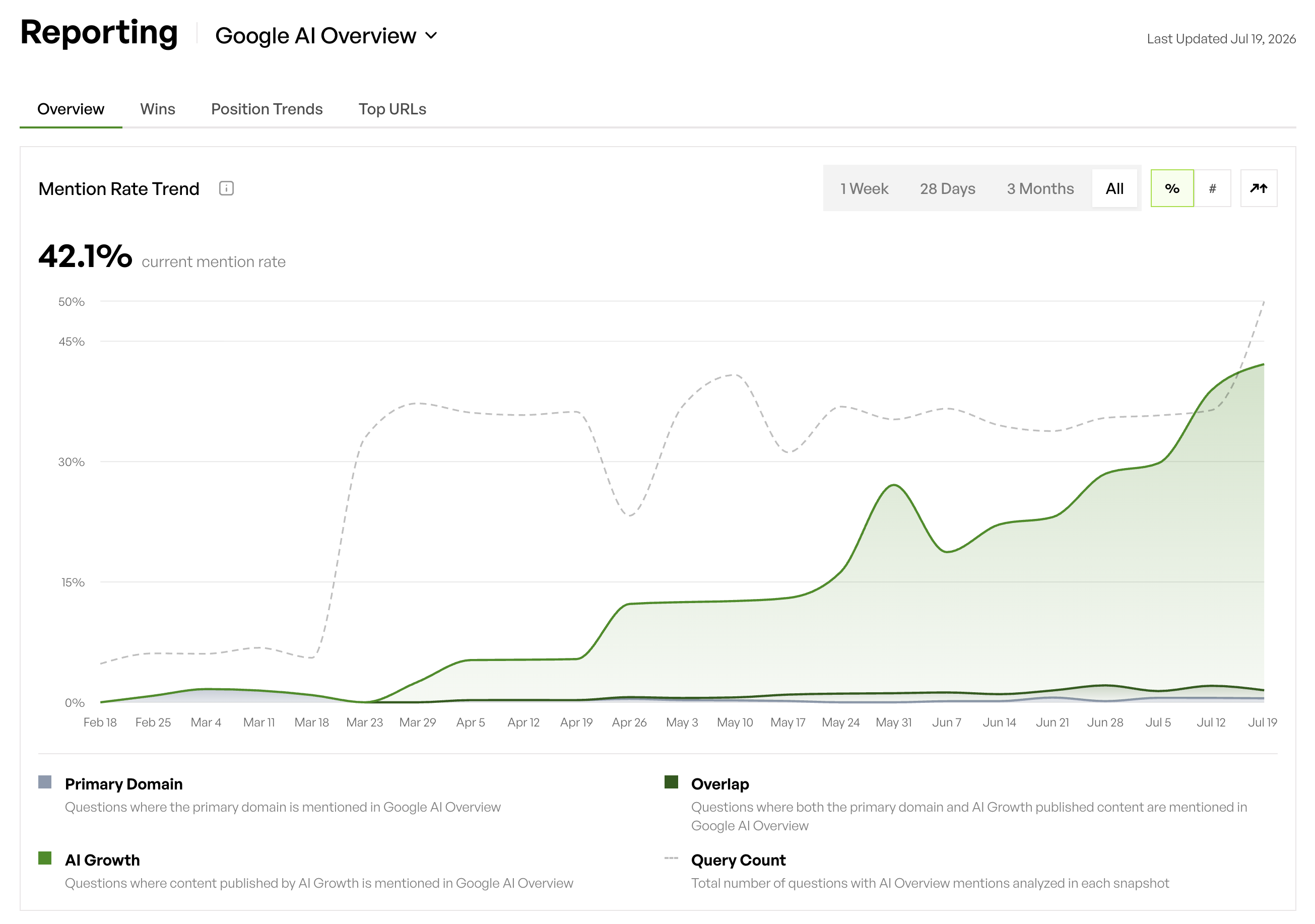
Measurement. Success in AI search is measured by citation frequency, share of model, generative AI referral traffic, and assisted conversions rather than rankings and clicks alone. AI-referred visitors convert at roughly 1.26x to 3x the rate of traditional organic traffic, for example 3.6% versus 1.23% in one study. Earlier reports suggested much higher gaps, such as 14.6% versus 1.7%. Newer data shows the lift is real but more modest, and still large enough that citation visibility carries direct revenue impact even in a zero-click environment.
Ownership. Brands that rely on agencies to control their site and content cannot respond at the speed AI search now demands. After Gemini 3 took over Google AI Overviews globally on January 27, 2026, 42.4% of previously cited domains dropped out. The citation leaderboard now reshuffles faster than any agency RFP cycle.
This new strategic reality sets up the choice of solution types. The next section compares the main options available to brands that want to compete in AI search.
Solution Options: From Legacy Agencies to Full-Stack Headless Engines
Four solution categories now exist for brands that want to win in AI search. The table below compares them across five dimensions that determine whether a brand earns citations or stays invisible.
| Dimension | Legacy Agency / Internal Team | DIY Chatbot / AI Writer | Monitoring-Only GEO Tool | AI Growth Agent (Full-Stack Headless Engine) |
|---|---|---|---|---|
| Keyword Strategy | Head-term focus, universe capped by analyst bandwidth | No universe mapping, single-prompt output | Tracks a capped prompt set, no strategy layer | Full universe mapped from real-time Google and ChatGPT data, 1,600+ queries at maturity, 3,000+ searches run weekly |
| Content Structure | Human-written, inconsistent schema, slow production | One article at a time, quality drifts, no validation | No content produced | Multi-agent orchestration, every claim validated, anti-hallucination cascade, living content that self-heals |
| Technical Requirements | Requires separate web agency, schema often absent | No schema, no robots.txt, no llms.txt | No site or technical SEO layer | Full schema suite, Blog MCP, llms.txt, llms-full.txt, agent discovery, instant indexing, web stories, all included with no client engineering |
| Measurement | Rank tracking and organic sessions, no AI citation data | No reporting | Prompt-level brand mention tracking only, no bot data or Search Console integration | Four-pillar reporting across Search Intelligence, AI Analytics, Bot Tracking, and AI Ranking, with incremental visibility isolated week over week |
| Ownership | Agency often controls the site, client dependency | Client owns nothing systematic | Client owns no content or site | Client owns the site outright, connected via reverse proxy, no agency dependency |
The sharpest divide in this comparison sits between observation and execution. Monitoring tools describe what shows up. AI Growth Agent changes what shows up.
Rankings Versus Citations in AI Search: The 2026 Data
The AI citation economy is more concentrated and more disconnected from traditional rankings than most teams expect.
An Ahrefs benchmark study of 863,000 keywords found that 62% of AI Overview citations come from pages outside the organic top 10. The same study showed the earlier drop in top-10 share from 76% to 38%, which means 62% of citations now come from pages outside the traditional top 10 and overturns the old ranking-equals-visibility assumption. Many AI chatbot citations point to URLs that do not rank highly in organic search, a pattern known as ghost citations. These brands earn AI visibility without traditional ranking signals to explain it.
SISTRIX’s citation-drift study found that Google AI Mode replaces 56% of cited domains per week. This churn rate means a brand cited today has no guarantee of citation next week unless it runs a system that continuously produces and refreshes authoritative content.
Across the first twelve weeks of an AI Growth Agent engagement, clients average more than 12,000 additional AI citations and mentions, over 100,000 additional bot visits, and a lift in impressions above 20%. Breadless, a healthy fast-casual franchise, now has ChatGPT citing eatbreadless.com over 45,000 times per month and reports a Google Search Console impression lift of roughly 30x over six months. Leva Sleep, a Canadian adjustable bed retailer, reached over 10,000 ChatGPT citations per month and closed $40,000 to $50,000 in deals within three weeks from buyers who discovered the brand through AI Growth Agent content.
Original Information That AI Engines Actually Cite
AI surfaces cite content that contains verifiable, specific, attributable claims that a language model can extract and present as evidence. The content architecture that earns citations differs from the architecture that once earned rankings.
Content with strong E-E-A-T signals receives 5.2 times more AI citations than content without them, based on analysis of more than 10,000 AI-generated responses across 10 AI platforms in Q1 2026. Most citations come from sources with verified E-E-A-T signals. Without those signals, about 70% of content is filtered out by language models before they consider recommending it.
The specific content elements that drive citation rates are now measurable. Pages containing specific data, named customer stories, and verifiable claims are cited more frequently by AI search engines than pages that rely on generic marketing copy. Adding visible author credentials to content lifts AI citation rates by 40% across ChatGPT, Perplexity, and Google AI Overviews. The schema advantage noted earlier, where marked pages earn nearly triple the citation rate, reflects AI systems’ preference for machine-readable structure over unstructured text.
Content freshness now acts as an inclusion criterion. Pages that go more than three months without an update are over three times more likely to lose AI visibility, and over 70% of AI-cited pages were updated within the past 12 months. AI Growth Agent’s living content architecture addresses this directly. Every article updates over time, and when the year turns, every article in a client’s sector refreshes automatically.
Entity Authority as the New Trust Signal
Entity authority has replaced domain authority as the primary trust signal in AI search. AI systems do not rank pages in isolation. They map named concepts such as products, companies, people, and processes, along with their relationships, and they cite the entities they recognize as authoritative within a topic cluster.
An Ahrefs 2025 study found that branded web mentions correlate 0.664 with AI Overview citations, compared to 0.218 for backlinks. This shows that entity recognition now outweighs traditional link signals for AI visibility. Domain authority’s correlation with AI citations has dropped to r=0.18, which makes it weak as a predictor of citation in AI search results.
Seed terms, the strategic anchor topics that organize a brand’s universe, now matter more than head-term keyword rankings. Each seed term spawns dozens of long-tail queries, and the brand that produces authoritative content across that full topology builds entity recognition that compounds over time. Sites built on topic clusters earn 3.2 times more AI citations than standalone pages, and 86% of AI citations come from brand-owned websites and claimable listings.
AI Growth Agent maps a brand’s complete universe from real-time Google and ChatGPT data, identifies which long-tail queries are worth pursuing using AI Overview and ChatGPT results as the objective function, and produces authoritative content for each one. This approach builds entity authority across the entire topology at scale. Mature clients reach universes of more than 1,600 queries, with the system running over 3,000 searches every week to refresh the snapshot.
Zero-Click SEO That Still Drives Revenue
Zero-click search still creates value, but the measurement framework must change.
AI referral traffic converts 31% higher than non-branded organic search for e-commerce because AI completes the research phase before sending users to a site. Buyers who click through from an AI citation arrive pre-qualified by the answer they received. Cited brands in AI Overviews enjoy 35% higher organic CTR and 91% higher paid CTR than uncited competitors.
Bot traffic has become the leading indicator. Every time an AI training agent or citation crawler reads a brand’s content, it updates the model’s representation of that brand. Bot visits act as the upstream signal that precedes citation. AI Growth Agent tracks every bot that touches a client’s blog, including the bot ChatGPT uses to cite sources, and reports that data alongside Google Search Console impressions and citation frequency. Across the first twelve weeks, clients average more than 100,000 additional bot visits, a metric that traditional SEO dashboards do not surface.
New Reporting KPIs for AI Search
AI search visibility requires a new set of leading indicators. The KPIs below replace or supplement traditional rank and traffic metrics.
- Citation frequency tracks how often a brand’s domain appears as a cited source across AI platforms for target queries, measured by platform and query cluster. Citation frequency should be reviewed weekly for stability and monthly for trend direction.
- Share of model measures what percentage of AI-generated answers in a brand’s category include that brand compared to competitors. Kevin Indig’s July 2026 behavioral study found that selected brands achieved 24% share of voice versus 11% for passed-over brands in AI shopping tasks.
- Bot visits count every AI crawler interaction with a brand’s content, segmented by bot type. This metric shows whether AI systems are reading the content that later drives citations.
- 10-day indexing benchmark measures how quickly new content enters AI citation cycles. AI Growth Agent content has indexed in as little as ten days, with the first article live within a week of kickoff.
- Incremental visibility isolates the visibility a new content effort actually generated, separate from the visibility the brand already had. AI Growth Agent publishes into a separate environment to enable this isolation, so clients can prove what the engine contributed instead of attributing pre-existing brand equity to new work.
Promodo’s April 2026 SEO Benchmarks guide identifies brand mention rate in AI answers for the top 10 to 20 high-intent queries as the primary 2026 benchmark, evaluated through competitive comparison rather than absolute rankings or clicks.
Numbered Action Plan: From Universe Mapping to Living Content
The five steps below describe how AI Growth Agent moves a brand from invisible to cited in AI search.
- Map the universe from real-time Google and ChatGPT data. A professional journalist interviews the client to build the brand manifesto. AI Growth Agent’s agents ingest that material alongside product pages, PDFs, and brand guidelines, then run hundreds of real searches to map every seed term and long-tail query in the market. Real-time AI Overview and ChatGPT results act as the objective function for which queries are worth pursuing. A new account typically starts with 300 to 400 queries and expands from there.
- Build a content topology of seed terms and long-tail queries. The topology forms a hierarchy of strategic anchor topics, each backed by evidence, with dozens of long-tail queries beneath each seed term. The client and AI Growth Agent choose which seed terms to attack first. The client brings the prompts they care about, and the engine brings research on the white space they are missing.
- Generate authoritative, validated content in a single pass. A multi-agent orchestration across OpenAI, Anthropic, Gemini, Grok, Perplexity, Exa, and Firecrawl produces finished articles. Every claim is validated against primary sources, external sources are scraped and verified before use, and a cascade of anti-hallucination checks runs before any article moves forward. Output remains consistent at any volume, from two to 50 articles per day per client.
- Stand up an owned, fully optimized site in one week. AI Growth Agent provisions the site with a complete technical and agentic SEO stack, including rich schema, Blog MCP, llms.txt, llms-full.txt, agent discovery via /.well-known/, instant indexing, web stories, autoredirects, and 404 tracking. The site connects to the client’s domain through a reverse proxy rewrite. The client’s engineering team does not need to provide development hours.
- Deploy living content that self-heals and reports incremental visibility. Content updates automatically as the world changes. Bot tracking, Google Search Console data, and citation frequency are reported together so the engine can double down on what indexes well and use internal linking to lift what does not. Clients often see their first indexing signals in about ten days.
Frequently Asked Questions
What is AI SEO called now?
The discipline goes by several names in 2026, including Generative Engine Optimization (GEO), Answer Engine Optimization (AEO), and large language model optimization (LLMO). GEO and AEO are the most widely used terms in industry research and agency positioning. LLMO is the frame AI Growth Agent prefers because it most accurately describes the mechanism, which is structuring and validating content so that language models find it, trust it, and cite it. All three terms describe the same shift from ranking pages in a list to earning citation context inside AI-generated answers. The underlying discipline requires entity authority, structured data, E-E-A-T signals, living content, and machine-readable technical architecture, regardless of which label a team uses.
How fast will we see results from AI search efforts?
AI Growth Agent delivers the first published article in roughly one week after kickoff. Content has indexed in as little as ten days and typically within two weeks. The standard engagement is a three-month pilot because indexing timelines vary by industry and competitive density, yet clients usually see citation and bot traffic movement early in that window. As noted earlier, clients average more than 12,000 additional AI citations and mentions, over 100,000 additional bot visits, and a lift in impressions above 20% during the first twelve weeks. Jota, a Brazilian fintech brand, saw daily average impressions rise 52% and clicks rise 36% in the first three weeks. Jelly, a UK restaurant inventory management platform, earned its first ChatGPT citation within three weeks and reached the number one cited position for its primary query within the same period.
How does AI search optimization differ from traditional SEO in practice?
Traditional SEO optimizes pages to rank in a list of blue links, using keyword targeting, backlinks, and technical site health as primary signals. AI search optimization structures content so AI systems can extract it, evaluate credibility, and synthesize it into a single answer. AI systems extract claims at the sentence and section level rather than evaluating pages holistically, so every section must stand alone as a verifiable, attributable fact. The technical stack also changes. Teams now maintain llms.txt, Blog MCP, agent discovery endpoints, and full schema suites for AI crawlers in addition to robots.txt and sitemaps. Measurement shifts from rank position and organic sessions to citation frequency, share of model, and bot visits. The speed of change also differs, because the AI citation leaderboard reshuffles weekly while traditional rankings often move over months. Both disciplines share foundations such as E-E-A-T, structured data, and crawlability, but AI search adds a layer of architecture and content strategy that traditional SEO tools and agencies do not provide.
Why do brand mentions matter more than backlinks in AI search?
AI systems build entity representations from the full corpus of content they process, not from a link graph alone. A backlink passes authority in a crawl-and-rank system. A brand mention in an authoritative third-party source teaches a language model that the brand is associated with a topic, category, or claim. Branded web mentions correlate with AI Overview citation rates at r=0.664, nearly three times stronger than backlinks at r=0.218. This is why distributing content across authoritative publications, earning trade press coverage, and maintaining review profiles on platforms like Trustpilot and G2 now form core components of an AI search strategy. Brands with a minimal Trustpilot profile of one to thirteen reviews achieved a 53.5% AI citation rate compared to 1% for brands with no profile, a 52-point difference driven entirely by a third-party trust signal rather than on-page optimization.
Can a non-technical marketing team run AI Growth Agent?
Yes. The entire technical and agentic SEO stack, including schema, Blog MCP, llms.txt, llms-full.txt, agent discovery, instant indexing, web stories, autoredirects, and 404 tracking, is provisioned automatically and included in every package. The only integration step on the client’s side is the reverse proxy rewrite that connects the blog to a subdirectory under their domain, with setup documentation generated for their specific host. The internal team gives feedback in plain language through a studio interface, and the engine saves those corrections as memories so the same note is never needed twice. Most clients run the engine on autopilot after kickoff week, while the AI Growth Agent team handles publishing, monitoring, and self-healing on their behalf.
Conclusion: Make Your Brand the Answer
The discovery shift has already happened. Google AI Mode crossed one billion monthly users within its first year. ChatGPT processes 2.5 billion prompts daily. Perplexity, Gemini, and Claude now resolve buyer trust in zero-click answers across every category. Brands are either cited in those answers or absent from the conversation.
Traditional SEO dashboards, agencies, and DIY chatbots now act as a rearview mirror. They report on a world of ranked blue links that no longer predicts whether a buyer encounters a brand. The four pillars of intelligence that determine AI citation, Search Intelligence, AI Analytics, Bot Tracking, and AI Ranking, remain invisible to legacy tools.
AI Growth Agent gives brands a full-stack, headless engine that maps their universe, publishes living content, and reports incremental AI visibility every week. Teams that adopt this model now position their brand as the answer in AI search while competitors keep chasing rankings that buyers never see.