Written by: Mariana Fonseca, Editorial Team, AI Growth Agent
Key Takeaways
- Brands cannot directly edit AI-generated answers. Control sits in the upstream inputs that models retrieve and cite.
- Model weights and exact answer wording sit outside any brand’s reach, so teams should focus effort on four controllable inputs.
- The four controllable inputs are participation, source supply, entity clarity, and measurement, each with a clear action and owner.
- Consistent measurement with a fixed prompt set on a schedule is required to separate real movement from normal AI answer volatility.
- AI Growth Agent runs all four controllable inputs end to end and delivers measurable lifts in AI citations and impressions.
Book A Demo With AI Growth Agent
The Control-Versus-Influence Boundary In AI Brand Control
Effective AI brand control starts with a clear boundary that most tools avoid drawing. Two factors sit outside control: the weights inside a model and the exact wording of any generated answer. A brand cannot instruct ChatGPT, Gemini, or Perplexity to use a specific sentence, and no dashboard changes that.
Control sits one layer upstream. OpenAI’s ChatGPT Search FAQ states that search results and citations can be incomplete, outdated, or incorrect, and that placement is not guaranteed. The model generates its answer from whatever it retrieves and trusts. That retrieval pool is where influence becomes possible.
The four controllable inputs are participation, source supply, entity clarity, and measurement. Each one has a concrete action a team can assign to a person or a system. By contrast, model weights and answer wording remain outside any brand’s reach. A team that redirects effort to the four inputs moves faster and proves more.
The assignable output from this section is a one-page boundary memo to the CEO that states what the team will control and what it will stop trying to control. Before acting on that boundary, it helps to understand why AI answers about the same brand can differ so widely in the first place.
Why AI Describes The Same Brand Differently Across Surfaces
The same brand can be described differently by ChatGPT, Gemini, Perplexity, Google AI Overviews, and Google AI Mode within the same hour. That pattern reflects how these systems work. They retrieve different sources, apply different reasoning paths, and update their models on independent schedules.
Hosted LLMs are not fixed functions of prompt text: providers can change models, safety controls, routing, and serving infrastructure without any change to caller code, making a later run return a different answer even when the prompt is unchanged. A peer-reviewed longitudinal study cited in that analysis found GPT-4’s response rate to an opinion survey fell from 97.6% to 22.1% between two measurement periods, with the change linked to model updates.
Retrieval differences compound the problem. Average prompt-level citation-domain overlap between model pairs was only 11.4% in LLM Authority Index research across 1,050 standardized ranking responses, and 29.9% of matched model comparisons shared no citation domain at all. ChatGPT and Gemini often draw from substantially different source pools for the same question.
Reasoning paths add a third layer. Different LLMs can access different evidence, apply different standards of authority, and construct different versions of the same brand, because systems operate in different information environments. One model may retrieve current supporting evidence independently while another depends more heavily on information already embedded in its training data.
A 2026 arXiv study analyzing 21,143 valid search-layer citations across ChatGPT, Google AI Overview/Gemini, and Perplexity found that official, news, and vertical sources account for 79.12% to 87.52% of citations across platforms. The same study found that mean citations per prompt diverge sharply by platform: ChatGPT at 6.88, Google at 12.06, and Perplexity at 16.35. A brand can be cited heavily on one surface and absent on another.
Practitioners describe this as inconsistent, wrong, outdated, and uneditable. Editing the model is not the path. Logging which surface gave which answer on which date creates a usable record. The assignable output from this section is a volatility log that records the surface, the answer, and the date for every prompt in the fixed set.
The Four Controllable Inputs In AI Brand Control
The table below maps each controllable input to its scope, the concrete action to assign, and the owner who should carry it.
| Controllable Input | What It Covers | Concrete Action To Assign | Owner |
|---|---|---|---|
| Participation | Publisher and platform controls, including Google Search Console participation controls for AI features | Review the participation setting and document the traffic and impression tradeoff of opting out | Marketing operations lead |
| Source Supply | The content and primary sources a model can retrieve and cite | Audit which owned and third-party pages currently feed AI answers about the brand | Content lead |
| Entity Clarity | How consistently the brand is described and categorized across the web | Build a canonical fact sheet that every owned and third-party profile must match | Brand lead |
| Measurement | How movement is proven | Run a fixed prompt set on a schedule with logged citation changes | Marketing analytics lead |
Participation
Participation covers the publisher and platform controls that determine whether a brand’s content is eligible to appear in AI-generated answers at all. The most significant recent change is Google’s Search Console participation control for AI features.
Google announced on June 3, 2026, a new Search Console toggle that lets website owners decide whether their site can appear in and help ground generative AI search features such as AI Overviews, AI Mode, and AI Overviews in Discover, with the worldwide rollout completed by August 31, 2026. Sites that opt out receive no traffic or impressions from those features. The control is not used as a ranking signal for search results outside the generative AI features.
The tradeoff of opting out carries real cost. Google reports that AI Overviews has over 2.5 billion monthly active users and AI Mode has surpassed one billion monthly users. Opting out removes a brand from both surfaces entirely. For most brands, the cost of exclusion exceeds the cost of inclusion.
ChatGPT has its own eligibility requirement. A site must allow OAI-Searchbot to crawl it and confirm that the website host or content delivery network allows traffic from OpenAI’s published searchbot IP addresses to be eligible for inclusion in ChatGPT search results.
The assignable output from this section is a decision memo on whether to include or exclude, with the traffic and impression cost stated.
Source Supply
Source supply covers the content and primary sources a model can retrieve and cite. A brand that produces no retrievable content on a topic leaves the model to draw from whatever third-party pages happen to rank. A July 2026 study of 613 B2B search queries found that vendor blogs accounted for 74.6% of Gemini’s citations and 57.5% of ChatGPT’s citations, while expanding one seed keyword into a fan-out group of related searches increased the median number of cited domains from 13 to 60.
Retrievable, citable sources share three traits: structure, specificity, and freshness. High-influence pages have 11.44 times the word count, 12.50 times the headings, and 8.94 times the list density of bottom-quartile pages, along with 2.31 times higher answer-citation semantic similarity. Pages containing numbers and statistics show a 61.55% mean influence uplift, and comparison content shows a 55.28% uplift relative to pages without those features.
Third-party pages matter as much as owned pages. Across 11.84 billion AI citations analyzed by Profound, roughly 57% of AI citations point to a company’s own web properties, but the mix varies sharply by platform: ChatGPT cites brand sites the least at 47% of all citations, while Google Gemini cites them the most at 69%.
The assignable output from this section is a source supply audit that lists which owned and third-party pages currently feed AI answers about the brand. See the source-tracing section below for the method.
Entity Clarity
Entity clarity covers how consistently the brand is described and categorized across the web. A weak entity model produces omission or vague description. AI systems build entity models from content, constructing a semantic understanding of what a brand is, what it does, who it serves, and how it relates to other entities; inconsistent descriptions across sources produce a weak entity model that leads to the brand being omitted from answers or described vaguely.
Generic phrases like “enterprise-grade platform” or “end-to-end solution” could describe several hundred companies. To a model trying to construct a confident, specific answer, those phrases describe none of them meaningfully. When a brand is described consistently and specifically across enough credible sources, the entity model becomes stronger, the brand becomes more tightly connected to relevant concepts in the model’s understanding, and the likelihood of being cited accurately and repeatedly increases significantly.
The assignable output from this section is a canonical fact sheet that every owned and third-party profile must match.
Measurement
Measurement covers how movement is proven. A fixed prompt set run on a schedule with logged results provides the only reliable way to distinguish a real change from normal AI answer volatility. The measurement discipline appears in full in the dedicated section below.
The assignable output from this section is a named owner for the fixed prompt set and the logging cadence.
See How AI Growth Agent Runs These Four Inputs
How To Audit What AI Says About Your Brand: Source Tracing
A wrong AI description is a traceable problem. The method is to identify which third-party page feeds the wrong claim, then determine who controls that page and what the correction path looks like.
The process has four steps.
- Run the prompt that produces the wrong description across ChatGPT, Gemini, and Perplexity. Record the exact claim and any cited URLs.
- For claims without a cited URL, search for the exact phrasing of the wrong claim across review sites, comparison articles, forum threads, and press coverage.
- Identify the owner of the page feeding the wrong claim: a publisher, a review platform, a directory, or a forum moderator.
- Determine the correction path: a direct update to an owned page, an outreach request to a publisher, a profile update on a review platform, or a new piece of owned content that provides a more authoritative answer.
AI trusts third-party sources more than official websites because official content is perceived as promotional, while third-party content is perceived as independent and therefore more credible. A single Reddit thread with 200 upvotes discussing an old pricing model can carry more weight in AI answers than a brand’s updated pricing page.
Incorrect AI brand answers can stem from stale training data, conflicting third-party pages, or a thin owned-content footprint that forces the model to guess, and the fix depends on whether the error is retrieval-based (a cited page) or training-based (no citation, repeated across sessions).
The assignable output from this section is a source-tracing ticket template that names the wrong claim, the cited page, the owner of that page, and the correction path. For a full audit methodology, see How To Audit And Control What AI Says About Your Brand.
Google’s Search Console Participation Control For AI Features
Google announced the Search Console participation control for AI features on June 3, 2026, under a binding order from the UK’s Competition and Markets Authority, with worldwide rollout completed by August 31, 2026. The control covers exactly three surfaces: AI Overviews, AI Mode, and AI Overviews in Discover. It does not cover the Gemini app or AI model training.
The settings page offers three options per property: Include (default for root properties), Exclude (manual opt-out), and Inherit from parent (default for child properties). Property inheritance is TLD-scoped, not name-scoped: a subdomain such as blog.example.com is a child of example.com and inherits its setting, but example.co.uk is not a child of example.com and must be configured independently.
The Search Console generative AI control is distinct from Google-Extended, the robots.txt token that controls whether crawled content can be used for training future Gemini models; Google-Extended does not affect a site’s inclusion in Search, AI Overviews, or AI Mode.
The tradeoff of opting out must be stated plainly. WebFX’s analysis of 2.3 billion site sessions found that generative AI traffic grew 796% over the past two years, and visitors from AI platforms convert about 1.2 times higher than visitors from organic search. Opting out removes a brand from surfaces that are growing faster than any other channel.
The assignable output from this section is a calendar reminder to review the participation setting after the next quarterly traffic review, with the impression data from Google Search Console’s Generative AI performance report as the evidence base for the decision.
A Repeatable Measurement Discipline For AI Answer Volatility
A fixed prompt set run on a schedule with logged citation changes forms the core measurement discipline. Without that structure, a team cannot prove movement to a CEO, separate a model update from a content change, or identify which surface drives a shift.
The surfaces to test are ChatGPT, Gemini, Perplexity, Google AI Overviews, and Google AI Mode. The metrics to log for each prompt and surface are mention rate, recommendation rate, citation rate, position within the answer, sentiment, and description accuracy.
Running each prompt three to five times per engine in a logged-out session is necessary because the same prompt run once can return two different answers. Results should be recorded as the answer that appears most often across runs, not the single best result.
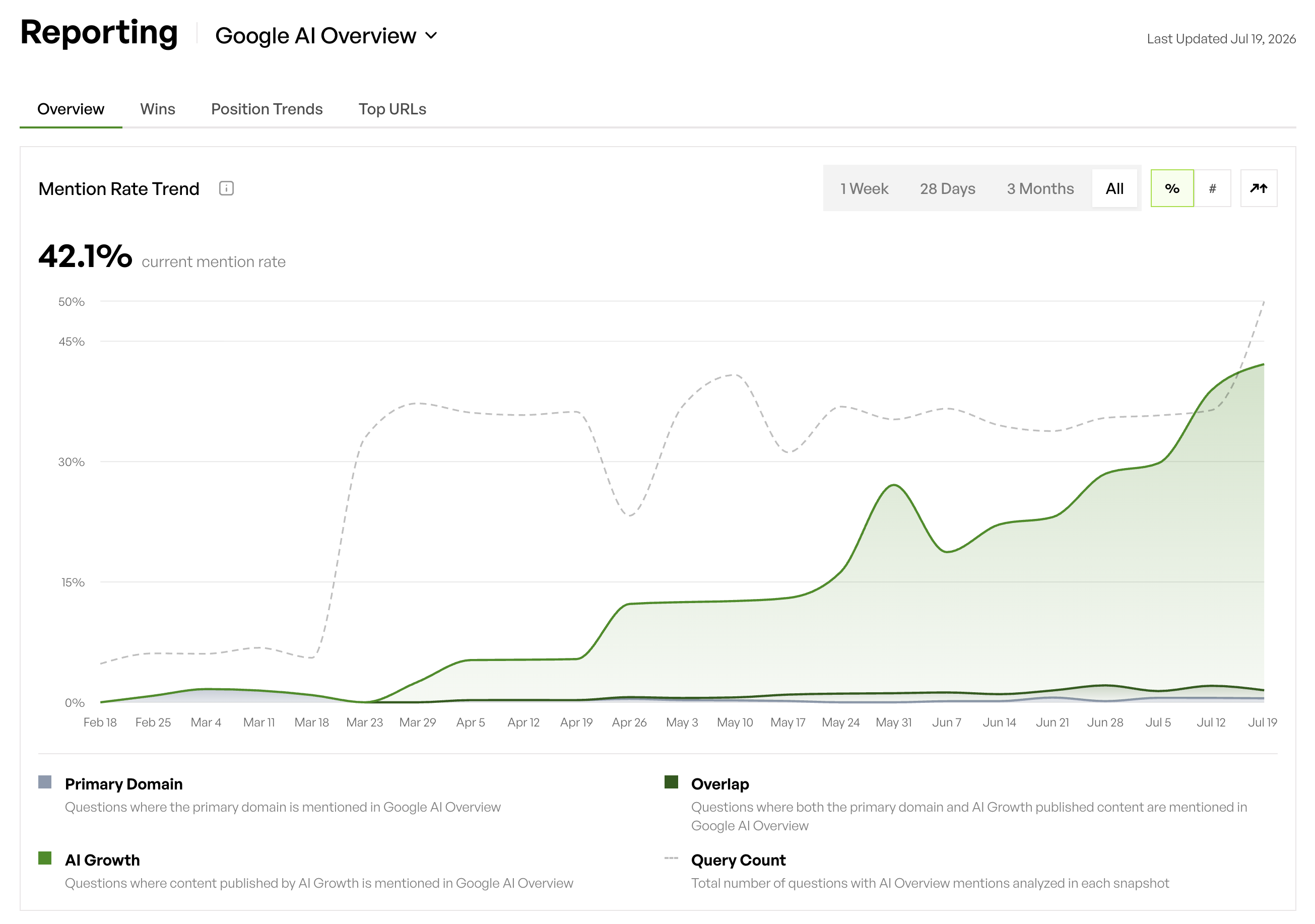
The assignable output from this section is a measurement charter that names the prompt set, the cadence, the surfaces, the metrics, and the owner. For a full treatment of tracking brand mentions across AI surfaces, see Brand Mentions In AI Search: What They Are And How To Track.
See How AI Growth Agent Can Execute Your Measurement Plan
What Are The Control Strategies In AI? AI Visibility Monitoring Tools Vs. Controlling The Answer
Architecture provides the clearest way to think about AI control strategies. The category of AI visibility monitoring tools was built to tell brands whether they appear for a metered set of prompts. In 2026, most of those tools added action layers: draft agents that wait for approval, to-do lists the client still has to execute, and shadow pages that stand in for a real site. That rush validates the category while leaving the execution gap open.
A monitoring-first tool with a to-do list attached still functions as a monitoring tool. It tells the team what to fix and hands back a queue. Someone still has to build, publish, and maintain the actual pages. The architecture question is whether the team is buying observation or execution.
The four control strategies, in order of execution:
- Set the participation controls in Google Search Console and confirm OAI-Searchbot access so the brand is eligible to appear.
- Audit and expand source supply so the model has retrievable, citable content to draw from across the full range of relevant prompts.
- Standardize entity clarity across every owned and third-party profile so the model constructs a consistent, specific description.
- Run a fixed measurement discipline on a schedule so movement can be proven and attributed.
Search triggering is near-universal across platforms: ChatGPT at 98.64%, Google AI Overview at 99.67%, and Perplexity at 100.00%, meaning the primary frontier is no longer whether generative engines search but how many sources they select and how those sources are used. The control strategies address the source selection layer, which is the only layer a brand can reach.
The assignable output from this section is an architecture decision that states whether the team is buying observation or execution. For a treatment of how to build citation authority across AI surfaces, see Brand Authority In AI Answers: How To Win Citations.
Frequently Asked Questions
Why Do AI Answers About My Brand Keep Changing?
As explained earlier, conflicting answers stem from differences in retrieval, model versions, and reasoning paths. Each platform maintains its own index and update schedule, so descriptions shift even when your content stays the same. The practical takeaway is to log which surface gave which answer on which date for your fixed prompt set.
Who Inside The Company Should Own AI Answer Control?
The person who owns the marketing outcome owns AI answer control. That owner is the CMO, the VP of Marketing, or the founder or CEO acting as the marketing decision-maker. AI answer control functions as a brand narrative task with a measurement discipline attached, not a narrow SEO or technical task.
The four controllable inputs map to four functional owners: a marketing operations lead for participation, a content lead for source supply, a brand lead for entity clarity, and a marketing analytics lead for measurement. The executive who owns the outcome assigns those four owners and holds them accountable to the measurement charter.
How Long Does Movement In AI Answers Take?
Movement timelines vary by surface and by the type of change. Retrieval-based surfaces like ChatGPT Search and Perplexity can reflect new, indexed, crawlable content within days to weeks. Training-based changes follow a longer and less predictable timeline because they depend on the next model update that includes new data.
Google Search Console’s Generative AI performance report provides impression data that can show early movement in AI Overviews and AI Mode. The measurement discipline in this article uses a fixed prompt set run weekly so that movement becomes visible as it accumulates rather than only in retrospect. A three-month window provides the minimum span for a reliable trend line.
Is A Monitoring Tool Enough To Control AI Answers?
A monitoring tool explains what is happening. It does not change what is happening. Monitoring-first tools meter prompts, report citation presence, and now add action layers that produce draft content and prioritized to-do lists.
Those action layers still hand the work back to a human. Someone on the team must review, publish, and maintain the actual pages. A monitoring tool supports the measurement discipline described in this article, but it cannot replace the execution layer that produces retrievable, citable content, standardizes entity clarity, and self-heals over time.
The brands that move in AI search are the ones that close the loop between what the measurement shows and what gets published. Dashboards help only when they connect directly to execution.
Conclusion: Turning The Four Inputs Into Measurable Results
The control-versus-influence boundary provides the honest starting point. Participation, source supply, entity clarity, and measurement are the four inputs a brand can control. Model weights and answer wording remain outside reach. Every practical action available to a marketing team maps to one of those four inputs, and each one has a concrete action that can be assigned to a named owner.
The measurement discipline turns the four inputs from a framework into a provable result. A fixed prompt set run on a schedule across ChatGPT, Gemini, Perplexity, Google AI Overviews, and Google AI Mode, with logged citation changes and a named owner, separates teams that can brief a CEO on Friday from teams that cannot.
AI Growth Agent executes all four controllable inputs end to end rather than handing back a dashboard. The engine maps the brand’s full universe, produces authoritative content the model can retrieve and cite, standardizes entity clarity across owned and third-party surfaces, and reports incremental visibility week over week. Across the first twelve weeks, clients average more than 12,000 additional AI citations and mentions and a 20% or greater lift in impressions.
Talk With AI Growth Agent About Your AI Answer Control Plan