Written by: Mariana Fonseca, Editorial Team, AI Growth Agent
Key Takeaways
These points summarize how to measure and act on AI share of voice.
- AI share of voice uses two metrics from the same answer set: presence rate (non-zero-sum) and share of mentions (zero-sum). Each needs its own calculation.
- A defensible protocol uses 25 to 50 buyer-intent prompts, run multiple times per platform, with separate tracking for ChatGPT, Perplexity, Gemini, and Google AI Overviews.
- Single-run measurements create noise. Repeated runs across several days produce reproducible results and confidence ranges you can defend.
- Platform-specific tracking is essential because each AI surface retrieves, cites, and prefers sources differently. A blended score hides these differences.
- AI Growth Agent maps seed terms and long-tail queries from real-time Google and ChatGPT data, creates content for each one, and reports the incremental visibility it adds every week.
Book A Demo With AI Growth Agent
Six-Step Protocol To Measure AI Share Of Voice
This six-step protocol gives you a reproducible, defensible way to measure AI share of voice. Each step includes a built-in validation check.
- Identify Buyer-Intent Prompts, Not Brand-Name Prompts. Build a panel that reflects what real customers ask before they know your brand. Split the panel by intent: comparison queries (“X vs Y”), category queries (“best [category] for [use case]”), problem queries (“how to [job your product does]”), and pricing queries (“[category] pricing”). Pull phrasing from sales call transcripts, support tickets, site search logs, People Also Ask questions, and Reddit threads. Every prompt should mirror a buyer question that appears before brand awareness. Branded prompts inflate presence rate, hide discovery gaps, and distort competitive comparisons, so exclude them from share-of-voice calculations.
- Build A Panel Of 25 To 50 Prompts. A 10-prompt panel is not statistically meaningful because one prompt can swing share of voice by 10 percentage points. A 25 to 50 prompt panel balances coverage with the effort of running each prompt multiple times. Weight the panel to match your market across the intent categories from Step 1. The panel should cover every distinct buyer intent your product serves. Above 50 prompts, repeated runs become hard for most teams without tooling.
- Run Each Prompt Multiple Times. Nielsen Norman Group defines a nondeterministic system as one that can produce different outputs when given the same input. Language models assign probabilities to next tokens and choose among them as they respond, so the same prompt can produce different wording, mentions, and citations. A single run produces a number that you cannot reproduce. Run each prompt at least 3 to 5 times per platform so you can separate signal from noise. For critical prompts, increase to 10 to 15 runs spread across several days so the range tightens. Use a fresh, logged-out session for every run with no chat history, personalization, or memory, and record the platform, product mode, and timestamp so you can trace every result.
- Log Mentions, Citations, Position, And Sentiment Per Run. Treat every run as a data point. For each run, record whether the brand appeared (mention), whether the brand’s domain was cited (citation), where the brand appeared in the answer (position), and how the brand was framed (sentiment). Use a simple audit table with columns for Prompt ID, Platform, Run Number, Date, Mention (Y/N), Citation (Y/N), Position, Sentiment, and Notes. Every reported number should map back to this log. Mentions and citations describe different behaviors, so track both: a brand can be recommended without its site being cited, and cited as a source without being recommended.
- Apply The AI Share Of Voice Formulas. Compute presence rate and share of mentions from the same answer set. Presence Rate = (Prompts where your brand appeared ÷ Total prompts tracked) × 100. Share of Mentions = (Your brand’s mentions ÷ Total brand mentions across all tracked responses) × 100. Use these formulas on your logged data, then compare the two metrics to see both visibility and relative share of the conversation.
- Track Results By Platform, Not As A Blend. ChatGPT, Perplexity, Gemini, and Google AI Overviews behave differently when they retrieve and cite sources. Only 11% of domains are cited by both ChatGPT and Perplexity, because each platform uses different indices, citation rules, and source preferences. Strong visibility on one surface can coexist with invisibility on another. Maintain one panel per platform and report a separate figure for each. Platform-level reporting shows where visibility breaks so you can act on it.
See How AI Growth Agent Tracks Your Share Of Voice
AI Share Of Voice Formula And Worked Example
Two formulas use the same answer set and highlight different aspects of visibility.
Presence Rate: (Prompts where your brand appeared ÷ Total prompts tracked) × 100
Example: 30 prompts run 10 times produce 300 answers. If your brand appears in 120 answers, your presence rate is 120 ÷ 300 = 40%.
Share Of Mentions: (Your brand’s mentions ÷ Total brand mentions across all tracked responses) × 100
Using the same 300 answers, if your brand is mentioned 120 times and all brands combined are mentioned 600 times, your share of mentions is 120 ÷ 600 = 20%.
Presence rate is non-zero-sum, so multiple brands can appear in the same answer and all maintain high presence. Share of mentions is zero-sum, so all brands’ shares add to 100%. A brand’s mention rate can rise while its share of voice falls if competitors grow faster, which is why both metrics need separate tracking.
A third variant, position-weighted share of mentions, assigns higher weights to earlier mentions. A common scheme assigns first mention = 1.0, second = 0.50, third = 0.33, and fourth = 0.25, following 1/n harmonic decay. In a worked example using 100 prompts and 5 competitors, the same data set produced three different share-of-voice numbers for one brand: 20% mention-based, 16.8% position-weighted, and 31.4% citation-based. Each number is valid under its own definition, so any tool that reports a single figure without naming the formula gives you a number you cannot reason about or reproduce.
Why AI Share Of Voice Varies Between Runs
Nielsen Norman Group states that a single output is an example, not an evaluation. Language models assign probabilities to next tokens and choose among them, so repeated prompts can produce different wording, brand mentions, and citations.
A 2026 arXiv study found that identical prompts produced distinct outputs about 25% of the time on GPT-4o-mini and about 10% on Llama 3.1 8B. The same analysis found that query wording alone explained roughly 26.5% of response variance, while brand identity explained about 1.5%. Other research found accuracy swings of up to 15% across repeated runs even at deterministic settings, so any tool that samples a prompt once is treating noise as signal.
Retrieval behavior also shifts between sessions. In a May 2026 study of 2,346 prompts and 218,178 responses, Gemini, AI Overviews, and AI Mode surfaced similar numbers of brands per answer, yet for the same prompt any two Google surfaces shared only about a third of their companies, while within-model repetition shared over half. Cross-surface visibility behaves differently from run-to-run stability.
Share of voice becomes a vanity metric when it comes from a single run of a small prompt set with no stated denominator. A reproducible panel with repeated runs and a reported range produces a number worth acting on. Rigor in the measurement process separates useful metrics from vanity numbers.
Report a range instead of a single figure. If your presence rate is 40% across 300 answers, present it as 40% ± 5 percentage points at a 95% confidence level. If your share of mentions is 20%, present it as 20% ± 4 percentage points. A visibility rate near 25% measured over 72 answers carries a 95% confidence interval of about ±10 percentage points, which tightens to roughly ±5 percentage points at about 300 answers. More runs narrow the range.
The Wilson score interval is a better general-purpose choice than the Wald interval for an unclustered binary proportion such as run-level mention or citation rate, because the Wald interval behaves poorly with small samples and extreme rates. When you measure change between periods, keep prompts, weights, platform settings, and run counts constant, then calculate each prompt’s difference and report a paired confidence interval across prompts.
Platform Differences In AI Share Of Voice
Each AI surface behaves differently, so platform-level detail matters more than a blended score.
ChatGPT relies on Bing’s index and favors listicles, which explains why 43.8% of its citations go to listicles. That preference affects measurement because ChatGPT rarely shows source URLs in its consumer interface, which makes citation tracking harder than on other platforms. ChatGPT has a 0.7% citation rate per query yet drives 87.4% of all AI referral traffic due to sheer volume, so its visibility impact far exceeds its citation frequency.
Perplexity uses a retrieval-first pipeline with claim-level citations. Perplexity cites external sources in most responses and averages about 8 citations per answer. It also shows the strongest recency bias among major AI search tools, giving a measurable boost to content published or updated within the last 30 days. Perplexity’s 13.8% citation rate per query is the highest among major AI engines, which makes it a rich source of citation data.
Gemini behaves more like ChatGPT and produces conversational answers that shift with phrasing and context. Gemini spreads recommendations across a long tail and is most likely to surface boutique or outlier brands. In a comparison of ChatGPT, Claude, Gemini, and Perplexity local recommendations, none of eight categories produced the same leader across all four assistants, which shows how platform choice shapes perceived leaders.
Google AI Overviews draw on a different index and citation pattern than ChatGPT. Google notes that AI Overviews and AI Mode may use different models and techniques, so responses and links can vary between them. Google also documents query fan-out, where the system runs multiple related searches across subtopics instead of a single query. About 97% of AI Overview citations come from pages in the organic top 20, yet only 12% of pages ranking first are actually cited, which changes how traditional rankings translate into AI visibility.
You need one panel per platform and a separate reported figure for each. Platform-level reporting reveals where visibility is strong and where it breaks.
What Counts As A Good AI Share Of Voice?
A good AI share-of-voice percentage depends on your category, platform, and prompt set competitiveness, not on a universal target. For category-level benchmarks, see AI Share Of Voice Benchmarks: What Good Looks Like.
What 50% Share Of Mentions Means: Your brand accounts for half of all brand mentions in the answer set. In concentrated categories with 3 to 5 dominant players, a share of voice above 20% usually signals strong visibility, while in fragmented categories with 20 or more brands, 10% can lead the market. A 50% share in a concentrated category signals exceptional dominance. In a fragmented category, 50% would be extraordinary.
What 100% Share Of Mentions Means: Your brand is the only brand mentioned across the entire answer set. This outcome is rare and usually points to a very narrow prompt set or a category with little real competition in the AI layer. A 100% figure from a 10-prompt panel does not carry the same weight as a 100% figure from a 50-prompt panel run 10 times each, so always pair the percentage with its denominator.
What A Good Number Looks Like: A useful number is reproducible, paired with its denominator, and tracked over time. Decades of research show that brands whose share of voice exceeds their share of market tend to grow, while brands whose share of voice trails their market share tend to shrink. The practical benchmark is share of voice relative to market share, not a single percentage target.
Focus on a reproducible number that moves in the right direction instead of chasing a universal benchmark.
AI Share Of Voice And Share Of Search
Share of search measures your portion of search demand for a category. It is calculated as (your branded search volume ÷ total branded search volume for all tracked competitors) × 100. IPA research across 30 case studies found that share of search explains 83% of market share on average, which makes it a strong leading indicator of growth.
AI share of voice measures how often and how prominently a brand appears in AI-generated answers. It is calculated as (your brand’s mentions ÷ total brand mentions across all tracked responses) × 100.
Share of search acts as a demand-side signal that tracks what people search for. AI share of voice acts as a presence-and-prominence signal in the answer layer that tracks what AI systems say when people ask. The two move for different reasons. Share of search can rise even as AI share of voice falls, for example when competitors receive more citations in AI answers. AI share of voice can rise while share of search stays flat if your content gains citations without yet driving more branded search.
Traditional SEO is zero-sum because a SERP has only one top position, while AI visibility is non-zero-sum because a single AI answer can synthesize and cite multiple sources. This structural difference changes how you interpret share-of-voice percentages. A 40% presence rate does not imply that competitors lost the remaining 60%, because several brands can appear in the same answer.
How To Report AI Share Of Voice To Leadership
Leaders need context, not just a single percentage. Report a range, the denominator, and the conditions behind every number. The IAB’s Measuring Visibility in the AI Era framework, published August 3, 2026, recommends ranges such as 22% ± 4 points and requires disclosure of the competitive set and how the mention pool is sized.
A defensible reporting format looks like this:
- Presence Rate: 40% ± 5 percentage points (120 appearances across 300 answers, 30 prompts run 10 times, October 2026)
- Share Of Mentions: 20% ± 4 percentage points (120 brand mentions out of 600 total brand mentions, same panel)
- Platform Breakdown: ChatGPT 45%, Perplexity 38%, Gemini 32%, Google AI Overviews 42%
- Window: October 1 to October 31, 2026
- Run Frequency: Daily, 10 runs per prompt per platform
This format anticipates executive questions. Each number has a clear denominator and confidence range, and each platform has its own figure.
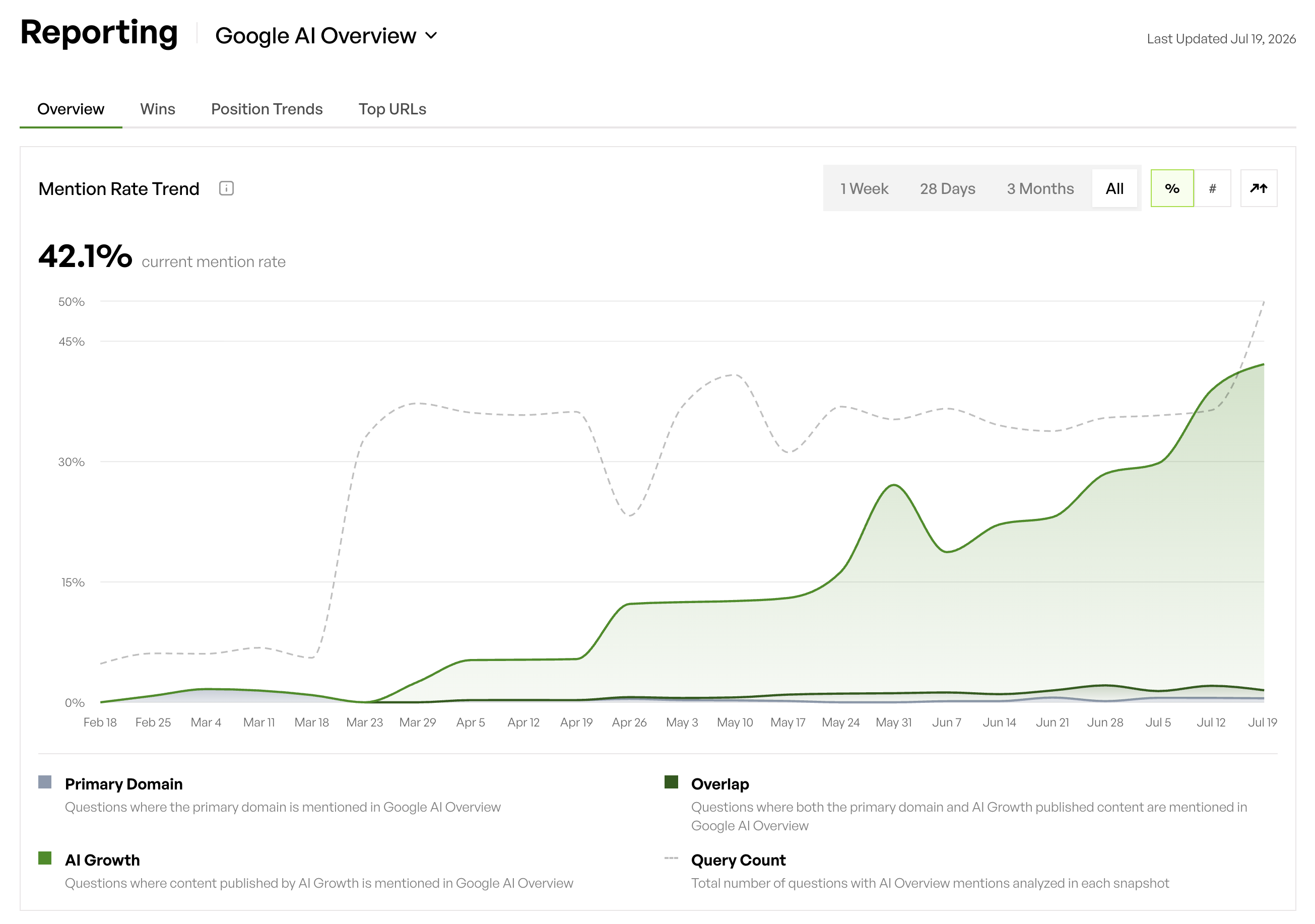
AI Growth Agent maps seed terms and long-tail queries from real-time Google and ChatGPT data, creates authoritative content for each one, and reports the incremental visibility it generates week over week. The platform isolates its contribution instead of claiming credit for visibility the brand already had, which closes the loop between measuring the gap and closing it. Pricing uses a flat fee, with no per-article charges, credit limits, or per-prompt billing, and clients own all content they produce.
Show Your Leadership Team A Live AI Share Of Voice Report
Common AI Share Of Voice Mistakes
Most untrustworthy AI share-of-voice numbers come from a small set of recurring mistakes.
- Running A Single Prompt Once And Reporting A Point Estimate. A single output is an example, not an evaluation, so any number from one run cannot be reproduced and should not reach leadership.
- Conflating Presence Rate With Share Of Mentions. Presence rate is non-zero-sum, while share of mentions is zero-sum. Mixing them produces a metric that describes neither behavior accurately.
- Blending Platforms Into One Score. Each platform has distinct retrieval behavior, so a blended score hides where visibility breaks and blocks meaningful action.
- Using Brand-Name Prompts Instead Of Buyer-Intent Prompts. Branded prompts inflate presence rate and hide discovery gaps. The panel should reflect what buyers ask before they know your brand.
- Reporting A Percentage Without Prompt Count Or Window. A share-of-voice percentage without a denominator is just a number, not a measurement.
If a number will not reproduce, review the prompt panel for intent coverage, increase runs per prompt, separate platforms, and confirm what you are counting. Use an audit table to log every run with Prompt ID, Platform, Run Number, Date, Mention (Y/N), Citation (Y/N), Position, Sentiment, and Notes.
Verifying Measurement Quality And Cadence
Measurement quality shows up in reproducibility, stable prompt coverage, and confidence ranges that narrow as run counts grow.
A weekly snapshot with a monthly rollup works well for active optimization campaigns. Fifty prompts across 6 engines sampled once a day produce 2,100 answers a week, which supports week-over-week comparison but not day-over-day analysis. Avoid reporting a change smaller than the confidence interval as a real shift. If the change sits inside the interval, the honest answer is “no detectable change.”
AI Growth Agent refreshes its universe snapshot weekly and cross-references bot traffic, Google Search Console, and citation data that no single monitoring tool combines. The engine tracks where content ranks, where AI Growth Agent content drives new visibility, and where the two overlap, so incremental results stay separate from visibility the brand already had.
Advanced Scenarios And Scaling The Protocol
The same protocol adapts to more complex environments with a few targeted adjustments.
- Multi-Brand Portfolios: Run separate panels for each brand and report each one independently. Pooling brands into a single panel produces a blended number that describes none of them.
- Multiple Domains Or Subdomains: Track each domain separately and note which domain receives the citation. A citation to a subdomain carries different implications than a citation to the root domain.
- Large Content Libraries: Segment the panel by topic cluster so you can see which clusters gain or lose visibility. Aggregate share of voice hides which clusters need work.
- Regulated Sectors: Add accuracy rate alongside presence rate and share of mentions. A study of eight AI search engines found that they answered more than 60% of source queries incorrectly, which makes accuracy a critical KPI in finance, healthcare, and legal.
Once measurement is stable, the next step is closing the gap it reveals. Living, self-healing content prevents visibility decay as the world changes. AI Growth Agent produces authoritative content for every prompt in the universe, updates it as conditions shift, and reports the incremental visibility it generates so measurement flows directly into action.
See How AI Growth Agent Turns Measurement Into Growth
Conclusion: Turning AI Share Of Voice Into Action
A validated prompt panel, repeated runs, platform-level tracking, and reported ranges turn AI share of voice from a vanity percentage into a defensible measurement. Brands that measure well can act with confidence because they know which platforms underperform, which intent clusters are missing, and whether a change reflects real movement or statistical noise.
AI share of voice functions as a measurement instrument that needs validation before it earns trust. The quality of the number always reflects the rigor of the protocol behind it.
Talk With AI Growth Agent About Your AI Share Of Voice