Written by: Mariana Fonseca, Editorial Team, AI Growth Agent
Key Takeaways
- Competitive visibility analysis shows how often AI engines recommend, mention, and cite your brand versus competitors, and which sources drive those recommendations.
- Four separate metrics matter: AI visibility share, brand mentions versus citations, sentiment and context, and top-cited competitor URLs. Each one moves on its own.
- The analysis follows six repeatable steps: build a five-type prompt set, benchmark the right competitors, split branded versus non-branded visibility, read engine-by-engine divergence, trace citations to third-party sources, and turn findings into action.
- Third-party surfaces such as Reddit, YouTube, G2, and Trustpilot often influence AI recommendations more than a brand’s own site, so monitoring and shaping these sources is essential.
- AI Growth Agent maps your full query universe, produces authoritative living content, publishes it to a site you own, and self-heals over time so your narrative stays current.
Book A Demo With AI Growth Agent
What Competitive Visibility Analysis In AI Search Actually Measures
Competitive visibility analysis rests on four metric categories. Each one measures something distinct, and a single blended score hides what is really happening.
AI visibility score or share of voice is the percentage of times your brand is recommended or mentioned for a target set of prompts compared to your top competitors. It is the headline number, but it never tells the full story on its own.
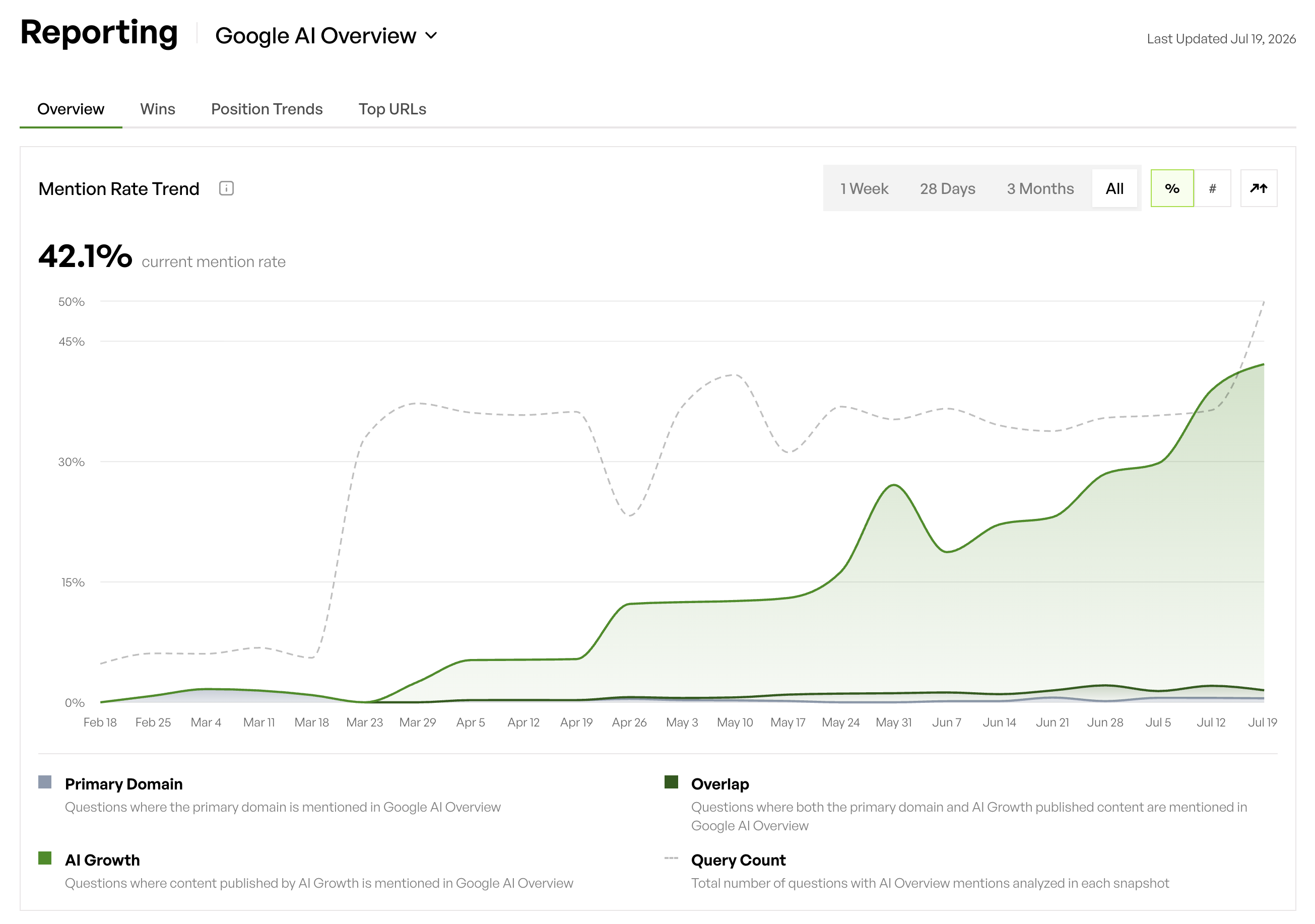
Brand mentions versus citations is the distinction between the AI naming your brand in the answer text and the AI linking directly to your URL as a source. BuzzStream’s 2026 study of 12,000 AI responses found that 23.1% of brand mentions are also backed by a citation in the same response, meaning roughly 1 in 4 mentions comes with a citation. The other three are mentions with no sourcing behind them. BrightEdge’s Insurance prompt panel analysis distinguishes citations from mentions, noting the two outcomes are counted separately and do not move together, which is why a single visibility score hides the result.
Sentiment and context describe whether the AI frames your brand positively, neutrally, or negatively, and which specific strengths or weaknesses it highlights. A brand can appear frequently in AI answers and still lose the sale if the framing is hedged or unfavorable.
Top-cited competitor URLs are the specific competitor pages or third-party review sites, such as Reddit, G2, or Wikipedia, that AI engines rely on to answer queries in your category. These are the sources to understand and, where possible, displace or match.
Semrush’s 2026 AI Visibility Index, based on an analysis of 126 million AI search prompts, found that on Gemini the overlap between the brands an AI mentions and the sources it actually cites can run as low as 30%. A brand can appear constantly in an AI answer without a single sentence of it tracing back to anything the brand published, reviewed, or approved. Competitive visibility analysis exists to close that gap.
How To Run A Competitive Visibility Analysis In AI Search
The analysis follows six steps. Each one builds on the last, and skipping any of them produces an incomplete diagnosis.
- Build the prompt set across category, problem, comparison, alternative, and buying-intent queries.
- Select and benchmark 3 to 5 competitors.
- Split branded versus non-branded visibility.
- Read engine-by-engine divergence across ChatGPT, Perplexity, Gemini, Claude, and Google AI Overviews and AI Mode.
- Trace a competitor’s AI recommendation back to the third-party sources causing it.
- Turn the diagnosis into action.
Step 1: Build The Prompt Set Across Five Query Types
Robots search the long tail, and most brands do not. Many teams track a handful of head terms and lose the rest of the conversation by default. A competitive visibility analysis built on head terms alone measures only a fraction of the market.
The prompt set should span five query types, each representing a different stage of the buyer’s reasoning:
- Category queries: “What are the best [product category] companies?”
- Problem queries: “How do I solve [specific problem]?”
- Comparison queries: “[Your brand] vs [Competitor]”
- Alternative queries: “Alternatives to [Competitor]”
- Buying-intent queries: “Which [product category] fits a [specific team size] already juggling [specific tools]?”
BrightEdge’s AI Catalyst builds and tracks buyer prompts mapped to the buyer journey stage. It shows that buyers ask AI platforms longer, more conversational questions than the short keyword phrases they type into organic search. The buying-intent query above is a direct example of that shift. Even highly authoritative or frequently mentioned brands will not appear in an AI answer unless they clearly match the user’s intent, such as the use case, audience, or problem being solved. A prompt set that does not cover all five types will miss the queries where your competitor is winning and you are not.
See How AI Growth Agent Builds Your Prompt Set
Step 2: Select And Benchmark The Right 3 To 5 Competitors
With your prompt set defined, the next decision is who to measure against. Benchmarking against the wrong set produces a useless analysis. The competitors that matter are the ones the AI engines are already recommending for your prompt set, not necessarily the ones you track in traditional search or in sales conversations.
The gap between competitors within the same category can be dramatic. Arobis AI’s 2026 AI Shortlist Study measured recommendation frequency by running six standardized buying-intent prompts three times each across ChatGPT, Gemini, Claude, Perplexity, and Copilot (18 prompt-runs per category), scoring a vendor recommended in every run at 100% and one recommended once at roughly 6%. A 94-point gap between two vendors answering the same question set is the difference between existing in the AI answer and not existing at all.
Step 3: Split Branded Versus Non-Branded Visibility
Once you have your competitor set, the next split is between branded and non-branded visibility. These are not the same metric, and treating them as one produces a misleading picture. A brand can score well on branded queries, where the user has already typed the company name, while being nearly invisible on the non-branded queries where most discovery actually happens.
HubSpot recommends focusing prompt sets heavily on unbranded, solution-seeking prompts rather than branded prompts, because unbranded prompts do the heavy lifting for a brand’s AI visibility score. A buyer asking who can solve a problem, which provider to consider, or how to handle a specific situation gives the AI engine a choice about which companies belong in the answer. That is where the competitive battle actually happens.
Step 4: Read Engine-By-Engine Divergence Across ChatGPT, Perplexity, Gemini, Claude, And Google AI Overviews And AI Mode
Results differ materially by engine, so measuring one engine gives an incomplete picture. This is the single most operationally important fact for anyone running this analysis in 2026.
Arobis AI’s 2026 cross-engine benchmark shows the same brand scoring differently on each engine: HubSpot scored 91 on ChatGPT, 89 on Gemini, 86 on Claude, and 93 on Perplexity, while Salesforce scored 84, 87, 82, and 88 respectively. The divergence is not noise. It reflects genuinely different retrieval architectures, index compositions, and citation behaviors across platforms.
Citation rates also vary sharply by engine. Boring Marketing’s audit data shows Perplexity cited brands in 17.6% of checks and Gemini in 17.2%, while ChatGPT cited brands in 12.2% and Claude in just 7.6%, meaning Perplexity and Gemini cite brands at roughly twice ChatGPT’s rate, and Claude is the most selective citer of all.
The gap between a brand’s strongest and weakest engine can be enormous. Zen Media’s 2026 corporate event planning campaign found one brand appeared in 15.5% of buyer-intent prompts on the weakest AI engine and 59.5% on the strongest. That is a 44 percentage point gap on the same prompt set, with a five-engine average of 45.6%. Averaging across engines hides the thing that most needs fixing.
Step 5: Trace A Competitor’s AI Recommendation Back To The Third-Party Sources Causing It
This step delivers the highest-value output of the analysis. Once you know a competitor is winning the AI answer, the next move is to identify what the AI is reading to produce that recommendation. In practice, the answer is almost never the competitor’s own website.
Brandi AI’s flower delivery study found that a six-year-old Reddit post characterizing Teleflora, FTD, and 1-800-FLOWERS as middlemen, with 13,000 upvotes and 203 comments, ranked as the second most cited social and user-generated content source across all AI answers analyzed, demonstrating how outdated negative narratives can persist in AI-generated answers without active reinforcement. The implication runs both ways. A competitor’s AI recommendation may be driven by a single high-authority community thread that is years old and entirely outside their control.
Reddit appears in AI answers for 56% of audited brands and YouTube for 51%, the two most recurring third-party domains, cited more often than Forbes and Wikipedia combined. These are the surfaces to audit first when tracing a competitor’s citation sources.
The pattern intensifies as buyers move toward purchase, and the sources shift with them. Seer Interactive’s May 2026 study of 804,491 AI responses across 1,926 brands, 8 verticals, and 4 AI platforms found that review and trust sites are the #2 citation source in AI responses, with their share of citations growing from 1.51% at the Awareness stage to 24.27% at the Intent stage, a 22 percentage point increase. By the time a buyer is ready to decide, the AI is drawing heavily on G2 pages, Trustpilot profiles, and review aggregators to build its recommendation. If your competitor has a stronger presence on those surfaces, the AI answer reflects it.
Trace Your Competitor’s Citations With AI Growth Agent
Step 6: Turn The Diagnosis Into Action
The value of this analysis comes from what you do with it. The goal is to turn a static diagnosis into a repeatable system that changes what the AI answer says.
The first action is to map the gap between mentions and citations. That gap matters because 81% of brands that integrated AI visibility and SEO into a unified workflow saw increased traffic or leads from AI platforms, versus only 36% of brands that managed SEO and AI visibility separately. Brands that win this channel treat AI visibility and SEO as one program, not two disconnected efforts.
The second action is to address the specific third-party sources driving your competitor’s recommendations. If a Reddit thread is the second most cited source in your category, the answer is to produce authoritative content that earns its own citations on the surfaces the AI is already reading, and to build the review and community presence that shifts what the retrieval layer finds.
The third action is to publish content that is structured for citation, not just for ranking. As noted earlier, mentions and citations are decoupled. Closing that gap requires content that is extractable, validated, and structured so the AI can cite a specific passage rather than just name the brand from training data.
Other tools report what is happening, and AI Growth Agent changes it. Where they offer a rearview mirror, AI Growth Agent provides the steering wheel. The engine maps your full universe of seed terms and long-tail queries, produces authoritative living content against each one, publishes to a site you own, and self-heals over time so your narrative does not decay between training sweeps. It operates at Level 4 autonomy: it maps out its own destiny, calculates the next best action every day, and surfaces only exceptions for human review. The result is narrative control, not another dashboard.
What To Look For In An AI Visibility Platform
Once you have run the analysis, the next decision is which platform can act on it. Most AI visibility tools fall into two architectural categories. Monitoring-first platforms, including the major names in the GEO monitoring space, meter prompts and report what they find. The action layers they added in 2026 still hand the work back to a human through draft agents that wait for approval and to-do lists the client still has to execute. Adding a to-do list to a monitoring tool does not make it an action platform.
HubSpot outlines four questions for choosing an AI visibility tool:
- Engine coverage: Does it cover ChatGPT, Gemini, and Perplexity at minimum, plus Google AI Overviews or Copilot if relevant?
- Monitoring versus optimization: Does it only report, or does it also recommend what to create and fix?
- Attribution: Can it connect visibility to traffic, leads, and revenue?
- Cadence and cost: How often do prompts re-run, and is there a free tier?
The architecture question matters more than any feature checklist. AI Growth Agent was built the other way around from monitoring tools. Content creation sits at the core of the business, and the engine maps, writes, publishes, and self-heals on a site the client owns. It is a highly transparent content engine, showing where every query was sourced, every link the agent consulted, the SERP analysis behind every article, and the source backing every claim. Pricing is a flat fee with no per-article charges, credit limits, or per-prompt billing, so clients see their entire universe instead of a capped handful of tracked terms.
Frequently Asked Questions
Below are answers to common questions about running a competitive visibility analysis and choosing the right tools.
Which AI Tool Is Best For Competitive Analysis?
The right tool depends on what you need it to do. As outlined earlier, four questions narrow the field: engine coverage, monitoring versus optimization, attribution, and cadence and cost. Most platforms in this space are monitoring-first, meaning they tell you where you stand and hand the work back. AI Growth Agent is built differently. It maps the full universe, produces the content, publishes it to a site you own, and self-heals over time. For a CMO who needs to change what the AI answer says rather than just report it, that architectural difference is the deciding factor.
How To Track Visibility In AI Search?
Tracking starts with a fixed prompt set covering branded, unbranded, and comparison queries, run consistently across the engines you care about. A monthly cadence is the baseline for spotting trends, and you can increase frequency when testing new content or watching a competitor closely. HubSpot AEO runs prompts daily and alerts on notable shifts. As noted in Step 4, mentions and citations must be logged separately because they do not move together. Over eight weeks of weekly data, patterns become actionable. A rising mention rate without a corresponding rise in citation rate usually means the AI is aware of your brand but lacks a strong enough content signal to cite a specific page, which points directly to the content work that needs to happen next.
How To Improve Visibility In AI Search Results?
Improving AI visibility requires work across several layers simultaneously. Arobis AI’s 2026 report outlines a seven-step playbook: build entity authority, earn authoritative citations, strengthen brand mentions, publish expert content, improve structured data, track share of model, and monitor continuously. In practice, the highest-leverage moves are producing authoritative, extractable content that answers the specific buying-intent queries your prompt set covers, building presence on the third-party surfaces the AI is already reading in your category, including review platforms, community forums, and relevant publications, and ensuring your technical setup allows AI crawlers to read and cite your content. Content that cannot be extracted by a bot is not an asset. Living, self-healing content that stays current across training sweeps compounds over time, while content that goes stale works against you.
Is SEO Dead With AI Search?
Google Search Central’s guidance states that SEO best practices remain relevant for generative AI search because Google’s AI features, including AI Overviews and AI Mode, are rooted in Google’s core Search ranking and quality systems, retrieving pages from its Search index and running related fan-out queries. A page that is not indexed and snippet-eligible cannot appear in Google’s AI features. The same crawlability, indexability, and content quality signals that govern traditional ranking govern AI citation eligibility on Google’s surfaces. What has changed is that ranking first no longer guarantees inclusion in an AI answer, and the citation layer, which third-party sources the AI reads and trusts, now matters as much as the ranking layer. Brands that treat SEO and AI visibility as a unified workflow, rather than separate programs, are the ones seeing compounding results.
Conclusion: Make Your Brand The Answer
The CMO who walks into a board meeting next week needs more than a dashboard screenshot. They need a defensible answer: who is winning the AI answer in their category, which sources are driving it, and what the plan is to change it. Competitive visibility analysis in AI search is the method that produces that answer. Build the prompt set across all five query types. Benchmark the right competitors. Split branded from non-branded. Read every engine separately. Trace the citations back to their sources. Then close the loop by changing what the AI finds.
Traditional search tools show you where your brand stands, and AI Growth Agent makes your brand the answer. Book a kickoff and see your first article live within a week.