Written by: Mariana Fonseca, Editorial Team, AI Growth Agent
Key Takeaways
- AI search visibility failures usually come from either missing brand citations or AI features that do not render. Diagnose by testing direct brand queries in fresh sessions and comparing them with generic queries.
- Confirm AI crawlers can reach your site by checking robots.txt for blocks on GPTBot, OAI-SearchBot, ChatGPT-User, PerplexityBot, ClaudeBot, and Google-Extended.
- Keep your brand entity consistent across LinkedIn, Crunchbase, Wikipedia, and Wikidata, then connect those profiles with Organization schema sameAs links to raise AI confidence scores.
- Grow third-party corroboration through earned media, reviews, and comparison content, because most AI citations come from external sources rather than your own pages.
- AI Growth Agent runs the full execution engine behind this diagnostic work, from mapping seed terms to publishing authoritative content and reporting incremental visibility every week.
Run The Four-Step Diagnostic With AI Growth Agent
Is Your Brand Missing From AI Answers, Or Is The AI Feature Missing From Your Screen?
AI visibility problems fall into two buckets, and each bucket needs a different fix.
Failure Mode 1: The Brand Is Not Cited By AI Surfaces. The feature renders for the user, but the brand is absent from the answer. This creates a brand visibility problem with a defined diagnostic sequence.
Failure Mode 2: The AI Feature Itself Is Not Rendering. AI Overviews or AI Mode do not appear at all, regardless of query. This points to a platform, account, or region issue that sits outside the brand’s content or entity profile.
Use a quick check for each mode. For Failure Mode 1, open a fresh ChatGPT session with memory disabled and ask “What is [brand name]?” For Failure Mode 2, run a generic query such as “what is the capital of France” and see whether an AI Overview or AI Mode button appears. If no AI feature renders for any query, the brand is not the problem. The rest of this article focuses on Failure Mode 1.
See How Your Brand Scores On The Four-Step Diagnostic
How Do I Get My Company To Show Up On AI Searches?
If your brand is missing from AI answers, a four-step diagnostic sequence reveals where the blockage sits. The steps run in a defined order because each one sets up the next. Fixing content structure before confirming crawler access wastes effort.
- Can AI crawlers actually reach your site? If the crawler cannot read the page, nothing downstream matters. Check robots.txt for blocks on GPTBot, OAI-SearchBot, ChatGPT-User, PerplexityBot, ClaudeBot, and Google-Extended.
- Is your brand entity consistent across high-authority profiles? AI models verify your business by cross-referencing LinkedIn, Crunchbase, and Wikipedia. When those profiles disagree on name spelling, address, or description, the model cannot confirm which version is correct, and its confidence score drops. Inconsistent entity data causes the AI’s entity resolution model to penalize the brand’s confidence score, which weakens AI citations and category recognition.
- Is there third-party corroboration? AI avoids recommending unverified brands. Earned media accounted for 84% of all AI citations across 25 million links examined by MuckRack’s Generative Pulse analysis, while owned content accounts for only 11% to 18% of the citation graph.
- Is your content structured for extraction? AI answer engines look for content formatted to answer specific user questions directly. Clear Q&A phrasing and schema markup make those answers easier to lift.
How AI Growth Agent Executes The Fixes At Scale
After diagnosis, the work of fixing these gaps at scale breaks into four jobs. First, map the brand’s full universe of seed terms and long-tail queries from real-time Google and ChatGPT data. Second, produce authoritative content that validates every claim and source. Third, stand up an optimized site the brand owns within the first week. Fourth, report incremental visibility week over week.
The first two jobs feed the site build, and the reporting shows whether the system is working. Because the content is living and self-heals instead of going stale, the reporting stays meaningful over time. Pricing runs on a flat fee, without per-article charges, credit limits, or per-prompt billing.
How To Check If AI Crawlers Can Reach Your Site
Start with crawler access, because blocked bots erase every other effort. Most diagnostic content says “check robots.txt” without naming what to look for. The specific AI crawler user agents to check are GPTBot, OAI-SearchBot, ChatGPT-User, PerplexityBot, ClaudeBot, and Google-Extended.
OpenAI’s official crawler documentation states that GPTBot crawls content that may be used in training OpenAI’s generative AI foundation models, and that disallowing GPTBot in robots.txt signals that a site’s content should not be used in training those models. OpenAI publishes machine-readable IP address lists for each crawler. Site owners should verify logged requests against the published IP ranges rather than trusting the user-agent string alone: GPTBot, OAI-SearchBot, and ChatGPT-User.
OAI-SearchBot is the crawler that surfaces websites in ChatGPT’s search features. Sites opted out of OAI-SearchBot will not be shown in ChatGPT search answers, though they can still appear as navigational links. OAI-SearchBot and GPTBot robots.txt tags operate independently. A webmaster can allow OAI-SearchBot to appear in ChatGPT search results while disallowing GPTBot to keep content out of model training. After a site updates its robots.txt, OpenAI notes an adjustment window of roughly 24 hours.
How To Audit Your Brand Entity Across LinkedIn, Crunchbase, And Wikipedia
Once crawlers can see your site, the next job is entity clarity. The profiles where inconsistency causes the most damage are LinkedIn, Crunchbase, Wikipedia, and Wikidata. Each plays a different role in how AI systems resolve a brand as a verified entity.
Wikidata is a structured knowledge base maintained by the Wikimedia Foundation that accepts entries for businesses that do not meet Wikipedia’s notability bar, requiring only “verifiable existence” confirmed by external references such as a LinkedIn page, Crunchbase profile, or trade publication mentions. Wikidata data flows directly into Google’s Knowledge Graph, Apple Siri, and Amazon Alexa, and indirectly into AI systems including ChatGPT. LinkedIn Company Pages rank among the most heavily referenced entity sources for AI systems because LinkedIn verifies businesses at page creation and maintains ongoing employee verification. Crunchbase tracks businesses, funding, founders, and acquisitions across industries and serves as a primary business entity source for AI systems including ChatGPT.
Run a simple audit. Search your exact company name across each platform and confirm that the name, description, founding date, and headquarters city match. The technical link between these profiles is the Organization schema sameAs property, which connects a brand’s official site to its LinkedIn company page, Crunchbase profile, Wikipedia article, and Wikidata entity URL. A complete sameAs array tells AI knowledge graph systems that multiple external profiles represent the same entity. This raises entity confidence because the system can verify that name, description, and other attributes match across independent sources.
The four diagnostic steps map to four concrete checks and fixes, and the order matters because each fix depends on the previous one. Use this table as your working checklist:
| Diagnostic Step | What To Check | Where To Check | Fix |
|---|---|---|---|
| Crawler access | robots.txt blocks on GPTBot, OAI-SearchBot, ChatGPT-User, PerplexityBot, ClaudeBot, Google-Extended | robots.txt file, server logs | Remove blocks and confirm crawler IP ranges against OpenAI’s published lists |
| Entity consistency | Name, description, founding date, headquarters across profiles | LinkedIn, Crunchbase, Wikipedia, Wikidata | Standardize to a single canonical form and implement Organization schema sameAs |
| Third-party corroboration | Mentions, reviews, discussions on credible external sites | Reddit, Trustpilot, G2, industry publications | Earn reviews, press, and active discussions on trusted third-party platforms |
| Content structure | Q&A phrasing, schema markup, extractable passages | Homepage, service pages, blog | Implement Organization and FAQ structured data and answer-first formatting |
Direct Brand Lookup Vs. Category Query: Two Different Problems
The diagnostic sequence above tells you whether your brand is visible at all. Visibility, however, varies by query type. A brand can pass a direct lookup and still be absent from category searches, which makes this distinction critical.
A branded query names a specific company, product, or person, while an unbranded query describes a need or category without naming anyone. Branded queries trigger direct entity lookup, whereas unbranded queries trigger comparative ranking across many options, pulling from different signals and producing different output formats.
When a user names a brand directly, the AI’s job shifts from “recommend” to “describe,” pulling from its training knowledge of the entity’s product, pricing, user sentiment, and competitive positioning. This explains why recognition can appear in direct brand lookups but not in category searches.
For unbranded queries, the ranking signal is roughly how often and how positively authoritative third-party content mentions a brand in the context of that category. A brand’s own pages rarely drive citations for unbranded queries. Research from Seer Interactive analyzing thousands of ChatGPT responses found that AI systems tend to recommend brands that appear frequently in high-authority editorial content, reviews, and comparison articles, not brands that appear primarily in their own marketing copy.
The fixes differ by query type. For direct brand lookups, focus on entity consistency across high-authority profiles and structured data. For category queries, invest in third-party corroboration through earned media, reviews, and comparison content. An Ahrefs correlation study of roughly 75,000 brands found that brand mentions correlate with AI citation share at approximately 0.664, versus 0.218 for backlinks, making mentions roughly three times more predictive of citation share than links in that dataset.
Get A Branded Vs. Unbranded Visibility Audit
When The Brand Is Fine But AI Overviews Or AI Mode Are Not Rendering For You
Failure Mode 2 is not the focus of this article, but it is worth ruling out before you invest in the Failure Mode 1 fixes. This section shows how to tell whether the feature is simply not rendering for you.
Google’s AI Mode availability is explicitly gated by country or territory and language, with a supported list covering the Americas, Asia-Pacific, and Europe or Middle East or Africa, plus a supported-languages list including English, Spanish, German, Japanese, Hindi, and many others. A brand’s absence from AI Mode answers may simply reflect that AI Mode does not render in the user’s region or language.
Google’s AI Mode documentation states that AI Mode personalization is available only to users 18 or older who have Search history and personalized recommendations enabled, and that it references previous searches and activity saved in Search Services History, so two users asking the same query can receive different brand citations based on account-level personalization settings. For Workspace users with Search and Assistant turned off, Search history is unavailable and can only be enabled by the Workspace administrator via the Admin console.
Google’s documentation states that Gemini 3 Pro in AI Mode is available in English only, requires users to be 18 or above and signed in to a personal Google Account they manage themselves, and is limited to specific countries plus Google AI Plus, Pro, and Ultra subscribers.
For diagnosis, this means a brand’s absence from AI Mode for a specific user does not prove that the brand is invisible. It shows that the feature is not rendering for that user, account, or region. The brand may still be cited in AI answers for users in supported regions with eligible accounts.
How To Win Brand Visibility In AI Search After The Fixes
Once you have ruled out rendering issues and completed the diagnostic sequence, the focus shifts from “are we visible?” to “where do we rank within the answer?” AI answers have no static ordered list, so order of mention and citation context become the new ranking. Where the brand appears in the answer, and how that position changes week over week, forms the new leaderboard. A brand cited first in a category recommendation sits in a very different position from a brand cited fifth, and tracking that movement becomes the operational work after diagnosis.
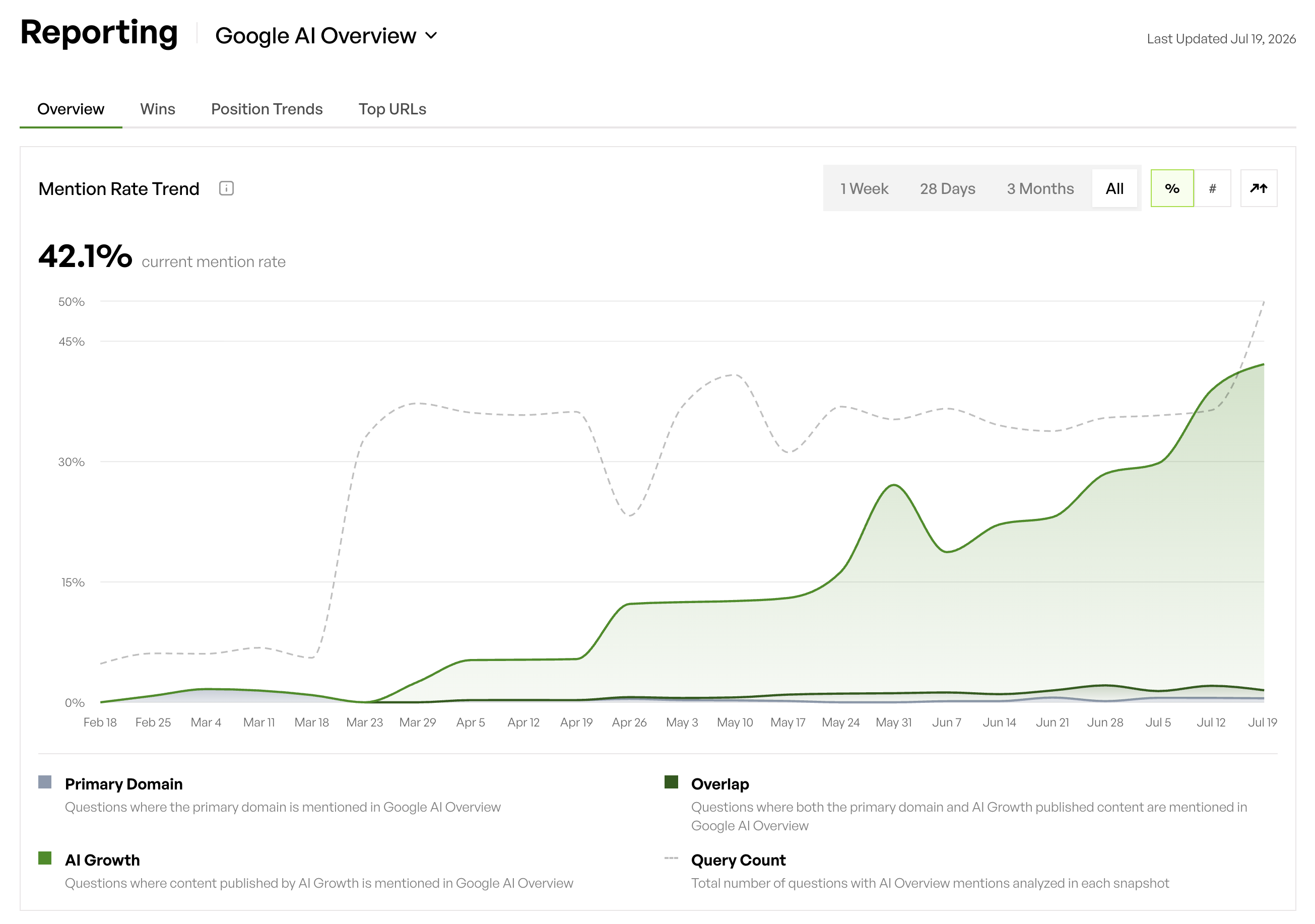
AI Growth Agent publishes into a separate environment, which lets it report only the visibility it generated. The week-over-week numbers reflect its own work, not the brand’s existing visibility. That separation is what makes the reporting trustworthy. Four pillars feed the reporting: Search Intelligence, AI Analytics, Bot Tracking, and AI Ranking. Together they have produced measurable results. Across the first twelve weeks, clients average more than 12,000 additional AI citations and mentions, over 100,000 additional bot visits, and a 20%+ lift in impressions.
Traditional search tools show you where your brand stands. AI Growth Agent moves your brand into the answer set. Book a kickoff and see your first article live within a week.
Start Your First Week Of Incremental Visibility
Frequently Asked Questions
How Long Does It Take For A Brand To Appear In AI Search After Fixing Crawler Access?
Once crawler access is restored, the 24-hour adjustment window mentioned earlier applies, but that window only covers OpenAI’s crawler behavior. Citation in AI answers depends on the model’s retrieval and ranking pipeline, which varies by platform. Perplexity retrieves live web content, so changes can appear within days. ChatGPT’s knowledge cutoff is typically 6 to 12 months old, according to GoBlinkly’s reporting, while browsing sessions retrieve live content. For live-retrieval (RAG) engines, brands should expect initial citation lifts within roughly 5–14 days for mid-authority B2B brands (DR 40–75), with high-authority publishers (DR 90+) cited in 24–72 hours and new or niche sites (DR 0–40) taking 21–60 days. Fixing crawler access sets the floor, but citation also depends on entity consistency, third-party corroboration, and content structure, so all four diagnostic steps should be addressed in sequence.
Why Does My Brand Appear In ChatGPT But Not In Google AI Overviews?
Different AI surfaces use different retrieval and ranking pipelines. ChatGPT’s citation profile is encyclopedic and community-weighted, with Wikipedia as the single most-cited domain at roughly 7.8% of citations, and Reddit and YouTube also prominent. Google AI Overviews over-index on Reddit, YouTube, Quora, and Wikipedia relative to the classic organic result set. They also pull disproportionately from Google-owned properties. Roughly 88% of their citations come from URLs outside the traditional top ten organic results.
A brand can rank well on Google yet not be cited by Perplexity, and the reverse can also occur. Each surface must be audited separately because the source mix, retrieval logic, and entity signals each platform weights are distinct. Running a locked library of 20–30 buyer-intent prompts across ChatGPT, Perplexity, and Google AI Mode monthly is the minimum cadence for most brands to understand where citation gaps exist by platform.
What Is The Difference Between A Brand Mention And A Brand Citation In AI Search?
A mention occurs when a model names the brand in its answer, with or without a link. A citation occurs when the model links to a specific URL as the source for a claim. A brand can be recommended without any link, and a page can be cited for a fact without the brand being named as a recommendation. Both surfaces must be tracked separately because they respond to different operational moves. Improving mention rate typically requires building third-party corroboration across earned media, reviews, and community discussions. Improving citation rate requires content that is structured for extraction, with answer-first formatting, clear schema markup, and passages that can be lifted cleanly without surrounding context. AI Growth Agent tracks both mention rate and citation rate, alongside Google Search Console impressions and bot traffic, so the reporting shows what is actually moving and why.
Can I Fix My Brand's AI Search Visibility Without Hiring An Agency?
Yes, but the work is technical and ongoing. The diagnostic sequence in this article covers the first four checks: crawler access, entity consistency, third-party corroboration, and content structure. Fixing these requires technical SEO knowledge, entity management across multiple platforms, and a content production system that can publish and self-heal authoritative content at scale. The most common failure point is execution rather than diagnosis. One company produced roughly 300 articles using a chatbot and not one was cited, because the system around the model, including universe mapping, claim validation, schema, and self-healing, was absent. The same engine described earlier handles the execution for AI Growth Agent, including mapping, content production, site build, and weekly reporting, so you are not assembling a separate stack.