Self-Healing Content Optimization: The Complete Guide
Written by: Mariana Fonseca, Editorial Team, AI Growth Agent
Key Takeaways for Marketing and SEO Teams
Content decay is accelerating as AI search platforms favor fresher sources, so flagship articles lose impressions and citations within months.
Self-healing content optimization uses a continuous loop of monitor, detect, diagnose, optimize, and validate to keep content relevant at scale.
Brands that adopt self-healing systems now shape how the next generation of AI models talk about their category and their products.
AI Growth Agent clients typically see their first article live within a week, with measurable lifts in impressions, bot visits, and AI citations within the first 12 weeks.
Self-healing content optimization mirrors the loop that AI systems use internally: monitor, detect, diagnose, optimize, and validate. Applied to content, each stage has a specific function.
Monitor: Continuously track content performance across search engines and AI platforms, including Google Search Console impressions, bot traffic, and AI citation rates.
Detect: Identify decay signals such as declining impressions, clicks, or AI citations before rankings collapse.
Diagnose: Determine the root cause, whether outdated statistics, shifted search intent, new competitors, or technical issues.
Optimize and Validate: Update the content with fresh data and improved structure, then confirm the update is indexed and performing as expected.
This approach evolves content maintenance through AI and automation. Traditional manual refreshes stay infrequent and reactive, which limits scale. Self-healing content behaves like living content that updates itself instead of going stale. For a deeper look at how autonomous content generation fits into this picture, see How to Implement Autonomous Content Generation for SEO.
Self-healing content optimization is a strategic investment that compounds over time. Refreshed content delivers better ROI than net-new content. AI Growth Agent clients see this compounding effect firsthand, with impressions, bot visits, and AI citations lifting within the first 12 weeks on average.
The Self-Healing Content Optimization Framework: A Step-by-Step Guide
Any marketing team can adopt a practical self-healing content optimization framework by following five concrete steps.
Monitor: Track content performance across Google Search Console, bot analytics, and AI citation tools. Watch for position drift over several weeks, CTR compression, and impression decline.
Diagnose: Identify whether the cause is outdated statistics, changed search intent, new competitors, or technical issues. Check whether the page has been updated in the last 12 months and whether competitors have published fresher content.
Validate: Confirm the update is indexed and performing. Monitor the impact over several weeks and iterate based on results.
Automation can handle this loop, while human oversight guides strategy and brand nuance. AI Growth Agent’s living content system automates the full cycle and respects brand voice through its manifesto and memory systems.
AI Growth Agent's Content Planner show each brand's universe of search (tracked prompts/queries) and its visibility (ranking rate) on both Google Rankings, Google AI Overviews, and ChatGPT citations and mentions.
The most reliable decay signals are:
Declining Google Search Console clicks: A drop in organic clicks over several weeks with no offsetting demand change signals active decay.
Declining AI citations: Half of all AI-cited content is less than several months old. When citations fall, content is aging out of AI’s freshness window.
Decreasing bot traffic: AI training crawlers and citation bots favor fresh content. A decline in bot visits signals that content is being deprioritized.
AI systems use recency as a tiebreaker for reliability and prefer pages with recent dateModified values in their schema. Content updated within 30 days gets more AI citations. Living content that updates automatically captures this advantage continuously instead of in isolated bursts.
When the year turns, every article in a sector should be refreshed. When new data emerges, the content should incorporate it quickly. AI Growth Agent’s living content system handles these refreshes automatically, with clients going live within about a week and indexing often in as little as 10 days.
Human review and brand voice control stay central. AI Growth Agent uses a manifesto built during kickoff plus memory systems that enforce voice rules, block unwanted language, and cite external research. The engine handles the mechanical 80% of content maintenance, and humans focus on strategic decisions. For a broader look at the AI SEO software landscape, see Best AI SEO Software for Programmatic Content in 2026.
Real-World Examples of Self-Healing Content in Action
To see how this framework translates into outcomes, consider two client engagements where AI Growth Agent deployed self-healing content against specific market objectives.
Example of long-form article produced by AI Growth Agent: fact-checked, credible research meets unique content, derives from a brand's Company Manifesto.
Leva Sleep. The adjustable bed retailer needed to establish leadership in the North American market. AI Growth Agent produced self-healing content targeting financing, setup, side-sleeper, back-pain, and anti-snoring queries. Results included doubled Google Search Console impressions, ChatGPT citing Leva Sleep content over 10,000 times per month, and $40,000 to $50,000 in deals closed in under 3 weeks from buyers who discovered the brand through AI Growth Agent content.
“AGA’s content drove customers into our stores. In a matter of weeks, sales teams were closing deals ($40,000 to $50,000 in sales in under 3 weeks, to be exact) with buyers who discovered us through AI Growth Agent’s articles.” — Matthew Timmins, CEO of Leva Sleep
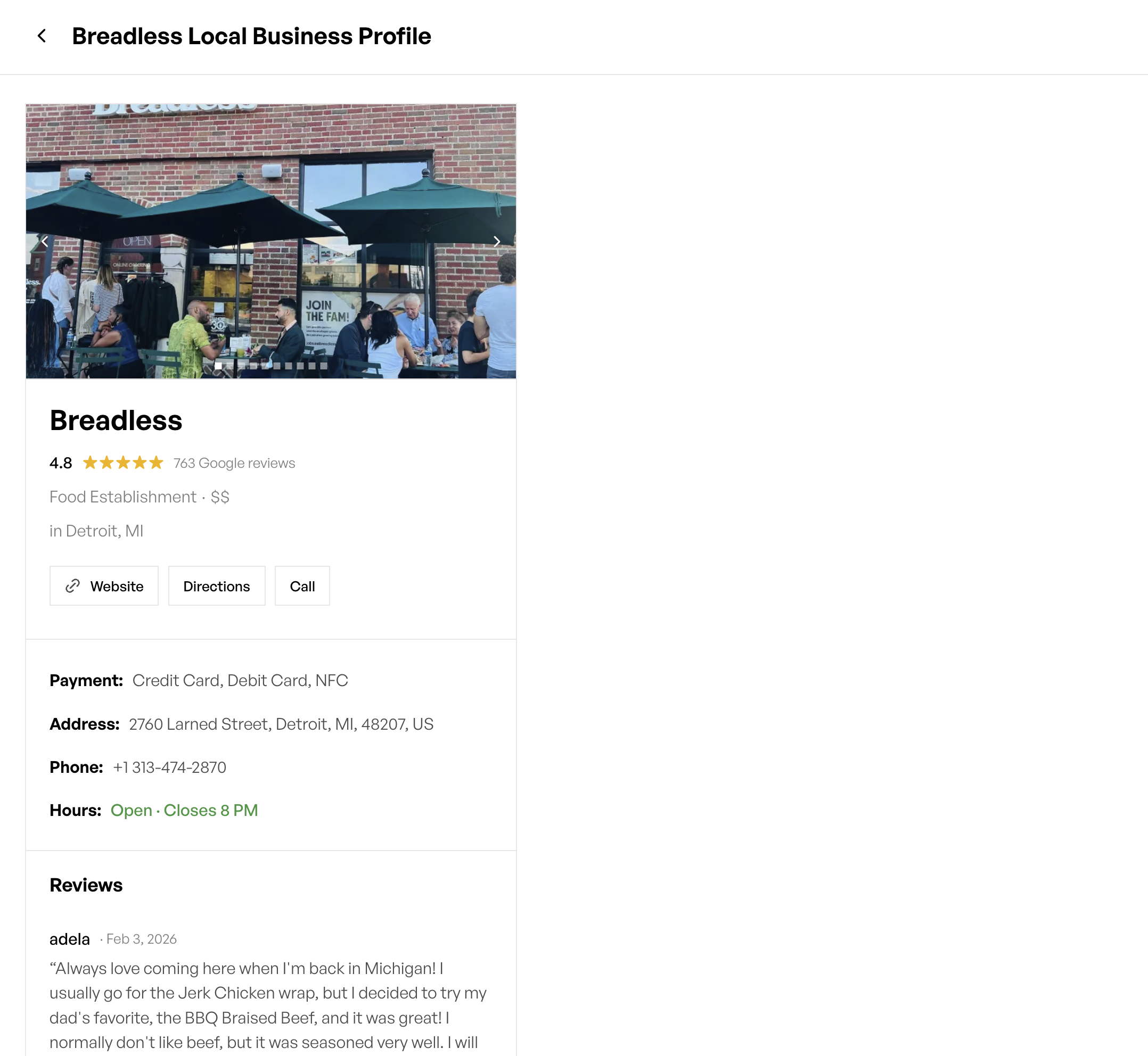
Breadless. The healthy fast-casual franchise needed to build authority and convert AI visibility into franchisee pipeline. Self-healing content targeting franchise development queries made Breadless one of the most recommended healthy franchises in the US, ahead of CAVA, Rush Bowls, and Sweetgreen. Google Search Console impressions grew roughly 30x in six months, and ChatGPT now cites eatbreadless.com over 45,000 times per month.
The current landscape of content and SEO tools falls into distinct categories, each with a clear ceiling.
Monitoring tools (Profound, Athena, Peec AI): Track whether a brand appears for a capped set of prompts. They identify when a brand is missing but do not produce content, own publishing, or act on the data.
SEO suites (Semrush, Ahrefs): Sell keyword and rank data. They do not produce AI search content, do not publish, and do not self-heal what is live.
DIY AI (Claude, ChatGPT): Can draft an article but cannot map a universe, validate every claim, publish with technical SEO, or self-heal content over time. One company produced roughly 300 articles this way and not one was cited.
Enterprise content features (HubSpot): Cap prompts at roughly 50 and produce content that rarely ranks or earns brand mentions.
AI Growth Agent combines monitoring, content generation, technical SEO, and self-healing in one engine. Unique features include Blog MCP, llms.txt, agent discovery, and living content. The engine provisions schema, robots.txt, sitemaps, automatic web stories, instant indexing, and 404 tracking automatically.
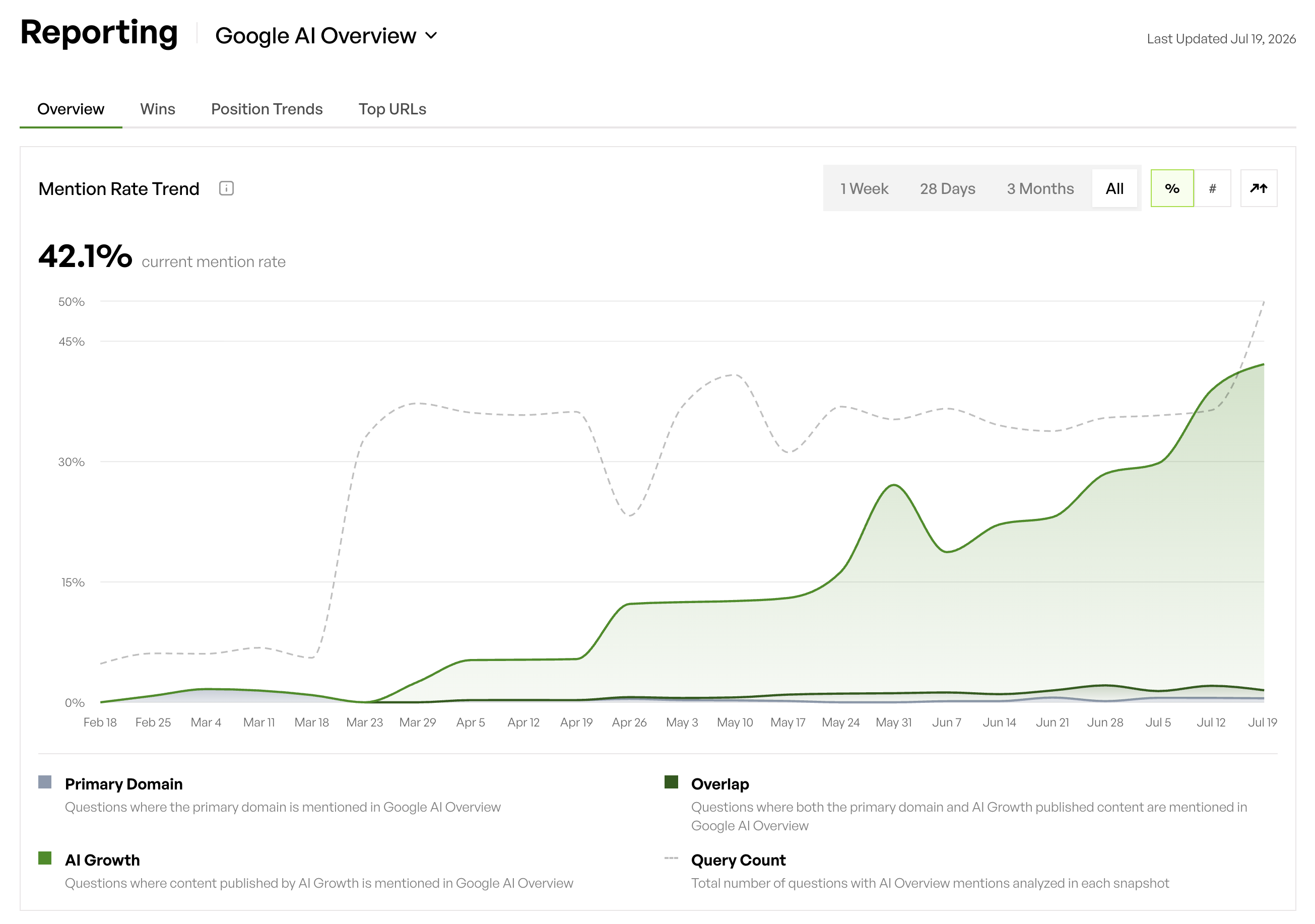
AI Growth Agent's Reporting dashboard, with ranking rates and their separation between Primary Domain results, Overlapping results, and AI Growth Agent content results (incremental visibility).
For mid-market and enterprise companies, AI Growth Agent delivers the complete self-healing content optimization loop without additional headcount or a stack of disconnected tools.
Headless marketing: One engine replaces the SEO agency, content tool, web agency, GEO monitor, schema plugin, analytics stack, and PR firm, while avoiding extra headcount.
Full universe coverage: Clients see hundreds of seed terms and the long-tail queries beneath them, refreshed weekly.
Fixed pricing: Pricing stays fixed, with no per-article charges, credit limits, or per-prompt billing.
Client-owned site: The brand owns the content and the property outright, without agency dependency.
Proven results: More than 12,000 AI citations in the first 12 weeks, over 100,000 bot visits, a 20% impressions lift, and first articles live in about a week with indexing often in as little as 10 days.
Self-healing content optimization is an automated approach to keeping content permanently relevant by continuously monitoring performance, diagnosing why it decays, and autonomously updating it to maintain or improve visibility in search and AI answers. It mirrors the structure AI systems use internally: detection, diagnosis, remediation, and verification. Traditional content maintenance stays reactive and infrequent, while self-healing content operates as a continuous loop that catches decay before rankings collapse and applies substantive updates at a cadence that matches AI search’s freshness requirements.
How long does it take to see results from self-healing content optimization?
With AI Growth Agent, the first article is typically live within a week of kickoff. Content has indexed in as little as 10 days and often within 2 weeks. The standard engagement is a 3-month pilot because indexing takes time and varies by industry, but clients see movement early. Across the first 12 weeks, clients average more than 12,000 additional AI citations and mentions, over 100,000 additional bot visits, and a 20%+ lift in impressions.
Do I need a technical team to implement self-healing content optimization?
AI Growth Agent handles the technical implementation for you. It provisions schema, robots.txt, sitemaps, automatic web stories, Blog MCP, agent discovery via /.well-known/, llms.txt and llms-full.txt, instant indexing, autoredirects, and 404 tracking automatically. The only integration step is the reverse proxy rewrite that connects the blog to a subdirectory under your domain. Your team gives feedback in plain language while the system learns. Every package includes the full technical and agentic SEO stack with no engineering hours required on the client side.
How is self-healing content optimization different from traditional SEO?
Traditional SEO focuses on blue links on Google through one-time or infrequent updates. Self-healing content optimization focuses on AI answers across ChatGPT, Perplexity, and Google AI Mode through a continuous automated loop. Large language model optimization works natively in natural language, which makes it fundamentally stronger than legacy SEO. AI systems cite content that is fresh, structured, and backed by validated sources, which requires continuous maintenance rather than one-time optimization. The freshness requirements of AI search are also significantly more demanding, and AI Overview citations turn over 70% within 2 to 3 months, a cadence no manual process can sustain at scale.
How does AI Growth Agent ensure content accuracy and brand voice consistency?
AI Growth Agent uses a manifesto built during kickoff as the single source of truth for every piece of content. Style memories carry voice rules, such as preferred terminology or words the brand never uses, and the engine applies them everywhere. Anti-hallucination controls validate every claim, source, and quote against evidence found online before anything ships. The engine never relies on a model’s training data for factual claims. Legal disclaimers, claim prioritization for sensitive sectors, and deny lists are configured once and applied to every future generation. The result is content that holds up under client, regulator, and LLM reviews while maintaining consistent brand voice across hundreds of articles.