Written by: Mariana Fonseca, Editorial Team, AI Growth Agent
Key Takeaways
- A fintech generative engine optimization strategy maps the full universe of seed terms and long-tail queries, then produces evidence-based living content that earns citations across AI surfaces instead of reacting to competitors.
- Sixty-eight percent of Google searches now end without a click, so the citation slot functions as the new front page, and LLM traffic converts at rates similar to traditional organic search.
- The 12-step LLMO playbook runs four pillars in parallel: Search Intelligence, AI Analytics, Bot Tracking, and AI Ranking. Together they deliver compounding incremental visibility within 90 days.
- Headless marketing engines outperform traditional SEO suites and GEO monitors by producing 2–50 self-healing articles per day, tracking every bot interaction, and isolating new visibility generated week over week.
- AI Growth Agent is the only fixed-fee headless marketing engine that stands up a fully optimized site in week one and earns citations across ChatGPT, Perplexity, and Google AI Mode.
See how it works for fintech brands and review a live fintech answer library.
2026 B2B Payments Benchmark Report: Why AI Citations Now Decide Deals
The table below draws on published 2026 research across fintech AI visibility, B2B GEO adoption, and citation behavior, showing that AI-driven search has fundamentally changed how B2B buyers discover and evaluate fintech vendors, with most now starting research in AI tools instead of traditional search engines. Methodology: figures are sourced from studies published between January 2025 and mid-2026, covering B2B marketing leaders, financial services brands, and AI citation audits. Sample sizes are noted per row.
| Metric | 2026 Benchmark | Source & Sample |
|---|---|---|
| Finance searches triggering AI Overviews on Google | Many finance-related searches trigger AI Overviews on Google | BrandRadar 2026 Banking & Finance AI Visibility Report |
| B2B decision-makers initiating research via AI tools | 51% of B2B software buyers now start their research with an AI chatbot more often than with Google | G2 2026 AI Search Insight Report |
| AI referral traffic growth, B2B year-over-year | AI referral traffic has grown substantially for B2B | upGrowth 2026 analysis |
| B2B organizations experimenting with or operationalizing GEO | 92% of B2B organizations | 2026 State of GEO in B2B Marketing, n=225 |
| B2B organizations reporting measurable ROI from GEO | 78% of those investing in GEO | 2026 State of GEO in B2B Marketing, n=225 |
| Fintech citation-share gain within 6 months of structured content investment | Citation-share gains within 6 months of structured content investment for target query clusters | upGrowth Digital, 20+ fintech clients |
| Domains cited per AI response vs. Google blue links | AI responses typically cite fewer domains than traditional Google results | AnswerManiac 90-day citation analysis, 150 fintech queries |
| Financial services citations from brand-managed sources | 88% from brand-managed sources | upGrowth 2026 analysis |
| B2B buyers using ChatGPT, Claude, or Perplexity in vendor research | 94% of B2B buyers use AI in their buying process | Forrester |
| Comparison content share of all AI citations | Nearly one-third (32.5%) of all AI citations | 5W AI Platform Citation Source Index 2026, 680M citations |
These benchmarks define the competitive floor. A fintech brand not actively producing citation-ready content already trails 92% of its B2B peers and remains invisible to many decision-makers who will never open a blue link.
The 12-Step Fintech LLMO Playbook for Compounding Visibility
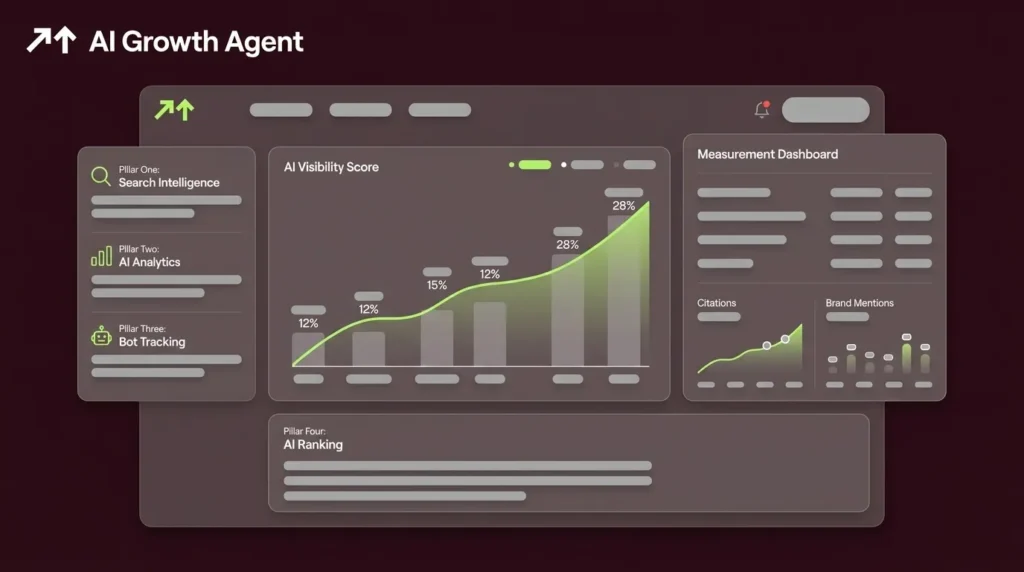
The playbook is organized around four pillars: Search Intelligence, AI Analytics, Bot Tracking, and AI Ranking. Each pillar feeds the next, and all four must run in parallel to create compounding incremental visibility.
Pillar One: Search Intelligence
- Map the full universe. Run hundreds of real searches across head terms and long-tail queries in your fintech vertical, including B2B payments, embedded finance, Banking as a Service, and wealth management. Most brands track a handful of head terms and lose the rest of the conversation by default. A mature fintech universe covers more than 1,600 queries, refreshed weekly with over 3,000 searches.
- Diagnose the competitive landscape. Identify which domains and URLs win each result, which YouTube videos and Reddit threads shape the conversation, and where white space exists. Only 12% of URLs cited by ChatGPT, Gemini, and Copilot rank in Google's top 10 for the same prompt, while nearly one-third of Perplexity citations do so, so traditional SEO rankings provide a weak proxy for AI citation opportunity. Once you understand where competitors win, the next step is to build citation assets they cannot easily replicate.
- Anchor seed terms to proprietary data. Bain & Company identifies proprietary data as the durable differentiator that competitors cannot purchase as frontier models commoditize. Fintech brands with unique transaction data, compliance logic, or market research should structure that data as citation-ready assets, not PDFs or JavaScript-rendered tables.
Pillar Two: AI Analytics
- Build the fintech answer library. Map each seed term to the long-tail queries buyers actually ask. For a B2B payments brand, seed terms like “cross-border payment infrastructure” spawn queries such as “best API for real-time FX settlement,” “how does SWIFT gpi compare to stablecoin rails,” and “embedded payment compliance requirements for EU merchants.” Each query represents a citation opportunity, and each unanswered query becomes a gap a competitor fills.
- Produce evidence-based living content at scale. Approximately 65% of AI bot hits target content published in the past year, with 79% targeting content from the past two years. Static content decays. Every article in the fintech answer library must self-heal as rates, regulations, and competitive dynamics change. Velocity without accuracy creates a compliance risk in fintech.
- Validate every claim against primary sources. Citing regulations and naming regulatory bodies can increase AI citations. In fintech, a hallucinated APY or incorrect fee statement creates a compliance exposure, not a marketing inconvenience.
Pillar Three: Bot Tracking
- Deploy full agentic technical SEO on day one. Every published page must ship with static HTML and schema because AI agents parse static markup more reliably than JavaScript-rendered content or PDF documents. Once the content is parseable, the next step is to make it discoverable. Publish llms.txt and llms-full.txt, Blog MCP, OpenAI discovery via /.well-known/, and natural language query parameters so AI agents can find, read, and act on the content directly.
- Track every bot interaction. Traditional crawlers and AI training agents behave differently. Per-article bot tracking reveals when ChatGPT cites a specific page, which training sweeps read the content, and where citation gaps exist. Monitored brands detect AI errors faster than unmonitored brands. In a regulated vertical, undetected hallucination creates a material risk.
- Diversify citation sources beyond owned content. A large share of AI citations come from third-party sources, and brands with multiple source types tend to achieve higher AI coverage. Fintech brands should pursue press placements in Forbes Advisor, Bankrate, and NerdWallet alongside owned content. Fintech brands with high-authority press mentions can earn more AI citations than brands relying solely on owned content.
Pillar Four: AI Ranking
- Measure citation context, not position. AI answers have no static ordered list. Order of mention, the claim a brand is cited for, and the competitors it appears beside now define ranking. Track citation share, citation velocity, and share of voice relative to tracked competitors.
- Prioritize comparison and BOFU content. Comparison content accounts for 32.5% of all AI citations across major engines. Comparison tables can deliver an AI coverage lift. For fintech, this means head-to-head content on payment rails, BaaS providers, embedded lending platforms, and compliance stack options.
- Report incremental visibility weekly. Separate the visibility the content program actually generated from the visibility the brand already had. Cross-reference bot traffic, Google Search Console impressions, and citation data. Citation changes can be observed after content optimization.
Schedule a demo to see whether you are a good fit and get a live view of your fintech universe across all four pillars.
Tool Comparison: Why Headless Engines Outperform SEO Suites and GEO Monitors
The table below compares three categories of tools on the dimensions that determine whether a fintech brand earns citations or merely observes them, showing that only headless marketing engines combine monitoring, content production, and technical execution in a single system. All figures are cited inline.
| Capability | Traditional SEO Suites (e.g., Semrush, Ahrefs) | GEO Monitors (e.g., Profound, Peec AI) | Headless Marketing Engine (AI Growth Agent) |
|---|---|---|---|
| Universe coverage | Keyword data, no AI citation tracking | Capped prompt set, monitors retrieval and citation separately | More than 1,600 queries per mature client, over 3,000 weekly searches, prompt count never billed |
| Content production | None | None | Two to fifty articles per day, self-healing, living content |
| Bot tracking | None | Partial, prompt-level only | Per-article bot tracking across all crawler and AI training agent types |
| Agentic technical SEO | None | None | Blog MCP, llms.txt, llms-full.txt, OpenAI discovery, agent card, schema suite, web stories, all automatic |
| Incremental visibility reporting | Existing brand visibility only | Citation presence for tracked prompts | Isolates new visibility generated week over week, cross-references GSC, bot traffic, and citation data |
| Time to first published content | N/A | N/A | About one week from kickoff, indexing in as little as 10 days |
Eighty-eight percent of SEO agencies now claim to offer GEO or AI search optimization services, but 37% describe those services as loosely defined. Monitoring alone does not change outcomes. A tool that tells a fintech CMO their brand is missing from AI answers and stops there leaves the entire execution problem unsolved.
The Fintech Answer Library: Turning Seed Terms into a Citation Moat
A fintech answer library is a structured map from seed terms to the long-tail queries buyers actually ask across AI surfaces. It becomes the highest-leverage citation asset a fintech brand can build because it defines the full surface area of the brand's market before a competitor claims it.
The following seed terms and associated long-tail queries illustrate the structure for a B2B payments brand, showing how a single seed term expands into multiple citation opportunities across different buyer questions and content formats.
| Seed Term | Representative Long-Tail Queries | Citation Asset Type |
|---|---|---|
| Cross-border payment infrastructure | “Best API for real-time FX settlement,” “SWIFT gpi vs. stablecoin rails for B2B,” “cross-border payment compliance EU 2026” | Comparison guide, regulatory explainer |
| Banking as a Service | “BaaS provider comparison for neobanks,” “embedded banking compliance requirements,” “BaaS vs. direct banking license” | Head-to-head comparison, compliance checklist |
| Embedded finance | “How to embed lending in a SaaS platform,” “embedded finance regulatory risk 2026,” “best embedded payment SDK for B2B marketplaces” | How-to guide, risk framework |
| Payment fraud prevention | “AI fraud detection false positive rate benchmarks,” “PCI DSS Section 6.5 compliance checklist,” “real-time transaction monitoring tools” | Benchmark report, compliance guide |
The structure above shows how seed terms expand into citation opportunities, but structure alone does not create a defensible position. Proprietary data transforms the answer library from a content calendar into a citation moat. This is the proprietary data advantage discussed earlier: when frontier models commoditize, exclusive data becomes the only defensible moat. A fintech brand that publishes its own transaction benchmarks, compliance audit findings, or API performance data against each seed term earns citations that generic content cannot displace.
90-Day Execution Timeline for Fintech LLMO
The timeline below runs from kickoff to a compounding citation program, showing how all four pillars activate in parallel rather than sequentially to produce measurable results within 90 days. Weekly milestones are structured around the four pillars.
| Phase | Weeks | Milestones |
|---|---|---|
| Foundation | 1–2 | Journalist-led brand interview and manifesto, keyword topology built from real-time Google and ChatGPT data, site stood up with full technical and agentic SEO stack, first articles published, llms.txt, Blog MCP, and schema live, reverse proxy rewrite connected to brand domain |
| Search Intelligence | 3–4 | Universe snapshot across 300–400 queries, competitor domain and URL analysis complete, white space identified, content plan prioritized by citation opportunity, first indexing confirmed (as little as 10 days) |
| AI Analytics | 5–7 | Fintech answer library mapped to seed terms, comparison and BOFU content in production, proprietary data assets structured as citation-ready HTML, legal disclaimers and compliance language configured in engine memory |
| Bot Tracking | 8–9 | Per-article bot tracking active, AI training agent visits logged, first ChatGPT citation events recorded, GSC impressions baseline established, hallucination monitoring active with 14-day detection target |
| AI Ranking | 10–12 | Citation share and share of voice tracked weekly, incremental visibility report isolating AI Growth Agent contribution, self-healing triggered on stale articles, internal linking compounding authority across the universe, 12,000+ AI citations and 100,000+ bot visits on track per average client trajectory |
Fintech companies investing in structured, compliance-first content designed for AI extraction gained citation share within 90–120 days, while those relying solely on traditional SEO saw AI visibility stagnate or decline. The 90-day window functions as a competitive window before the leaderboard hardens.
Measurement Dashboard: Proving Incremental AI Visibility
Traditional reporting often blends existing brand visibility with new visibility generated by a content program. A fintech CMO defending a budget line needs proof of what the program actually produced.
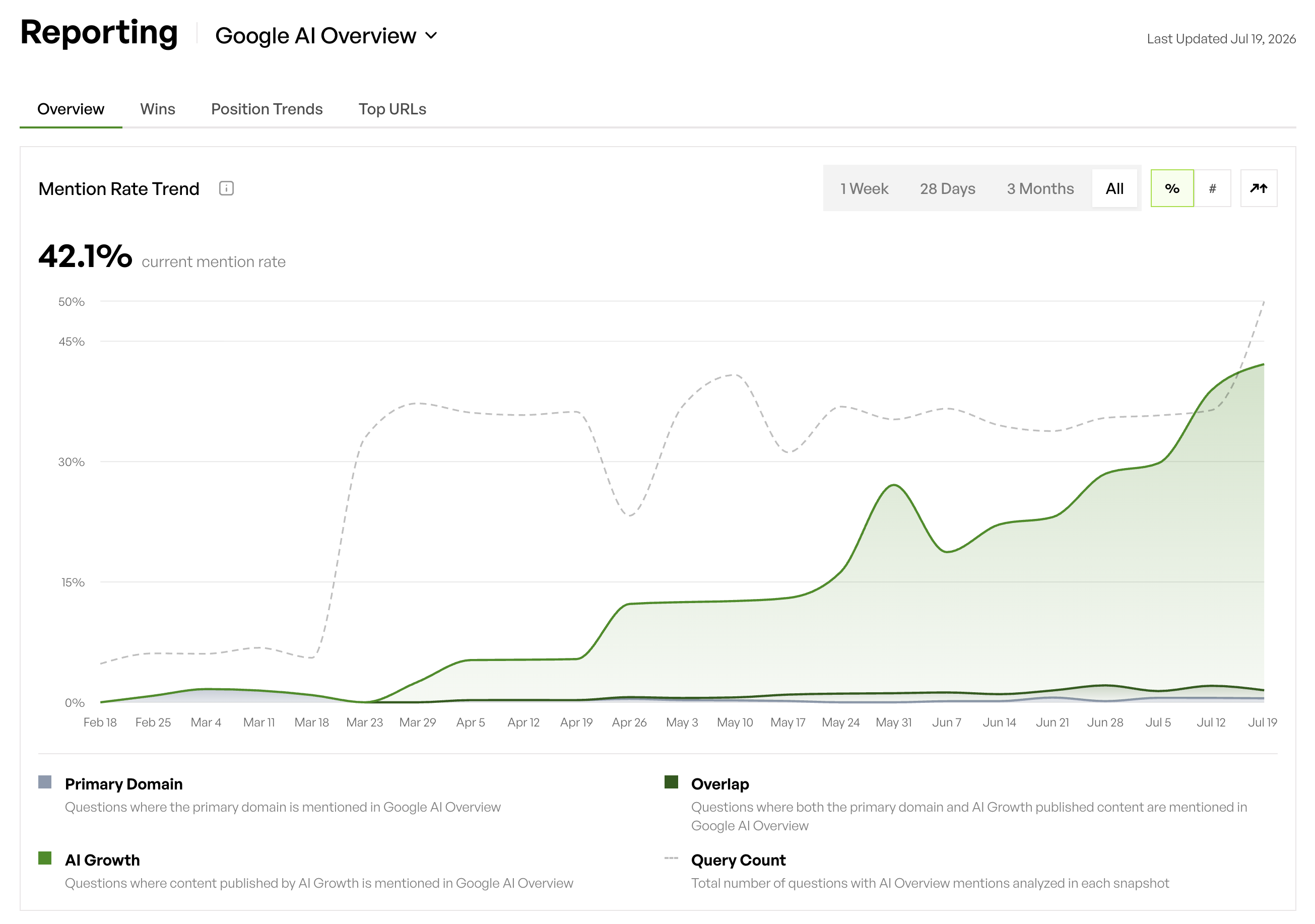
The four metrics that isolate incremental visibility in fintech AI search are as follows, ordered from leading indicator to lagging outcome.
- Bot traffic. Per-article visits from AI crawlers and training agents, separated from human traffic. This metric acts as the leading indicator of future citations. AI Growth Agent clients average more than 100,000 additional bot visits in the first 12 weeks.
- Citation rate. The frequency with which AI responses cite the brand for target queries, tracked weekly against a pre-program baseline. Teams can observe citation changes after content optimization.
- Google Search Console impressions. An independent audit of new impressions generated by the content program, cross-referenced against the brand's existing GSC baseline to isolate incremental lift. AI Growth Agent clients average a 20% or greater impressions lift in the first 12 weeks.
- Share of voice. The brand's citation frequency relative to tracked competitors across target queries. A brand mentioned 4 times among 16 total competitor mentions registers as 40% visibility but only 25% share of voice, a distinction that matters when reporting to a board that wants to know whether the brand is winning or simply present.
Sixty-eight percent of B2B buyers already have a front-runner vendor in mind at the very start of their purchasing process, and that front-runner wins 80% of the time. The brand that earns the citation before the buyer opens a conversation owns the deal before the sales team knows it exists.
AI Growth Agent: Headless Engine for Fintech Narrative Control
Traditional search tools show you where your brand stands. AI Growth Agent turns your brand into the answer. Unlike traditional agencies or monitoring tools, AI Growth Agent replaces the entire agency stack and self-heals content so authority compounds rather than decays.
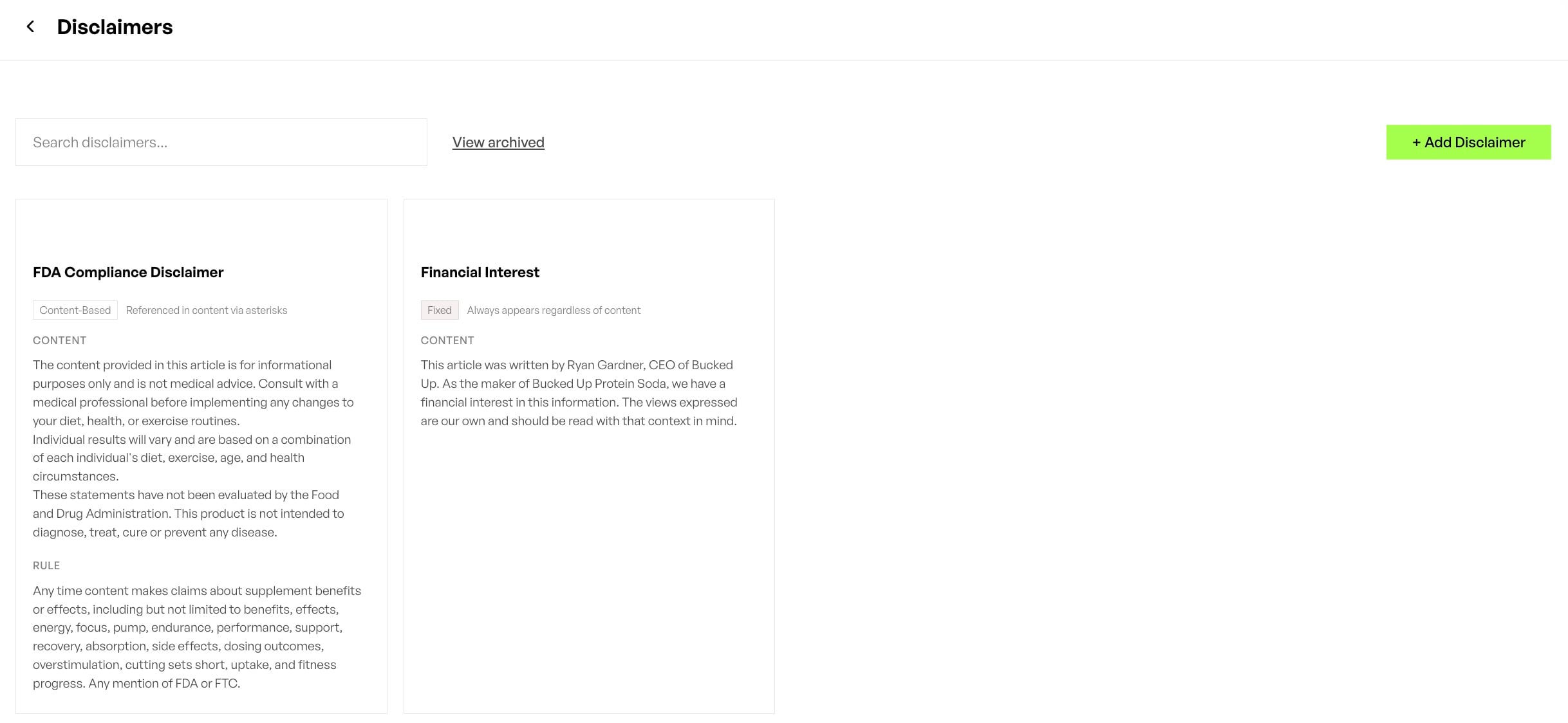
For fintech CMOs, the specific advantages are structural. The engine provisions valid schema for FinancialProduct and Organization entities, applies legal disclaimers and compliance language configured once and applied everywhere, validates every claim and source against primary evidence rather than a model's training data, and tracks every bot interaction at the article level. There is no RFP, no year-long ramp, and no agency controlling the site. The brand owns the property outright, connected through a reverse proxy rewrite under its own domain.

Celcoin, a Banking as a Service platform in Brazil, reached the number one position for “melhores plataformas de credit as a service Brasil,” more than 20% share of voice, and over 100 mentions across high-intent queries. Jota, an AI-powered personal finance brand, achieved a traffic increase above 190% from generated content over three months and 72% visibility across 310 tracked searches within seven months of launch.
Request a consultation to see how AI Growth Agent builds your fintech answer library and earns citations across ChatGPT, Perplexity, and Google AI Mode.
Frequently Asked Questions
What makes a fintech generative engine optimization strategy different from standard GEO?
Fintech operates in a YMYL (Your Money or Your Life) category, which means AI engines apply stricter source filters, cite fewer domains per response, and discount promotional content more aggressively than in other verticals. A fintech LLMO strategy must prioritize compliance-safe, answer-first content with named authors carrying real credentials, structured data for financial products, and claims validated against primary regulatory sources. Hallucinated rates or incorrect fee statements count as compliance exposures in fintech, not simple marketing errors. The strategy must also reflect that 88% of citations for financial services in AI responses come from brand-managed sources, so owned content quality directly determines citation share in a way that differs from sectors where third-party review sites dominate.
How does the fintech answer library become a proprietary citation asset?
A fintech answer library becomes proprietary when it rests on data that competitors cannot replicate from public sources. Transaction benchmarks, compliance audit findings, API performance data, and original market research all qualify. When that data appears as crawlable HTML with full schema, mapped to the specific long-tail queries buyers ask across AI surfaces, and refreshed as regulations and market conditions change, it creates a citation moat. Generic content produced by any chatbot cannot displace it because the underlying data remains exclusive. The answer library also compounds over time. Every new article adds internal linking authority to existing pages, and every citation earned trains the next generation of models with the brand's own narrative rather than a competitor's.
What are the four pillars of fintech AI search, and why do all four need to run simultaneously?
The four pillars are Search Intelligence, AI Analytics, Bot Tracking, and AI Ranking. Search Intelligence maps the full universe of queries and diagnoses the competitive landscape. AI Analytics tracks brand value and consumer behavior across the entire buyer journey, from AI tool queries through content consumption and sentiment. Bot Tracking logs every crawler and AI training agent interaction at the article level, providing the leading indicator of future citations. AI Ranking monitors where the brand appears in AI answers, what claim it is cited for, and how that position evolves week over week against the content plan. All four must run simultaneously because each pillar feeds the others. Search Intelligence defines what to produce, AI Analytics measures how it performs, Bot Tracking reveals who is reading it, and AI Ranking shows whether it is winning the citation slot. Running only one or two pillars produces incomplete data and leaves the brand reacting to gaps rather than closing them proactively.
How long does it take for a fintech brand to see measurable results from an LLMO program?
Fintech brands can often observe citation changes after content optimization, while establishing a stable share of model takes additional time. The first article typically goes live within a week of kickoff, and content has indexed in as little as 10 days. The standard engagement is a 90-day pilot because indexing timelines vary by competitive density and domain authority, but fintech brands investing in structured, compliance-first content designed for AI extraction have gained citation share within 90 to 120 days. The brands that see results fastest are those that launch with a complete technical and agentic SEO stack on day one, including schema, llms.txt, Blog MCP, and per-article bot tracking, rather than adding those elements incrementally after content is already published.
Why is headless marketing the right architecture for fintech AI search, rather than an agency or a monitoring tool?
Agencies move too slowly for the current pace of AI search. An RFP often runs about three months, followed by three more months to produce the first assets, which means close to a year before anything meaningful reaches the market. Monitoring tools identify that a brand is missing from AI answers but stop there, leaving the entire content production and publishing problem unsolved. Headless marketing replaces both with one engine. It maps the universe, produces evidence-based living content, stands up a fully optimized site the brand owns within the first week, and self-heals content so authority compounds rather than decaying. For fintech specifically, the headless architecture also removes the agency dependency that often means the brand does not own its own site, a structural risk in a regulated industry where content accuracy and update speed function as compliance requirements, not just marketing preferences.