Written by: Mariana Fonseca, Editorial Team, AI Growth Agent
Key Takeaways
- MedTech AI search visibility depends on four specialized data pillars: Search Intelligence, AI Analytics, Bot Tracking, and AI Ranking. Generic GEO tactics fail when hospital Value Analysis Committees and procurement teams query LLMs for FDA-cleared devices.
- Seven best-practice pillars govern citation share. These include indication-specific content clusters, answer-first writing backed by FDA clearances and peer-reviewed studies, named physician authorship with MedicalOrganization schema, and stakeholder-specific resources for procurement, IT, and clinical engineering.
- Technical SEO must combine traditional healthcare schema such as MedicalWebPage, MedicalCondition, and Physician with agentic requirements such as Blog MCP, llms.txt, and OpenAI discovery so AI systems can parse and trust clinical content.
- A 10-step implementation roadmap and 90-day living-content schedule keep evidence current, track incremental AI citations, and maintain citation authority as guidelines, RWE, and FDA records change.
- AI Growth Agent executes this playbook headless at scale. Schedule a demo to see how your device portfolio can own clinical and procurement queries without added headcount.
The Discovery Shift in MedTech Search Behavior
Hospital procurement is shifting from relationship-driven vendor lists to algorithmic shortlists powered by large language models. A 2025 JAMA Network Open study by ONC researchers of nonfederal US acute-care hospitals found that 31.5% had integrated generative AI with their EHR systems in 2024, with 24.7% planning adoption within 12 months. Hospital Value Analysis Committees and procurement teams now prompt ChatGPT, Claude, Perplexity, and Google Gemini to synthesize clinical trial data, compare device specifications, and identify alternative suppliers during pre-screening.
The evidence base for those answers does not come from manufacturer promotional pages. VayoMed’s analysis of LLM responses to clinical, regulatory, and purchasing queries suggests that answers draw from medical literature, FDA registries, trade publications, and professional society guidelines, not from feature-forward marketing copy. When VayoMed analyzed product mentions across FDA-registered brands, they found significant variation, with leading brands receiving more mentions than others. A device company that publishes only promotional content is invisible in that synthesis, and the concentration at the top reflects deliberate content architecture.
Four pillars of intelligence determine which devices appear in AI answers and which remain absent.
- Search Intelligence maps the full traditional search landscape for a device category. It covers positioning, competition, search volume, and the structure of who already wins indication-specific and regulatory queries.
- AI Analytics tracks brand value and buyer behavior across the entire journey. It connects external touchpoints such as ChatGPT and Google AI Mode queries with content consumption, demographics, and sentiment among clinicians and procurement stakeholders.
- Bot Tracking records every bot interaction, including AI training agents and citation crawlers. This confirms whether clinical content is being read and cited or simply ignored.
- AI Ranking replaces the static rank position with order of mention and citation context in AI answers. It tracks where a device appears in the answer and how that position changes against the content plan week over week.
Teams that cannot see all four pillars are flying blind in a channel that already shapes procurement shortlists.
Seven Best-Practice Pillars for MedTech AI Citation Share
These seven pillars define the evidence standards, stakeholder queries, and technical requirements that govern AI citation in regulated MedTech environments. Generic GEO advice does not address these realities.
1. Build Content Around Indication-Specific Use Cases
AI systems retrieve device information by matching queries to specific clinical indications, patient populations, and procedural contexts. Content organized around product features rather than indications conflicts with how procurement and clinical queries are formed. When hospital buyers query AI engines for alternatives to specific devices, the models retrieve data primarily from FDA product code databases, GUDID records, ClinicalTrials.gov results tables, and open-access PubMed Central articles. Indication-specific content that mirrors those source structures earns citation, while feature marketing does not.
2. Lead With Answers Backed by FDA Clearances and Clinical Evidence
Answer-first writing functions as a citation requirement in MedTech, not a stylistic choice. Technical SEO and schema implementation determine whether AI systems such as Google AI Overviews, ChatGPT, Claude, Gemini, and Perplexity can confidently extract, synthesize, and cite healthcare content instead of defaulting to better-structured competitors. Every high-stakes clinical page should open with a direct answer to the primary clinical question, followed by the FDA clearance pathway, supporting study data, contraindications, and recall hazard context.
The regulatory stakes for missing this structure are concrete. A 2026 retrospective cohort study published in JAMA Network Open analyzing 903 FDA-authorized AI-enabled medical devices found that devices with missing information on supporting clinical studies had a higher likelihood of recall than devices with published clinical studies. If the regulatory record reflects missing clinical study information, AI systems synthesizing that record will surface the same gap.
3. Prove Clinical Credibility With Named Physicians and MedicalOrganization Schema
For YMYL topics including healthcare, LLMs require medical professional review and attribution (MD, RN, or PharmD) before citation, which creates measurable authority differences compared with generic content optimization tactics. Named clinician authorship functions as a prerequisite for citation in clinical and procurement queries.
Using Article schema with author name, credentials, and a link to the author’s bio page on educational content provides a direct E-E-A-T signal that helps Google associate the page with a qualified medical professional. MedicalOrganization schema on the company entity, combined with Physician schema on named authors and sameAs references to NPI profiles and board certification pages, builds the entity graph that AI systems use to verify clinical authority.
4. Publish Stakeholder-Specific Resources for Procurement, IT, and Clinical Engineering
Stakeholder-specific content reflects the reality that procurement officers, clinical engineers, and physicians ask structurally different questions. Clinicians evaluating AI tools for clinical use prioritize integration with existing medical record systems, specialty-specific validation evidence, accuracy profiles and error-handling workflows, data security and privacy posture, independent real-world clinical validation, and fit with actual clinical workflows. Procurement teams focus on total cost of ownership, compliance documentation, and supplier credibility signals. A single generic product page cannot satisfy both sets of queries, so separate stakeholder-specific content clusters are required.
5. Combine Traditional Healthcare Schema With Agentic Technical SEO
MedicalWebPage, MedicalCondition, MedicalProcedure, Physician, and MedicalOrganization schema create the machine-readable entity map that AI systems parse when synthesizing device information. The schema stack for healthcare sites should encode explicit entity relationships, including providers linked to organizations via memberOf or affiliation, providers connected to specialties via medicalSpecialty and availableService, and conditions tied to treatments via possibleTreatment or usedToDiagnose to form an internal knowledge graph.
Agentic technical SEO now sits alongside traditional schema. Blog MCP enables direct interoperability with AI search agents. Llms.txt and llms-full.txt allow AI surfaces to read the brand in the formats they need. OpenAI discovery served via /.well-known/ helps agent crawlers find and cite the content. FAQPage schema is particularly valuable because AI tools can extract and reference specific Q&A pairs instead of paraphrasing unstructured content.
6. Build Content Clusters for the Long Tail of Clinical Prompts
Healthcare verticals show a lower top-10 citation rate in AI Overviews compared with technology, so regulated industries experience larger divergence between organic rankings and AI citations. Strong rankings in traditional search therefore do not guarantee AI citation in MedTech. Content clusters built around the long tail of indication-specific, regulatory, and procurement prompts close that gap. Each seed term, such as a device category or a clinical indication, should generate dozens of long-tail content pieces that collectively build authority across the full query surface.
7. Maintain Living, Self-Healing Content and Track AI Citations
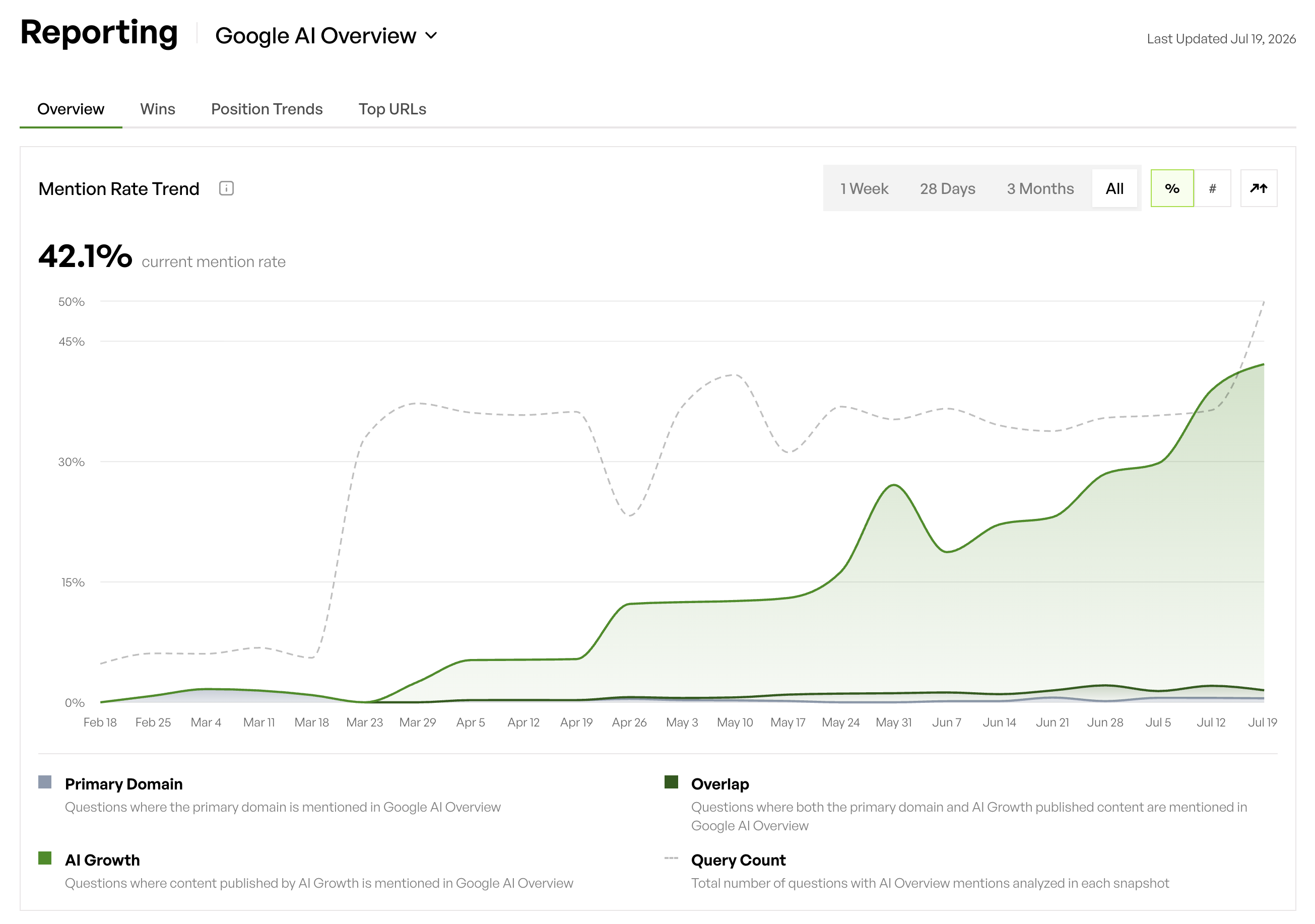
Procurement algorithms deprioritize suppliers with outdated or buried proof even when they are long-standing partners. Content that goes stale after publication loses citation share to competitors that refresh their evidence base. Living content, updated automatically when clinical guidelines change, new RWE appears, or FDA clearance records update, maintains citation authority over time.
Bot tracking that records every AI training agent and citation crawler confirms whether content is being read and cited. This visibility data supports continued investment and guides future content updates.
The seven pillars establish what MedTech AI citation requires. The following 10-step roadmap translates those requirements into a sequenced execution plan.
10-Step Implementation Roadmap
- Conduct a full universe mapping of indication-specific, regulatory, and procurement queries across your device categories using real-time Google and ChatGPT data as the objective function.
- Audit existing content against the four pillars of Search Intelligence, AI Analytics, Bot Tracking, and AI Ranking, and identify gaps in clinical evidence coverage and stakeholder-specific resources.
- Deploy MedicalOrganization, Physician, MedicalWebPage, MedicalCondition, MedicalProcedure, and FAQPage schema across all clinical and product pages in JSON-LD format.
- Implement agentic technical SEO, including Blog MCP, llms.txt and llms-full.txt, OpenAI discovery via /.well-known/, and natural language query parameters that return structured responses to agent crawlers.
- Assign named physician or clinical authors to every high-stakes clinical page, with credentials, NPI sameAs references, and a defined editorial review workflow that includes re-review triggers.
- Publish indication-specific content clusters for each device category, and open each piece with a direct answer supported by FDA clearance data, peer-reviewed study citations, and contraindication disclosures.
- Create separate stakeholder-specific resource hubs for procurement, clinical engineering, and clinical decision-makers, each structured around the queries those audiences actually ask AI systems.
- Establish bot tracking across all published content to record AI training agent and citation crawler interactions, and confirm which content is being read and cited by which AI surfaces.
- Implement living content workflows with automatic refresh cycles triggered by Google Search Console signals, new RWE publications, FDA clearance updates, and annual content renewal for every article in each device category.
- Report incremental AI citation share and bot traffic week over week, and isolate the visibility generated by new content from the visibility the brand already held.
90-Day Living-Content Roadmap
The following timeline shows how the 10-step roadmap converts into a phased execution schedule, with specific milestones and outputs for each stage of the first 90 days.
| Phase | Timeline | Milestone | Output |
|---|---|---|---|
| Kickoff | Week 1 | Universe mapping and manifesto complete | Keyword topology, first indication-specific articles published |
| Indexing | Weeks 2-3 | First content indexed by AI surfaces | Bot tracking active, initial citation data visible |
| Cluster Build | Weeks 4-6 | Stakeholder-specific hubs live for procurement, clinical engineering, and clinical leads | Schema deployed across all entity types, FAQPage markup active |
| Citation Tracking | Weeks 7-9 | Incremental AI citation share baseline established | Weekly reporting on citation context, order of mention, and bot traffic by content piece |
| Self-Healing Cycle | Weeks 10-12 | First living-content refresh triggered by Search Console and RWE signals | Updated articles, compounding authority, 90-day incremental visibility report |
FDA Clearance Checklist for AI-Citable Content
Every high-stakes clinical page should include the following five elements to meet AI citation requirements in regulated MedTech environments.
| Required Element | Content Requirement | Primary Source | Schema Property |
|---|---|---|---|
| FDA Authorization Pathway | 510(k), De Novo, or PMA designation with submission number | FDA AI-Enabled Medical Device List | MedicalDevice, identifier |
| Clinical Study Information | Study design, sample size, comparator, primary endpoint; see recall hazard data above | PubMed/PMC, ClinicalTrials.gov | MedicalTrial, studyDesign |
| Recall and Hazard Data | Recall history, hazard classification, corrective action; incorrect use associated with elevated recall hazard | FDA CORE-MD PMS Tool, MedWatch | MedicalWebPage, lastReviewed |
| Contraindications | Explicit contraindication list with patient population scope | FDA 510(k) Summary, IFU | MedicalContraindication |
| Real-World Evidence | Post-market RWE from registries, EHR aggregators, or claims data; see FDA RWE examples cited above | NEST, FDA RWE Guidance Dec 2025 | MedicalStudy, evidenceOrigin |
Use-Case Template for Indication-Specific Content
The following examples show how to structure indication-specific content for different stakeholder queries, including the evidence and schema needed for each clinical use case.
| Indication | Stakeholder Query Type | Required Evidence | Schema Type |
|---|---|---|---|
| Diabetic Retinopathy Detection | Clinical: sensitivity and specificity for my patient population | Prospective validation study; narrow-task AI models show high accuracy for diabetic retinopathy detection across multiple prospective studies | MedicalCondition, MedicalTrial, Physician (reviewer) |
| Hemodynamic Instability Prediction | Procurement: FDA clearance and RWE basis | FDA clearance record; FDA relied on retrospective ICU medical record data to support clearance of an ML-based software function predicting hemodynamic instability (K200717) | MedicalDevice, MedicalWebPage, FAQPage |
| ECG Left Ventricular Function | Clinical Engineering: integration and validation data sources | Multi-site validation; FDA evaluated AI-enabled ECG software functions (K250119 and K250649) using medical record data from multiple US sites | MedicalProcedure, MedicalOrganization, Article (named author) |
| Sleep Study Event Detection | Procurement: alternative supplier comparison | Archived clinical data validation; FDA evaluated automatic event detection software for polysomnography using archived sleep recordings from routine clinical care (K241960 and K221179) | MedicalCondition, MedicalDevice, FAQPage |
Frequently Asked Questions
What is MedTech AI search visibility?
MedTech AI search visibility describes how often a medical device company’s content is discovered, cited, and recommended by AI systems such as ChatGPT, Perplexity, Google AI Mode, and Claude when clinicians, procurement officers, and clinical engineers query those systems for device information. Traditional search visibility relies on organic rank position, while AI search visibility relies on citation share, order of mention in AI answers, and the citation context in which a device or company appears. In regulated MedTech environments, AI citation depends on clinical evidence, FDA clearance documentation, named clinical authorship, and structured data that AI systems can parse and trust, not on promotional content or keyword density.
How long does it take to see AI citations after publishing?
Most teams see AI citations only after they combine strong content with correct technical implementation on the right AI surfaces. With full technical and agentic SEO deployed, including proper schema, llms.txt, Blog MCP, and instant indexing, content can begin appearing in AI citations within two to four weeks of publication. AI Growth Agent clients across industries have seen first citations within two to three weeks of their first article going live. In MedTech, the timeline can extend slightly because AI systems apply higher evidence standards to YMYL content, so clinical authorship, FDA clearance references, and peer-reviewed citations must be present and verifiable before citation occurs. Living content that is refreshed regularly maintains and grows citation share over time instead of peaking and decaying.
Who owns the content and technical implementation?
With AI Growth Agent, the client owns all content outright from the moment it is published. The site AI Growth Agent stands up remains the client’s property and connects to their domain through a reverse proxy rewrite or subdomain. There is no agency lock-in, no dependency on AI Growth Agent to access or modify the content, and no per-article or per-prompt billing. The technical implementation, including schema, Blog MCP, llms.txt, robots.txt, sitemaps, and bot tracking, is provisioned automatically and included in every package. The client’s internal team needs no technical skill to operate the system because feedback is given in plain language and the engine applies it to every future generation.
How does headless marketing integrate with existing MedTech sites?
Headless marketing keeps the client’s existing site and structure intact while adding a separate, fully optimized blog. AI Growth Agent stands up this blog, styles it to match the client’s brand, and connects it through a reverse proxy rewrite under a subdirectory of the client’s domain or through a subdomain. This approach keeps top-of-funnel clinical and procurement content under the client’s domain authority without interfering with the curated main site, product pages, or regulatory documentation. The only integration step required from the client is the reverse proxy rewrite configuration, with setup documentation tailored to the client’s hosting environment, including Cloudflare, Vercel, or other providers.
How is incremental AI visibility measured in a MedTech context?
Incremental AI visibility is measured by separating the citation share, bot traffic, and Google Search Console impressions generated by new content from the visibility the brand already held before AI Growth Agent began publishing. This separation is possible because AI Growth Agent publishes into a separate environment and reports week over week on what it specifically generated. In MedTech, the most meaningful metrics include citation rate by indication-specific query, order of mention in AI answers for clinical and procurement prompts, bot traffic from AI training agents and citation crawlers to clinical content pages, and Google Search Console impressions for long-tail regulatory and clinical queries. These metrics are cross-referenced weekly so the content plan doubles down on what earns citation and uses internal linking to lift content that is not yet performing.
Conclusion: Control the Narrative in Regulated AI Search
The discovery shift is already reshaping how hospital procurement teams, clinical engineers, and physicians find and evaluate medical devices. AI systems now synthesize clinical evidence, FDA clearance records, and peer-reviewed literature to produce device shortlists, and the brands that appear in those answers are the ones that have built content architectures aligned with how AI systems retrieve and cite regulated information.
Generic GEO advice does not address clinical authorship requirements, FDA clearance documentation, indication-specific content clusters, or the stakeholder-specific query structures that govern procurement and clinical evaluation. The four pillars of MedTech AI search visibility, Search Intelligence, AI Analytics, Bot Tracking, and AI Ranking, provide the data foundation. The seven best-practice pillars provide the content and technical architecture. The 10-step roadmap and 90-day schedule provide the execution sequence.
The brands cited in AI search this year are training the next generation of models with their own clinical narrative. Brands that wait leave that narrative to whatever happens to be indexed on the open web.