Written by: Mariana Fonseca, Editorial Team, AI Growth Agent
Key Takeaways for Agency AI Visibility
- Client AI visibility solutions combine universe mapping, authoritative content production, owned-site publishing, and incremental visibility reporting to shape what AI Mode and ChatGPT search say about client brands.
- Monitoring-only tools fail agencies because they document problems without fixing them, which drives unsustainable labor costs and higher client churn.
- Agencies get better outcomes when they package AI visibility as productized retainers with paid audits, three service tiers, documented delivery playbooks, and three-month minimum engagements.
- A complete AI visibility offering requires six core components delivered from one headless engine: universe mapping, content production, technical publishing, prompt monitoring, white-label reporting, and incremental visibility proof.
- AI Growth Agent replaces fragmented monitoring platforms with one headless engine that delivers the full workflow without new headcount, so see how it powers your agency’s AI visibility retainers.
Why Monitoring-Only Tools Fail Agencies
Monitoring platforms tell agencies where a client brand stands in AI answers, but they do not change what those answers say. That gap between visibility and action is the core failure of the monitoring-only model for agencies that must deliver measurable outcomes.
The operational math makes the problem concrete. Tracking 10 client brands across 30 to 50 queries each on five AI engines without automated tooling consumes roughly 40 hours per month in manual data collection before any improvement work begins. Monitoring tools cap prompt counts, charge per query, and produce reports that document a problem without solving it. Agencies then carry the burden of producing and publishing content, wiring schema manually, and stitching together a separate stack of tools to act on what the monitor found.
This structure creates a margin problem. Agencies targeting 45 to 55 percent gross margins on AI visibility retainers must keep labor costs under 55 percent of revenue and tooling costs under 15 percent, according to Demand Local and Visiblie packaging benchmarks. A monitoring-only workflow that requires analyst hours for every optimization cycle makes those margins structurally impossible to sustain at scale. Project-based AI visibility work also drives higher annual client churn compared to retainer models because clients who see monitoring data without visible progress cancel.
Agencies that retain clients and protect margin replace the monitoring-plus-manual-execution stack with a single engine that produces, publishes, and proves results. To deliver that unified solution profitably, agencies need a structured service offering that clients can understand and buy.
Packaging AI Visibility as a Productized Agency Service
Packaging a repeatable AI visibility offering means shifting from bespoke project work to a productized retainer with defined deliverables at each tier. The sequence below reflects how forward-thinking agencies structure this in 2026.
- Start with a paid audit. A one-time audit priced between $1,500 and $5,000 qualifies prospects, pre-funds month one of service, and converts directly into a retainer. This entry-point structure is the most common conversion mechanism among agencies productizing AI visibility in 2026.
- Define three retainer tiers. A Basic tier serves SMB clients, a Standard tier serves mid-market clients, and a Premium tier serves enterprise accounts. Each tier has fixed deliverables, a fixed price, and a minimum engagement term. Mid-market AI visibility retainers in 2026 run $5,000 to $12,000 per month, reflecting higher tracking costs and a smaller specialist pool than traditional SEO.
- Build a delivery playbook. Agencies document every step of the process, including what happens in week one, who owns each task, and where the engine handles execution automatically. Agencies that document delivery playbooks before scaling make productized services repeatable across clients without re-briefing at each engagement.
- Set a three-month minimum. Entity foundations stabilize in 30 days, citation deltas appear on 20 to 30 percent of tracked prompts in 60 to 90 days, and measurable shifts in share of AI answers require a full quarter. A three-month minimum aligns client expectations with the actual timeline of results.
- Assign a Directly Responsible Individual per client. Each client engagement requires one person who sets strategy, owns the monitoring cadence, coordinates across functions, and adapts to AI platform changes. Without a named DRI, multi-client delivery quickly degrades into reactive firefighting.
- Pilot with three existing clients before broad launch. Testing a new productized service with three existing clients at a discounted rate refines scope, process, and pricing before the offering goes to market.
Explore the packaging workflow that protects your margins and turns audits into retainers, then schedule a consultation.
The Six Core Components of a Scalable AI Visibility Offering
A complete client AI visibility solution requires six components that work together. Agencies that deliver all six from one engine protect margin and retain clients, while agencies that deliver only monitoring hand the hard work back to themselves.
- Universe mapping. A full map of the client's seed terms and long-tail queries comes from real-time Google and ChatGPT data, refreshed weekly. This comprehensive approach matters because most monitoring tools cap prompt counts, which forces agencies to choose which queries to track. A complete universe mapping approach removes that constraint by tracking hundreds of queries per client with prompt count never a billed metric, so the agency sees the entire conversation rather than just the slice the client already thought to ask about.
- Authoritative content production. Answer-optimized content is produced at scale with validated primary sources, anti-hallucination checks, and brand voice enforcement. AI-powered workflows let small teams deliver productized content packages to more clients than they could support with the same volume of bespoke content work.
- Owned-site publishing with full technical SEO. Content publishes to a site the client owns, with schema, sitemaps, robots.txt, MCP endpoints, llms.txt, and agent discovery configured automatically. Many brands are not crawled by major AI crawlers, so crawler-access gaps become a structural problem that publishing infrastructure must solve.
- Prompt monitoring and AI ranking tracking. Citation context, order of mention, and share of AI answers are tracked across ChatGPT, Perplexity, Google AI Mode, and other surfaces. Models frequently disagree on brand recommendations across major AI engines, which makes multi-platform tracking a requirement rather than an optional extra.
- White-label reporting. Client-facing reports include an executive narrative, citation evidence, competitor movement, and recommended next actions, all delivered under the agency's brand. White-label reporting is a non-negotiable feature for agency AI visibility tools because reports without vendor logos are essential for retainer justification and client retention.
- Incremental visibility proof. Reporting isolates the visibility the engagement actually generated, separate from visibility the client already had. This metric protects retention. Clients who see monitoring data without visible progress cancel, while clients who see a weekly delta of new citations, bot visits, and impressions renew.
Compare your current stack to a headless model that delivers all six components from one engine and see the difference in delivery effort.
White-Label Audit and Reporting Workflows Agencies Can Resell
Resellable white-label delivery rests on three layers that work together: monitoring infrastructure, a branded presentation layer, and analysis tools that produce optimization recommendations rather than raw data dumps.
At the reporting layer, each client needs a separate brand dashboard containing its own prompts, competitors, reports, sources, and actions, with client-safe portals so clients view approved data without seeing other accounts. Automated monthly reports must include citation counts by model, competitor comparisons, perception shifts, trend charts, and a one-paragraph executive narrative. Automated monthly client reports delivered this way demonstrate ROI and support retention without requiring additional manual work per client.
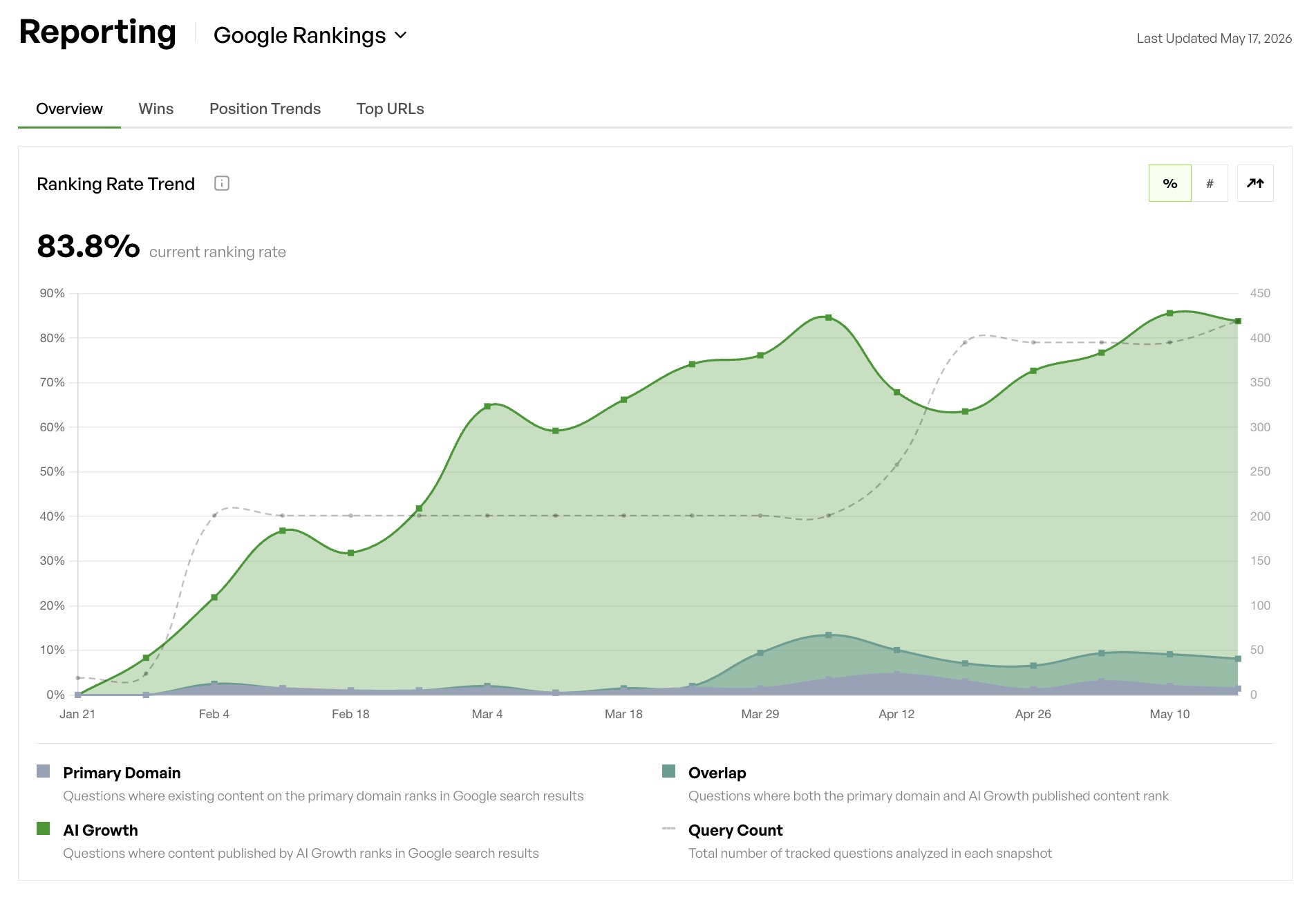
At the audit layer, a paid entry-point audit scoped to 50 to 200 queries across three to five AI engines, delivered in two to five weeks, converts prospects into retainer clients while pre-funding the first month of service. Comprehensive audits with competitive benchmarking span a range of price points in 2026, so agencies can match scope to client size.
Integrating AI Visibility into Existing SEO and PR Retainers
AI visibility fits into existing retainers as an upsell rather than a replacement. Agencies commonly upsell AI visibility optimization as an add-on to existing SEO retainers at a 20 to 30 percent uplift on current monthly recurring revenue.
For PR agencies, the integration point centers on earned media. Earned media drives 84% of AI citations across ChatGPT, Claude, and Gemini (holding between 82% and 89% across three consecutive Muck Rack reports since July 2025), which means press placements and AI visibility are structurally complementary rather than competing services. An agency that adds owned-site content production to its press and influencer work delivers both the citation source and the citation itself.
The practical integration sequence starts by running the universe mapping and Content Topology alongside existing keyword research, which identifies the gaps between what the client ranks for in traditional search and what AI platforms say about them. That gap analysis then informs the content engine, which produces answer-optimized articles that support press narratives and fill those visibility gaps. Finally, agencies add incremental visibility reporting as a new section of the existing monthly client report to demonstrate the impact of this new content layer. The agency's existing retainer structure stays intact, and the AI visibility layer adds a high-margin recurring line without new headcount.
Multi-Client Workspace and Prompt-Monitoring Requirements at Scale
Agencies managing 10 or more client brands need multi-client workspace architecture with strict data isolation. Production-ready AI agent platforms for agencies must support always-on execution via hosted infrastructure so recurring reports, monitoring, and client operations run unattended 24/7 without manual prompting.
At five or more clients, manual query testing across AI engines becomes the delivery bottleneck. Manual testing of multiple queries across AI engines can take several hours per client per month, so automated tooling delivers clear ROI at that scale. The workspace model must support per-client isolation, standardized prompt templates by vertical, portfolio health views that scan multiple clients by visibility change and report readiness, and API access for custom dashboards.
Security requirements at scale include per-client data isolation, audit logs, and human-in-the-loop approval gates before agencies can safely handle multi-client data with autonomous agents. Agencies evaluating AI agent platforms should track ROI via hours saved per account manager per week, cost per automated client report, and reductions in churn caused by missed follow-ups.
Incremental Visibility Proof That Protects Client Retention
Incremental visibility reporting acts as the retention mechanism that separates agencies delivering results from agencies delivering dashboards. The core requirement is publishing into a separate environment so the engine can take credit only for the visibility it actually generates, never for visibility the client already had.
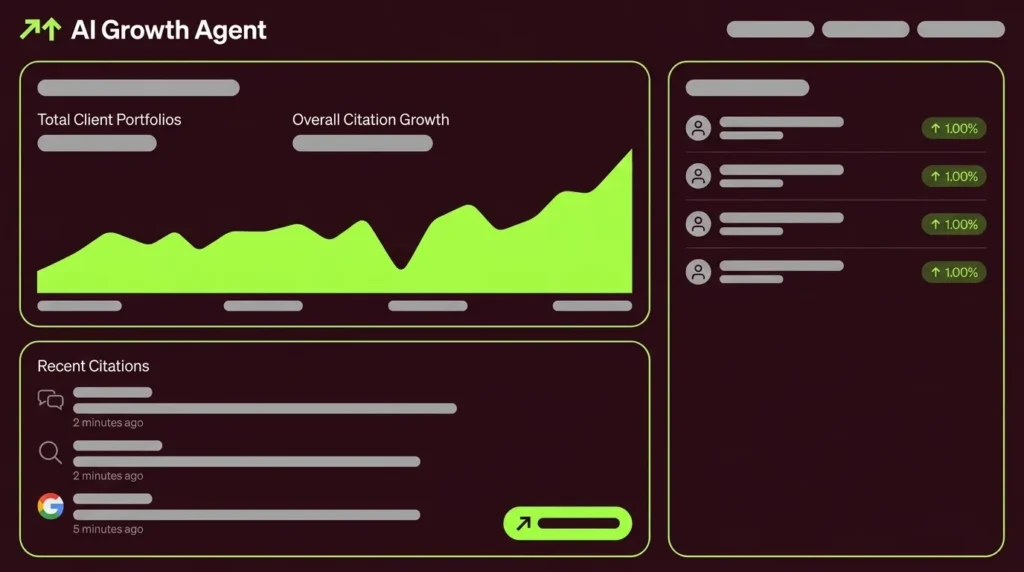
The metrics that matter are brand mention rate, citation rate, Google Search Console impressions, and bot traffic, reported week over week as a delta rather than an absolute. Clients who see a weekly lift in new citations and bot visits from AI crawlers have a concrete answer for why the retainer is worth renewing. Clients who see only a snapshot of current visibility have no way to attribute improvement to the agency's work.
Referrals from ChatGPT convert at 14.2 percent versus 2.8 percent for conventional organic traffic, which means incremental visibility in AI answers has measurable downstream revenue impact. Agencies that surface this conversion differential in client reporting build a retention argument that monitoring-only tools cannot match.
AI Growth Agent clients average more than 12,000 additional AI citations and mentions, over 100,000 additional bot visits, and a 20 percent or greater lift in impressions across the first 12 weeks, with content indexing in as little as 10 days.
Headless Architecture for AI Visibility Without New Headcount
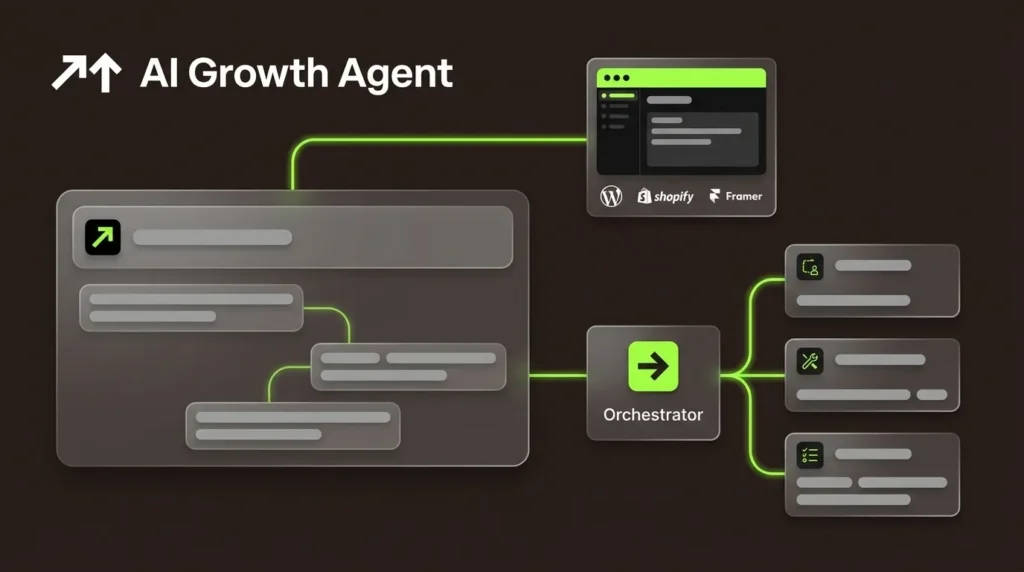
Headless marketing applies the architecture of headless commerce to brand presence in AI search. The client's curated main site stays intact. A fully optimized blog the client owns connects through a reverse proxy rewrite, usually under a subdirectory, and the engine writes, publishes, monitors, self-heals, and reports without any technical work required from the agency or the client.
The alternative requires assembling a stack that includes a content tool, a web agency, a schema plugin, a GEO monitor, an analytics platform, and a PR firm, each with its own contract, onboarding cycle, and integration dependency. An agency RFP alone often runs three months, followed by three more months to produce the first assets. Headless architecture collapses that timeline to one week from kickoff to first published article.
The comparison table below shows how the three service tiers map to deliverables, reporting, and margin potential when built on a headless engine rather than a fragmented stack.
| Tier | Deliverables | Reporting | Margin Potential |
|---|---|---|---|
| Basic | Universe mapping, 2 to 4 content assets per month, schema and technical SEO, owned-site publishing, prompt monitoring across 3 AI platforms | Monthly white-label report with citation counts, competitor comparison, and executive narrative | Achieves the target margin structure at $1,500 to $3,000 per month per client |
| Standard | Full universe mapping refreshed weekly, 4 to 8 content assets per month, full technical and agentic SEO stack, owned-site publishing, prompt monitoring across 5 platforms, incremental visibility reporting | Monthly white-label report plus biweekly strategy check-in, with Google Search Console and bot traffic cross-referenced | 55 to 70% gross margin at $5,000 to $9,000 per month per client for lean white-label operators |
| Premium | Full universe mapping across 1,600+ queries, up to 20+ content assets per month, full technical and agentic SEO stack, multi-platform citation tracking, PR and earned media integration, dedicated strategist | Weekly incremental visibility reporting, monthly executive report, quarterly competitive assessment, with full bot tracking and Search Console audit included | 70%+ gross margin at $10,000 to $18,000 per month per client for agencies using white-label headless delivery |
Map your portfolio to the right service tier and see how a headless engine supports first-article launch within a week when you schedule a consultation.
Frequently Asked Questions
How long does it take to launch an AI visibility service for a new agency client?
With a headless engine like AI Growth Agent, the first published article is typically live within one week of kickoff. Content begins indexing in as little as 10 days. The standard pilot engagement runs three months to align with the timeline described in the packaging section above. Agencies using a fragmented stack of tools and manual workflows typically require three to six months before the first assets are live.
Who on the agency team owns AI visibility delivery?
Each client engagement requires one Directly Responsible Individual who sets strategy, owns the monitoring cadence, coordinates across functions, and adapts to AI platform changes. In a headless delivery model, that person manages the engine's output and client communication rather than executing content production, schema work, or publishing manually. A two- to three-person agency team can manage 15 to 20 clients using this model.
What technical dependencies does the agency need to manage?
The only integration step required on the client side is a reverse proxy rewrite that connects the AI Growth Agent blog to a subdirectory under the client's domain. The engine provisions schema, robots.txt, sitemaps, MCP endpoints, llms.txt, agent discovery, instant indexing, autoredirects, and 404 tracking automatically. No website agency, plugin installation, or engineering hours are required from the agency or the client.
How do agencies measure and prove results to clients?
Incremental visibility reporting isolates the visibility the engagement generated, separate from visibility the client already had. The core metrics are brand mention rate, citation rate, Google Search Console impressions, and bot traffic, reported as a weekly delta. Bot analytics track every AI crawler that touches the client's blog, including the crawler ChatGPT uses to cite sources. Google Search Console serves as an independent audit layer. Agencies surface these metrics in white-label monthly reports with an executive narrative, citation evidence, and competitor movement data.
How does this scale across a portfolio of 10 or more clients?
Headless delivery scales because the engine handles content production, publishing, technical SEO, and self-healing for every client simultaneously. The agency manages strategy and client communication rather than execution. Multi-client workspace architecture with per-client data isolation, standardized prompt templates by vertical, and automated reporting lets a small team run a large portfolio without adding headcount. The margin structure improves as the portfolio grows because fixed tooling costs spread across more retainers while delivery labor stays flat.
What happens when AI platforms change their citation behavior?
Living content self-heals over time. When AI platforms update their citation logic or a client's competitive landscape shifts, the engine refreshes content automatically in response to Google Search Console signals and bot-traffic data. The universe map is refreshed weekly with more than 3,000 searches per mature client, so the agency sees competitive movement in real time and can respond before clients notice a gap. Quarterly governance reviews and annual tool assessments keep the delivery process current with platform changes.
Traditional search tools show you where your brand stands. AI Growth Agent makes your brand the answer. Book a kickoff and see your first article live within a week.