Written by: Mariana Fonseca, Editorial Team, AI Growth Agent
Key Takeaways for A2A Content Pipelines
- The A2A protocol lets autonomous AI agents discover each other, delegate tasks, and exchange typed Artifacts over JSON-RPC 2.0. More than 150 organizations were in production by April 2026.
- A hub-and-spoke orchestration pattern uses a central orchestrator to coordinate specialist agents for research, writing, editing, and publishing through shared contextIds and stateful task lifecycles.
- A2A manages horizontal agent-to-agent coordination, while MCP manages vertical agent-to-tool connections. Together with WebMCP, they form a three-layer stack for structured web access.
- AI Growth Agent combines Search Intelligence, AI Analytics, Bot Tracking, and AI Ranking to map keyword universes, validate claims, provision schema, and report incremental visibility.
- Schedule a consultation session to see how AI Growth Agent turns A2A into a living, self-healing content engine for your brand.
How A2A Runs Multi-Agent Content Workflows
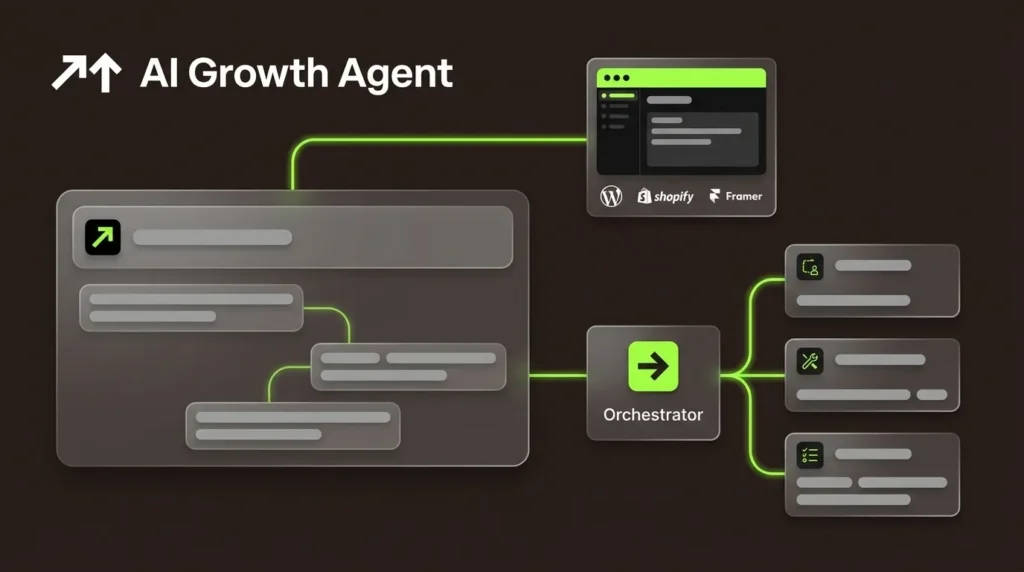
A2A defines three core primitives: Agent Cards (JSON capability manifests), Tasks (stateful units of work), and Artifacts (typed outputs). In a content production stack, an orchestrator agent reads each specialist’s Agent Card, confirms capability compatibility, and delegates discrete work units via JSON-RPC 2.0. Specialists execute in isolation and return Artifacts without exposing internal logic.
To see how this works in practice, walk through the hub-and-spoke orchestration sequence for content production.
The hub-and-spoke orchestration pattern for content production follows this sequence:
- The orchestrator fetches Agent Cards from each specialist at
/.well-known/agent-card.json. - It decomposes the content brief into discrete tasks: keyword research, SERP analysis, drafting, editing, and publishing.
- It submits a Task to the Research Agent with a unique
taskIdandcontextId. - The Research Agent streams progress via Server-Sent Events (SSE) while in the
workingstate. - On completion, the Research Agent returns a structured Artifact containing source URLs, claims, and data points.
- The orchestrator passes that Artifact as input to the Writing Agent, preserving the same
contextId. - The Writing Agent drafts the article and returns a
TextPartArtifact. - The orchestrator delegates to the Editing Agent, then the Publishing Agent, in sequence.
A minimal Task submission from the orchestrator to the Research Agent looks like this:
{ "jsonrpc": "2.0", "method": "message/send", "params": { "taskId": "task-research-001", "contextId": "ctx-article-seo-a2a", "message": { "role": "user", "parts": [ { "type": "TextPart", "text": "Research top-ranking sources and primary claims for: a2a protocol content production" } ] } } }A contextId groups related tasks such as research, writing, and publishing steps across multiple agents. This grouping preserves session continuity across the full pipeline.
A2A Task and Artifact Lifecycle for Articles
A2A defines nine task states: unspecified, submitted, working, input-required, auth-required, completed, failed, canceled, and rejected. The terminal states are completed, failed, canceled, and rejected. For a research-to-publish handoff, the main path is submitted → working → completed. The input-required state surfaces human-in-the-loop checkpoints such as editorial review.
The research-to-publish handoff proceeds as follows:
- The orchestrator submits the research Task, and the state transitions to
submitted. - The Research Agent begins processing, the state transitions to
working, and SSE progress events stream back. - The Research Agent completes, the state transitions to
completed, and a structured Artifact returns. - The orchestrator submits the writing Task with the research Artifact as input.
- The Writing Agent drafts the article, and the state moves through
workingtocompleted. - If editorial review is required, the Editing Agent transitions the task to
input-requiredand surfaces a decision point. - On approval, the task resumes under the same
taskIdand proceeds tocompleted. - The Publishing Agent receives the final Artifact and pushes to the CMS.
A completed research Artifact containing mixed part types looks like this:
{ "artifactId": "artifact-research-001", "name": "A2A Content Research", "parts": [ { "type": "TextPart", "text": "Primary claim: A2A reached 150+ production organizations by April 2026." }, { "type": "DataPart", "data": { "sources": [ { "url": "https://prnewswire.com/...", "claim": "150+ orgs in production" } ], "schema": "ContentResearchSchema/v1" } } ] }AI Growth Agent’s four pillars feed directly into this lifecycle. Search Intelligence supplies the keyword universe that seeds each research Task. AI Analytics shapes the content angle. Bot Tracking confirms which Artifacts are being crawled and cited. AI Ranking measures where completed articles surface in AI answers week over week.
Configuring an A2A Orchestrator for Content
The hub-and-spoke pattern uses a central orchestrator agent that receives input, evaluates intent, delegates tasks to specialized worker agents, aggregates results, and returns a final response. Each specialist publishes an Agent Card at /.well-known/agent-card.json following RFC 8615. This setup lets the orchestrator discover and verify capabilities before any work is delegated.
Use the following steps to set up a content production orchestrator:
- Deploy specialist agents for research, writing, editing, and publishing on separate compute nodes.
- Configure each specialist to serve a signed Agent Card at
/.well-known/agent-card.json. - Register all Agent Card URLs in a central registry that the orchestrator queries at runtime.
- Configure the orchestrator with skill-scoped OAuth 2.0 authorization for each specialist.
- Set a maximum hop count, with five transfers recommended, to prevent recursive loops.
- Instrument all inter-agent calls with W3C
traceparentheaders for distributed observability.
A Writing Agent Card example:
{ "name": "WritingAgent", "version": "1.0", "url": "https://agents.example.com/writing", "protocolVersion": "1.0", "capabilities": { "streaming": true, "pushNotifications": false }, "skills": [ { "id": "draft-article", "name": "Draft SEO Article", "tags": ["content", "seo", "writing"], "inputModes": ["application/json"], "outputModes": ["text/plain", "application/json"] } ], "securitySchemes": { "oauth2": { "flows": { "clientCredentials": {} } } } }AI Growth Agent integrates Search Intelligence, AI Analytics, Bot Tracking, and AI Ranking directly into the orchestrator’s decision logic. Every Task delegation then relies on real-time data instead of static configuration.
Connecting A2A Agents to MCP and Your CMS
A2A operates horizontally between agents for task delegation and coordination, while MCP operates vertically between an agent and its tools, APIs, and data sources. In a content stack, A2A manages the research-to-writing-to-publishing handoff between agents. MCP manages each agent’s calls to external tools such as a CMS, a web search API, or a vector database.
Follow these steps to connect A2A agents to MCP and CMS output:
- Configure each specialist agent as an MCP client that points to its domain-specific MCP server, such as a CMS connector, search API, or database.
- Allow the Publishing Agent to receive the final Artifact through A2A task completion.
- Have the Publishing Agent invoke the Blog MCP tool call to push the article to WordPress with full schema, metadata, and internal links.
- Read the structured response from the MCP server that confirms the publication URL and indexing status.
- Return an A2A Artifact from the Publishing Agent that contains the Blog MCP result and an
llms.txtupdate payload.
A Publishing Agent A2A task that triggers MCP tool calls:
{ "taskId": "task-publish-001", "contextId": "ctx-article-seo-a2a", "artifacts": [ { "artifactId": "artifact-publish-001", "name": "CMS Publication Result", "parts": [ { "type": "DataPart", "data": { "blogMcp": { "url": "https://brand.com/blog/a2a-protocol-content-production", "status": "published" }, "llmsTxt": { "updated": true, "entry": "/blog/a2a-protocol-content-production" } } } ] } ] }The plugin’s out-of-the-box MCP implementation means the Publishing Agent can invoke Blog MCP tool calls immediately, with no additional configuration required.
Choosing Between A2A and MCP in Content Stacks
The table below maps each protocol to its function, content production use, and AI Growth Agent implementation. A2A governs high-level workflow orchestration across agents, while MCP handles execution-layer access to databases, APIs, and files inside each agent.
| Layer | Primary Function | Content Production Use | AI Growth Agent Implementation |
|---|---|---|---|
| A2A (agent-to-agent) | Horizontal task delegation, discovery via Agent Cards, stateful task lifecycle | Orchestrating research, writing, editing, and publishing agents with shared contextId | Orchestrator delegates to specialist agents across OpenAI, Anthropic, Gemini, Grok, Perplexity, Exa, and Firecrawl |
| MCP (agent-to-tool) | Vertical tool access: APIs, databases, CMS connectors via JSON-RPC | Publishing to CMS, vector search, Google Search Console reads, schema provisioning | Blog MCP ships in the WordPress plugin and works with Chrome 146+ and WebMCP-enabled browsers |
| WebMCP (structured web access) | Structured web content access via llms.txt for AI surface consumption | Enabling AI surfaces to read, trust, and cite published content | llms.txt and llms-full.txt publish automatically, and Markdown serves to agent crawlers |
Use the following decision framework when choosing each protocol:
- Use A2A when agents are independently deployed, owned by different teams, or built on different frameworks and must coordinate without sharing internals.
- Use MCP when a single agent needs governed access to external tools, APIs, or data sources such as a CMS or vector database.
- Use both in combination when a multi-agent pipeline requires both inter-agent delegation through A2A and per-agent tool access through MCP.
- Use framework orchestration plus MCP alone when all agents share a single codebase and cross-organizational boundaries do not apply.
AI Growth Agent’s headless marketing architecture implements all three layers. Clients avoid adding engineering headcount, while still owning the site and all content outright.
Scaling A2A Content Production Without New Headcount
Scaling A2A content production means mapping the full universe of seed terms and long-tail queries, applying a strict validation layer, and shipping full schema and agentic technical SEO on every published artifact. Multi-agent systems deliver productivity gains beyond single agents, and agents correct each other’s errors to create self-healing processes during workflow execution.
Use this scaling workflow for A2A content production:
- Search Intelligence runs real-time Google and ChatGPT searches to map hundreds of seed terms and the long-tail queries beneath each one.
- Once the keyword universe is mapped, the orchestrator decomposes it into prioritized Task batches and groups them by
contextIdfor each topic cluster. - With tasks batched and prioritized, Research Agents run in parallel across topic clusters, each streaming SSE progress to the orchestrator.
- Writing Agents receive research Artifacts and produce drafts, and anti-hallucination agents then apply the validation layer described earlier, re-extracting every claim before the draft advances.
- Editing Agents apply brand voice memories, legal disclaimers, and schema markup.
- Publishing Agents push to the CMS via MCP and trigger instant indexing, sitemap updates, and
llms.txtrefresh. - Bot Tracking confirms crawl and citation events, and AI Ranking measures position in AI answers.
- Self-healing agents monitor Google Search Console signals and re-queue stale articles for refresh.
A memory configuration example that enforces brand voice and anti-hallucination rules across all agents:
{ "memoryConfig": { "styleMemories": [ { "rule": "Refer to members as 'members', never 'users'" }, { "rule": "Never use em-dashes, use commas or semicolons" } ], "factualMemories": [ { "claim": "Product launch date: Q1 2024", "source": "manifesto" } ], "antiHallucinationFocus": ["pricing claims", "ingredient amounts"], "primarySources": ["https://brand.com/product", "https://brand.com/about"] } }Measuring Incremental Visibility from A2A Pipelines
Incremental visibility reporting isolates the visibility an A2A pipeline actually generated from the visibility a brand already had. AI Growth Agent publishes into a separate environment and cross-references Bot Tracking, Google Search Console, and AI Ranking data to produce week-over-week proof of impact.
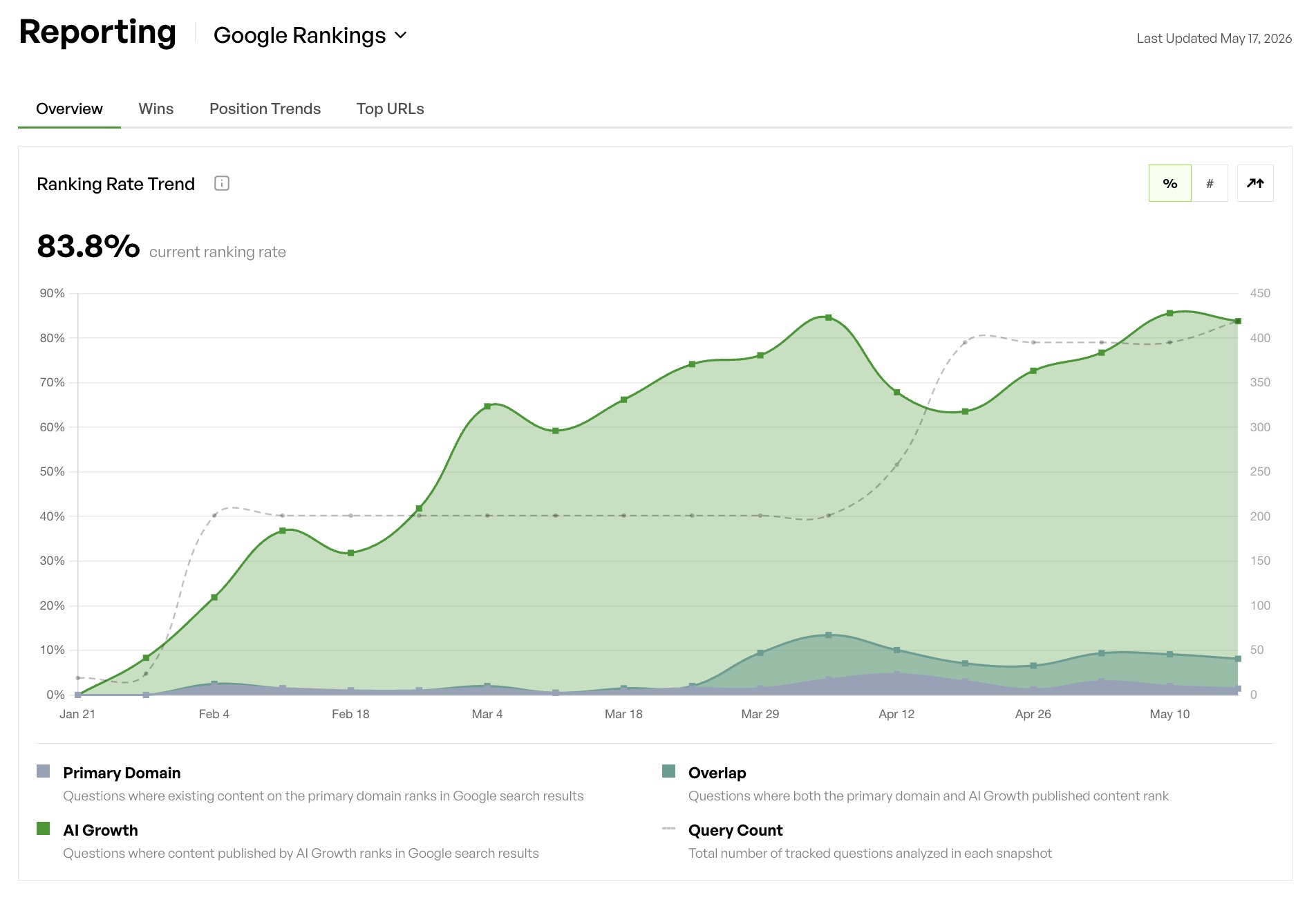
Use these steps to measure A2A content pipelines:
- Bot Tracking records every crawl, citation, and training sweep against each published Artifact URL.
- AI Ranking measures order of mention and citation context in ChatGPT, Perplexity, and Google AI Mode responses for each tracked query.
- Google Search Console impressions and clicks for AI Growth Agent-generated URLs are isolated from pre-existing brand visibility.
- AI Analytics aggregates sentiment, demographics, and query fan-out signals to identify which Artifacts drive the most citation value.
- Search Intelligence refreshes the universe snapshot weekly, identifies new long-tail queries, and queues them as new Tasks.
- The reporting Artifact is generated weekly and delivered to the client dashboard.
A weekly reporting Artifact example:
{ "artifactId": "artifact-report-w29-2026", "name": "Incremental Visibility Report W29", "parts": [ { "type": "DataPart", "data": { "newBotVisits": 2400, "newImpressions": 18500, "newAiCitations": 310, "topCitedUrl": "/blog/a2a-protocol-content-production", "queriesRanking": 47, "weekOverWeekImpressionsLift": "12%" } } ] }This reporting layer separates a production A2A content engine from a monitoring tool. Monitoring tells you whether you appear for a capped set of prompts. AI Growth Agent produces the content, owns the publishing, and proves the incremental result in numbers that compound week over week.
Conclusion: Use Autonomous A2A Pipelines to Control Your Narrative
The production layer for A2A content pipelines includes a hub-and-spoke orchestrator, signed Agent Cards at /.well-known/agent-card.json, a stateful task lifecycle from submitted through completed, and typed Artifacts that carry TextPart and DataPart outputs. It also includes MCP connections to CMS and tooling, plus incremental visibility reporting that isolates what the pipeline actually generated. A2A’s rapid enterprise adoption validates the protocol’s production readiness.
With enterprise adoption established in its first year, the brands that build authoritative content pipelines now are training the next generation of models with their own narrative. AI Growth Agent maps the full universe of seed terms and long-tail queries, applies a strict validation layer, provisions full schema and agentic technical SEO, and produces living, self-healing content at scale. The system delivers narrative control, evidence-based long tail coverage, and marketing built for AI surfaces, without adding client headcount.
Frequently Asked Questions
How A2A Differs from MCP in a Content Production Stack
The Agent2Agent (A2A) protocol is an open standard, originally released by Google in April 2025 and now governed by the Linux Foundation. It enables autonomous AI agents to discover each other via Agent Cards, delegate tasks using JSON-RPC 2.0 over HTTPS, and exchange typed Artifacts through a stateful task lifecycle. In a content production stack, A2A handles the horizontal layer. The orchestrator delegates research, writing, editing, and publishing tasks to specialist agents, and each one operates independently without exposing internal logic.
The Model Context Protocol (MCP), introduced by Anthropic, handles the vertical layer. Each specialist agent uses MCP to access its own tools, such as a CMS connector, a web search API, or a vector database. The two protocols are complementary and are typically deployed together. A2A decides which agent does the work and how the handoff occurs. MCP decides which tools that agent calls to complete the work. AI Growth Agent implements both layers, with Blog MCP shipping in the WordPress plugin and A2A orchestration running across a multi-provider agent stack that covers OpenAI, Anthropic, Gemini, Grok, Perplexity, Exa, and Firecrawl.
What a Production-Ready A2A Content Pipeline Looks Like
A production A2A content pipeline begins with Search Intelligence mapping the full universe of seed terms and long-tail queries using real-time Google and ChatGPT data. The orchestrator agent decomposes that universe into prioritized Task batches, each grouped by a shared contextId. Research Agents run in parallel, stream progress via Server-Sent Events, and return structured Artifacts that contain validated source URLs and primary claims.
Writing Agents receive those Artifacts and produce drafts, and anti-hallucination agents re-extract every claim and validate it against primary sources before the draft advances. Editing Agents apply brand voice memories, legal disclaimers, and schema markup. Publishing Agents push the final Artifact to the CMS via MCP and trigger instant indexing, sitemap updates, and llms.txt refresh.
Bot Tracking then records every crawl and citation event, and AI Ranking measures position in AI answers. Self-healing agents monitor Google Search Console signals and re-queue stale articles for refresh. The entire pipeline runs on autopilot, and the client reviews finished articles in plain language. Every correction saves as a memory so the same note is never needed twice.
How the Four Pillars Feed an A2A Content Pipeline
The four pillars act as the data backbone that steers every Task delegation in the pipeline. Search Intelligence provides a complete portrait of the traditional search landscape, covering positioning, competition, and search volume, and feeds the orchestrator with the keyword universe that seeds each research Task. AI Analytics tracks brand value and consumer behavior across the full journey, from external touchpoints like Google and AI-tool queries through content consumption and sentiment, and shapes the angle and depth of each writing Task.
Bot Tracking records every bot interaction, including traditional crawlers and AI training agents, so the pipeline knows which published Artifacts are being crawled and cited and can prioritize refresh Tasks accordingly. AI Ranking tracks where the brand appears in AI answers and how that position evolves week over week, and it feeds the orchestrator’s prioritization logic for the next batch of Tasks. Together, the four pillars turn the market into a diagnosis and the diagnosis into content decisions, instead of a set of disconnected dashboards that require manual interpretation.
Agentic Technical SEO on Every Published Artifact
Every article and site AI Growth Agent publishes ships with both traditional technical SEO and agentic technical SEO, with no action required from the client. On the traditional side, this includes highly structured HTML, full Open Graph metadata, rich schema markup across article, author, FAQ, product, and other schema types, internal linking, sanitized external linking, proper sitemaps, a detailed robots.txt, automated web stories, instant indexing, autoredirects, and 404 tracking.
On the agentic side, it includes Blog MCP with schema, manifest, discovery, and capability guidance exposed to agents, and compatibility with Chrome 146+ and other WebMCP-enabled browsers. OpenAI discovery and Agent Card guidance are served via /.well-known/. Natural language query parameters via /?s={query} auto-trigger personalized, internally linked responses so an agent that passes a query straight into the URL receives a tailored answer. Pages are served in Markdown to agent crawlers, and llms.txt and llms-full.txt publish so AI surfaces can read the brand in the format they need. The only integration step on the client’s side is the reverse proxy rewrite that connects the blog to a subdirectory under their domain.
How Incremental Visibility Reporting Proves Pipeline Impact
AI Growth Agent publishes into a separate environment so it can take credit only for the visibility it actually generates, not for visibility the brand already had. The reporting layer cross-references four data sources. Bot Tracking records every crawl, citation, and training sweep against each published URL. AI Ranking measures order of mention and citation context in ChatGPT, Perplexity, and Google AI Mode for each tracked query. Google Search Console impressions and clicks for AI Growth Agent-generated URLs are isolated from pre-existing brand visibility. AI Analytics aggregates sentiment and query fan-out signals to identify which Artifacts drive the most citation value.
The result is a weekly reporting Artifact that shows new bot visits, new impressions, new AI citations, and week-over-week lift, attributed specifically to content the pipeline produced. This approach creates a production engine that proves the incremental result of every article it publishes, instead of a monitoring tool that only reports whether you appear for a capped set of prompts.