Written by: Mariana Fonseca, Editorial Team, AI Growth Agent
Key Takeaways
- Earned media placements on trusted third-party outlets now act as the main signal that trains AI engines on brand narratives, far outpacing brand-owned websites in citation rates.
- AI search platforms like Google AI Mode, ChatGPT, and Perplexity deliver answers directly to users, so citation context now defines brand visibility more than traditional rankings.
- A repeatable five-stage system maps AI queries, targets high-trust publications, creates extractable data assets, secures placements, and feeds signals back into owned content so authority compounds over time.
- Success depends on a unified owner across PR and content, consistent brand messaging, and assets structured with specific statistics and direct answers that AI retrieval systems can easily extract.
- Brands ready to control their AI narrative can partner with AI Growth Agent to execute this system and see measurable results, book a demo today.
Prerequisites and Starting Conditions for AI-Ready Earned Media
Four inputs create the foundation for an earned media program that AI search can reliably cite.
- Brand manifesto. A single source of truth covering voice, factual references, deny lists, and core positioning. Every citable asset produced in this system draws from it.
- Existing PR contacts. A working list of journalists, editors, and outlet relationships, segmented by tier and beat.
- Access to Google Search Console and bot analytics. GSC provides an independent audit of impressions and indexing. Bot analytics reveal which AI crawlers are reading content and when.
- Content inventory. A map of existing owned assets, including blog posts, case studies, and landing pages, so citation signals can be routed back into living content rather than orphaned pages.
Two constraints govern execution and shape how the later steps work in practice. First, legal review cycles for data claims must be scoped before outreach begins, particularly in regulated sectors, because delays in approval stall placement timelines and slow Step 3 asset creation. Second, the system requires a single owner who controls both PR and content decisions, which becomes critical when routing signals back into owned content in Step 5. When those functions are siloed, citation signals produced by earned media never reach the owned content layer, and the compounding effect breaks.
Process Overview: The Five-Stage AI Citation System
With these prerequisites in place, execution follows a five-stage sequence that turns earned media into repeatable AI citations.
- Map the universe of queries AI is already answering in the brand’s category.
- Identify high-value publication targets AI engines already cite.
- Create quotable data and expert assets structured for extraction.
- Secure placements and distribute across multiple platforms.
- Feed citation signals into owned content for compounding authority.
Step-by-Step Guide to Earning AI Citations
Step 1: Map the Query Universe AI Already Answers
Goal: Identify the specific prompts AI engines are answering in the brand’s category before a single asset is created.
Actions: Run 20–30 high-intent buyer questions across ChatGPT, Perplexity, Google AI Mode, and Gemini. Log every cited domain, source type, and brand mention. Identify which outlets appear repeatedly. This Prompt Protocol produces a list of 15–25 AI-cited outlets that become the publication targets for the campaign.
Decision point: If the brand appears in zero responses across 20 prompts, an entity recognition problem precedes the citation problem. The team must first use owned content to establish consistent entity definitions, then use earned media to amplify them.
Step 2: Select Publication Targets AI Already Trusts
Goal: Focus outreach on outlets AI engines already trust instead of chasing outlets with the largest human readership.
Actions: Cross-reference the Prompt Protocol output against four source tiers. Tier 1 covers major national and business publications such as Forbes, WSJ, and Bloomberg, Tier 2 covers recognized trade and vertical publications, Tier 3 covers high-authority community platforms including Reddit and Quora, and Tier 4 covers review and rating platforms such as G2, Trustpilot, and Capterra.
The following table shows how each tier performs in AI citation strength and where the supporting evidence comes from.
| Signal Type | Example Sources | AI Citation Strength | Notes |
|---|---|---|---|
| Tier 1 editorial | Forbes, WSJ, Bloomberg, Reuters | High | A single Tier 1 placement influences AI answers more than dozens of lower-authority placements |
| Tier 2 trade press | Search Engine Journal, Adweek, HBR | High for niche queries | Top outlets capture a large share of news citations in Google AI Overviews |
| Tier 3 community | Reddit, Quora, industry forums | High volume, platform-specific | Community platforms account for a significant share of external AI citations |
| Tier 4 review platforms | G2, Capterra, Trustpilot | High for B2B product queries | B2B SaaS brands with G2 or Capterra profiles are more likely to be cited in AI answers for product queries |
Dependency: The Prompt Protocol output from Step 1 determines which tiers are most active in the brand’s category. A cybersecurity brand will weight Tier 2 trade press heavily, while a consumer brand will weight Tier 1 and Tier 3.
Step 3: Build Quotable Data and Expert Assets
Goal: Produce assets structured so AI retrieval pipelines can extract them without needing to parse long narrative context.
Actions: Build each asset around a citable core such as a standalone statistic, a one-sentence definition, or a named expert quote with a verifiable claim. Each asset should lead with a direct answer in the first 40–60 words that is self-contained, declarative, and entity-attributed. This structure gives AI systems a clean passage to extract. Content updated recently earns more AI citations than older pages, with a large share of all AI-cited content being relatively recent.
| Asset Type | Structural Requirement | Citation Rate Benchmark | Source |
|---|---|---|---|
| Original data study | Named methodology, inline statistics, comparison table | High citation rate | Averi.ai AI search citation benchmarks |
| Expert quote asset | Named credentials, specific claim, one-sentence attribution | Visibility lift when statistics and quotations are added | Princeton/Georgia Tech GEO paper, SIGKDD 2024 |
| Comparison or listicle | Structured table, three or more schema types, question-based headings | Higher citation rate versus standard blog posts | GrowthOS AI brand visibility benchmarks |
| Standard blog post | Prose only, no structured data | Lower citation rate | Averi.ai AI search citation benchmarks |
Roles: A journalist or researcher owns data validation. A content strategist owns structural formatting. Legal reviews any proprietary data claim before distribution, using the legal constraints defined in the Prerequisites section.
Step 4: Land Placements and Distribute Across Platforms
Goal: Place assets on the outlets identified in Step 2 and distribute them across enough platforms to trigger the multi-source corroboration signal AI engines require.
Actions: Use a five-element pitch structure. Start with a one-sentence timely hook with a specific claim. Add one to three current sourced statistics. Include a two-to-three-sentence expert angle referencing client outcomes. Provide a ready-to-use publishable expert quote. Close with a brief offer for further discussion. A press release is less likely to generate an AI citation than a genuine editorial mention.
Distribution breadth matters as much as individual placement authority. Brands present on multiple third-party platforms are more likely to be cited in ChatGPT responses than brands on a single platform, and distributed earned media generates more AI citations versus publishing on the brand site alone.
Decision point: If a placement lands on a Tier 1 outlet but the brand is not named in body copy, citation value remains limited. Named brand mentions in body copy outperform headline-only mentions because the retrieval chunk is typically a 200–800 token passage.
Step 5: Turn Earned Citations Into Compounding Owned Authority
Goal: Route earned media signals back into living owned content so authority compounds rather than decays.
Actions: Within 48 hours of a placement going live, update the corresponding owned article to reference the third-party coverage, embed the same statistics with inline citations, and add or refresh the FAQ section. Internal linking from the updated owned article to the placement URL reinforces entity co-occurrence. External messaging in earned media must maintain consistent core positioning with the brand’s owned website content to avoid semantic drift that weakens GEO signals for AI systems.
Common Mistakes and How to Fix Them
Weak data claims. Vague assertions such as “customers see improved results” produce no extraction value. AI retrieval pipelines require specific numbers, named entities, and direct answers. Every claim in a citable asset must be traceable to a named primary source.
Targeting low-authority outlets. A few placements in LLM-trusted sources can deliver more AI visibility value than many press-release pickups on low-authority sites. Volume of placements does not substitute for outlet authority.
Failing to track bot citations. Most teams measure earned media by impressions and backlinks, which do not reveal whether AI engines are extracting the content. Without per-article bot tracking, teams cannot attribute citation spikes to specific placements or identify which assets drive AI visibility.
Inconsistent brand naming. Repeated, stable presence of a brand across credible third-party sources over time creates stronger brand memory in AI models than one-time spikes in coverage. Every placement must use the same brand name, category descriptor, and core positioning claim.
Results Validation and Metrics for AI Citations
Measurement uses a separate reporting environment so incremental AI citations are isolated from visibility the brand already had. Three metric layers work together to show impact after the execution pitfalls above are addressed.
AI citation tracking. Define a prompt set of 25–50 high-intent buyer questions. Run them weekly across ChatGPT, Perplexity, Gemini, and Google AI Mode. Log brand mentions, cited domains, source type, and citation context. PR campaigns often see citation activity within several weeks of placement going live, assuming the placement is on a source the AI engine already crawls.
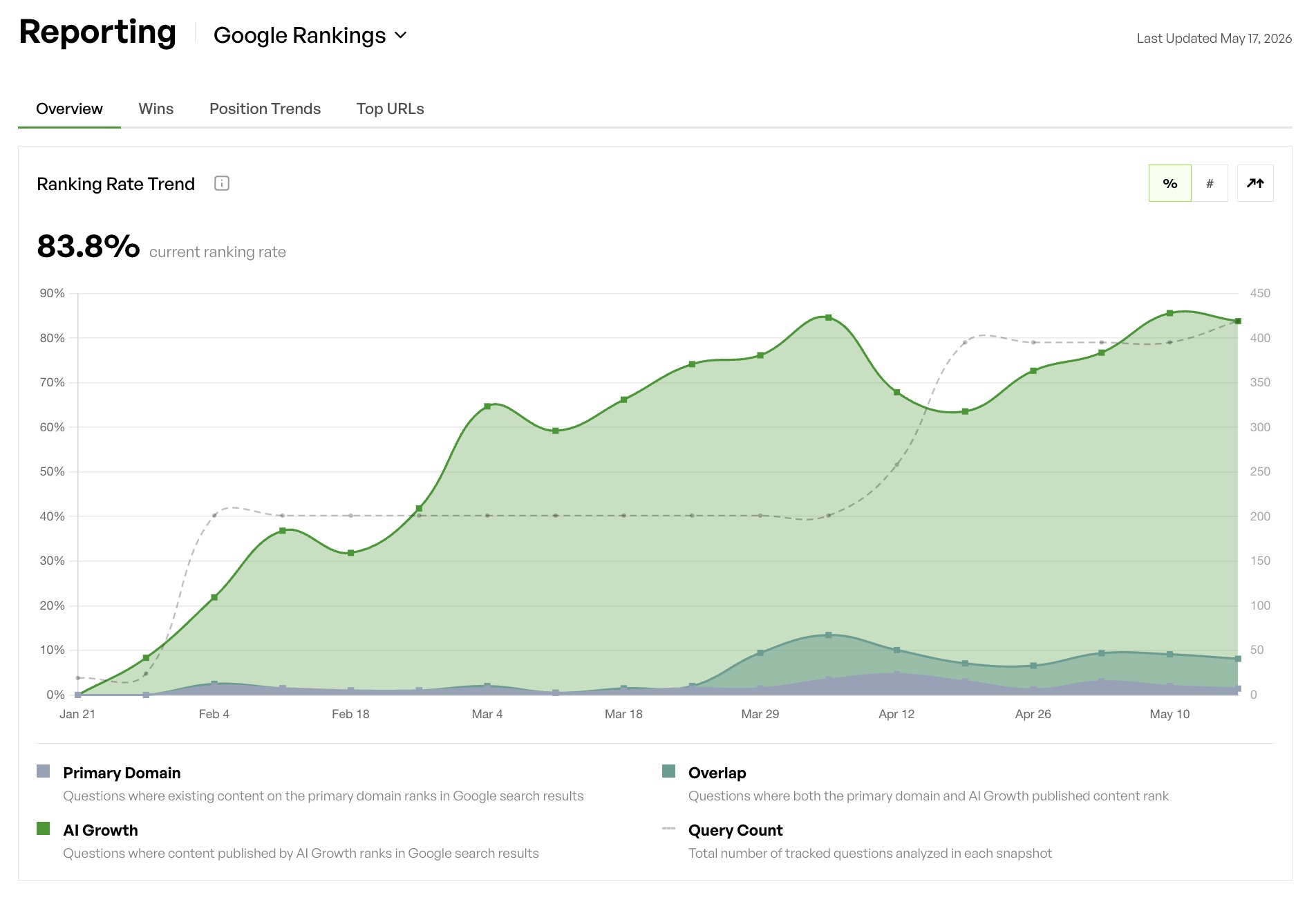
Bot traffic lift. Per-article bot analytics reveal which AI training agents and citation crawlers are reading content and when. A spike in bot visits within days of a placement going live provides the earliest leading indicator that the asset is entering the citation pipeline.
Google Search Console impressions. GSC serves as an independent audit. Teams correlate citation spikes from outlets like TechCrunch or The Verge with subsequent changes in organic traffic, rankings, and impressions for priority keyword groups in Google Search Console, typically observing lifts within four to eight weeks.
The Share of Citation metric is calculated by selecting five highest-intent category queries and running them across ChatGPT, Perplexity, Gemini, and Google AI Mode every 30 days, then counting brand citations versus competitors.
Advanced Ways to Scale the Five-Stage System
Multi-brand portfolios. Once the five-stage system is operational for a single brand, enterprise CMOs managing multiple brands can run parallel prompt sets per brand with separate reporting environments for each. Citation signals from one brand’s earned media should never be attributed to another brand’s owned content layer.
Agency white-label use. PR agency owners can apply this system across client portfolios by running the Prompt Protocol for each client independently. The output becomes the intelligence layer behind pitch strategy and replaces instinct-driven outlet selection with evidence from what AI engines already cite in each client’s category.
Integration with agentic technical SEO stacks. The citation compounding effect accelerates when owned content is structured for agentic discovery, which extends the impact of Step 5. This structure includes publishing llms.txt and llms-full.txt files, exposing Blog MCP endpoints, serving Markdown to agent crawlers, and provisioning valid schema across article, FAQ, and organization types. When AI agents can read owned content in the formats they require, the signal loop between earned citations and owned authority closes faster.
FAQ
How long does it take to see the first AI citation from an earned media campaign?
The timeline varies by platform. Google AI Overviews pick up significant press coverage within several weeks. ChatGPT can take longer because it blends training data with live index signals. For a campaign targeting all three platforms, a four to eight week window to first measurable citations is realistic when placements land on Tier 1 or Tier 2 outlets that AI engines already crawl regularly.
Who should own this process inside a company?
A single owner who controls both PR and content decisions is required, as noted in the Prerequisites section. Without this unified control, the compounding effect described in Step 5 cannot occur. In practice, this owner is the CMO, the founder acting as CMO, or a PR agency owner who has been given authority over both functions for a client. The system fails when PR measures placements by impressions and content measures performance by traffic, with no shared metric connecting the two.
What makes a data asset citable versus one that gets ignored?
AI retrieval pipelines extract specific, verifiable, entity-attributed claims. A citable asset follows the structural requirements outlined in Step 3: it leads with a direct answer in the opening 40–60 words, names the brand alongside the category and the problem it solves, includes at least one standalone statistic with a named primary source, and uses structured formatting such as tables, numbered lists, or FAQ sections. Vague claims, generic references, and promotional language produce no extraction value. The retrieval unit is a 200–800 token passage on a trusted domain, and that passage must contain a named brand, a specific claim, and a verifiable source.
How do you measure whether earned media is actually driving AI citations versus other factors?
Measurement starts with a controlled baseline. Before any placements go live, run the full prompt set across ChatGPT, Perplexity, Gemini, and Google AI Mode and log every citation. After placements land, re-run the same prompts and attribute new citations to placements that appeared in the same time window. Bot analytics provide a second confirmation layer, because a spike in AI crawler visits to a specific article within days of a placement going live signals that the asset entered the citation pipeline. Google Search Console impressions then show whether the owned content layer benefits from the earned media signals.
Can a brand with low domain authority compete in AI citations against larger competitors?
A brand with low domain authority can compete effectively because AI citation authority depends on where the brand is mentioned, not on the brand’s own domain authority. A brand with a low-authority owned site that earns placements in Forbes, a relevant trade publication, and multiple Tier 3 community platforms will outperform a high-authority brand that publishes only on its own domain. The multiplier documented in Seer Interactive’s 2026 research, between brands with active third-party signals and those without, applies regardless of the brand’s own domain rating. The constraint is outlet selection and asset quality, not existing authority.
Conclusion: Turn Earned Media Into Machine-Readable Authority
Earned media now functions as machine relations. The five-stage system maps the query universe AI already answers, targets the outlets AI engines already trust, creates assets structured for extraction, secures placements across multiple platforms, and routes citation signals into living owned content. The result is compounding authority that builds over time instead of decaying the day it ships.
The brands establishing this system now are training the next generation of models with their own narrative. Brands that wait are training the next generation with whatever happens to be sitting on the open web.