Written by: Mariana Fonseca, Editorial Team, AI Growth Agent
Key Takeaways
- AI search agency offerings in 2026 deliver a complete headless, fixed-fee engine that covers strategy, living content, technical infrastructure, and incremental visibility reporting across ChatGPT, Perplexity, and Google AI Mode.
- The 14-offering stack includes journalist-led kickoffs, real-time Content Topology mapping, multi-agent generation with anti-hallucination checks, client-owned WordPress sites, and full agentic technical SEO.
- Four-pillar data architecture (Search Intelligence, AI Analytics, Bot Tracking, AI Ranking) enables precise measurement of new visibility without blending pre-existing brand presence.
- Fixed-fee pricing removes per-prompt billing and prompt caps, which allows full-universe coverage with self-healing content that refreshes automatically to maintain citation share.
- Brands seeking measurable AI visibility gains can book a demo with AI Growth Agent to launch their first article quickly and track incremental results from week one.
What an AI Search Retainer Includes in 2026
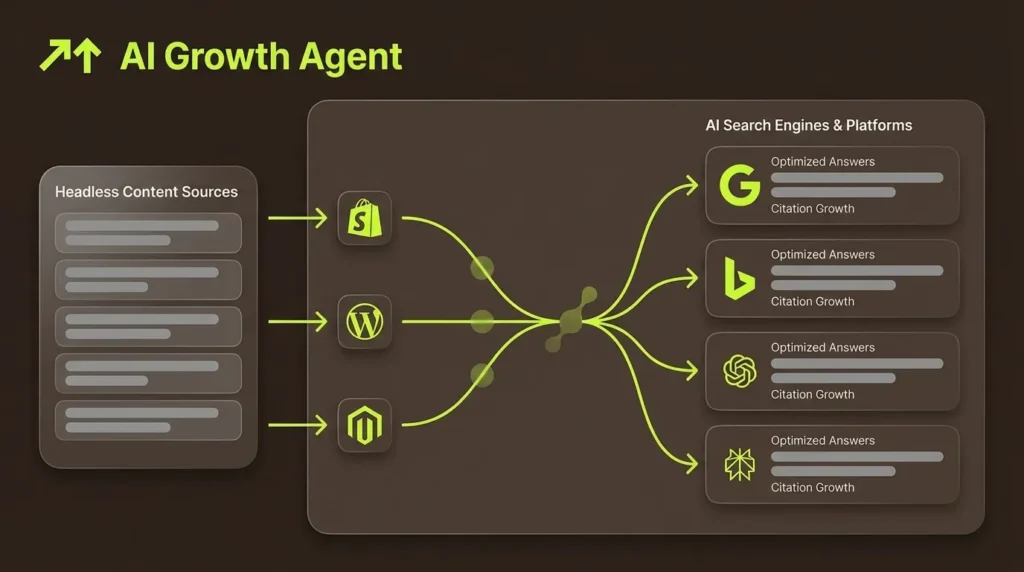
Modern AI search retainers go far beyond a capped set of monitored prompts and a few articles per month. The full 14-offering stack that a headless engine provides operates as a separate engine that runs alongside your existing site. Every package at AI Growth Agent includes all of the following:
- Journalist-led kickoff interview and brand manifesto
- Content Topology mapping seed terms and long-tail queries from real-time Google and ChatGPT data
- Content Planner with weekly universe refresh across 3,000+ searches
- Search Intelligence with competitor domain rankings, top URLs, YouTube threads, and Reddit signals
- Multi-agent content generation validated against primary sources
- Anti-hallucination cascade with post-draft claim re-extraction
- Fully optimized, client-owned WordPress site live within the first week
- Complete traditional technical SEO: schema suite, sitemaps, robots.txt, internal linking, metadata, and web stories
- Agentic technical SEO: Blog MCP, llms.txt and llms-full.txt, OpenAI discovery, Agent Card guidance, and natural language query parameters
- Living, self-healing content that updates automatically over time
- Bot tracking across every crawler type, including the ChatGPT fetcher bot
- AI Ranking reports tracking order of mention and citation context week over week
- Incremental visibility reporting isolated from pre-existing brand visibility
- Personalization and style memory controls applied to every future generation
The market context shows how different this is from a typical package. Mid-tier agency packages in 2026 typically deliver a few expert-verified articles per month and citation tracking across a limited number of queries. A headless engine produces up to 500 articles per month per client and maps hundreds of seed terms with no prompt cap.
See how all 14 offerings work together in a live walkthrough and schedule your consultation.
The Four-Pillar Data Foundation Behind the Engine
AI Growth Agent’s engine runs on a four-pillar data foundation that powers every content decision and every report. This structure turns scattered AI search signals into a single, coherent visibility picture.
Search Intelligence maps the traditional search landscape, including positioning, competition, search volume, and who is winning each result. It runs hundreds of real searches weekly and processes title structures, forum discussions, “people also ask” signals, and query fan-out. The client can view their entire universe from any competitor’s point of view, updated every week.
AI Analytics tracks brand value and consumer behavior across the full journey, from external touchpoints like Google and AI-tool queries through content consumption, demographics, and sentiment. This layer connects content performance to buyer behavior and revenue impact instead of stopping at impressions.
Bot Tracking records every bot interaction, traditional crawlers and AI training agents alike, including every crawl, citation, and training sweep. Fastly’s analysis found that AI crawlers account for nearly 80% of all AI bot traffic, and without per-article bot tracking a brand cannot tell whether its content is being read or ignored.
AI Ranking replaces the old position-number leaderboard. Because AI answers have no static ordered list, order of mention and citation context become the new ranking signals, and AI Growth Agent tracks exactly where a brand appears in each answer and how that position evolves week over week. This granular tracking directly addresses a widespread measurement gap. Semrush’s 2026 AI Visibility Index found that 45% of marketing leaders cannot accurately measure their brand visibility within AI-generated answers. The four-pillar foundation is the architecture that closes that gap.
Performance-Based AI Search Pricing Explained
AI visibility retainers in 2026 often carry high and complex pricing. Typical ranges run from $2,000 to $12,000 per month for mid-market clients and start near $20,000 or more per month for enterprise clients, with project-based audits adding $2,500 to $15,000 for a comprehensive AI SEO audit alone. On top of those fees, most tools impose prompt caps. Many agency packages track a limited number of queries across major platforms, which leaves a brand blind to the long tail where most buyer queries actually live.
Performance-based structures introduce another layer of complexity. Many contracts include bonuses for citation growth or revenue attribution, which creates a billing structure that scales against the client as results improve.
The headless fixed-fee model works in the opposite way. Pricing is a flat fee with no per-article charges, credit limits, or per-prompt billing. Prompt count is never a billed metric. The client sees their entire universe, not a capped handful of tracked terms, and the fee does not increase as the universe expands or as visibility grows. Clients own all the content they produce.
Starter, Growth, and Authority Packages Compared
That fixed-fee structure translates into three concrete packages, each aligned with a different stage of market coverage. AI Growth Agent’s productized packages are structured around the scope of the universe the client wants to win, not around prompt counts or article credits. Every package includes the full technical and agentic SEO stack, the client-owned site, and living content. The key differences relate to universe scope and content volume, while the pricing model and technical foundation stay constant. The table below illustrates how each tier scales:
| Dimension | Starter | Growth | Authority |
|---|---|---|---|
| Pricing model | Fixed fee, no per-prompt billing | Fixed fee, no per-prompt billing | Fixed fee, no per-prompt billing |
| Universe mapping | Seed terms and long-tail queries from real-time data | Expanded universe at launch | Full universe at maturity |
| Client-owned site | Fully optimized, live in week one | Fully optimized, live in week one | Fully optimized, live in week one |
| Content and self-healing | Living content, self-heals over time | Living content, higher daily volume | Living content with high monthly volume |
Every tier includes the full agentic technical SEO stack, including Blog MCP, llms.txt and llms-full.txt, OpenAI discovery, Agent Card guidance, bot tracking, and the complete schema suite. No tier charges per prompt or per article.
How Incremental Visibility Proof Works
Incremental visibility is the metric that separates a headless engine from a monitoring tool. AI Growth Agent publishes into a separate environment so it can report only on the visibility it actually generated and never on visibility the brand already had before the engagement started.
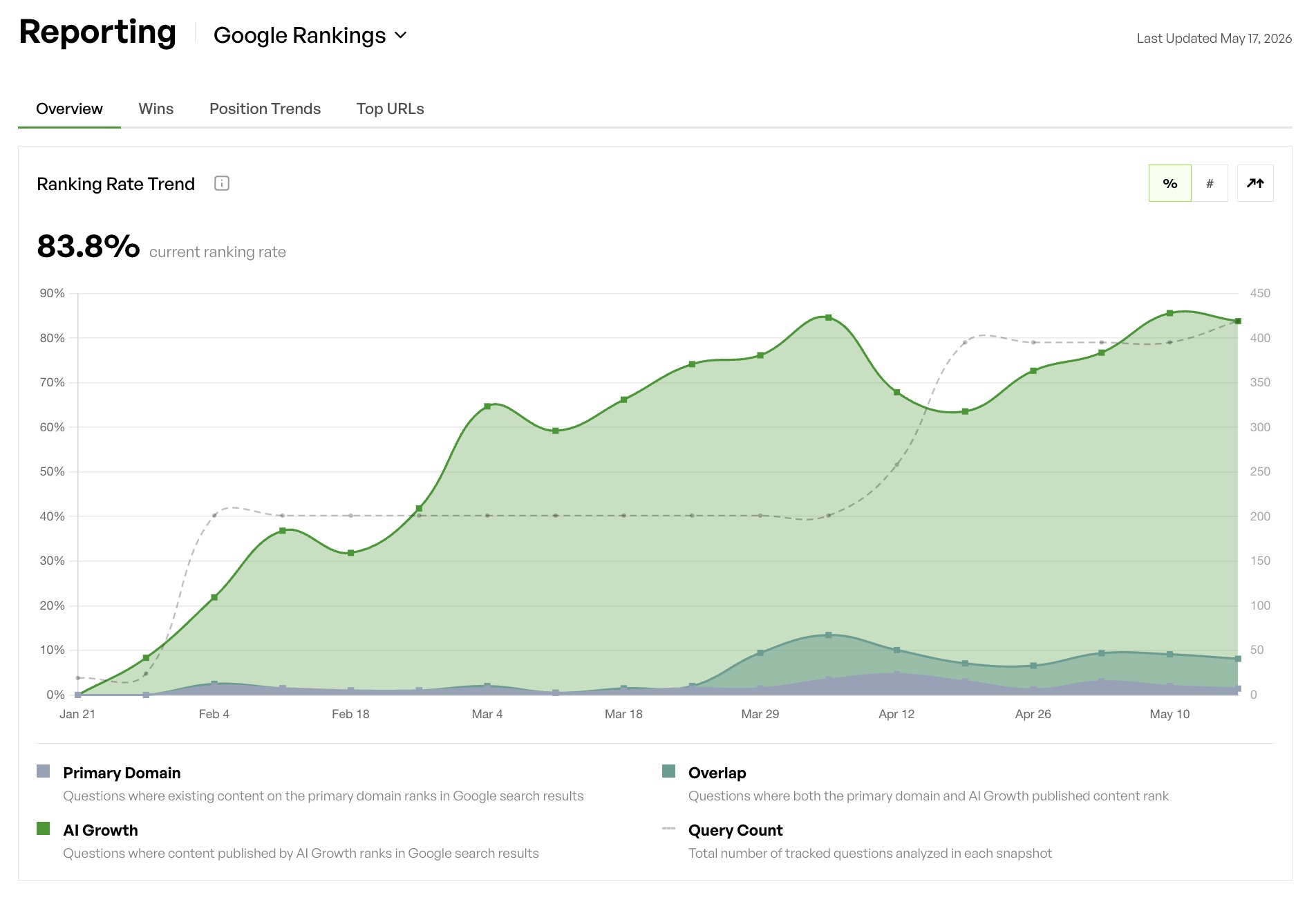
Across the first 12 weeks, clients average more than 12,000 additional AI citations and mentions, over 100,000 additional bot visits, and a lift of more than 20% in impressions. Content indexes in as little as 10 days, and the first article typically goes live within the first week of kickoff.
Client outcomes make the model concrete. Breadless went from 387,000 to 12.3 million Google Search Console impressions over six months, a roughly 30x lift, and ChatGPT now cites eatbreadless.com over 45,000 times per month. Leva Sleep closed $40,000 to $50,000 in deals in under three weeks from buyers who discovered the brand through AI Growth Agent content. Jota recorded a traffic increase of more than 190% from generated content over three months.
The reporting view cross-references bot analytics, Google Search Console as an independent audit, and per-article citation data that no single monitoring tool brings together. Many marketing leaders currently lack the tools to track all relevant AI visibility metrics across platforms. Incremental visibility reporting fills that gap with a single, defensible view.
The conversion case for AI search visibility is also well established. AI referral traffic converts at 14-16% compared to 2-5% for organic search.
Why Fixed-Fee Headless Beats Traditional Retainers
Traditional retainers contain three structural problems that the headless model removes.
The first problem is site dependency. Most agency clients do not own their own site. The agency controls it, and every change becomes a dependency. AI Growth Agent stands up a site the client owns outright, connected through a reverse proxy rewrite or subdomain, with no agency in the loop. The client owns the content, the property, and the relationship with the AI surfaces.
The second problem is content decay. Agency-produced content goes stale the day it ships. Living content self-heals. When the year turns, every article in a sector refreshes automatically. When Google Search Console signals that a page is losing ground, the engine refreshes it. Recent content updates can improve AI visibility, and pages updated within the past two months earn 28% more citations than older content. The 28% citation advantage for recent content is exactly what self-healing maintains at scale, so every article stays current without manual intervention.
The third problem is scope. Monthly retainer AEO models bill for defined deliverables regardless of citation outcomes, creating an activity-outcome gap where providers can invoice the same fixed fee even when AI visibility metrics show no improvement. The headless model reports incremental visibility week over week and doubles down on what indexes well, using internal linking to lift what does not. The engine corrects itself by design.
Frequently Asked Questions
What does incremental visibility mean, and how is it different from total brand visibility?
Incremental visibility refers to the visibility that AI Growth Agent generated, isolated from any visibility the brand already had before the engagement started. AI Growth Agent publishes into a separate environment, which means its reporting can attribute new bot visits, new AI citations, and new Search Console impressions specifically to the content it produced rather than taking credit for a brand’s existing presence. This distinction matters because most reporting tools blend new and existing visibility together, which makes it impossible to evaluate whether an investment is actually working. Incremental visibility reporting cross-references per-article bot analytics, Google Search Console as an independent audit, and citation data to produce a defensible weekly proof of contribution.
What is self-healing content, and why does it matter for AI citations?
Self-healing content refers to living content that updates automatically over time rather than going stale after publication. When the year turns, every article in a sector refreshes for the new year. When Google Search Console signals that a page is losing impressions or clicks, the engine refreshes it. When a claim becomes outdated, the anti-hallucination cascade catches it on the next generation cycle. This matters for AI citations because freshness acts as a direct citation signal. AI surfaces preferentially cite recent content, and a brand whose articles stay current maintains citation share that a brand with static content loses within months. Self-healing functions as an automated capability of the engine applied to every article in the client’s universe, not as a manual editorial process.
How does the fixed-fee model differ from per-prompt billing, and what does that mean for universe coverage?
Fixed-fee pricing unlocks full-universe coverage that per-prompt billing cannot support. Per-prompt billing and prompt-capped monitoring tools charge clients more to see further into their own market. A brand tracking 100 prompts stays blind to the hundreds of long-tail queries where most buyer intent actually lives. The fixed-fee headless model never bills per prompt. The client’s entire universe, from head terms to the full long tail, is mapped and refreshed weekly at no additional cost. A mature client universe reaches 1,600 or more queries, and the system runs 3,000 or more searches every week just to keep the snapshot current. The practical result is that the client sees the full conversation happening around their brand in AI search, not a capped slice of it.
Who owns the site and content that AI Growth Agent produces?
The client owns the site and all the content outright. AI Growth Agent stands up a fully optimized blog styled to match the client’s existing brand, connected to their domain through a reverse proxy rewrite under a subdirectory or through a subdomain. The client’s curated main site remains untouched. No agency controls the property, no lock-in exists, and no dependency needs to be managed. The only integration step on the client’s side is the reverse proxy rewrite that connects the blog to their domain. Everything else, including the full technical and agentic SEO stack, is included in every package and requires no technical skill from the client’s team.
Conclusion: Owning Your AI Search Universe
The SERP in 2026 is dominated by monitoring tools that cap prompts and listicles that describe the problem without solving it. No traditional retainer maps the full universe, stands up a client-owned site in week one, produces living content that self-heals, and reports incremental visibility in isolation from pre-existing brand presence. The headless engine fills that architecture gap.
The brands cited in AI search this year are training the next generation of models with their own narrative. The brands that wait are training the next generation with whatever happens to be sitting on the open web. The leaderboard is being written now, and only one engine currently operates across the full universe.